
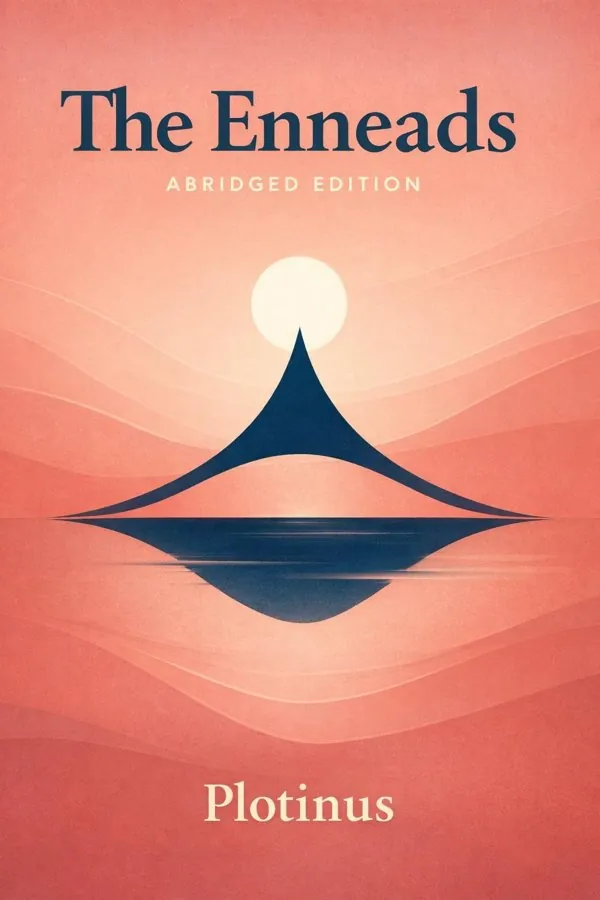
The Enneads: Abridged Edition: Summary & Key Insights
by Plotinus
 10 min9 chaptersAudio available
Key Takeaways from The Enneads: Abridged Edition
The deepest reality, Plotinus insists, cannot be captured by any ordinary definition.
Reality, for Plotinus, unfolds in an ordered cascade rather than through random assembly.
Human life feels divided because the soul itself stands between two worlds.
The visible world is not ultimate, but neither is it meaningless.
For Plotinus, philosophy is not complete when it explains the world; it must also transform the soul.
What Is The Enneads: Abridged Edition About?
The Enneads: Abridged Edition by Plotinus is a western_phil book spanning 7 pages. The Enneads: Abridged Edition is one of the most powerful works in Western philosophy because it asks the largest possible questions: What is ultimate reality? Why does the soul feel divided? What is evil, beauty, and true happiness? In these treatises, Plotinus offers a vision of existence as a living hierarchy flowing from a supreme source he calls the One. From that source arise Intellect, Soul, and finally the material world, creating a universe that is ordered, meaningful, and spiritually charged. Yet this is not only a metaphysical system. It is also a practical path of inner ascent, teaching readers how to turn away from distraction, purify desire, and recover their deepest identity. Compiled by Porphyry from Plotinus's teachings in Rome, the Enneads became the foundational text of Neoplatonism and influenced Christian, Islamic, and Jewish thought as well as later mysticism and metaphysics. Plotinus writes with both rigor and urgency: he is not merely describing reality but inviting us to awaken to it. This abridged edition makes that invitation more accessible while preserving the work's enduring philosophical depth.
This FizzRead summary covers all 9 key chapters of The Enneads: Abridged Edition in approximately 10 minutes, distilling the most important ideas, arguments, and takeaways from Plotinus's work. Also available as an audio summary and Key Quotes Podcast.
The Enneads: Abridged Edition
The Enneads: Abridged Edition is one of the most powerful works in Western philosophy because it asks the largest possible questions: What is ultimate reality? Why does the soul feel divided? What is evil, beauty, and true happiness? In these treatises, Plotinus offers a vision of existence as a living hierarchy flowing from a supreme source he calls the One. From that source arise Intellect, Soul, and finally the material world, creating a universe that is ordered, meaningful, and spiritually charged. Yet this is not only a metaphysical system. It is also a practical path of inner ascent, teaching readers how to turn away from distraction, purify desire, and recover their deepest identity.
Compiled by Porphyry from Plotinus's teachings in Rome, the Enneads became the foundational text of Neoplatonism and influenced Christian, Islamic, and Jewish thought as well as later mysticism and metaphysics. Plotinus writes with both rigor and urgency: he is not merely describing reality but inviting us to awaken to it. This abridged edition makes that invitation more accessible while preserving the work's enduring philosophical depth.
Who Should Read The Enneads: Abridged Edition?
This book is perfect for anyone interested in western_phil and looking to gain actionable insights in a short read. Whether you're a student, professional, or lifelong learner, the key ideas from The Enneads: Abridged Edition by Plotinus will help you think differently.
- ✓Readers who enjoy western_phil and want practical takeaways
- ✓Professionals looking to apply new ideas to their work and life
- ✓Anyone who wants the core insights of The Enneads: Abridged Edition in just 10 minutes
Want the full summary?
Get instant access to this book summary and 100K+ more with Fizz Moment.
Get Free SummaryAvailable on App Store • Free to download
Key Chapters
The deepest reality, Plotinus insists, cannot be captured by any ordinary definition. The One is not simply the greatest being in the universe; it is beyond being, beyond thought, beyond language itself. We usually understand things by identifying their properties, limits, or functions. But the One has no parts, no deficiency, and no comparison. It is absolute unity, the source from which everything else derives its existence, order, and value.
This idea matters because Plotinus is trying to solve a basic philosophical problem: how can the many arise from a single ultimate principle without that principle becoming divided or diminished? His answer is that the One overflows by its very perfection. Just as the sun radiates light without losing brightness, the One gives rise to all reality without ceasing to be simple and complete. Every beautiful thing, every act of intelligence, and every instance of goodness points back to this inexhaustible source.
In practical terms, Plotinus is warning us against mistaking fragments for the whole. We often treat career success, status, pleasure, or even knowledge as ultimate. Yet each of these is partial and unstable. The hunger for something more unified, more lasting, is not a weakness but a clue about our origin. When we feel restless amid abundance, Plotinus would say we are sensing the difference between finite goods and the Good itself.
A useful application is reflective subtraction: instead of asking what more you need, ask what false absolutes you can stop worshipping. Notice where you seek total fulfillment from temporary things. Actionable takeaway: spend ten minutes each day identifying one attachment you treat as ultimate, and consciously place it in perspective against the search for what is truly highest.
Reality, for Plotinus, unfolds in an ordered cascade rather than through random assembly. From the One proceeds Intellect, or Nous, the first and perfect expression of divine fullness. If the One is beyond all thought, Intellect is the level at which thought and being coincide. It is the realm of the Forms, where truth is not pieced together through argument but immediately present in complete intelligibility.
Plotinus adapts Plato here but gives the doctrine a dynamic structure. The Forms are not floating abstractions. They live in Intellect as its content, and Intellect lives by contemplating the One. In other words, the universe is intelligible because its deepest structures come from an eternal act of understanding. The order we encounter in mathematics, nature, and moral insight is not accidental. It reflects a reality in which intelligence is woven into the fabric of existence.
This has a practical side. Human beings often live at the level of scattered impressions: endless news, emotional reactions, unfinished thoughts, and sensory overload. Plotinus offers Intellect as a model of inward coherence. To become more rational is not merely to calculate better; it is to align the mind with enduring order. Whenever you move from confusion to principle, from noise to pattern, you are dimly participating in this higher mode of life.
Think of a teacher helping students see the underlying concept behind many examples, or a leader stepping back from crisis to identify the central issue. That movement from fragments to structure mirrors the ascent toward Intellect. Plotinus would say wisdom comes when the mind stops chasing disconnected particulars and learns to dwell in wholes.
Actionable takeaway: when faced with a complex problem, pause before reacting and ask, “What larger pattern explains these details?” Train your mind daily to seek principles rather than merely accumulating information.
Human life feels divided because the soul itself stands between two worlds. Plotinus teaches that Soul proceeds from Intellect and gives life, motion, and order to the cosmos. At its highest, soul remains turned toward the intelligible realm; at its lower activity, it governs bodily life and the material world. This double orientation explains why we can reason, imagine, desire, and suffer all at once. We belong both to a higher origin and to a changing environment.
The descent of the soul into embodied existence is not, for Plotinus, an absolute fall into evil. It is a movement into multiplicity, where attention becomes dispersed and identity can be forgotten. The problem is not embodiment itself but misplaced attachment. When the soul becomes absorbed in external things, it loses awareness of its deeper nature and begins to live as though it were nothing more than appetite, social image, or physical condition.
This insight remains strikingly modern. Many people experience themselves through roles alone: employee, consumer, parent, patient, online persona. These roles matter, but Plotinus reminds us they are not the whole self. There is in us a dimension capable of contemplation, moral freedom, and inward recollection. Much anxiety comes from overidentifying with what changes and neglecting what can orient and unify us.
A practical example is the difference between feeling angry and becoming anger. The embodied self experiences emotion, but the higher soul can witness, evaluate, and redirect it. Similarly, failure in one area of life does not define the whole person unless the soul collapses into the event.
Actionable takeaway: practice inward recollection once a day by stepping back from your current mood or role and asking, “What in me is aware of this experience?” Strengthen identification with the observing, ordering self rather than the passing state.
The visible world is not ultimate, but neither is it meaningless. Plotinus argues that sensible reality depends on intelligible reality the way an image depends on its model. The material world changes, decays, and divides; the intelligible world is stable, unified, and fully real. Yet the lower is not cut off from the higher. Nature, beauty, proportion, and living order all reveal traces of their intelligible source.
This position allows Plotinus to avoid two extremes. He does not reduce reality to matter, as if all meaning were a human projection onto blind mechanism. Nor does he reject the world as sheer illusion. The sensible realm is real in a derivative way. It participates in higher principles without possessing their perfection. A beautiful face, a just law, or a well-composed symphony are not ultimate realities, but they can point beyond themselves toward intelligible order.
This way of seeing changes ordinary experience. Instead of consuming appearances at the surface level, we can ask what they express. Why does symmetry satisfy us? Why does moral nobility move us? Why does great art feel revelatory? Plotinus's answer is that sensible forms awaken memory of deeper realities. The world can either distract the soul or educate it, depending on how we attend to it.
In practical life, this means learning to treat experiences as signs rather than endpoints. A work of art can become an occasion for wonder rather than prestige. Time in nature can restore inner order if we see more than scenery. Even disciplined craftsmanship can become philosophical when it seeks harmony, proportion, and fitness.
Actionable takeaway: choose one everyday experience this week—music, architecture, nature, or conversation—and ask not only whether you enjoy it, but what deeper order, beauty, or truth it reveals.
For Plotinus, philosophy is not complete when it explains the world; it must also transform the soul. Ethical life is therefore not merely social obedience or rule-following. It is purification, the gradual freeing of the self from domination by lower impulses so that it may return toward its source. Virtue matters because it reorders attention. Justice, temperance, courage, and wisdom are not decorative qualities but conditions of spiritual ascent.
Plotinus distinguishes between civic virtue and higher virtue. Civic virtue regulates action within communal life: it moderates desire, restrains excess, and supports social order. Higher virtue goes further by detaching the soul inwardly from dependence on externals. A person may behave well yet still be inwardly enslaved by praise, fear, or pleasure. The deeper task is to become like the divine by cultivating simplicity, self-mastery, and contemplative clarity.
This perspective gives ethics unusual depth. Goodness is not only about what we do but about what kind of being we are becoming. Consider someone who donates generously for recognition versus someone who gives from inward abundance. The outward act may look similar, but the soul's orientation differs sharply. Plotinus wants us to examine the roots of action, not only its visible effects.
Modern application is straightforward. We often try to improve life by optimizing circumstances while neglecting character. Plotinus would reverse the order: inner formation allows us to use circumstances well. Reducing distraction, disciplining appetites, and making time for reflection are not self-help tricks; they are philosophical exercises in becoming more whole.
Actionable takeaway: pick one recurring habit that scatters your attention—impulsive scrolling, reactive speech, compulsive comparison—and practice one concrete restraint around it for seven days. Use that restraint as ethical training in reclaiming the soul's direction.
One of Plotinus's boldest claims is that evil is not a positive force equal to the good. Evil has no independent principle; it is privation, a lack of order, form, and fullness. In the hierarchy of reality, the farther things are from the One, the more they exhibit limitation and fragmentation. Matter, in its most indeterminate sense, represents the lowest level of this process and is associated with deficiency rather than active wickedness.
This view helps Plotinus protect the goodness of the ultimate source. If all things come from the One, how can evil exist? His answer is that what proceeds from the One becomes progressively less unified and therefore more vulnerable to disorder. Evil is not created as a rival reality. It appears where good is diminished, distorted, or absent. Blindness is not a thing added to sight but the loss of sight; injustice is not a substance but the breakdown of right order.
Practically, this shifts how we interpret moral and personal failure. Instead of seeing vice as mysterious power, Plotinus encourages us to see it as disintegration. Cruelty, addiction, vanity, and deceit reduce the soul's integrity. They scatter attention, weaken judgment, and pull us away from what is properly human. The remedy is not panic but restoration of form through truth, discipline, and reorientation toward the good.
This also matters emotionally. Many people give evil too much metaphysical glamour, as if darkness were as deep as light. Plotinus refuses that symmetry. Disorder can be pervasive and destructive, but it is still parasitic on what is good.
Actionable takeaway: when confronting a harmful habit or situation, ask, “What good is missing here?” Focus on restoring clarity, order, and truth rather than merely fighting symptoms in the abstract.
At every level of reality, Plotinus sees a movement toward unity. Bodies cohere, living things organize themselves, minds seek understanding, and souls long for the good. This is not sentimental optimism but a metaphysical principle: everything desires, in its own way, to participate more fully in what grounds it. Multiplicity without unity collapses into chaos, so the drive toward oneness is built into existence itself.
This idea reframes many familiar experiences. Our search for consistency, belonging, beauty, and meaning is not arbitrary. It expresses a deeper tendency of being. We suffer when we are internally divided because division opposes our nature. Likewise, communities fall apart when they lose shared purpose, and knowledge fragments when facts are detached from understanding. Unity is not mere uniformity. It is ordered harmony, the fitting together of many elements under a higher principle.
Plotinus also turns this into a philosophy of return. Since all things come from the One by emanation, the highest life is not endless outward dispersion but conscious reorientation toward the source. The soul returns not by spatial movement but by inward simplification: gathering itself, abandoning excess attachment, and rising through contemplation.
In ordinary life, this can mean integrating your values instead of living by compartment. A person who seeks health while working compulsively, or seeks peace while feeding resentment, lives in contradiction. Return begins when priorities become aligned. Even simple acts—keeping promises, speaking honestly, finishing what matters—strengthen inner unity.
Actionable takeaway: write down your top three stated values and compare them with how you actually spend time and energy. Choose one mismatch and correct it this week to make your life more unified.
Beauty, in Plotinus, is far more than pleasant appearance. It is a sign that form has triumphed over disorder and that intelligible reality is shining through matter. We are moved by beauty because the soul recognizes in it something akin to its own origin. A beautiful object, person, melody, or action does not merely stimulate the senses; it can awaken recollection of a higher world.
Plotinus criticizes shallow accounts of beauty that reduce it to symmetry alone. Some simple things, such as light or a noble soul, can be beautiful without complex proportion. The deeper reason for beauty is participation in form, unity, and intelligible life. Conversely, ugliness arises where matter remains unshaped, where inner order is lacking, or where the soul has become deformed by vice.
This matters practically because beauty can educate desire. In a culture saturated with seductive images, Plotinus asks us to distinguish between attraction and elevation. Some things seize attention but leave the soul emptier; others quietly enlarge perception and invite reverence. Great art, moral excellence, and intellectual clarity can all function as ladders upward if we respond properly.
Consider the difference between consuming aesthetic novelty for stimulation and dwelling with a work that reveals depth over time. The first leaves us restless; the second gathers us. Plotinus would say beauty should lead us beyond possession toward contemplation. The right response is not grasping but becoming inwardly beautiful ourselves through order and virtue.
Actionable takeaway: spend time this week with one form of genuine beauty—a poem, piece of music, landscape, or act of moral courage—and ask how it calls you to greater inner order rather than mere enjoyment.
If the universe flows from the One through Intellect and Soul, then the highest human life must involve more than practical success. For Plotinus, contemplation is the soul's noblest activity because it aligns us with reality at its most intelligible and divine levels. To contemplate is not simply to think hard. It is to become inwardly still enough for truth to be present without distortion, and to let the mind be shaped by what is higher than itself.
Plotinus does not deny action. He simply insists that action should arise from vision rather than agitation. A life devoted solely to production, competition, or external achievement remains trapped in the lower register of existence. Contemplation gathers the self, heals fragmentation, and restores contact with first principles. In its highest moments, it can culminate in mystical union, where the distinction between knower and known falls away in an experience of profound simplicity.
Even short of mystical experience, the lesson is powerful. Modern life rewards constant responsiveness, yet perpetual reaction erodes judgment. Leaders, creators, and moral agents often do their best work after a period of silence, study, and inward clarification. Plotinus gives philosophical dignity to that pattern. Withdrawal, when rightly practiced, is not escape but preparation for wiser presence.
You need not become an ancient sage to apply this. A daily period without devices, noise, or task-switching can deepen attention. Reflective reading, meditative prayer, or sustained thought about a single principle can gradually retrain a scattered mind.
Actionable takeaway: establish a non-negotiable fifteen-minute window each day for uninterrupted contemplation. No multitasking, no input stream—just sustained attention to a truth, question, or reality worthy of your highest mind.
All Chapters in The Enneads: Abridged Edition
About the Author
Plotinus (c. 204-270 CE) was a Greek philosopher and the central founder of Neoplatonism, one of the most influential traditions in the history of Western thought. Born likely in Roman Egypt, he later studied philosophy under Ammonius Saccas in Alexandria before moving to Rome, where he taught and gathered a devoted circle of students. His teachings were written down and organized after his death by Porphyry into six groups of nine treatises, known as the Enneads. Plotinus drew deeply on Plato but created an original metaphysical vision centered on the One, Intellect, and Soul. His work shaped later pagan philosophy, Christian theology, Islamic and Jewish thought, and enduring traditions of mysticism, ethics, and metaphysical inquiry.
Get This Summary in Your Preferred Format
Read or listen to the The Enneads: Abridged Edition summary by Plotinus anytime, anywhere. FizzRead offers multiple formats so you can learn on your terms — all free.
Available formats: App · Audio · PDF · EPUB — All included free with FizzRead
Download The Enneads: Abridged Edition PDF and EPUB Summary
Key Quotes from The Enneads: Abridged Edition
“The deepest reality, Plotinus insists, cannot be captured by any ordinary definition.”
“Reality, for Plotinus, unfolds in an ordered cascade rather than through random assembly.”
“Human life feels divided because the soul itself stands between two worlds.”
“The visible world is not ultimate, but neither is it meaningless.”
“For Plotinus, philosophy is not complete when it explains the world; it must also transform the soul.”
Frequently Asked Questions about The Enneads: Abridged Edition
The Enneads: Abridged Edition by Plotinus is a western_phil book that explores key ideas across 9 chapters. The Enneads: Abridged Edition is one of the most powerful works in Western philosophy because it asks the largest possible questions: What is ultimate reality? Why does the soul feel divided? What is evil, beauty, and true happiness? In these treatises, Plotinus offers a vision of existence as a living hierarchy flowing from a supreme source he calls the One. From that source arise Intellect, Soul, and finally the material world, creating a universe that is ordered, meaningful, and spiritually charged. Yet this is not only a metaphysical system. It is also a practical path of inner ascent, teaching readers how to turn away from distraction, purify desire, and recover their deepest identity. Compiled by Porphyry from Plotinus's teachings in Rome, the Enneads became the foundational text of Neoplatonism and influenced Christian, Islamic, and Jewish thought as well as later mysticism and metaphysics. Plotinus writes with both rigor and urgency: he is not merely describing reality but inviting us to awaken to it. This abridged edition makes that invitation more accessible while preserving the work's enduring philosophical depth.
You Might Also Like
A Little History of Philosophy
Nigel Warburton
10 min
Areopagitica
John Milton
10 min
How To Think Like A Philosopher: Essential Principles For Clear Thinking
Peter Cave
10 min
Language, Truth and Logic
A. J. Ayer
10 min
The Age of Reason
Thomas Paine
10 min
The Essays
Michel De Montaigne
10 minBrowse by Category
Ready to read The Enneads: Abridged Edition?
Get the full summary and 100K+ more books with Fizz Moment.