
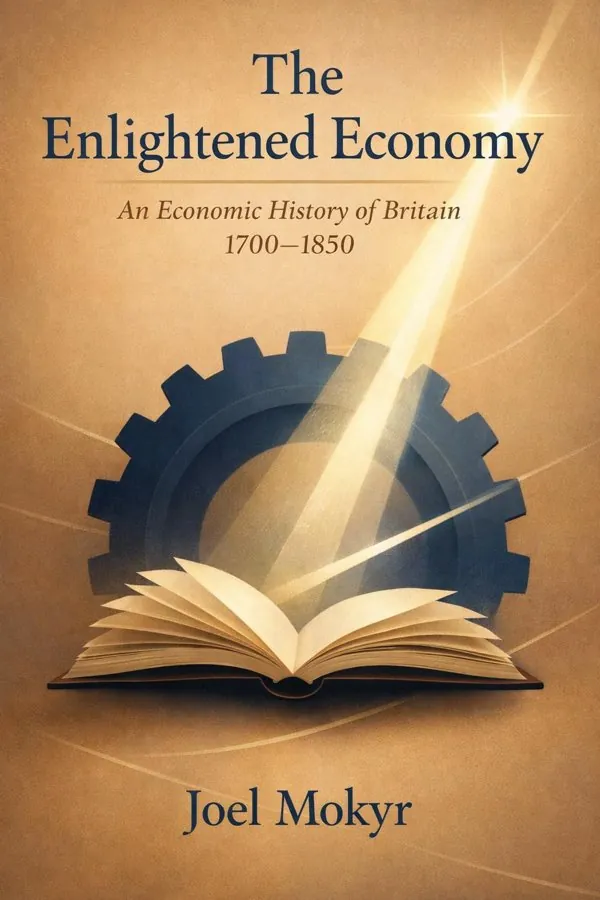
The Enlightened Economy: An Economic History of Britain 1700–1850: Summary & Key Insights
by Joel Mokyr
 10 min10 chaptersAudio available
Key Takeaways from The Enlightened Economy: An Economic History of Britain 1700–1850
A society changes course when it stops treating knowledge as decoration and starts treating it as a tool.
Brilliant ideas rarely matter unless a society gives people reasons and opportunities to use them.
The most transformative breakthroughs often occur between worlds rather than within them.
Innovation looks solitary in hindsight, but it is usually social in real time.
A discovery that stays local changes little; a discovery that spreads can change an economy.
What Is The Enlightened Economy: An Economic History of Britain 1700–1850 About?
The Enlightened Economy: An Economic History of Britain 1700–1850 by Joel Mokyr is a economics book spanning 10 pages. Why did Britain industrialize first? Joel Mokyr’s The Enlightened Economy offers a striking answer: the Industrial Revolution was not only a story of coal, capital, and machinery, but also a triumph of ideas. Mokyr argues that between 1700 and 1850, Britain benefited from an intellectual culture shaped by the Enlightenment—one that valued useful knowledge, open inquiry, practical experimentation, and the application of science to everyday problems. In this view, economic transformation began in workshops, laboratories, coffeehouses, societies, and print networks long before it appeared in factories. What makes this book important is its ability to connect economic history with the history of science, technology, and culture. Rather than treating invention as accidental or purely profit-driven, Mokyr shows how knowledge itself became a productive force. Britain’s institutions, social norms, and communication networks helped turn scattered discoveries into cumulative progress. The result was sustained innovation on a scale the world had never seen before. As one of the leading economic historians of technological change, Mokyr brings exceptional authority to this argument, making the book essential for anyone who wants to understand how ideas can remake an economy.
This FizzRead summary covers all 10 key chapters of The Enlightened Economy: An Economic History of Britain 1700–1850 in approximately 10 minutes, distilling the most important ideas, arguments, and takeaways from Joel Mokyr's work. Also available as an audio summary and Key Quotes Podcast.
The Enlightened Economy: An Economic History of Britain 1700–1850
Why did Britain industrialize first? Joel Mokyr’s The Enlightened Economy offers a striking answer: the Industrial Revolution was not only a story of coal, capital, and machinery, but also a triumph of ideas. Mokyr argues that between 1700 and 1850, Britain benefited from an intellectual culture shaped by the Enlightenment—one that valued useful knowledge, open inquiry, practical experimentation, and the application of science to everyday problems. In this view, economic transformation began in workshops, laboratories, coffeehouses, societies, and print networks long before it appeared in factories.
What makes this book important is its ability to connect economic history with the history of science, technology, and culture. Rather than treating invention as accidental or purely profit-driven, Mokyr shows how knowledge itself became a productive force. Britain’s institutions, social norms, and communication networks helped turn scattered discoveries into cumulative progress. The result was sustained innovation on a scale the world had never seen before. As one of the leading economic historians of technological change, Mokyr brings exceptional authority to this argument, making the book essential for anyone who wants to understand how ideas can remake an economy.
Who Should Read The Enlightened Economy: An Economic History of Britain 1700–1850?
This book is perfect for anyone interested in economics and looking to gain actionable insights in a short read. Whether you're a student, professional, or lifelong learner, the key ideas from The Enlightened Economy: An Economic History of Britain 1700–1850 by Joel Mokyr will help you think differently.
- ✓Readers who enjoy economics and want practical takeaways
- ✓Professionals looking to apply new ideas to their work and life
- ✓Anyone who wants the core insights of The Enlightened Economy: An Economic History of Britain 1700–1850 in just 10 minutes
Want the full summary?
Get instant access to this book summary and 100K+ more with Fizz Moment.
Get Free SummaryAvailable on App Store • Free to download
Key Chapters
A society changes course when it stops treating knowledge as decoration and starts treating it as a tool. That is the starting point of Mokyr’s argument. Before the modern era, natural philosophy was often pursued for prestige, curiosity, or metaphysical reflection. By the eighteenth century, however, Enlightenment culture increasingly encouraged people to ask a different question: what can knowledge do? This shift toward “useful knowledge” helped create the intellectual foundations of Britain’s Industrial Revolution.
Mokyr distinguishes between abstract understanding of nature and practical know-how. The power of the period came from linking the two. Scientific inquiry did not automatically produce better machines, but it created methods, habits, and confidence that practical problems could be solved systematically. Engineers, artisans, and inventors began to draw on chemistry, mechanics, and measurement in more deliberate ways. The result was not a single breakthrough but a cumulative rise in problem-solving capacity.
You can see this in industries like textiles, mining, metallurgy, and steam power. Improvements often emerged from repeated experiments informed by observation and theory. Better understanding of heat, materials, and motion allowed tinkerers to improve engines and processes. Even when formal science lagged behind practice, the cultural prestige of inquiry encouraged people to test, record, compare, and refine.
The broader lesson is that economies grow faster when they value knowledge that can circulate and be applied. Innovation is not only about genius; it is about creating a culture where ideas are expected to solve real problems. Actionable takeaway: treat learning as an economic asset—build habits and institutions that connect abstract insight with practical application.
Brilliant ideas rarely matter unless a society gives people reasons and opportunities to use them. Mokyr emphasizes that Britain’s success did not rest on ideas alone. It also depended on institutions that rewarded experimentation, protected property to a workable degree, and enabled inventors, investors, and manufacturers to collaborate. In other words, knowledge needed organizational support before it could transform production.
Britain offered a relatively favorable environment for commercial enterprise. Patent systems, while imperfect, could make invention profitable. Markets were large and increasingly integrated. Financial mechanisms helped channel capital into new ventures. Political fragmentation on the European continent sometimes trapped talent in local restrictions, but Britain’s national market created wider scope for scaling successful techniques. Institutions also reduced some of the risks of sharing ideas. If inventors believed they might gain recognition, income, or partnership, they were more likely to participate in the wider economy of innovation.
At the same time, Mokyr avoids a simplistic celebration of institutions. Patents could be expensive and difficult to enforce. Guilds and vested interests could still obstruct change. Yet compared with many alternatives, Britain was unusually capable of turning individual ingenuity into cumulative economic gains. Think of a modern parallel: a startup ecosystem thrives not just because smart people exist, but because laws, funding channels, legal norms, and professional networks help smart people act.
The practical insight is that innovation ecosystems require rules as much as talent. A culture of invention collapses if experimenters cannot finance their work, share discoveries, or benefit from success. Actionable takeaway: when evaluating innovation, look beyond ideas and ask which institutions make those ideas scalable, shareable, and worth pursuing.
The most transformative breakthroughs often occur between worlds rather than within them. Mokyr uses the idea of the “Industrial Enlightenment” to describe a culture in which learned elites, practical artisans, engineers, and entrepreneurs increasingly interacted. This was crucial because economic progress did not come from pure science on one side or manual skill on the other. It came from the growing traffic between theoretical understanding and hands-on problem solving.
In earlier periods, scholars and craftsmen often occupied separate social spheres. Enlightenment Britain narrowed that distance. Scientific societies, lectures, publications, demonstrations, and informal networks allowed practical people to absorb new concepts and educated elites to appreciate technical challenges. This exchange did not erase social hierarchy, but it created more channels through which useful knowledge could move.
A classic example is the steam engine. James Watt was not merely a mechanic tinkering in isolation; he worked in an environment where instrument making, scientific measurement, and entrepreneurial partnership could reinforce one another. Similar patterns appeared in chemistry, agriculture, canal building, and metallurgy. The point is not that scientists directly invented industrialization, but that the boundaries between knowing and making became more permeable.
This matters today because innovation still depends on translation across domains. Breakthroughs in AI, biotech, energy, or manufacturing require researchers, designers, technicians, investors, and operators to understand enough of one another’s world to collaborate productively. When those groups remain isolated, progress slows.
Mokyr’s lesson is that civilization advances when knowledge communities connect. The Industrial Enlightenment was not a single institution but a style of intellectual cooperation. Actionable takeaway: create bridges between theory and practice—innovation accelerates when experts and practitioners regularly exchange problems, methods, and feedback.
Innovation looks solitary in hindsight, but it is usually social in real time. Mokyr challenges the heroic myth of the lone inventor by showing that Britain’s engineers and innovators operated inside webs of mentorship, apprenticeship, correspondence, patronage, and partnership. The Industrial Revolution featured talented individuals, but those individuals were most effective when embedded in communities that shared tools, standards, and information.
Inventors such as Watt, Arkwright, or Smeaton did not work in a vacuum. They relied on skilled craftsmen, financiers, suppliers, scientific acquaintances, and local knowledge. Improvements often came from incremental adjustments made by many hands. A machine might be conceived by one person, made reliable by another, commercialized by a third, and adapted across industries by dozens more. Knowledge was cumulative because the social structure of innovation allowed practical experience to be transmitted and improved.
This networked process helps explain why Britain could sustain momentum. Once enough trained mechanics, engineers, and manufacturers existed, each new problem encountered a larger pool of potential solvers. Workshops became schools. Industrial districts became reservoirs of tacit knowledge. Repetition generated competence, and competence generated further invention.
A modern analogy would be open-source software or advanced manufacturing clusters. The most effective contributors may be brilliant, but their brilliance compounds because they can draw on existing code, shared standards, user feedback, and specialist communities. Progress is faster when communities preserve and extend prior knowledge.
Mokyr reminds us that talent matters most where circulation matters. Economies do not merely need inventors; they need systems that help inventors learn from and build on one another. Actionable takeaway: if you want more innovation, strengthen the networks around creators—training, peer exchange, collaboration, and practical feedback are as important as raw genius.
A discovery that stays local changes little; a discovery that spreads can change an economy. One of Mokyr’s central insights is that Britain’s advantage lay not only in producing useful knowledge but also in distributing it. Books, pamphlets, trade manuals, lectures, coffeehouses, learned societies, provincial associations, and correspondence networks allowed technical and scientific ideas to travel with unusual speed and persistence.
This diffusion mattered because innovation is cumulative. A mill owner in one region could adopt a better process developed elsewhere. A metallurgist could learn about new methods through print or personal contact. An engineer could attend demonstrations, read descriptions, or correspond with peers. Even imperfect transmission created gains, because it lowered duplication of effort and exposed more people to tested improvements.
Print culture was especially important. The expansion of publishing reduced the cost of accessing practical information. Encyclopedias, handbooks, and proceedings did not merely entertain; they turned specialized knowledge into a semi-public resource. Informal meeting places also played a role. Coffeehouses and clubs functioned as venues where merchants, natural philosophers, manufacturers, and tinkerers exchanged information outside rigid institutional settings.
This has obvious relevance now. In the digital age, the speed of knowledge diffusion has become even more decisive. Companies and societies that share best practices, research findings, and technical standards adapt faster than those that hoard or isolate knowledge.
Mokyr’s broader point is that communication infrastructure is economic infrastructure. Roads move goods, but networks of print and conversation move techniques. Without diffusion, each generation starts too close to zero. Actionable takeaway: invest in systems that make good ideas portable—documentation, teaching, open channels of exchange, and communities of practice multiply the value of innovation.
Economic revolutions are rarely the result of one invention; they emerge from a long chain of improvements that steadily raise productivity. Mokyr insists that Britain’s transformation was not a sudden miracle powered by a few iconic machines. It was a process of ongoing technological change across many sectors, where small gains accumulated until they reshaped the economy.
This perspective corrects a common misunderstanding. People often reduce the Industrial Revolution to steam power or textile machinery, but Mokyr highlights a much broader pattern: better tools, more efficient processes, improved materials, superior organization, and rising technical competence. Productivity rose because producers became better at solving recurring problems. Innovation was often micro-level and iterative rather than dramatic and isolated.
For example, improvements in mining reduced bottlenecks in fuel supply; advances in iron production supported machinery; transport innovations lowered costs and widened markets; agricultural changes released labor and increased food supply. These sectors interacted. Progress in one area made progress elsewhere easier. The economy became more dynamic because technical change was self-reinforcing.
This way of thinking is useful for anyone studying growth today. Modern productivity gains also often come from incremental process improvements rather than headline-grabbing inventions. Better logistics software, improved battery efficiency, streamlined manufacturing, and smarter quality control may look modest individually, but together they drive major change.
Mokyr’s argument reminds us that sustained prosperity depends less on occasional brilliance than on continual adaptation. Growth happens when many people, across many domains, keep making things a little better. Actionable takeaway: focus on systems of continuous improvement—small, repeated advances can produce transformational results over time.
Historical change is rarely uniform, and one of Mokyr’s strengths is showing how Britain’s development varied sharply across industries and places. The Industrial Revolution was not a smooth national tide lifting all sectors equally. Some regions became hotbeds of experimentation and industrial concentration, while others changed more slowly. Some industries were transformed rapidly; others remained labor-intensive or technologically conservative for much longer.
This unevenness matters because it reveals the true mechanics of growth. Industrialization depended on local conditions: access to coal, transport links, skilled labor, commercial networks, entrepreneurial traditions, and regional cultures of experimentation. Lancashire’s textile dynamism, the Midlands’ engineering capacity, and certain mining or metallurgical districts’ technical depth were not random. They reflected clusters of complementary resources and knowledge.
Sectoral differences were equally important. Cotton mechanized dramatically. Iron and steam power saw major breakthroughs. Other fields advanced through more gradual process changes. This means there was no single industrial model. Britain’s success came from multiple pathways of improvement, some science-intensive, some craft-driven, some market-led, and some infrastructure-dependent.
A modern parallel is the geography of innovation today. Software may cluster in one region, biotech in another, advanced manufacturing in a third. National success often depends on whether these local ecosystems can deepen their strengths while connecting to wider markets and knowledge networks.
Mokyr’s nuanced view helps us avoid simplistic narratives about “the” Industrial Revolution. Transformations spread through specific places and sectors before they become national patterns. Actionable takeaway: when analyzing economic change, pay close attention to clusters, local capabilities, and sector-specific dynamics instead of assuming uniform development.
No nation innovates in complete isolation. Although Mokyr explains why Britain gained a leading position, he does not portray its rise as a sealed national miracle. Britain’s economic transformation occurred within a wider European and global exchange of ideas, materials, institutions, and competition. What made Britain distinctive was not that it invented knowledge alone, but that it absorbed, adapted, and applied knowledge exceptionally well.
The Enlightenment itself was transnational. Scientific ideas crossed borders through books, correspondence, travel, and translation. Britain learned from continental natural philosophy, mathematics, and engineering traditions even as it developed its own strengths. It also benefited from imperial trade, access to raw materials, and global markets that expanded the commercial rewards of productivity gains. Foreign competition created pressure to improve, while international exchange enriched the pool of available techniques.
Mokyr’s perspective is especially valuable because it avoids nationalism disguised as history. Britain industrialized first, but not because other societies lacked intelligence. The difference lay in how effectively Britain’s institutions and culture converted broader currents of knowledge into practical innovation. Borrowing, adapting, and recombining were central to the process.
This pattern remains familiar today. The most successful economies do not simply generate new ideas domestically; they import talent, learn from foreign advances, integrate into global markets, and localize international knowledge. Progress comes from openness combined with absorptive capacity.
The lesson is that leadership in innovation is relational, not solitary. Nations rise by participating intelligently in wider systems of exchange. Actionable takeaway: build the ability to learn from everywhere—economic advantage often belongs to societies that can absorb external knowledge and turn it into local capability.
It is tempting to explain Britain’s rise by saying that ideas changed everything. Mokyr comes close to that view, but his real argument is more disciplined: ideas matter immensely, yet they operate within constraints. Useful knowledge can expand what is possible, but it does not erase geography, politics, resource availability, conflict, or social resistance. The enlightened economy was powerful, not magical.
Britain still faced material limits. Transport bottlenecks, imperfect science, legal disputes, poor urban conditions, and institutional frictions could slow diffusion. Many inventions failed. Some sectors remained stubbornly resistant to mechanization. Knowledge did not spread evenly, and not every promising line of inquiry generated practical gains. Moreover, intellectual cultures themselves are fragile. They depend on tolerance, trust, patronage, and stable channels of communication.
This balance is one of the book’s greatest strengths. Mokyr elevates culture and ideas without drifting into idealism. He shows that economic history must account for both minds and matter. A society may possess talent and curiosity, but unless that energy is supported by material capabilities and social organization, progress will remain partial.
This is a useful corrective in modern debates. We often overstate the power of technology while underestimating implementation obstacles. Better ideas do not automatically become better outcomes. Institutions, incentives, infrastructure, and human behavior still determine how much value knowledge creates.
The lasting message is that intellectual openness is necessary but not sufficient. To produce lasting growth, ideas must survive contact with reality. Actionable takeaway: champion creativity and knowledge, but always ask what practical conditions are needed to turn promising insights into durable results.
All Chapters in The Enlightened Economy: An Economic History of Britain 1700–1850
About the Author
Joel Mokyr is an influential economic historian and a professor of economics and history at Northwestern University. He is widely known for his work on the Industrial Revolution, technological change, and the role of ideas in economic development. Rather than explaining growth only through material resources or market forces, Mokyr has consistently highlighted the importance of culture, scientific inquiry, and the accumulation of useful knowledge. His scholarship bridges economics, intellectual history, and the history of science, making him one of the most distinctive voices in the study of long-term economic change. Through books such as The Lever of Riches, The Gifts of Athena, and The Enlightened Economy, he has shaped debates about why Europe industrialized and how innovation becomes sustained across generations.
Get This Summary in Your Preferred Format
Read or listen to the The Enlightened Economy: An Economic History of Britain 1700–1850 summary by Joel Mokyr anytime, anywhere. FizzRead offers multiple formats so you can learn on your terms — all free.
Available formats: App · Audio · PDF · EPUB — All included free with FizzRead
Download The Enlightened Economy: An Economic History of Britain 1700–1850 PDF and EPUB Summary
Key Quotes from The Enlightened Economy: An Economic History of Britain 1700–1850
“A society changes course when it stops treating knowledge as decoration and starts treating it as a tool.”
“Brilliant ideas rarely matter unless a society gives people reasons and opportunities to use them.”
“The most transformative breakthroughs often occur between worlds rather than within them.”
“Innovation looks solitary in hindsight, but it is usually social in real time.”
“A discovery that stays local changes little; a discovery that spreads can change an economy.”
Frequently Asked Questions about The Enlightened Economy: An Economic History of Britain 1700–1850
The Enlightened Economy: An Economic History of Britain 1700–1850 by Joel Mokyr is a economics book that explores key ideas across 10 chapters. Why did Britain industrialize first? Joel Mokyr’s The Enlightened Economy offers a striking answer: the Industrial Revolution was not only a story of coal, capital, and machinery, but also a triumph of ideas. Mokyr argues that between 1700 and 1850, Britain benefited from an intellectual culture shaped by the Enlightenment—one that valued useful knowledge, open inquiry, practical experimentation, and the application of science to everyday problems. In this view, economic transformation began in workshops, laboratories, coffeehouses, societies, and print networks long before it appeared in factories. What makes this book important is its ability to connect economic history with the history of science, technology, and culture. Rather than treating invention as accidental or purely profit-driven, Mokyr shows how knowledge itself became a productive force. Britain’s institutions, social norms, and communication networks helped turn scattered discoveries into cumulative progress. The result was sustained innovation on a scale the world had never seen before. As one of the leading economic historians of technological change, Mokyr brings exceptional authority to this argument, making the book essential for anyone who wants to understand how ideas can remake an economy.
You Might Also Like

Business Adventures
John Brooks
10 min
Nudge
Richard H. Thaler, Cass R. Sunstein
10 min
The Hitchhiker"s Guide to the Galaxy
Douglas Adams
10 minThe Muqaddimah
Ibn Khaldun
10 minThe Outsiders
William N. Thorndike
10 min
A Little History of Economics
Niall Kishtainy
10 minBrowse by Category
Ready to read The Enlightened Economy: An Economic History of Britain 1700–1850?
Get the full summary and 100K+ more books with Fizz Moment.