
Joel Mokyr Books
Joel Mokyr is a professor of economics and history at Northwestern University, known for his research on the economic history of Europe and the Industrial Revolution. His work often focuses on the role of ideas, culture, and knowledge in driving technological and economic change.
Known for: The Enlightened Economy: An Economic History of Britain 1700–1850
Books by Joel Mokyr
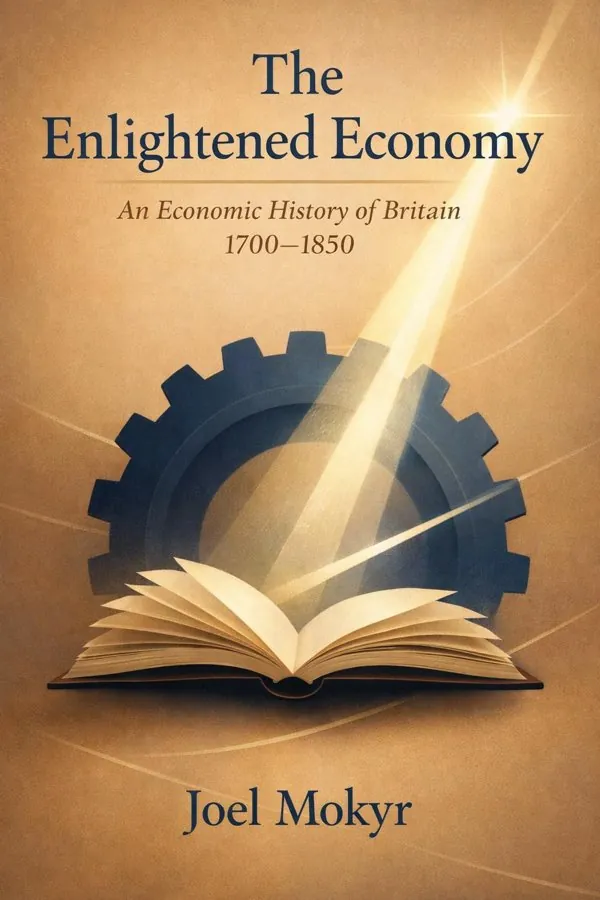
The Enlightened Economy: An Economic History of Britain 1700–1850
Why did Britain industrialize first? Joel Mokyr’s The Enlightened Economy offers a striking answer: the Industrial Revolution was not only a story of coal, capital, and machinery, but also a triumph of ideas. Mokyr argues that between 1700 and 1850, Britain benefited from an intellectual culture shaped by the Enlightenment—one that valued useful knowledge, open inquiry, practical experimentation, and the application of science to everyday problems. In this view, economic transformation began in workshops, laboratories, coffeehouses, societies, and print networks long before it appeared in factories. What makes this book important is its ability to connect economic history with the history of science, technology, and culture. Rather than treating invention as accidental or purely profit-driven, Mokyr shows how knowledge itself became a productive force. Britain’s institutions, social norms, and communication networks helped turn scattered discoveries into cumulative progress. The result was sustained innovation on a scale the world had never seen before. As one of the leading economic historians of technological change, Mokyr brings exceptional authority to this argument, making the book essential for anyone who wants to understand how ideas can remake an economy.
Read SummaryKey Insights from Joel Mokyr
The Enlightenment Made Knowledge Economically Useful
A society changes course when it stops treating knowledge as decoration and starts treating it as a tool. That is the starting point of Mokyr’s argument. Before the modern era, natural philosophy was often pursued for prestige, curiosity, or metaphysical reflection. By the eighteenth century, howeve...
From The Enlightened Economy: An Economic History of Britain 1700–1850
Institutions Turned Ideas Into Incentives
Brilliant ideas rarely matter unless a society gives people reasons and opportunities to use them. Mokyr emphasizes that Britain’s success did not rest on ideas alone. It also depended on institutions that rewarded experimentation, protected property to a workable degree, and enabled inventors, inve...
From The Enlightened Economy: An Economic History of Britain 1700–1850
The Industrial Enlightenment Bridged Science and Craft
The most transformative breakthroughs often occur between worlds rather than within them. Mokyr uses the idea of the “Industrial Enlightenment” to describe a culture in which learned elites, practical artisans, engineers, and entrepreneurs increasingly interacted. This was crucial because economic p...
From The Enlightened Economy: An Economic History of Britain 1700–1850
Inventors Thrived in Collaborative Networks
Innovation looks solitary in hindsight, but it is usually social in real time. Mokyr challenges the heroic myth of the lone inventor by showing that Britain’s engineers and innovators operated inside webs of mentorship, apprenticeship, correspondence, patronage, and partnership. The Industrial Revol...
From The Enlightened Economy: An Economic History of Britain 1700–1850
Communication Networks Accelerated Knowledge Diffusion
A discovery that stays local changes little; a discovery that spreads can change an economy. One of Mokyr’s central insights is that Britain’s advantage lay not only in producing useful knowledge but also in distributing it. Books, pamphlets, trade manuals, lectures, coffeehouses, learned societies,...
From The Enlightened Economy: An Economic History of Britain 1700–1850
Growth Came From Continuous Technological Improvement
Economic revolutions are rarely the result of one invention; they emerge from a long chain of improvements that steadily raise productivity. Mokyr insists that Britain’s transformation was not a sudden miracle powered by a few iconic machines. It was a process of ongoing technological change across ...
From The Enlightened Economy: An Economic History of Britain 1700–1850
About Joel Mokyr
Joel Mokyr is a professor of economics and history at Northwestern University, known for his research on the economic history of Europe and the Industrial Revolution. His work often focuses on the role of ideas, culture, and knowledge in driving technological and economic change.



Frequently Asked Questions
Joel Mokyr is a professor of economics and history at Northwestern University, known for his research on the economic history of Europe and the Industrial Revolution. His work often focuses on the role of ideas, culture, and knowledge in driving technological and economic change.
Read Joel Mokyr's books in 15 minutes
Get AI-powered summaries with key insights from 1 book by Joel Mokyr.