
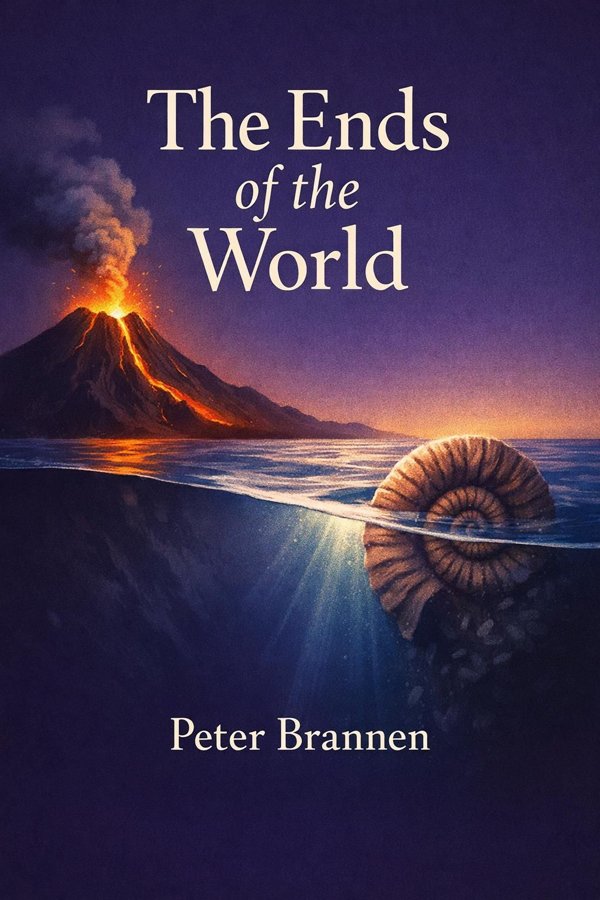
The Ends of the World: Volcanic Apocalypses, Lethal Oceans, and Our Quest to Understand Earth's Past Mass Extinctions: Summary & Key Insights
 10 min9 chaptersAudio available
What Is The Ends of the World: Volcanic Apocalypses, Lethal Oceans, and Our Quest to Understand Earth's Past Mass Extinctions About?
The Ends of the World: Volcanic Apocalypses, Lethal Oceans, and Our Quest to Understand Earth's Past Mass Extinctions by Peter Brannen is a popular_sci book spanning 9 pages. In this vivid and engaging exploration, science journalist Peter Brannen takes readers on a journey through Earth's five mass extinctions, from the Ordovician to the Cretaceous, revealing how life on our planet has repeatedly collapsed and recovered. Combining geology, paleontology, and climate science, Brannen connects these ancient cataclysms to the environmental challenges humanity faces today, offering a sobering yet fascinating perspective on Earth's resilience and fragility.
This FizzRead summary covers all 9 key chapters of The Ends of the World: Volcanic Apocalypses, Lethal Oceans, and Our Quest to Understand Earth's Past Mass Extinctions in approximately 10 minutes, distilling the most important ideas, arguments, and takeaways from Peter Brannen's work. Also available as an audio summary and Key Quotes Podcast.
The Ends of the World: Volcanic Apocalypses, Lethal Oceans, and Our Quest to Understand Earth's Past Mass Extinctions
In this vivid and engaging exploration, science journalist Peter Brannen takes readers on a journey through Earth's five mass extinctions, from the Ordovician to the Cretaceous, revealing how life on our planet has repeatedly collapsed and recovered. Combining geology, paleontology, and climate science, Brannen connects these ancient cataclysms to the environmental challenges humanity faces today, offering a sobering yet fascinating perspective on Earth's resilience and fragility.
Who Should Read The Ends of the World: Volcanic Apocalypses, Lethal Oceans, and Our Quest to Understand Earth's Past Mass Extinctions?
This book is perfect for anyone interested in popular_sci and looking to gain actionable insights in a short read. Whether you're a student, professional, or lifelong learner, the key ideas from The Ends of the World: Volcanic Apocalypses, Lethal Oceans, and Our Quest to Understand Earth's Past Mass Extinctions by Peter Brannen will help you think differently.
- ✓Readers who enjoy popular_sci and want practical takeaways
- ✓Professionals looking to apply new ideas to their work and life
- ✓Anyone who wants the core insights of The Ends of the World: Volcanic Apocalypses, Lethal Oceans, and Our Quest to Understand Earth's Past Mass Extinctions in just 10 minutes
Want the full summary?
Get instant access to this book summary and 100K+ more with Fizz Moment.
Get Free SummaryAvailable on App Store • Free to download
Key Chapters
Our journey begins some 445 million years ago, in a world completely alien yet strangely familiar. The continents were clustered near the South Pole, blanketed in tropical reef systems teeming with trilobites, brachiopods, and the first coral-like communities. Life existed almost entirely in the sea. Then came a sudden chill—a global cooling so profound that it froze the edges of the planet and locked vast amounts of water into ice caps. The Ordovician extinction was triggered by this climatic crash. As glaciers spread, sea levels plummeted, draining the shallow continental shelves where most marine life thrived. When the ice finally melted, oceans flooded back, now oxygen-poor and deadly. In this double strike of freezing and drowning, about 85 percent of marine species perished. To imagine the Ordovician world is to confront one of nature’s hardest truths: stability is an illusion. Even without asteroids or infernos, the planet can lurch into chaos. What fascinates me is the forensic science that allows us to reconstruct such catastrophe. Geologists trace glacial deposits in ancient rocks, read oxygen isotopes in fossilized shells like time capsules of temperature. From these clues, we learn that even small shifts in carbon dioxide can tip the balance between life and extinction. The Ordovician die-off, born of ice, set a precedent for the pattern we will see again and again: a world delicately dependent on the carbon cycle, undone when that balance fails.
Fast forward 70 million years, and life had grown bold. Fish with jaws prowled coastal seas; forests of primitive plants seized the land. Yet this greening of the continents—so triumphant from our perspective—set in motion another collapse. Plants drew carbon dioxide from the air, cooling the planet and feeding soils whose runoff clogged and poisoned the oceans. The seas turned stagnant, sapped of oxygen. This condition, we now know, is called oceanic anoxia: the suffocation of marine worlds. For twenty million years, waves of extinction rolled across the Devonian, wiping out coral reefs and armored fish. The story seems paradoxical: life itself became the agent of death. The transformation of land ecology rewrote the chemistry of the oceans, showing again that the biosphere is not a collection of separate parts but one great interlinked system. What moves me most about the Devonian crisis is how eerily its mechanisms anticipate the present. Then, as now, the alteration of carbon flow from air to land to sea destabilized the climate. Scientists working in Greenland and Morocco trace black shales rich with organic carbon—the graves of oxygen-starved waters—to map the spread of death zones. In our time, warming and acidification are creating similar dead zones in modern oceans. The Devonian tells us that evolution’s greatest innovations, if unbalanced, may carry the seeds of disaster.
+ 7 more chapters — available in the FizzRead app
All Chapters in The Ends of the World: Volcanic Apocalypses, Lethal Oceans, and Our Quest to Understand Earth's Past Mass Extinctions
About the Author
Peter Brannen is an award-winning science journalist whose work has appeared in The New York Times, The Atlantic, The Washington Post, and Wired. He specializes in Earth science and paleontology, bringing complex geological and evolutionary stories to life for general audiences.
Get This Summary in Your Preferred Format
Read or listen to the The Ends of the World: Volcanic Apocalypses, Lethal Oceans, and Our Quest to Understand Earth's Past Mass Extinctions summary by Peter Brannen anytime, anywhere. FizzRead offers multiple formats so you can learn on your terms — all free.
Available formats: App · Audio · PDF · EPUB — All included free with FizzRead
Download The Ends of the World: Volcanic Apocalypses, Lethal Oceans, and Our Quest to Understand Earth's Past Mass Extinctions PDF and EPUB Summary
Key Quotes from The Ends of the World: Volcanic Apocalypses, Lethal Oceans, and Our Quest to Understand Earth's Past Mass Extinctions
“Our journey begins some 445 million years ago, in a world completely alien yet strangely familiar.”
“Fast forward 70 million years, and life had grown bold.”
Frequently Asked Questions about The Ends of the World: Volcanic Apocalypses, Lethal Oceans, and Our Quest to Understand Earth's Past Mass Extinctions
The Ends of the World: Volcanic Apocalypses, Lethal Oceans, and Our Quest to Understand Earth's Past Mass Extinctions by Peter Brannen is a popular_sci book that explores key ideas across 9 chapters. In this vivid and engaging exploration, science journalist Peter Brannen takes readers on a journey through Earth's five mass extinctions, from the Ordovician to the Cretaceous, revealing how life on our planet has repeatedly collapsed and recovered. Combining geology, paleontology, and climate science, Brannen connects these ancient cataclysms to the environmental challenges humanity faces today, offering a sobering yet fascinating perspective on Earth's resilience and fragility.
You Might Also Like
Structures: Or Why Things Don"t Fall Down
J.E. Gordon
10 min
The Road to Wigan Pier
George Orwell
10 min
Bonk: The Curious Coupling of Science and Sex
Mary Roach
10 min
First Bite: How We Learn to Eat
Bee Wilson
10 min
In Pursuit Of The Unknown: 17 Equations That Changed The World
Ian Stewart
10 min
Napoleon's Buttons: 17 Molecules That Changed History
Penny Le Couteur and Jay Burreson
10 minBrowse by Category
Ready to read The Ends of the World: Volcanic Apocalypses, Lethal Oceans, and Our Quest to Understand Earth's Past Mass Extinctions?
Get the full summary and 100K+ more books with Fizz Moment.