
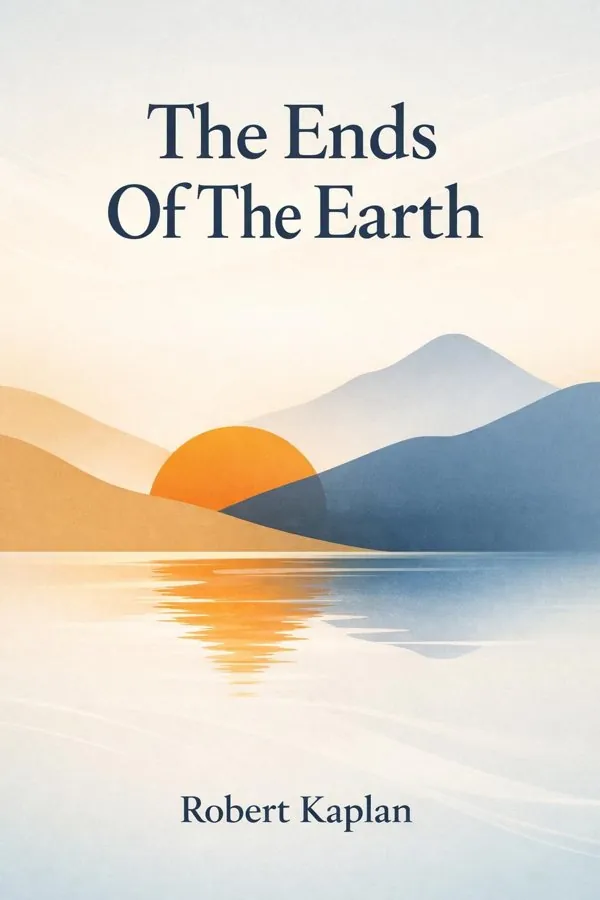
The Ends Of The Earth: Summary & Key Insights
 10 min9 chaptersAudio available
What Is The Ends Of The Earth About?
The Ends Of The Earth by Robert Kaplan is a politics book spanning 9 pages. In this travelogue and geopolitical analysis, Robert D. Kaplan journeys through Africa, the Middle East, and Asia to explore the social and political forces shaping the post–Cold War world. Blending reportage with historical insight, Kaplan examines how geography, culture, and conflict intertwine to define the future of nations and civilizations.
This FizzRead summary covers all 9 key chapters of The Ends Of The Earth in approximately 10 minutes, distilling the most important ideas, arguments, and takeaways from Robert Kaplan's work. Also available as an audio summary and Key Quotes Podcast.
The Ends Of The Earth
In this travelogue and geopolitical analysis, Robert D. Kaplan journeys through Africa, the Middle East, and Asia to explore the social and political forces shaping the post–Cold War world. Blending reportage with historical insight, Kaplan examines how geography, culture, and conflict intertwine to define the future of nations and civilizations.
Who Should Read The Ends Of The Earth?
This book is perfect for anyone interested in politics and looking to gain actionable insights in a short read. Whether you're a student, professional, or lifelong learner, the key ideas from The Ends Of The Earth by Robert Kaplan will help you think differently.
- ✓Readers who enjoy politics and want practical takeaways
- ✓Professionals looking to apply new ideas to their work and life
- ✓Anyone who wants the core insights of The Ends Of The Earth in just 10 minutes
Want the full summary?
Get instant access to this book summary and 100K+ more with Fizz Moment.
Get Free SummaryAvailable on App Store • Free to download
Key Chapters
West Africa was my entry point into the postcolonial world, and it felt like a descent into the laboratory of the twenty-first century. Countries such as Sierra Leone and the Ivory Coast embodied the extremes of corruption and decay that could afflict fragile states once the thin veneer of imposed order collapses. The European colonial borders—drawn with no regard for ethnic groups or terrain—had produced nations with little coherence. As I traveled through Freetown and Abidjan, I saw how politics had dissolved into networks of patronage and survival. The politicians ruled through the manipulation of scarcity, and the people adapted through remarkable ingenuity.
What struck me most was that the breakdown of governance was not sudden; it was a gradual erosion of trust and infrastructure. Roads crumbled, schools decayed, and bureaucracies hollowed out. Yet amidst the apparent ruin, new social structures emerged—informal economies, ethnic solidarities, and the profound adaptability of people living with perpetual uncertainty. I realized that what many in the West see as 'chaos' is, in fact, a kind of reordered life built around scarcity. In these conditions, the state is not an institution but a rumor. Geography reinforced this fragility: the humid forests, the coastal enclaves, the poor soils—all constrained development. Here was a vivid lesson in how geographic destiny, once ignored by imperial planners, now reasserted itself with brutal clarity.
Moving northward into Egypt and the Maghreb, I encountered a different kind of tension—the struggle between a proud Islamic culture and the pressures of modernization. Cairo, pulsating with millions of souls, was an urban organism bursting beyond its limits. The desert pressed against the city like a physical metaphor for the constraints on society. Authoritarianism, here, was not merely political but geographic: the state existed to contain chaos, not liberate its citizens. In Morocco and Tunisia, I found similar themes—modernization crafted under the heavy hand of the state, producing stability but not dynamism.
I spent long nights listening to young men speak of frustration and yearning, their words torn between reverence for faith and desire for progress. Religion offered moral order, but it also became the refuge of those excluded from the promises of modernity. The struggle between Islam and Westernization was not a clash of civilizations, as some popular writers later claimed—it was an internal wound within civilization itself. In the cafes of Casablanca or the alleys of Cairo, globalization was visible, but so was the stubborn endurance of identity. The very geography of the Nile Valley, that narrow green ribbon hemmed by desert, mirrored the nation’s condition: vitality pressed against scarcity, continuity shadowed by constraint.
+ 7 more chapters — available in the FizzRead app
All Chapters in The Ends Of The Earth
About the Author
Robert D. Kaplan is an American journalist, author, and geopolitical analyst known for his works on international affairs and travel. He has written extensively for The Atlantic and served as a senior fellow at the Center for a New American Security.
Get This Summary in Your Preferred Format
Read or listen to the The Ends Of The Earth summary by Robert Kaplan anytime, anywhere. FizzRead offers multiple formats so you can learn on your terms — all free.
Available formats: App · Audio · PDF · EPUB — All included free with FizzRead
Download The Ends Of The Earth PDF and EPUB Summary
Key Quotes from The Ends Of The Earth
“West Africa was my entry point into the postcolonial world, and it felt like a descent into the laboratory of the twenty-first century.”
“Moving northward into Egypt and the Maghreb, I encountered a different kind of tension—the struggle between a proud Islamic culture and the pressures of modernization.”
Frequently Asked Questions about The Ends Of The Earth
The Ends Of The Earth by Robert Kaplan is a politics book that explores key ideas across 9 chapters. In this travelogue and geopolitical analysis, Robert D. Kaplan journeys through Africa, the Middle East, and Asia to explore the social and political forces shaping the post–Cold War world. Blending reportage with historical insight, Kaplan examines how geography, culture, and conflict intertwine to define the future of nations and civilizations.
You Might Also Like
Antifa: The Anti-Fascist Handbook
Mark Bray
10 min
Attack from Within: How Disinformation Is Sabotaging America
Barbara McQuade
10 min
Coercion, Capital, and European States, AD 990–1992
Charles Tilly
10 min
Digital Democracy: Concepts, Methodologies, Tools, and Applications
Various Authors
10 min
Fascism
Stanley G. Payne
10 min
Fire And Fury: Inside The Trump White House
Michael Wolff
10 minBrowse by Category
Ready to read The Ends Of The Earth?
Get the full summary and 100K+ more books with Fizz Moment.