
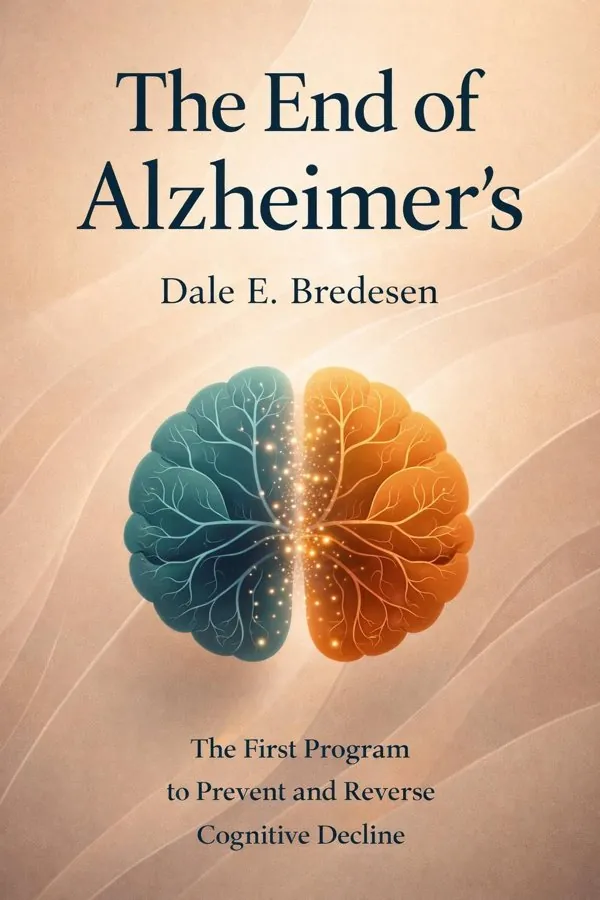
The End of Alzheimer's: The First Program to Prevent and Reverse Cognitive Decline: Summary & Key Insights
 10 min5 chaptersAudio available
What Is The End of Alzheimer's: The First Program to Prevent and Reverse Cognitive Decline About?
The End of Alzheimer's: The First Program to Prevent and Reverse Cognitive Decline by Dale E. Bredesen is a health_med book spanning 5 pages. In this groundbreaking work, neurologist Dale E. Bredesen presents a comprehensive program designed to prevent and even reverse cognitive decline associated with Alzheimer’s disease. Drawing on decades of research, Bredesen introduces the Bredesen Protocol, a personalized, multifactorial approach that targets the underlying causes of neurodegeneration rather than merely treating symptoms. The book outlines practical steps involving diet, exercise, sleep, and metabolic optimization to support brain health and cognitive resilience.
This FizzRead summary covers all 5 key chapters of The End of Alzheimer's: The First Program to Prevent and Reverse Cognitive Decline in approximately 10 minutes, distilling the most important ideas, arguments, and takeaways from Dale E. Bredesen's work. Also available as an audio summary and Key Quotes Podcast.
The End of Alzheimer's: The First Program to Prevent and Reverse Cognitive Decline
In this groundbreaking work, neurologist Dale E. Bredesen presents a comprehensive program designed to prevent and even reverse cognitive decline associated with Alzheimer’s disease. Drawing on decades of research, Bredesen introduces the Bredesen Protocol, a personalized, multifactorial approach that targets the underlying causes of neurodegeneration rather than merely treating symptoms. The book outlines practical steps involving diet, exercise, sleep, and metabolic optimization to support brain health and cognitive resilience.
Who Should Read The End of Alzheimer's: The First Program to Prevent and Reverse Cognitive Decline?
This book is perfect for anyone interested in health_med and looking to gain actionable insights in a short read. Whether you're a student, professional, or lifelong learner, the key ideas from The End of Alzheimer's: The First Program to Prevent and Reverse Cognitive Decline by Dale E. Bredesen will help you think differently.
- ✓Readers who enjoy health_med and want practical takeaways
- ✓Professionals looking to apply new ideas to their work and life
- ✓Anyone who wants the core insights of The End of Alzheimer's: The First Program to Prevent and Reverse Cognitive Decline in just 10 minutes
Want the full summary?
Get instant access to this book summary and 100K+ more with Fizz Moment.
Get Free SummaryAvailable on App Store • Free to download
Key Chapters
When I first entered the field of neurodegenerative diseases, I was taught a singular truth: that Alzheimer’s was a buildup of amyloid plaques and tangles, an inevitable outcome of aging for those genetically predisposed. But such simplicity fails to explain the complexity of human biology. Alzheimer’s is not one disease; it is a protective response gone awry. Our brains, in their brilliance, produce amyloid-beta not out of error, but as a shield—a biochemical firewall triggered by perceived danger.
Over years of research and clinical observation, it became clear that the brain doesn’t randomly degenerate. It prioritizes short-term survival over long-term function. When facing inflammatory insults, nutrient deprivation, or metabolic chaos, the brain pulls back from the energetically costly task of maintaining synaptic connections—the very networks that sustain memory, creativity, and personality. This process manifests as what we label ‘cognitive decline.’
At the cellular level, Alzheimer’s begins silently. Toxic insults—from chronic inflammation, insulin resistance, nutritional deficiencies, infections, or environmental toxins—trigger biochemical cascades that break communication between neurons. Amyloid and tau proteins accumulate not as pure pathology, but as the immune system’s attempt to isolate damage. Thus, removing amyloid alone, as so many drugs have attempted, is akin to removing the firefighter rather than extinguishing the flames.
Our work shifted toward asking: what sparks those flames? Why does one person’s brain respond resiliently to age while another’s falters? The answers point not to destiny, but to network effects: inflammation, hormonal imbalance, insulin signaling, mitochondrial energy failure, and exposure to neurotoxins. Once we see this web, the apparent mystery of cognitive decline dissolves into a system-level problem—one that systems medicine can finally decode.
To treat Alzheimer’s effectively, we must first recognize its subtypes. Through biochemical profiling of hundreds of patients, my team identified three main forms—each requiring distinct strategies.
The first, inflammatory Alzheimer’s (Type 1), arises when chronic inflammation drives the brain’s defense machinery into overdrive. Typical markers include elevated C-reactive protein, cytokines, and other inflammatory molecules. Here, the immune system mistakes our own tissues for invaders. The solution lies not in suppressing symptoms, but in cooling inflammation from its multiple sources—dietary, infectious, or metabolic.
Type 2, atrophic or ‘cold’ Alzheimer’s, reflects a shortfall rather than an assault. The brain loses the hormonal and nutritional support it needs to maintain connections: estrogen, testosterone, thyroid hormones, vitamin D, B12, and others. These deficiencies drain the brain’s energy, leading to gradual shrinkage of neural networks. Restoring balance through hormonal optimization, nutrient repletion, and improved mitochondrial function can reignite cognitive vitality.
Type 3, toxic Alzheimer’s, is the stealthiest. It develops from exposure to biotoxins such as mold, mercury, or organic pollutants. These toxins bypass the body’s detoxification pathways, forcing the brain to seal itself off with amyloid—its desperate measure to block further damage. In these cases, detoxification and removal of exposure sources are paramount before cognitive regeneration can occur.
Understanding these categories doesn’t oversimplify—it empowers. It allows clinicians and patients alike to pinpoint the underlying contributors to decline. Two people with the same symptoms may have entirely different root causes. Therefore, treatment cannot be standardized; it must be individualized. This realization reshaped every aspect of how we approach neurological care.
+ 3 more chapters — available in the FizzRead app
All Chapters in The End of Alzheimer's: The First Program to Prevent and Reverse Cognitive Decline
About the Author
Dale E. Bredesen, M.D., is an American neurologist and researcher specializing in neurodegenerative diseases. He served as a professor at UCLA and the founding president of the Buck Institute for Research on Aging. His work focuses on the mechanisms underlying Alzheimer’s disease and the development of therapeutic strategies to prevent and reverse cognitive decline.
Get This Summary in Your Preferred Format
Read or listen to the The End of Alzheimer's: The First Program to Prevent and Reverse Cognitive Decline summary by Dale E. Bredesen anytime, anywhere. FizzRead offers multiple formats so you can learn on your terms — all free.
Available formats: App · Audio · PDF · EPUB — All included free with FizzRead
Download The End of Alzheimer's: The First Program to Prevent and Reverse Cognitive Decline PDF and EPUB Summary
Key Quotes from The End of Alzheimer's: The First Program to Prevent and Reverse Cognitive Decline
“But such simplicity fails to explain the complexity of human biology.”
“To treat Alzheimer’s effectively, we must first recognize its subtypes.”
Frequently Asked Questions about The End of Alzheimer's: The First Program to Prevent and Reverse Cognitive Decline
The End of Alzheimer's: The First Program to Prevent and Reverse Cognitive Decline by Dale E. Bredesen is a health_med book that explores key ideas across 5 chapters. In this groundbreaking work, neurologist Dale E. Bredesen presents a comprehensive program designed to prevent and even reverse cognitive decline associated with Alzheimer’s disease. Drawing on decades of research, Bredesen introduces the Bredesen Protocol, a personalized, multifactorial approach that targets the underlying causes of neurodegeneration rather than merely treating symptoms. The book outlines practical steps involving diet, exercise, sleep, and metabolic optimization to support brain health and cognitive resilience.
More by Dale E. Bredesen
You Might Also Like

On Immunity
Eula Biss
10 min
The Three-Body Problem
Liu Cixin
10 min
Community Health Volunteer Toolkit: Training and Practical Activities
World Health Organization
10 min
Healing Back Pain: The Mind-Body Connection
John E. Sarno
10 min
Health Literacy for All: Practical Guides to Communicate Health Information (Compilations)
World Health Organization
10 min
The Complete Guide to Sports Supplements: An Evidence-Based Review
Anita Bean
10 minBrowse by Category
Ready to read The End of Alzheimer's: The First Program to Prevent and Reverse Cognitive Decline?
Get the full summary and 100K+ more books with Fizz Moment.