
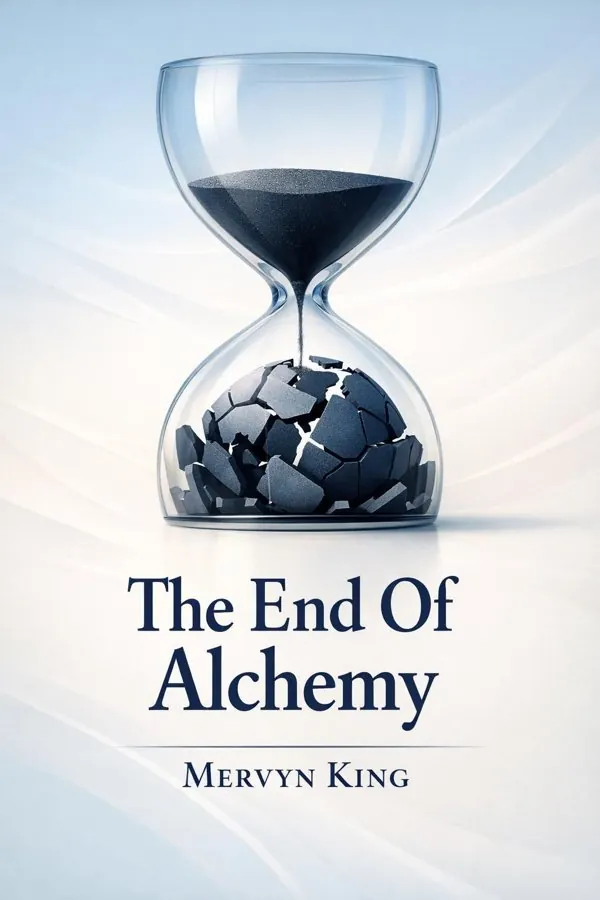
The End Of Alchemy: Money, Banking, And The Future Of The Global Economy: Summary & Key Insights
by Mervyn King
 10 min10 chaptersAudio available
What Is The End Of Alchemy: Money, Banking, And The Future Of The Global Economy About?
The End Of Alchemy: Money, Banking, And The Future Of The Global Economy by Mervyn King is a economics book spanning 10 pages. In this influential work, former Governor of the Bank of England Mervyn King explores the fragility of the modern financial system and proposes a radical rethink of how money and banking operate. Drawing on his experience during the 2008 financial crisis, King examines the deep flaws in current economic models and offers a vision for a more stable and equitable global economy.
This FizzRead summary covers all 10 key chapters of The End Of Alchemy: Money, Banking, And The Future Of The Global Economy in approximately 10 minutes, distilling the most important ideas, arguments, and takeaways from Mervyn King's work. Also available as an audio summary and Key Quotes Podcast.
The End Of Alchemy: Money, Banking, And The Future Of The Global Economy
In this influential work, former Governor of the Bank of England Mervyn King explores the fragility of the modern financial system and proposes a radical rethink of how money and banking operate. Drawing on his experience during the 2008 financial crisis, King examines the deep flaws in current economic models and offers a vision for a more stable and equitable global economy.
Who Should Read The End Of Alchemy: Money, Banking, And The Future Of The Global Economy?
This book is perfect for anyone interested in economics and looking to gain actionable insights in a short read. Whether you're a student, professional, or lifelong learner, the key ideas from The End Of Alchemy: Money, Banking, And The Future Of The Global Economy by Mervyn King will help you think differently.
- ✓Readers who enjoy economics and want practical takeaways
- ✓Professionals looking to apply new ideas to their work and life
- ✓Anyone who wants the core insights of The End Of Alchemy: Money, Banking, And The Future Of The Global Economy in just 10 minutes
Want the full summary?
Get instant access to this book summary and 100K+ more with Fizz Moment.
Get Free SummaryAvailable on App Store • Free to download
Key Chapters
To comprehend where we are, one must first see where we came from. The history of money and banking is, in essence, a story of trust. Early systems of barter, constrained by coincidence of wants, gradually gave way to commodity money—metals that held intrinsic value. Yet as societies and trade grew more complex, we moved from tangible commodities to representations of value—to credit. This transformation required a leap of faith: that a coin, a note, or a ledger entry would be accepted in exchange for real goods tomorrow.
The banks that evolved in Renaissance Italy and beyond were institutions forged upon this trust. They accepted deposits, extended credit, and increasingly, acted as intermediaries between those who wished to save and those who wished to borrow. This process—a seemingly simple act of matching time preferences—created the foundations of modern capitalism.
But with each leap in abstraction, from metal to paper, from paper to digits, we built a system ever more dependent on collective belief. Central banks arose to stabilize this system, first through convertibility into gold, later through monetary policy. When we abandoned the gold standard, we implicitly acknowledged that money is not metal—it is memory, a record of promises. Yet we did not build the institutional architecture to match this insight. The trust that underpinned our system became fragile, shadowed by leverage and opacity. The history of money, then, is also the history of recurrent crises: moments when confidence broke, and the web of promises tore.
Money is often described as a medium of exchange, a unit of account, and a store of value. But these textbook definitions hide a deeper truth: money is not a thing, it is a relationship. It is a social technology based upon mutual trust. When I hand you a note, you believe it has value because you believe others will accept it. That belief, sustained by legal and institutional promises, is the foundation of entire economies.
In this sense, money embodies the moral dimension of economic life. It represents promises—promises that someone will repay, that credit will be honored, that value will persist. Yet promises are only as reliable as those who make them. And when promises are multiplied through the machinery of modern banking—when every loan creates a new deposit—we confront a paradox. The system grows on a foundation of credit expansion, yet its stability depends on collective restraint.
This duality is what makes money both powerful and perilous. In tranquil periods, confidence feeds upon itself, money flows freely, and credit expands. But when doubt arises, the same mechanism turns vicious. Depositors demand cash, liquidity evaporates, and the social fabric of trust begins to unravel. Understanding money, therefore, requires not only economic reasoning but ethical reflection. It is about the management of promises under uncertainty.
+ 8 more chapters — available in the FizzRead app
All Chapters in The End Of Alchemy: Money, Banking, And The Future Of The Global Economy
About the Author
Mervyn King, Baron King of Lothbury, served as Governor of the Bank of England from 2003 to 2013. A distinguished economist and academic, he has been a key figure in shaping modern monetary policy and financial regulation in the United Kingdom.
Get This Summary in Your Preferred Format
Read or listen to the The End Of Alchemy: Money, Banking, And The Future Of The Global Economy summary by Mervyn King anytime, anywhere. FizzRead offers multiple formats so you can learn on your terms — all free.
Available formats: App · Audio · PDF · EPUB — All included free with FizzRead
Download The End Of Alchemy: Money, Banking, And The Future Of The Global Economy PDF and EPUB Summary
Key Quotes from The End Of Alchemy: Money, Banking, And The Future Of The Global Economy
“To comprehend where we are, one must first see where we came from.”
“Money is often described as a medium of exchange, a unit of account, and a store of value.”
Frequently Asked Questions about The End Of Alchemy: Money, Banking, And The Future Of The Global Economy
The End Of Alchemy: Money, Banking, And The Future Of The Global Economy by Mervyn King is a economics book that explores key ideas across 10 chapters. In this influential work, former Governor of the Bank of England Mervyn King explores the fragility of the modern financial system and proposes a radical rethink of how money and banking operate. Drawing on his experience during the 2008 financial crisis, King examines the deep flaws in current economic models and offers a vision for a more stable and equitable global economy.
More by Mervyn King
You Might Also Like
Business Adventures
John Brooks
10 min
Nudge
Richard H. Thaler, Cass R. Sunstein
10 min
The Hitchhiker"s Guide to the Galaxy
Douglas Adams
10 minThe Muqaddimah
Ibn Khaldun
10 minThe Outsiders
William N. Thorndike
10 min
A Little History of Economics
Niall Kishtainy
10 minBrowse by Category
Ready to read The End Of Alchemy: Money, Banking, And The Future Of The Global Economy?
Get the full summary and 100K+ more books with Fizz Moment.