
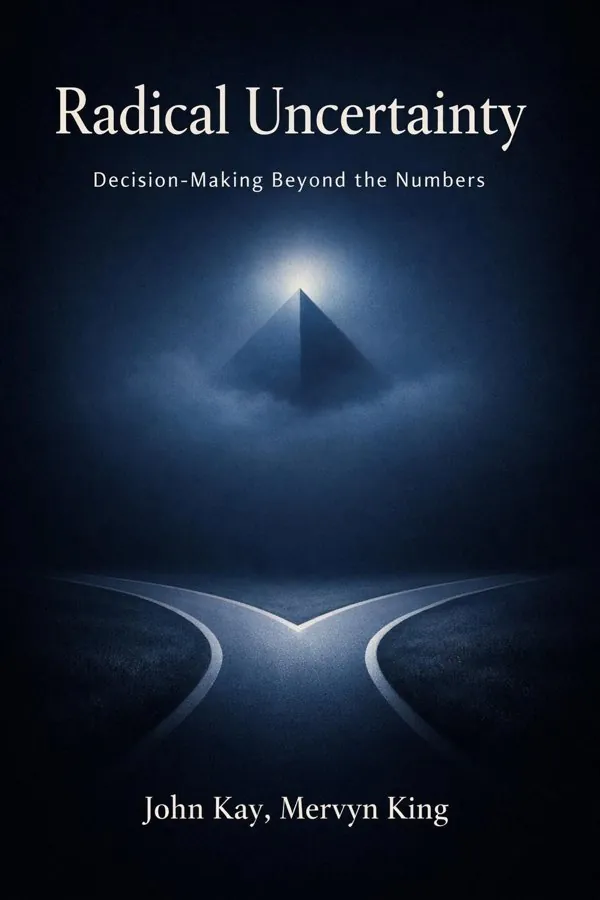
Radical Uncertainty: Decision-Making Beyond the Numbers: Summary & Key Insights
by John Kay, Mervyn King
 10 min6 chapters
What Is Radical Uncertainty: Decision-Making Beyond the Numbers About?
Radical Uncertainty: Decision-Making Beyond the Numbers by John Kay, Mervyn King is a economics book spanning 6 pages. This book explores how individuals and organizations can make decisions in a world characterized by radical uncertainty—where probabilities cannot be calculated and models fail to predict outcomes. The authors argue for a more narrative and judgment-based approach to decision-making, challenging the dominance of quantitative models in economics and business.
This FizzRead summary covers all 6 key chapters of Radical Uncertainty: Decision-Making Beyond the Numbers in approximately 10 minutes, distilling the most important ideas, arguments, and takeaways from John Kay, Mervyn King's work.
Radical Uncertainty: Decision-Making Beyond the Numbers
This book explores how individuals and organizations can make decisions in a world characterized by radical uncertainty—where probabilities cannot be calculated and models fail to predict outcomes. The authors argue for a more narrative and judgment-based approach to decision-making, challenging the dominance of quantitative models in economics and business.
Who Should Read Radical Uncertainty: Decision-Making Beyond the Numbers?
This book is perfect for anyone interested in economics and looking to gain actionable insights in a short read. Whether you're a student, professional, or lifelong learner, the key ideas from Radical Uncertainty: Decision-Making Beyond the Numbers by John Kay, Mervyn King will help you think differently.
- ✓Readers who enjoy economics and want practical takeaways
- ✓Professionals looking to apply new ideas to their work and life
- ✓Anyone who wants the core insights of Radical Uncertainty: Decision-Making Beyond the Numbers in just 10 minutes
Want the full summary?
Get instant access to this book summary and 100K+ more with Fizz Moment.
Get Free SummaryAvailable on App Store • Free to download
Key Chapters
We begin with the central distinction that underpins the entire argument: the difference between measurable risk and radical uncertainty. Risk describes situations in which we can assign probabilities to outcomes—the classic coin toss, insurance calculation, or roulette table. The domain of risk is the 'small world' where the rules are known and the probabilities, though uncertain, are calculable. But life doesn’t confine itself to such neat boundaries. Most real-world events—the evolution of technology, geopolitical shocks, pandemics, cultural mood shifts—occur in the 'large world,' where probabilities cannot even be meaningfully specified. Here lies radical uncertainty. It represents the open-ended nature of reality where the future cannot be reduced to a statistical distribution.
Kay and King trace how economists, since Frank Knight and John Maynard Keynes, recognized this distinction, yet modern theory flattened the complexity of uncertainty into an illusion of calculability. The authors use vivid examples from the financial crisis of 2008 to demonstrate how the failure to acknowledge radical uncertainty leads to misplaced confidence. Banks used quantitative risk models assuming that historic volatility patterns would predict future ones—a belief that collapsed once systemic interdependencies broke those very conditions.
Understanding radical uncertainty means recognizing that decision-making under such conditions is narrative, not numeric. People create stories to make sense of the world: doctors interpret symptoms, entrepreneurs envision market futures, policymakers weave socio-economic narratives. This is not softness—it’s realism. In radical uncertainty, imagination and interpretation replace computation.
Kay and King next walk us through the intellectual history of how economics became obsessed with quantification. They describe the journey from the early 20th century when Keynes and Knight still spoke of 'unknowable uncertainty,' to the mid-century formalism of expected utility theory, rational expectations, and general equilibrium models. The logic of these systems presupposed complete information and stable probabilities—conditions convenient for mathematics but misleading about reality.
The authors, having lived through decades of economic policymaking, show how each crisis—from inflation in the 1970s to the global financial meltdown—revealed the limits of quantitative precision. They argue that economics turned from a discipline aimed at understanding human behavior within society into a branch of applied mathematics. This transformation birthed what they call the 'claim of universality'—the belief that all uncertainties can be tamed by algorithms and that rational actors optimize outcomes based on known distributions.
In their critique, they do not dismiss quantitative tools outright but reposition them. Probabilistic reasoning works beautifully within bounded environments—for example, insurance underwriting or weather prediction—but fails in open systems where human behavior, innovation, and interconnections rewrite the game itself. The downfall of excessive modeling lies not in malice but in misplaced confidence. Kay and King gently remind us that models are maps, not territories. They illuminate certain features but never capture the whole landscape.
+ 4 more chapters — available in the FizzRead app
All Chapters in Radical Uncertainty: Decision-Making Beyond the Numbers
About the Authors
Get This Summary in Your Preferred Format
Read or listen to the Radical Uncertainty: Decision-Making Beyond the Numbers summary by John Kay, Mervyn King anytime, anywhere. FizzRead offers multiple formats so you can learn on your terms — all free.
Available formats: App · Audio · PDF · EPUB — All included free with FizzRead
Download Radical Uncertainty: Decision-Making Beyond the Numbers PDF and EPUB Summary
Key Quotes from Radical Uncertainty: Decision-Making Beyond the Numbers
“We begin with the central distinction that underpins the entire argument: the difference between measurable risk and radical uncertainty.”
“Kay and King next walk us through the intellectual history of how economics became obsessed with quantification.”
Frequently Asked Questions about Radical Uncertainty: Decision-Making Beyond the Numbers
Radical Uncertainty: Decision-Making Beyond the Numbers by John Kay, Mervyn King is a economics book that explores key ideas across 6 chapters. This book explores how individuals and organizations can make decisions in a world characterized by radical uncertainty—where probabilities cannot be calculated and models fail to predict outcomes. The authors argue for a more narrative and judgment-based approach to decision-making, challenging the dominance of quantitative models in economics and business.
You Might Also Like
Business Adventures
John Brooks
10 min
Nudge
Richard H. Thaler, Cass R. Sunstein
10 min
The Hitchhiker"s Guide to the Galaxy
Douglas Adams
10 minThe Muqaddimah
Ibn Khaldun
10 minThe Outsiders
William N. Thorndike
10 min
A Little History of Economics
Niall Kishtainy
10 minBrowse by Category
Ready to read Radical Uncertainty: Decision-Making Beyond the Numbers?
Get the full summary and 100K+ more books with Fizz Moment.