
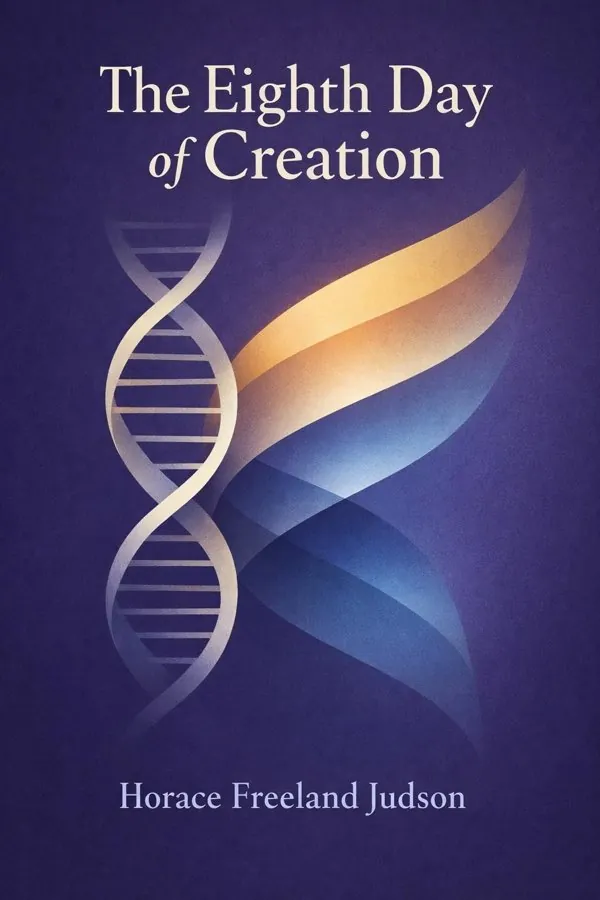
The Eighth Day of Creation: Makers of the Revolution in Biology: Summary & Key Insights
 10 min10 chaptersAudio available
Key Takeaways from The Eighth Day of Creation: Makers of the Revolution in Biology
Scientific revolutions often begin not with bigger theories, but with smaller objects.
A field can be transformed when outsiders enter it with different habits of mind.
The most important discoveries often begin as unpopular possibilities.
Some discoveries matter not only because they answer a question, but because they reveal an entirely new way to ask questions.
A revolution is incomplete until it explains translation between levels.
What Is The Eighth Day of Creation: Makers of the Revolution in Biology About?
The Eighth Day of Creation: Makers of the Revolution in Biology by Horace Freeland Judson is a life_science book spanning 10 pages. Horace Freeland Judson’s The Eighth Day of Creation is one of the most celebrated histories of modern science ever written. It tells the story of how biology changed from a largely descriptive field into a precise molecular science, centered on genes, DNA, proteins, and the flow of information within cells. Rather than presenting discovery as a neat sequence of facts, Judson reconstructs the revolution through the people who made it: brilliant, competitive, eccentric, collaborative, and often unsure of what they were really finding until the evidence forced a new worldview into place. From the rise of microbial genetics to the discovery of DNA’s structure and the cracking of the genetic code, the book captures science as a living, messy human process. What makes it especially powerful is Judson’s authority. Drawing on extensive interviews with the principal scientists and deep archival work, he writes with the rigor of a historian and the narrative skill of a novelist. The result is not just a history of molecular biology, but a profound account of how transformative ideas are born, tested, resisted, and finally accepted.
This FizzRead summary covers all 10 key chapters of The Eighth Day of Creation: Makers of the Revolution in Biology in approximately 10 minutes, distilling the most important ideas, arguments, and takeaways from Horace Freeland Judson's work. Also available as an audio summary and Key Quotes Podcast.
The Eighth Day of Creation: Makers of the Revolution in Biology
Horace Freeland Judson’s The Eighth Day of Creation is one of the most celebrated histories of modern science ever written. It tells the story of how biology changed from a largely descriptive field into a precise molecular science, centered on genes, DNA, proteins, and the flow of information within cells. Rather than presenting discovery as a neat sequence of facts, Judson reconstructs the revolution through the people who made it: brilliant, competitive, eccentric, collaborative, and often unsure of what they were really finding until the evidence forced a new worldview into place. From the rise of microbial genetics to the discovery of DNA’s structure and the cracking of the genetic code, the book captures science as a living, messy human process. What makes it especially powerful is Judson’s authority. Drawing on extensive interviews with the principal scientists and deep archival work, he writes with the rigor of a historian and the narrative skill of a novelist. The result is not just a history of molecular biology, but a profound account of how transformative ideas are born, tested, resisted, and finally accepted.
Who Should Read The Eighth Day of Creation: Makers of the Revolution in Biology?
This book is perfect for anyone interested in life_science and looking to gain actionable insights in a short read. Whether you're a student, professional, or lifelong learner, the key ideas from The Eighth Day of Creation: Makers of the Revolution in Biology by Horace Freeland Judson will help you think differently.
- ✓Readers who enjoy life_science and want practical takeaways
- ✓Professionals looking to apply new ideas to their work and life
- ✓Anyone who wants the core insights of The Eighth Day of Creation: Makers of the Revolution in Biology in just 10 minutes
Want the full summary?
Get instant access to this book summary and 100K+ more with Fizz Moment.
Get Free SummaryAvailable on App Store • Free to download
Key Chapters
Scientific revolutions often begin not with bigger theories, but with smaller objects. At the start of the twentieth century, biology was rich in observation but limited in mechanism. Scientists could describe inheritance, variation, and development, yet they lacked a convincing explanation of how traits were stored and transmitted. Mendelian genetics had provided patterns, but not the physical basis of heredity. Much of biology remained organized around visible traits, organisms, and tissues rather than molecules.
Judson shows that the transformation of biology began when researchers stopped asking only how whole organisms behaved and began asking what happened inside cells, and then inside chromosomes, and finally inside genes. This shift in scale changed everything. Instead of studying heredity only through plant breeding or visible mutations, scientists began seeking a material entity that could replicate, mutate, and direct cellular processes. That demand for mechanism pushed biology toward chemistry and physics.
A practical lesson emerges from this historical shift. Complex problems often become solvable when reframed at the right level. In medicine, for example, diseases once described only by symptoms are now understood through molecular pathways. In agriculture, crop traits are no longer just inherited patterns; they can be traced to gene networks. Even outside science, durable progress often comes from moving from surface description to underlying structure.
Judson’s account reminds readers that biology did not become modern simply by gathering more facts. It became modern by finding the correct unit of explanation. Actionable takeaway: when facing a difficult problem, ask whether you are studying the visible outcome instead of the hidden mechanism that generates it.
A field can be transformed when outsiders enter it with different habits of mind. One of Judson’s most striking themes is the role of physicists in the birth of molecular biology. Figures such as Max Delbrück came into biology not as passive adopters, but as intellectual disruptors. Trained to look for fundamental laws, simple systems, and elegant experimental designs, they brought a new style of reasoning to a field that often seemed sprawling and descriptive.
The appeal of biology to these physicists was profound. After the great achievements of early twentieth-century physics, heredity presented a mystery of similar depth: how could living systems store instructions, reproduce them, and maintain order? Delbrück and others helped create a research culture that favored tractable organisms, especially bacteriophages and bacteria, because these systems allowed precise experiments on replication, mutation, and selection. The famous “phage group” was not important only because of its findings, but because it established a way of doing biology that prized clarity, quantification, and conceptual boldness.
This interdisciplinary migration matters far beyond history. Many modern breakthroughs happen at borders between fields: physics and biology in imaging, computer science and genetics in bioinformatics, chemistry and medicine in drug design. Judson’s account shows that innovation is often less about accumulating specialists and more about inviting people who ask unfamiliar questions.
The practical application is clear for researchers, managers, and students alike. If a problem seems stagnant, bring in someone trained to think differently. Their methods may expose hidden assumptions. Actionable takeaway: seek cross-disciplinary perspectives when a field’s conventional tools no longer produce meaningful insight.
The most important discoveries often begin as unpopular possibilities. For years, many scientists assumed that proteins, with their chemical complexity, must carry hereditary information. DNA seemed too simple, too monotonous, too chemically dull to bear the richness of life. Judson carefully recounts how that assumption was overturned through a sequence of experiments that slowly made DNA impossible to ignore.
The turning point came through work such as Oswald Avery’s demonstration that the “transforming principle” in bacteria was DNA. This was not merely a technical result; it was a conceptual earthquake. If purified DNA could transfer heritable traits from one bacterial strain to another, then heredity had a material basis far more specific than many had imagined. Yet as Judson emphasizes, decisive evidence is not always instantly persuasive. Many biologists resisted Avery’s conclusion because it contradicted their expectations. Later experiments, including Alfred Hershey and Martha Chase’s work with bacteriophages, added further support by showing that DNA, not protein, entered bacterial cells during viral infection.
This episode offers a practical lesson in evidence and belief. People rarely reject old models simply because a new experiment appears. Interpretation depends on existing assumptions, institutional influence, and conceptual readiness. The path from data to consensus is social as well as empirical.
Today, the same pattern appears in emerging fields such as microbiome science, AI in medicine, or climate intervention. Strong evidence still needs advocates, replication, and an audience prepared to understand its implications. Actionable takeaway: when evaluating new evidence, ask not only whether the data are strong, but whether your prior assumptions are preventing you from seeing what they imply.
Some discoveries matter not only because they answer a question, but because they reveal an entirely new way to ask questions. The determination of DNA’s structure by James Watson and Francis Crick stands at the center of Judson’s narrative for precisely this reason. Their model of the double helix did more than identify the architecture of a molecule. It explained how hereditary information could be copied, preserved, and altered.
Judson presents the discovery as both intellectual triumph and human drama. It depended on chemistry, model-building, X-ray diffraction, and fierce competition. Rosalind Franklin’s data were indispensable to the emerging picture, while Maurice Wilkins, Linus Pauling, and others formed part of an intense international race. The double helix made heredity legible because base pairing suggested a mechanism for replication: each strand could serve as a template for the other. In one conceptual leap, structure implied function.
The broader significance is enormous. Once scientists understood DNA as an information-bearing molecule with a replicable architecture, biology could be organized around sequence, coding, mutation, and molecular interaction. Modern genetics, genomics, forensic science, evolutionary analysis, and biotechnology all stand on this foundation. Even practical tools like genetic testing and PCR-based diagnostics depend indirectly on the conceptual world opened by the double helix.
Judson’s deeper point is that elegant models can accelerate entire disciplines when they connect diverse observations into a coherent form. Actionable takeaway: in any complex field, look for explanations that do not merely fit the facts, but generate new predictions and reveal the mechanism hidden within the pattern.
A revolution is incomplete until it explains translation between levels. Once DNA had been identified as the hereditary material and its structure had been determined, a central mystery remained: how did sequences in nucleic acids specify the amino acid sequences of proteins? Judson traces the remarkable effort to crack the genetic code, one of the most intellectually exhilarating episodes in twentieth-century science.
Scientists such as George Gamow, Sydney Brenner, Francis Crick, Marshall Nirenberg, Har Gobind Khorana, and others attacked the problem from different directions. Some worked theoretically, trying to infer the coding system’s logic; others designed biochemical experiments to determine which RNA triplets corresponded to specific amino acids. The eventual solution revealed a triplet code, redundancy in coding, and a universal logic shared by nearly all life. This was a stunning unification: bacteria, plants, and humans all read genetic instructions in essentially the same language.
The practical consequences are everywhere. The genetic code made recombinant DNA technology possible, enabled gene synthesis, clarified inherited disease mechanisms, and laid foundations for synthetic biology. Today, when a mutation is linked to a defective protein in a genetic disorder, we are relying on the conceptual bridge these scientists built. Even mRNA vaccines rest on the principle that nucleotide sequences can be designed to direct protein production.
Judson makes clear that cracking the code required both abstraction and craftsmanship. It was not solved by genius alone, but by many minds using complementary methods. Actionable takeaway: when a system has two connected levels, focus on the translation rules between them; that bridge often unlocks the whole problem.
Ideas may drive science, but techniques determine what can be seen, tested, and trusted. One of Judson’s most important insights is that molecular biology did not advance through theory alone. It grew because scientists invented and refined methods that made invisible processes experimentally accessible. New tools turned bold speculation into measurable mechanism.
Microbial culture methods, phage assays, radioactive labeling, ultracentrifugation, chromatography, enzymatic analysis, and later nucleic acid manipulation techniques all reshaped the field. These methods did not merely answer old questions more efficiently; they created questions that had previously been impossible to ask. Once scientists could track labeled molecules through cells, they could study replication, transcription, and protein synthesis dynamically. Once they could isolate enzymes and compare mutants, they could infer pathways and control points with increasing precision.
This historical lesson remains highly relevant. In modern biology, CRISPR, single-cell sequencing, cryo-electron microscopy, and high-throughput computation are transforming research in exactly the way earlier techniques once did. The pattern is consistent: breakthrough tools expand imagination. A problem that seems conceptually murky often becomes tractable once the right measurement system exists.
There is also a practical message for readers outside the lab. In any serious endeavor, outcomes improve when observation improves. Better instruments, better data collection, and better process tracking lead to better decisions. Whether in health, business, or education, the quality of your tools shapes the quality of your thinking.
Judson’s history reminds us that method is not secondary to discovery; it is one of discovery’s main engines. Actionable takeaway: invest in better ways to observe and measure, because clearer evidence often changes not just the answer, but the very question.
Every mature science needs a conceptual grammar. In molecular biology, one of the most influential organizing ideas was Francis Crick’s central dogma: information flows from DNA to RNA to protein, but not from protein back to nucleic acid. Judson treats this not as a rigid law handed down from above, but as a powerful framework for thinking about life at the molecular level.
The central dogma helped scientists distinguish storage, transmission, and execution of biological information. DNA preserved the code, RNA acted as intermediary in many contexts, and proteins carried out most cellular work. This map provided a disciplined way to interpret experiments and structure new research programs. It did not explain every detail, and later discoveries such as reverse transcription complicated simplistic versions of it. Yet even those apparent exceptions reinforced the value of the framework by clarifying where information could and could not move.
Its importance extends beyond biology. Good frameworks help people reason effectively without pretending to know everything. In medicine, clinicians use causal models to organize symptoms, mechanisms, and treatments. In software, designers rely on information architecture to manage complexity. In personal learning, mental models help distinguish core principles from surface noise.
Judson’s account shows that successful scientific ideas are often useful not because they are final, but because they are clarifying. The central dogma gave researchers a shared language for asking better questions, even when later evidence forced revision. That is how strong concepts work: they guide inquiry while remaining open to correction.
Actionable takeaway: build and use simple explanatory frameworks, but hold them firmly enough to guide action and lightly enough to revise when better evidence appears.
Discovery is often described as if it were produced by logic alone, but Judson insists on a richer truth: science is a human activity shaped by personality, ambition, rivalry, friendship, error, and style. One of the great achievements of The Eighth Day of Creation is that it restores the emotional and social life of research without reducing science to politics or gossip. The ideas matter, but so do the people carrying them.
Throughout the book, we see how collaboration and competition coexist. Scientists share data, mentor younger colleagues, and build communities around techniques or model organisms. At the same time, they race for priority, defend intellectual territory, and sometimes dismiss evidence that threatens their standing. The drama around DNA’s structure is the most famous example, but Judson shows this pattern throughout molecular biology. Careers, institutions, personalities, and timing all influence which questions are pursued and which answers gain traction.
This matters because it corrects two common misconceptions: that science is purely objective in practice, and that human motives make scientific knowledge untrustworthy. The truth is subtler. Science works not because individuals are free of bias, but because methods, criticism, replication, and community standards gradually discipline those biases.
In practical terms, this is useful for anyone working in teams. Progress depends on both rigor and relationships. Good ideas can fail in toxic environments, while collaborative cultures can amplify talent and speed learning. Judson’s history encourages humility: brilliance alone is rarely enough.
Actionable takeaway: if you want better results in any knowledge-driven field, design environments that combine intellectual honesty, constructive challenge, and trust among collaborators.
When a science changes its subject, it also changes its philosophy. Judson ends not just with the success of molecular biology, but with its broader implications. Once heredity, development, and cellular function could be described in molecular terms, biology gained extraordinary explanatory power. Yet that power raised new questions about reductionism, identity, responsibility, and control over life.
To explain an organism in molecular language is not the same as exhausting its meaning, but it does alter how we think about health, disease, individuality, and evolution. A trait becomes not merely a visible feature, but a molecular event or network. A disease becomes not only a syndrome, but a disruption in information flow, protein structure, or gene regulation. This shift made modern medicine more precise, but it also encouraged forms of thinking that can become overly deterministic if handled carelessly.
Judson’s history invites reflection on the balance between explanation and wisdom. Molecular biology made genetic diagnosis, biotechnology, and later genetic engineering conceivable. Those developments promise immense benefits, from targeted therapies to improved crops, while also creating ethical dilemmas around privacy, manipulation, inequality, and the meaning of normality.
The book therefore matters not only to scientists, but to any thoughtful citizen. The molecular revolution changed policy, healthcare, education, and public imagination. We now live inside its consequences. Understanding how these ideas emerged helps us judge how they should be used.
Actionable takeaway: when a powerful explanatory tool changes what is possible, pair technical understanding with ethical reflection so that capability does not outrun judgment.
Fields become mature not only when they solve problems, but when they can tell the story of how they solved them. In Judson’s epilogue-like perspective, molecular biology comes of age as a discipline when its scattered experiments, personalities, and conceptual leaps can be seen as a coherent historical transformation. This matters because stories shape memory, identity, and future ambition.
The rise of molecular biology was not a single discovery but a chain of linked advances: the move to model systems, the proof that DNA carries heredity, the elucidation of the double helix, the cracking of the genetic code, the study of gene regulation, and the development of new molecular techniques. By narrating these together, Judson shows how disciplines are built through cumulative clarification. What once looked like isolated findings becomes a revolution when viewed at the right scale.
There is a practical insight here for institutions and individuals. Progress is easier to sustain when people understand the larger arc of their work. Teams perform better when they know not only their tasks, but their mission. Students learn more deeply when facts are connected into developmental stories. Even organizations change more effectively when their members can explain how past experiments, failures, and breakthroughs led to current strategy.
Judson’s book itself performs this service for science. It preserves memory against simplification and reminds readers that knowledge grows through continuity as well as disruption. A discipline with a history becomes more self-aware, and self-awareness often leads to better judgment.
Actionable takeaway: do not collect achievements as disconnected events; build narratives that connect them, because meaning and long-term direction emerge from understanding the sequence, not just the milestones.
All Chapters in The Eighth Day of Creation: Makers of the Revolution in Biology
About the Author
Horace Freeland Judson (1931–2011) was an American writer, historian of science, and academic known for his masterful accounts of modern scientific thought. He studied the development of biology with unusual depth, combining archival research, firsthand interviews, and a strong grasp of scientific ideas. Judson taught at Johns Hopkins University and became widely respected for writing that joined scholarly rigor with narrative elegance. His most famous work, The Eighth Day of Creation, is considered a classic in the history of science because it captures both the intellectual substance and the human drama of the molecular biology revolution. Across his career, Judson explored how discoveries are made, how scientific communities function, and how ideas reshape our understanding of life. He remains an essential voice for readers who want science explained historically, critically, and vividly.
Get This Summary in Your Preferred Format
Read or listen to the The Eighth Day of Creation: Makers of the Revolution in Biology summary by Horace Freeland Judson anytime, anywhere. FizzRead offers multiple formats so you can learn on your terms — all free.
Available formats: App · Audio · PDF · EPUB — All included free with FizzRead
Download The Eighth Day of Creation: Makers of the Revolution in Biology PDF and EPUB Summary
Key Quotes from The Eighth Day of Creation: Makers of the Revolution in Biology
“Scientific revolutions often begin not with bigger theories, but with smaller objects.”
“A field can be transformed when outsiders enter it with different habits of mind.”
“The most important discoveries often begin as unpopular possibilities.”
“Some discoveries matter not only because they answer a question, but because they reveal an entirely new way to ask questions.”
“A revolution is incomplete until it explains translation between levels.”
Frequently Asked Questions about The Eighth Day of Creation: Makers of the Revolution in Biology
The Eighth Day of Creation: Makers of the Revolution in Biology by Horace Freeland Judson is a life_science book that explores key ideas across 10 chapters. Horace Freeland Judson’s The Eighth Day of Creation is one of the most celebrated histories of modern science ever written. It tells the story of how biology changed from a largely descriptive field into a precise molecular science, centered on genes, DNA, proteins, and the flow of information within cells. Rather than presenting discovery as a neat sequence of facts, Judson reconstructs the revolution through the people who made it: brilliant, competitive, eccentric, collaborative, and often unsure of what they were really finding until the evidence forced a new worldview into place. From the rise of microbial genetics to the discovery of DNA’s structure and the cracking of the genetic code, the book captures science as a living, messy human process. What makes it especially powerful is Judson’s authority. Drawing on extensive interviews with the principal scientists and deep archival work, he writes with the rigor of a historian and the narrative skill of a novelist. The result is not just a history of molecular biology, but a profound account of how transformative ideas are born, tested, resisted, and finally accepted.
You Might Also Like
The Selfish Gene
Richard Dawkins
10 min
Awakenings
Oliver Sacks
10 min
Parasite Rex: Inside the Bizarre World of Nature's Most Dangerous Creatures
Carl Zimmer
10 min
The Atlas of Life on Earth
Various
10 min
The Book of Humans: The Story of How We Became Us
Adam Rutherford
10 min
The Horse
Wendy Williams
10 minBrowse by Category
Ready to read The Eighth Day of Creation: Makers of the Revolution in Biology?
Get the full summary and 100K+ more books with Fizz Moment.