
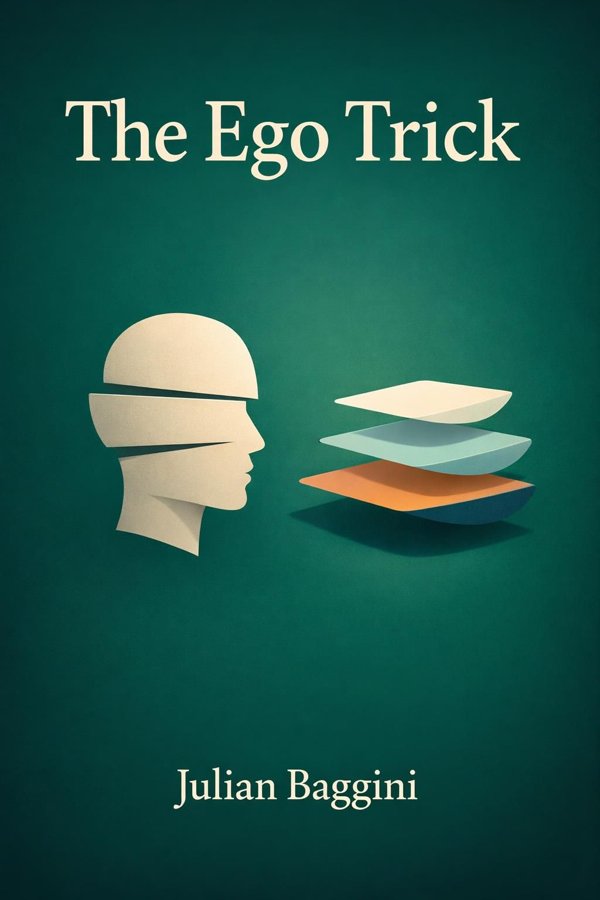
The Ego Trick: What Does It Mean to Be You?: Summary & Key Insights
 10 min10 chaptersAudio available
What Is The Ego Trick: What Does It Mean to Be You? About?
The Ego Trick: What Does It Mean to Be You? by Julian Baggini is a western_phil book spanning 10 pages. In this philosophical exploration, Julian Baggini examines the nature of personal identity and the illusion of a fixed self. Drawing on psychology, neuroscience, and philosophy, he argues that the 'self' is not a single, unchanging entity but a dynamic construct shaped by experiences, memories, and social interactions. The book challenges readers to rethink what it means to be 'you' and how understanding the ego trick can lead to greater self-awareness and compassion.
This FizzRead summary covers all 10 key chapters of The Ego Trick: What Does It Mean to Be You? in approximately 10 minutes, distilling the most important ideas, arguments, and takeaways from Julian Baggini's work. Also available as an audio summary and Key Quotes Podcast.
The Ego Trick: What Does It Mean to Be You?
In this philosophical exploration, Julian Baggini examines the nature of personal identity and the illusion of a fixed self. Drawing on psychology, neuroscience, and philosophy, he argues that the 'self' is not a single, unchanging entity but a dynamic construct shaped by experiences, memories, and social interactions. The book challenges readers to rethink what it means to be 'you' and how understanding the ego trick can lead to greater self-awareness and compassion.
Who Should Read The Ego Trick: What Does It Mean to Be You??
This book is perfect for anyone interested in western_phil and looking to gain actionable insights in a short read. Whether you're a student, professional, or lifelong learner, the key ideas from The Ego Trick: What Does It Mean to Be You? by Julian Baggini will help you think differently.
- ✓Readers who enjoy western_phil and want practical takeaways
- ✓Professionals looking to apply new ideas to their work and life
- ✓Anyone who wants the core insights of The Ego Trick: What Does It Mean to Be You? in just 10 minutes
Want the full summary?
Get instant access to this book summary and 100K+ more with Fizz Moment.
Get Free SummaryAvailable on App Store • Free to download
Key Chapters
Let us begin with the heart of the matter—the 'ego trick'. We feel, almost unavoidably, that there is a central point inside us, an unchanging self that experiences the world from behind our eyes. But that feeling is deceptive. Neuroscience and psychology reveal that the brain operates through countless subsystems, none of which houses an internal 'I'. What synthesizes the impressions of sights, sounds, emotions, and memories is not a metaphysical soul but a mental integration so seamless that we take the outcome as a single point of selfhood.
I call this the 'trick' because it is akin to a magician’s performance: all the components are visible, but their coordination elicits the sense of magic. The ego trick is no error—it is a functional illusion. Without it, the world would dissolve into confusion. Our capacity to perceive a stable self provides continuity, enabling moral responsibility and narrative coherence. Yet, when we treat that continuity as evidence of an immutable essence, we misunderstand its nature. It is precisely because the self is flexible that it works.
Consider the ordinary experience of changing over the years: your tastes shift, your opinions evolve, and yet you still feel that you are the same person. It’s not that your identity persists as a static core—it’s that you remember, you coordinate, you weave the present with the past. The trick is not deceitful but generative. Once we accept this, a more profound authenticity becomes possible, for we cease striving to preserve a mythical sameness and instead embrace our continuous becoming.
This understanding does not arise in isolation. For centuries, thinkers have wrestled with the question of personal identity. Descartes declared, 'I think, therefore I am,' grounding the self in the act of thought and inferring an indivisible mind distinct from the body. But later philosophers, most notably David Hume, doubted such unity. Hume observed that when he looked inward, he found only a bundle of sensations, perceptions, and emotions—never any fixed self behind them. In many ways, Hume was the first to glimpse the ego trick.
Through the twentieth century, existentialists like Sartre and phenomenologists like Merleau-Ponty reinforced the dynamic, embodied understanding of identity. They viewed the self as arising from engagement in the world, not from introspective isolation. The self becomes through doing, through relation. My own exploration builds upon these traditions while aiming to connect them to empirical evidence from psychology and neuroscience, demonstrating that what philosophy intuited centuries ago now finds empirical footing.
Philosophy’s task has always been to make sense of experience, and here, too, we find its relevance: the self is not a metaphysical entity but a narrative process binding momentary experiences together. The story you tell about who you are becomes the self you inhabit. But unlike fiction, this story is authored in real-time, by neurons and cultural contexts, by memory and imagination alike.
+ 8 more chapters — available in the FizzRead app
All Chapters in The Ego Trick: What Does It Mean to Be You?
About the Author
Julian Baggini is a British philosopher and writer known for making complex philosophical ideas accessible to a general audience. He co-founded The Philosophers’ Magazine and has authored numerous books on ethics, identity, and rational thinking. His work often bridges academic philosophy and everyday life, encouraging critical reflection and intellectual curiosity.
Get This Summary in Your Preferred Format
Read or listen to the The Ego Trick: What Does It Mean to Be You? summary by Julian Baggini anytime, anywhere. FizzRead offers multiple formats so you can learn on your terms — all free.
Available formats: App · Audio · PDF · EPUB — All included free with FizzRead
Download The Ego Trick: What Does It Mean to Be You? PDF and EPUB Summary
Key Quotes from The Ego Trick: What Does It Mean to Be You?
“Let us begin with the heart of the matter—the 'ego trick'.”
“This understanding does not arise in isolation.”
Frequently Asked Questions about The Ego Trick: What Does It Mean to Be You?
The Ego Trick: What Does It Mean to Be You? by Julian Baggini is a western_phil book that explores key ideas across 10 chapters. In this philosophical exploration, Julian Baggini examines the nature of personal identity and the illusion of a fixed self. Drawing on psychology, neuroscience, and philosophy, he argues that the 'self' is not a single, unchanging entity but a dynamic construct shaped by experiences, memories, and social interactions. The book challenges readers to rethink what it means to be 'you' and how understanding the ego trick can lead to greater self-awareness and compassion.
You Might Also Like
A Little History of Philosophy
Nigel Warburton
10 min
Areopagitica
John Milton
10 min
How To Think Like A Philosopher: Essential Principles For Clear Thinking
Peter Cave
10 min
Language, Truth and Logic
A. J. Ayer
10 min
The Age of Reason
Thomas Paine
10 min
The Essays
Michel De Montaigne
10 minBrowse by Category
Ready to read The Ego Trick: What Does It Mean to Be You??
Get the full summary and 100K+ more books with Fizz Moment.