
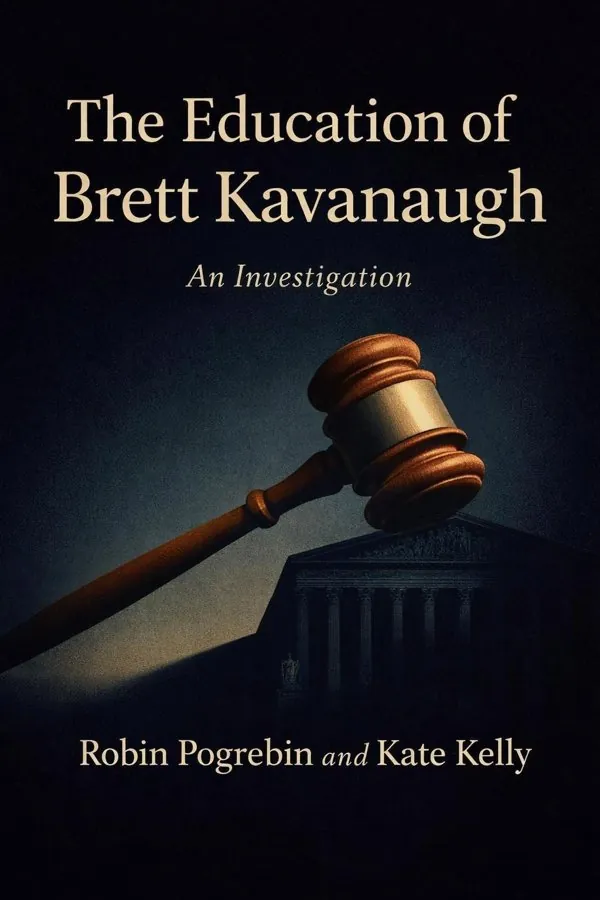
The Education of Brett Kavanaugh: An Investigation: Summary & Key Insights
 10 min10 chaptersAudio available
Key Takeaways from The Education of Brett Kavanaugh: An Investigation
One of the book’s strongest insights is that privilege rarely presents itself as privilege.
Education is never just academic; it is social training for power.
A central tension in the book is whether the behavior of teenagers and young adults should define them forever.
Careers at the top of American law are rarely built by brilliance alone.
A Supreme Court nomination is often described as a search for judicial excellence, but the book makes clear that it is also a struggle over ideology, legacy, and political control.
What Is The Education of Brett Kavanaugh: An Investigation About?
The Education of Brett Kavanaugh: An Investigation by Robin Pogrebin and Kate Kelly is a politics book spanning 9 pages. The Education of Brett Kavanaugh: An Investigation is a deeply reported examination of how one Supreme Court confirmation became a national struggle over memory, class, gender, and political power. Journalists Robin Pogrebin and Kate Kelly revisit Brett Kavanaugh’s upbringing, elite schooling, social world, legal career, and bruising nomination process to understand not only the man at the center of the storm, but also the institutions that shaped and defended him. Their focus is broader than scandal. The book asks how privilege operates, why allegations of misconduct are so difficult to prove or disprove decades later, and what happens when a lifetime of ambition collides with a changing cultural landscape shaped by the #MeToo movement. Pogrebin and Kelly bring unusual authority to the subject. Both are veteran New York Times reporters who covered the confirmation battle in real time and then expanded their reporting through extensive interviews and documentary research. The result is a careful, unsettling portrait of American elite culture and a useful case study in how personal history, institutional loyalty, media incentives, and partisan warfare can converge at the highest levels of public life.
This FizzRead summary covers all 10 key chapters of The Education of Brett Kavanaugh: An Investigation in approximately 10 minutes, distilling the most important ideas, arguments, and takeaways from Robin Pogrebin and Kate Kelly's work. Also available as an audio summary and Key Quotes Podcast.
The Education of Brett Kavanaugh: An Investigation
The Education of Brett Kavanaugh: An Investigation is a deeply reported examination of how one Supreme Court confirmation became a national struggle over memory, class, gender, and political power. Journalists Robin Pogrebin and Kate Kelly revisit Brett Kavanaugh’s upbringing, elite schooling, social world, legal career, and bruising nomination process to understand not only the man at the center of the storm, but also the institutions that shaped and defended him. Their focus is broader than scandal. The book asks how privilege operates, why allegations of misconduct are so difficult to prove or disprove decades later, and what happens when a lifetime of ambition collides with a changing cultural landscape shaped by the #MeToo movement. Pogrebin and Kelly bring unusual authority to the subject. Both are veteran New York Times reporters who covered the confirmation battle in real time and then expanded their reporting through extensive interviews and documentary research. The result is a careful, unsettling portrait of American elite culture and a useful case study in how personal history, institutional loyalty, media incentives, and partisan warfare can converge at the highest levels of public life.
Who Should Read The Education of Brett Kavanaugh: An Investigation?
This book is perfect for anyone interested in politics and looking to gain actionable insights in a short read. Whether you're a student, professional, or lifelong learner, the key ideas from The Education of Brett Kavanaugh: An Investigation by Robin Pogrebin and Kate Kelly will help you think differently.
- ✓Readers who enjoy politics and want practical takeaways
- ✓Professionals looking to apply new ideas to their work and life
- ✓Anyone who wants the core insights of The Education of Brett Kavanaugh: An Investigation in just 10 minutes
Want the full summary?
Get instant access to this book summary and 100K+ more with Fizz Moment.
Get Free SummaryAvailable on App Store • Free to download
Key Chapters
One of the book’s strongest insights is that privilege rarely presents itself as privilege. It usually appears as discipline, talent, leadership, and hard work. Brett Kavanaugh’s early life in suburban Maryland illustrates this pattern. He was raised in a stable Catholic household, attended prestigious schools, and moved through environments where confidence, polish, and social belonging were rewarded. None of this means he lacked ability. The point is that ability was cultivated and validated inside institutions already designed to recognize people like him.
Pogrebin and Kelly show how family networks, school culture, and social expectations can create a pipeline to power that feels natural to those inside it. Kavanaugh’s upbringing at Georgetown Prep, in particular, mattered not only because of academics, but because of the norms it reinforced: masculine camaraderie, competition, discretion, and the assumption that youthful excess would not permanently damage future prospects. These settings often teach more than classroom content. They teach who gets the benefit of the doubt.
This matters far beyond one person. In business, politics, and academia, people often treat elite success as pure evidence of merit while overlooking the advantages that made that success easier to achieve and easier to protect. A résumé can reveal accomplishment while concealing insulation.
A practical way to apply this insight is to examine any narrative of achievement with two questions: What opportunities made this possible, and who did not receive the same grace for similar behavior? Actionable takeaway: when evaluating leaders, look beyond credentials and ask how institutions helped shape, shield, and elevate them.
Education is never just academic; it is social training for power. The book presents Kavanaugh’s years at Georgetown Prep and later Yale as formative not only because of the classes he took, but because of the cultures he absorbed. These schools offered prestige, connections, and identity. They also reinforced assumptions about who belongs in elite spaces and whose behavior gets normalized within them.
At Georgetown Prep, the atmosphere mixed religious seriousness with intense male bonding and a party culture that, according to the reporting, sometimes celebrated heavy drinking and crude behavior. At Yale, Kavanaugh entered an even more influential world, where social clubs, status markers, and peer networks could shape futures long after graduation. Pogrebin and Kelly suggest that these institutions do more than educate individuals. They reproduce elite confidence and mutual recognition, allowing former classmates to become future colleagues, defenders, and references.
This theme helps explain why old school ties matter in moments of crisis. When allegations surfaced during the confirmation process, debates were not only about facts. They were also about competing interpretations of elite youth culture: Was such behavior shocking, common, exaggerated, or protected? The schools themselves became part of the story.
The broader lesson is that institutions transmit moral habits along with credentials. A workplace, university, or professional network can normalize silence, excuse excess, or reward loyalty over truth.
Actionable takeaway: evaluate schools and organizations not just by reputation, but by the behaviors they encourage, the harms they excuse, and the kinds of leaders they consistently produce.
A central tension in the book is whether the behavior of teenagers and young adults should define them forever. The authors do not reduce that question to a simple yes or no. Instead, they show how youthful conduct can remain politically and morally significant when it reveals deeper patterns: entitlement, group loyalty, attitudes toward women, and the ways memory is managed later in life.
The reporting on Kavanaugh’s high school and college years highlights a culture of alcohol-fueled socializing in which bravado, coded language, and boundary-crossing were not always treated as serious. Supporters saw ordinary adolescent recklessness. Critics saw evidence of a broader culture that minimized harm and protected status. The real issue, the book suggests, is not merely what happened in isolated incidents, but what those incidents say about an environment and about a person’s later willingness to confront that past honestly.
This is relevant in many contexts. Employers increasingly review patterns of behavior rather than single mistakes. Universities reconsider traditions once dismissed as harmless. Families, too, grapple with how to talk about old conduct without either erasing growth or excusing injury.
The book encourages a more mature standard: accountability should consider time, evidence, context, and whether the person has shown insight or remorse. Growth matters, but so does candor.
Actionable takeaway: when reflecting on your own past or judging others, ask not only whether a mistake was youthful, but whether there has been honest reckoning, changed behavior, and respect for those who may have been harmed.
Careers at the top of American law are rarely built by brilliance alone. They are assembled through clerkships, mentorship, patronage, ideological alignment, and carefully navigated opportunities. The book traces Kavanaugh’s professional ascent through the federal judiciary, Republican politics, the George W. Bush White House, and eventually the influential U.S. Court of Appeals for the D.C. Circuit. This ascent demonstrates how institutions identify, sponsor, and promote talent that fits their needs.
Pogrebin and Kelly portray Kavanaugh as hardworking, disciplined, and strategic. He was not simply carried upward; he pursued advancement aggressively. But the important insight is that elite systems reward those who understand their codes. In law and politics, this means cultivating mentors, surviving highly partisan battles, building a reputation for reliability, and positioning oneself as both intellectually strong and institutionally useful.
The authors also show how long-term ambition can shape personal presentation. Public personas become polished. Records are managed. Networks are maintained. This is not unique to judges. Executives, academics, and elected officials all learn how to convert résumé lines into legitimacy.
For readers, the value lies in recognizing how careers are actually built. Formal qualifications matter, but sponsorship and timing often matter just as much. If we ignore these mechanisms, we misunderstand how power reproduces itself.
Actionable takeaway: study not only what successful people achieved, but the structures, mentors, and gatekeepers that enabled their rise. If you want fairer systems, push for transparency in how institutions recruit, evaluate, and promote future leaders.
A Supreme Court nomination is often described as a search for judicial excellence, but the book makes clear that it is also a struggle over ideology, legacy, and political control. Kavanaugh’s nomination unfolded in an atmosphere where every seat on the Court carried enormous stakes: abortion, executive power, administrative law, and the long-term direction of American governance. That context shaped every response to his nomination.
Pogrebin and Kelly show that once a nominee becomes central to a party’s judicial strategy, the process changes. Questions of character and truth are filtered through electoral fear and partisan urgency. Supporters may worry that abandoning a nominee will hand victory to the other side. Opponents may see the nomination as a symbolic test of moral seriousness as well as a substantive fight over law. In this environment, evidence is not merely evaluated; it is weaponized, defended, reframed, or dismissed.
The Kavanaugh confirmation therefore became larger than Kavanaugh. It exposed how constitutional appointments are now fought like major campaigns, complete with messaging operations, interest-group pressure, and media choreography. The process was legal in form but deeply political in practice.
This insight applies widely. Leadership selections in corporations, universities, and nonprofits often claim neutrality while actually reflecting strategic institutional priorities.
Actionable takeaway: whenever a high-stakes appointment is being made, ask what larger goals the decision-makers are protecting. Understanding those incentives helps explain why some concerns are elevated, others minimized, and compromise becomes nearly impossible.
One reason the Kavanaugh case gripped the country is that it forced people to confront a painful reality: many serious allegations emerge long after the events in question, when evidence is incomplete and memory is imperfect. Christine Blasey Ford’s allegation became the emotional center of the confirmation fight because it was detailed, personal, and publicly delivered under enormous pressure. Her testimony introduced a dilemma familiar to many institutions: how should claims be judged when the passage of time makes certainty difficult?
The book treats this question with care. Pogrebin and Kelly do not present memory as either flawless or useless. Instead, they show that trauma can preserve certain details while blurring others, and that denial can stem from innocence, self-protection, or selective recall. Assessing credibility therefore requires more than choosing whom one likes or politically trusts. It requires examining consistency, corroboration, motive, and the context in which testimony is given.
The broader lesson is highly practical. Schools, workplaces, courts, and families often face delayed claims of misconduct. These situations demand procedures that are fair to accusers and accused alike while recognizing that traditional standards of proof may not settle every moral question.
The Kavanaugh hearings demonstrated how badly these conversations can collapse when institutions lack legitimacy and time is compressed by political deadlines.
Actionable takeaway: build habits of evaluating serious allegations with patience and rigor. Resist reflexive certainty, seek corroborating context, and support systems that allow claims to be investigated before public trust depends on rushed judgment.
Deborah Ramirez’s allegation added a different dimension to the public debate. If Ford’s accusation focused national attention on a specific event from high school, Ramirez’s account pointed back to Yale and raised the possibility that troubling behavior was not isolated to one stage of life. The significance of her allegation in the book is not only its content, but what it suggested about pattern recognition. Public understanding often shifts when separate claims appear to echo one another across time and setting.
Pogrebin and Kelly explore the challenges involved in reporting and evaluating Ramirez’s account, including questions of memory, corroboration, and timing. They also show how difficult it is for individuals to come forward when they anticipate reputational attack, political scrutiny, and intimate public exposure. In high-profile cases, allegations are never received in a vacuum. They arrive inside media ecosystems that reward speed and polarization.
The practical importance of this chapter lies in understanding how patterns are interpreted. In organizations, repeated complaints about a leader can reveal culture problems even when no single claim alone seems definitive. At the same time, institutions must avoid treating accumulation as automatic proof without careful assessment.
The book urges readers to think in terms of both individual evidence and systemic signals. One claim may be contested; multiple claims may indicate a climate that deserves investigation.
Actionable takeaway: when evaluating misconduct concerns, do not isolate incidents too quickly. Look for recurring behaviors, common environments, and repeated reports that may reveal a larger institutional failure to notice, document, or address warning signs.
Modern political controversies are shaped as much by storytelling as by evidence. The book details how the Kavanaugh hearings unfolded across cable news, newspapers, social media, and partisan commentary, creating a fragmented reality in which different audiences consumed different versions of the same events. To some, Kavanaugh was a victim of last-minute character assassination. To others, Ford and Ramirez represented long-silenced truth colliding with entrenched male power.
Pogrebin and Kelly show that media institutions did not merely report the battle; they helped structure it. Editorial choices about headlines, sourcing, timing, and framing influenced public reaction. Social media intensified emotional identification while punishing nuance. In such a climate, uncertainty becomes intolerable. People often prefer a morally complete narrative to an incomplete factual record.
This dynamic matters far beyond politics. Workplace scandals, celebrity accusations, and campus controversies now unfold under similar pressures. Institutions feel compelled to respond quickly because public judgment forms almost instantly, yet fast responses can harden before facts are established.
The book implicitly argues for a more disciplined media literacy: readers should distinguish reporting from commentary, evolving facts from fixed conclusions, and emotional resonance from evidentiary strength.
Actionable takeaway: when following a high-conflict public controversy, compare multiple credible sources, notice framing differences, and avoid confusing viral certainty with verified truth. Good judgment begins with slowing down how you consume dramatic news.
The Senate hearings and the aftermath revealed a painful institutional truth: systems under pressure often act first to preserve legitimacy, authority, and continuity rather than to pursue full moral clarity. The Senate had to decide whether to confirm a nominee, but the process it used also communicated what kinds of evidence, testimony, and emotional risk the institution was willing to absorb. The FBI inquiry, the hearing structure, and the compressed timeline all became symbols of what the system prioritized.
Pogrebin and Kelly show how every major actor faced competing obligations. Senators balanced party loyalty, electoral consequences, procedural fairness, and personal conscience. The Court itself remained an unspoken institutional stake; prolonged uncertainty could damage public trust, yet so could a rushed decision. These tensions do not excuse flawed process, but they explain why institutions often produce outcomes that satisfy almost no one.
This is a valuable lens for readers because similar dynamics appear in corporations dealing with misconduct complaints, universities facing protests, and religious bodies confronting abuse scandals. Organizations often seek narrow procedural closure when broader cultural examination is needed.
The lesson is not cynicism but realism. Institutions are not neutral truth machines. They are self-preserving systems with incentives, blind spots, and thresholds for action.
Actionable takeaway: when judging an institution’s response to crisis, ask what it was trying to protect: fairness, reputation, power, speed, or stability. That question often reveals why official processes feel insufficient even when they appear formally complete.
The lasting significance of The Education of Brett Kavanaugh lies in its argument that this was never only about one judge. The confirmation battle became a mirror reflecting larger American conflicts: gender relations after #MeToo, the resilience of class privilege, the fragility of institutional trust, and the way political identity shapes beliefs about truth. Kavanaugh’s story mattered because so many people recognized pieces of their own social world in it, whether in elite schools, partisan media, or experiences with misconduct and disbelief.
Pogrebin and Kelly encourage readers to see the episode as a collision between old assumptions and changing moral expectations. For decades, many institutions tolerated behavior that was informal, boozy, exclusionary, and often dismissive of women’s experiences. The #MeToo era challenged those norms, but not evenly or conclusively. The Kavanaugh hearings showed both the power of that challenge and the persistence of structures resistant to it.
This cultural lens helps explain why the controversy remains emotionally charged. It touched not only on legal standards, but on questions people ask in their own lives: Whom do we believe? What does accountability look like after many years? Can success coexist with serious moral blind spots? When does defending due process become a way to avoid deeper reckoning?
Actionable takeaway: use this case not as a partisan litmus test, but as an invitation to examine the cultures you inhabit. Ask what behaviors are normalized, whose stories are doubted, and what accountability would look like before crisis forces the issue.
All Chapters in The Education of Brett Kavanaugh: An Investigation
About the Authors
Robin Pogrebin and Kate Kelly are American journalists best known for their work at The New York Times. Pogrebin has long covered culture, institutions, and public controversies, bringing a careful eye to the way power operates inside respected establishments. Kelly has reported extensively on business, Wall Street, politics, and high-profile investigations, with particular strength in uncovering how elite networks influence public outcomes. Together, they combine narrative clarity with rigorous investigative reporting. Their collaboration on The Education of Brett Kavanaugh draws on extensive interviews, documentary research, and firsthand experience covering the confirmation battle as it unfolded. As reporters rather than polemicists, they focus on reconstructing events, examining evidence, and placing individual actions within larger institutional and cultural systems.
Get This Summary in Your Preferred Format
Read or listen to the The Education of Brett Kavanaugh: An Investigation summary by Robin Pogrebin and Kate Kelly anytime, anywhere. FizzRead offers multiple formats so you can learn on your terms — all free.
Available formats: App · Audio · PDF · EPUB — All included free with FizzRead
Download The Education of Brett Kavanaugh: An Investigation PDF and EPUB Summary
Key Quotes from The Education of Brett Kavanaugh: An Investigation
“One of the book’s strongest insights is that privilege rarely presents itself as privilege.”
“Education is never just academic; it is social training for power.”
“A central tension in the book is whether the behavior of teenagers and young adults should define them forever.”
“Careers at the top of American law are rarely built by brilliance alone.”
“A Supreme Court nomination is often described as a search for judicial excellence, but the book makes clear that it is also a struggle over ideology, legacy, and political control.”
Frequently Asked Questions about The Education of Brett Kavanaugh: An Investigation
The Education of Brett Kavanaugh: An Investigation by Robin Pogrebin and Kate Kelly is a politics book that explores key ideas across 10 chapters. The Education of Brett Kavanaugh: An Investigation is a deeply reported examination of how one Supreme Court confirmation became a national struggle over memory, class, gender, and political power. Journalists Robin Pogrebin and Kate Kelly revisit Brett Kavanaugh’s upbringing, elite schooling, social world, legal career, and bruising nomination process to understand not only the man at the center of the storm, but also the institutions that shaped and defended him. Their focus is broader than scandal. The book asks how privilege operates, why allegations of misconduct are so difficult to prove or disprove decades later, and what happens when a lifetime of ambition collides with a changing cultural landscape shaped by the #MeToo movement. Pogrebin and Kelly bring unusual authority to the subject. Both are veteran New York Times reporters who covered the confirmation battle in real time and then expanded their reporting through extensive interviews and documentary research. The result is a careful, unsettling portrait of American elite culture and a useful case study in how personal history, institutional loyalty, media incentives, and partisan warfare can converge at the highest levels of public life.
You Might Also Like

Antifa: The Anti-Fascist Handbook
Mark Bray
10 min
Attack from Within: How Disinformation Is Sabotaging America
Barbara McQuade
10 min
Coercion, Capital, and European States, AD 990–1992
Charles Tilly
10 min
Digital Democracy: Concepts, Methodologies, Tools, and Applications
Various Authors
10 min
Fascism
Stanley G. Payne
10 min
Fire And Fury: Inside The Trump White House
Michael Wolff
10 minBrowse by Category
Ready to read The Education of Brett Kavanaugh: An Investigation?
Get the full summary and 100K+ more books with Fizz Moment.