
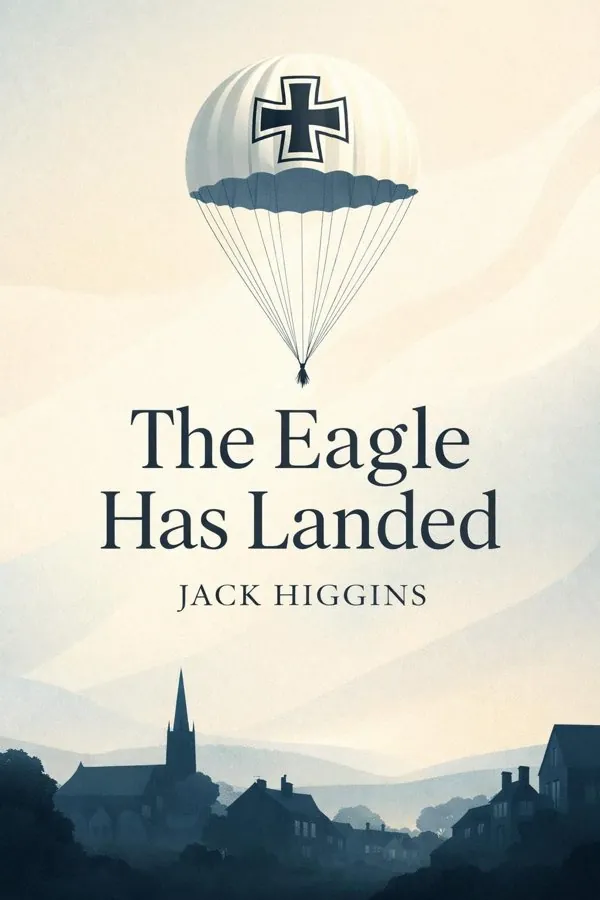
The Eagle Has Landed: Summary & Key Insights
by Jack Higgins
 10 min8 chaptersAudio available
Key Takeaways from The Eagle Has Landed
The most dangerous operations are often born not from strength, but from decline.
Every great covert plan depends on one unpredictable element: the human being who cannot be reduced to a role.
Courage becomes morally interesting only when it resists the system it serves.
The most fragile part of any operation is the moment when preparation meets reality.
War becomes most tragic when ordinary people stumble into extraordinary violence.
What Is The Eagle Has Landed About?
The Eagle Has Landed by Jack Higgins is a war_military book spanning 5 pages. What makes a wartime thriller endure is not only suspense, but the unsettling question it leaves behind: what if the impossible had almost happened? In The Eagle Has Landed, Jack Higgins builds an audacious World War II premise around a covert German plan to kidnap Winston Churchill from an isolated English village. What begins as an intelligence operation soon becomes a tense study of deception, discipline, chance, and divided loyalties. Higgins combines military detail with human complexity, giving readers not cardboard heroes and villains, but capable men trapped inside a destructive historical machine. The novel matters because it turns a wildly dramatic idea into something psychologically convincing. Its tension comes not just from whether the mission succeeds, but from how carefully it is conceived, how plausibly it unfolds, and how moral ambiguity shadows every step. Higgins, writing under the pen name of Harry Patterson, became one of the defining thriller writers of the twentieth century, known for crisp pacing and deep familiarity with conflict. The Eagle Has Landed remains his signature achievement: a war novel, espionage tale, and moral drama in one unforgettable story.
This FizzRead summary covers all 8 key chapters of The Eagle Has Landed in approximately 10 minutes, distilling the most important ideas, arguments, and takeaways from Jack Higgins's work. Also available as an audio summary and Key Quotes Podcast.
The Eagle Has Landed
What makes a wartime thriller endure is not only suspense, but the unsettling question it leaves behind: what if the impossible had almost happened? In The Eagle Has Landed, Jack Higgins builds an audacious World War II premise around a covert German plan to kidnap Winston Churchill from an isolated English village. What begins as an intelligence operation soon becomes a tense study of deception, discipline, chance, and divided loyalties. Higgins combines military detail with human complexity, giving readers not cardboard heroes and villains, but capable men trapped inside a destructive historical machine.
The novel matters because it turns a wildly dramatic idea into something psychologically convincing. Its tension comes not just from whether the mission succeeds, but from how carefully it is conceived, how plausibly it unfolds, and how moral ambiguity shadows every step. Higgins, writing under the pen name of Harry Patterson, became one of the defining thriller writers of the twentieth century, known for crisp pacing and deep familiarity with conflict. The Eagle Has Landed remains his signature achievement: a war novel, espionage tale, and moral drama in one unforgettable story.
Who Should Read The Eagle Has Landed?
This book is perfect for anyone interested in war_military and looking to gain actionable insights in a short read. Whether you're a student, professional, or lifelong learner, the key ideas from The Eagle Has Landed by Jack Higgins will help you think differently.
- ✓Readers who enjoy war_military and want practical takeaways
- ✓Professionals looking to apply new ideas to their work and life
- ✓Anyone who wants the core insights of The Eagle Has Landed in just 10 minutes
Want the full summary?
Get instant access to this book summary and 100K+ more with Fizz Moment.
Get Free SummaryAvailable on App Store • Free to download
Key Chapters
The most dangerous operations are often born not from strength, but from decline. That is the engine behind The Eagle Has Landed. By 1943, Germany is no longer charging forward with confidence; it is trying to recover initiative in a war that is slipping away. In that atmosphere, a fantastical proposal emerges inside the Abwehr: kidnap Winston Churchill while he visits a lightly guarded English village. The plan is initially absurd, yet its very absurdity makes it attractive to men desperate for a dramatic reversal.
Higgins uses this premise to show how institutions under pressure begin to flirt with reckless brilliance. Admiral Canaris, weary and increasingly disillusioned with Hitler, recognizes both the tactical allure and the madness of the scheme. Colonel Radl, more practical but equally drawn in, becomes the man tasked with making fantasy operational. Their discussions reveal a key truth about leadership under crisis: desperation lowers the threshold between the improbable and the actionable.
This is not just a wartime lesson. Businesses in decline, political movements under pressure, and even individuals facing personal setbacks can become seduced by grand, improbable gambits. Sometimes boldness is necessary. But Higgins reminds us that when urgency replaces judgment, planning becomes vulnerable to ego, hope, and denial.
The novel’s opening therefore does more than launch a thriller. It explores how failing systems generate dangerous creativity. The operation is brilliant on paper precisely because it is conceived in a moment when ordinary logic no longer satisfies those in power.
Actionable takeaway: when evaluating any bold plan, ask whether it is driven by strategy or by desperation disguised as strategy.
Every great covert plan depends on one unpredictable element: the human being who cannot be reduced to a role. Liam Devlin is that element. Recruited from Ireland by Colonel Radl, Devlin is a poet, IRA veteran, smuggler, and professional survivor. He is competent enough to be useful, cynical enough to see through ideology, and independent enough to remain dangerous even to his allies. Higgins makes him central because missions are not won by plans alone; they are shaped by personalities capable of improvisation under pressure.
Devlin’s appeal lies in contradiction. He is not a conventional patriot, nor is he a committed Nazi. He joins because the mission is difficult, because money matters, and because he recognizes in it a kind of fatalistic elegance. That ambiguity gives the novel much of its moral depth. Devlin is willing to work with Germans, yet he never truly belongs to them. He can read people, sense hidden motives, and move between political loyalties without surrendering his own code.
In practical terms, Devlin represents the importance of unconventional talent. Organizations often look for reliability in familiar forms, but the people most suited to unusual problems are frequently the ones who do not fit standard categories. They bring creativity, adaptability, and outsider perspective. They also bring risk, because they cannot be controlled by simple loyalty.
Higgins avoids turning Devlin into a romantic rogue without consequences. His intelligence and charm make the mission possible, but his independence also exposes the fragile trust holding the operation together. He reminds readers that skill and alignment are not the same thing.
Actionable takeaway: when choosing people for difficult work, value competence and adaptability, but never ignore the complexities of motive.
Courage becomes morally interesting only when it resists the system it serves. Kurt Steiner, the German paratroop commander chosen to lead the kidnapping mission, is one of Higgins’s most compelling creations because he is both an elite soldier and a man with limits. He has already shown disobedience in the past by acting with humanity where Nazi brutality demanded obedience. That history makes him ideal for a near-suicidal mission: he is disciplined, skilled, and expendable.
Steiner’s presence elevates the novel beyond a simple good-versus-evil structure. He is a German officer, but not a fanatical one. He commands respect because he protects his men, thinks clearly under pressure, and honors courage wherever he finds it. Higgins uses him to explore a difficult wartime truth: individuals inside criminal regimes may still possess personal honor, even while serving destructive ends. This does not absolve them, but it complicates them.
The practical importance of Steiner’s character is significant. In any hierarchy, there is a difference between obedience and integrity. Obedience follows orders; integrity imposes moral conditions on action. Steiner understands violence, but he is not intoxicated by it. His leadership inspires loyalty because it is rooted in competence and restraint rather than ideology.
For modern readers, Steiner offers a lesson about ethical professionalism. Many people work inside flawed systems—governments, corporations, institutions—with values they do not fully share. The question becomes how much conscience can survive within duty, and what happens when those two come into conflict.
Actionable takeaway: judge leaders not only by their effectiveness, but by the moral boundaries they refuse to cross when pressure is highest.
The most fragile part of any operation is the moment when preparation meets reality. Once Steiner and his men land in England disguised as Polish troops, the mission enters its most suspenseful phase. Planning gives way to performance. Every gesture, accent, routine, and interaction must support the illusion. Higgins captures the exhausting truth of covert work: success depends not on dramatic action, but on the repeated accuracy of small details.
The village setting is crucial. An isolated English community appears peaceful, but peaceful places are often highly observant. Outsiders are noticed. Patterns matter. Familiarity is its own kind of surveillance. Steiner’s unit must blend into local expectations while also advancing the mission. Higgins shows how deception is rarely a single mask; it is a sustained social activity requiring emotional control, discipline, and constant recalibration.
This part of the novel also reveals the limits of impersonation. The soldiers can copy uniforms and procedures, but they cannot erase who they are. Tension accumulates through tiny fractures: chance encounters, personal relationships, curiosity from villagers, and the strain of maintaining false identities under scrutiny.
In everyday life, people also operate in forms of disguise—professional personas, diplomatic language, social performance. Higgins’s insight is that disguises can be effective, but they are mentally costly and inherently unstable. The longer they are maintained, the more likely reality is to intrude.
The infiltration succeeds for a time because of discipline, but its success is temporary because disguise can only manage appearances, not control all human variables. That is what gives this section its power.
Actionable takeaway: when executing any delicate plan, focus on the small, repeatable details, because credibility is usually won or lost in ordinary moments.
War becomes most tragic when ordinary people stumble into extraordinary violence. One of the novel’s most memorable turns occurs when the hidden mission collides with village life and civilian vulnerability. Higgins carefully builds the contrast between the calm routines of the English countryside and the lethal purpose of the men concealed within it. The kidnapping plot is no longer an abstract military exercise; it is now embedded inside a living community with children, clergy, workers, and families.
This collision matters because it strips away the clean geometry of strategy. Military planners think in routes, timing, personnel, and objectives. Civilians think in habits, relationships, and trust. When those worlds overlap, the consequences become deeply human. Acts of bravery arise from unexpected places, but so do panic, misunderstanding, and irreversible loss. Higgins refuses to portray villagers merely as helpless bystanders. Their presence changes the mission because they introduce conscience, unpredictability, and emotional cost.
A particularly important effect of this shift is that it humanizes the German soldiers as well. Faced directly with innocent lives, they are no longer operating in the abstract language of wartime necessity. They must respond as men, not only as operatives. This is where the novel gains much of its emotional force.
The broader application is clear: decisions made at the strategic level often look radically different at ground level. Policies, plans, and systems can appear rational until they meet actual people. Leaders who forget this are prone to moral blindness.
Actionable takeaway: before committing to any high-stakes decision, consider not only the objective, but the ordinary lives that will be disrupted by its execution.
No matter how intelligent a plan appears, chance always waits just outside the frame. The Eagle Has Landed is built on meticulous preparation, yet the operation begins to unravel not because the planners are foolish, but because reality is crowded with variables no planner can fully command. Accidents, emotional reactions, timing errors, and moments of human decency all combine to undermine what looked almost airtight.
Higgins is especially good at showing how failure rarely arrives in a single dramatic burst. Instead, it accumulates through pressure points. One event forces a quick adjustment. That adjustment creates new exposure. Someone notices something inconsistent. A relationship forms that was never intended. An act of heroism or compassion disrupts the cold mechanics of the mission. The result is not simply bad luck, but the breakdown that occurs when a rigid design meets a fluid world.
This insight has broad relevance. In project management, negotiations, logistics, and leadership, people often overestimate how much planning can eliminate uncertainty. Good planning matters enormously, but resilience matters just as much. The most effective teams are not those with flawless plans; they are those prepared to adapt when the environment changes.
The novel also warns against arrogance. The mission’s architects believe that if enough intelligence is gathered and enough discipline imposed, outcomes can be controlled. Higgins respects competence, but he does not worship it. He insists that uncertainty is not a minor inconvenience. It is a permanent condition.
Actionable takeaway: build contingency into every ambitious plan, because success depends not only on design, but on how well you respond when the unexpected becomes unavoidable.
The deepest tension in the novel is not between Germany and Britain, but between duty and conscience. Higgins populates the story with characters whose loyalties are real yet morally complicated. Canaris serves a regime he distrusts. Radl pursues an operation he knows is nearly impossible. Devlin works alongside enemies he does not truly embrace. Steiner fights skillfully for a cause that does not deserve him. Even the British characters are challenged by secrecy, status, and the burden of responsibility.
This moral ambiguity is what gives the book staying power. Higgins refuses the easy comfort of pure categories. Readers are invited to admire bravery in men who serve the wrong side, and to recognize flaws among those defending the right one. That complexity does not flatten moral distinctions between the Allied and Nazi causes. Rather, it makes the human reality of war more convincing. Historical conflict may define sides clearly, but individuals inside it remain psychologically mixed.
In practical terms, the novel encourages mature judgment. Real life often presents us with imperfect institutions, divided motives, and people who are neither wholly admirable nor wholly corrupt. Understanding this complexity does not require moral relativism. It requires discernment—the ability to distinguish personal decency from the larger system a person may serve.
Higgins’s achievement is that he allows readers to feel the tragedy of wasted courage. So much skill, intelligence, and discipline are expended in service of violence and illusion. That recognition gives the book emotional and ethical weight beyond its thriller plot.
Actionable takeaway: practice judging actions, motives, and systems separately, because moral clarity often depends on seeing that people and causes are not always equal in character.
Some operations fail so completely that history tries to bury them. In the final movement of The Eagle Has Landed, Higgins turns from suspense to aftermath. The mission collapses into violence and sacrifice, and what remains is not triumph, but secrecy. Death arrives not as glorious closure, but as the brutal settling of a reckless wager. Those who survive carry memory; institutions move quickly to control narrative.
This ending matters because it rejects the comforting logic of adventure fiction. A failed mission does not simply disappear. It leaves bodies, grief, compromised loyalties, and inconvenient truths. Higgins suggests that governments—on all sides—have reasons to suppress stories that expose vulnerability, embarrassment, or moral complexity. Official silence becomes a second battlefield, one where facts are managed rather than fought over.
There is a practical insight here about history itself. Readers are reminded that archives are incomplete, public versions of events are selective, and what societies remember is often shaped by power as much as by truth. The novel’s framing device reinforces this idea by presenting the story with the texture of recovered secret history, making readers question how many real events have been tidied, simplified, or erased.
On a personal level, the theme also resonates. Families, organizations, and nations often hide painful failures behind cleaner stories. But suppressed truth does not vanish; it lingers in behavior, memory, and unresolved consequence.
Actionable takeaway: when examining any official account—historical, political, or personal—ask what incentives might exist to omit the most uncomfortable parts of the story.
All Chapters in The Eagle Has Landed
About the Author
Jack Higgins was the pen name of Harry Patterson, a British novelist born in 1929 in Newcastle upon Tyne. After serving in the British Army and later studying at university, he turned to writing and built a remarkably prolific career. Although he published many books before finding global fame, his breakthrough came with The Eagle Has Landed, which established him as a leading voice in modern thriller fiction. Higgins became known for lean, fast-paced storytelling, military and espionage themes, and morally complex protagonists operating in dangerous political worlds. Over the course of his career, his novels sold millions of copies worldwide and were translated into numerous languages. He remains especially admired for bringing together action, historical atmosphere, and psychological tension in a form that appealed to both popular and serious readers.
Get This Summary in Your Preferred Format
Read or listen to the The Eagle Has Landed summary by Jack Higgins anytime, anywhere. FizzRead offers multiple formats so you can learn on your terms — all free.
Available formats: App · Audio · PDF · EPUB — All included free with FizzRead
Download The Eagle Has Landed PDF and EPUB Summary
Key Quotes from The Eagle Has Landed
“The most dangerous operations are often born not from strength, but from decline.”
“Every great covert plan depends on one unpredictable element: the human being who cannot be reduced to a role.”
“Courage becomes morally interesting only when it resists the system it serves.”
“The most fragile part of any operation is the moment when preparation meets reality.”
“War becomes most tragic when ordinary people stumble into extraordinary violence.”
Frequently Asked Questions about The Eagle Has Landed
The Eagle Has Landed by Jack Higgins is a war_military book that explores key ideas across 8 chapters. What makes a wartime thriller endure is not only suspense, but the unsettling question it leaves behind: what if the impossible had almost happened? In The Eagle Has Landed, Jack Higgins builds an audacious World War II premise around a covert German plan to kidnap Winston Churchill from an isolated English village. What begins as an intelligence operation soon becomes a tense study of deception, discipline, chance, and divided loyalties. Higgins combines military detail with human complexity, giving readers not cardboard heroes and villains, but capable men trapped inside a destructive historical machine. The novel matters because it turns a wildly dramatic idea into something psychologically convincing. Its tension comes not just from whether the mission succeeds, but from how carefully it is conceived, how plausibly it unfolds, and how moral ambiguity shadows every step. Higgins, writing under the pen name of Harry Patterson, became one of the defining thriller writers of the twentieth century, known for crisp pacing and deep familiarity with conflict. The Eagle Has Landed remains his signature achievement: a war novel, espionage tale, and moral drama in one unforgettable story.
You Might Also Like
Patriot
Andrew Britton
10 min
War
John Hersey
10 min
An Army at Dawn: The War in North Africa, 1942–1943
Rick Atkinson
10 min
Brave New War: The Next Stage of Terrorism and the End of Globalization
John Robb
10 min
Catch-22
Joseph Heller
10 min
Command and Control: Nuclear Weapons, the Damascus Accident, and the Illusion of Safety
Eric Schlosser
10 minBrowse by Category
Ready to read The Eagle Has Landed?
Get the full summary and 100K+ more books with Fizz Moment.