
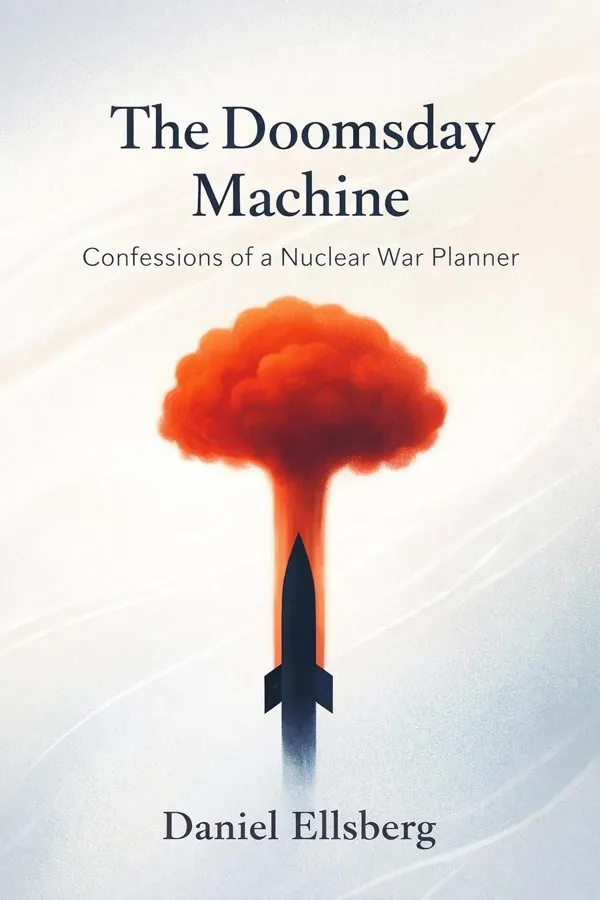
The Doomsday Machine: Confessions of a Nuclear War Planner: Summary & Key Insights
 10 min11 chapters
What Is The Doomsday Machine: Confessions of a Nuclear War Planner About?
The Doomsday Machine: Confessions of a Nuclear War Planner by Daniel Ellsberg is a politics book spanning 11 pages. In this revelatory memoir, Daniel Ellsberg, the whistleblower behind the Pentagon Papers, exposes the inner workings of America’s nuclear war planning during the Cold War. Drawing on his experience as a defense analyst at RAND Corporation and the Pentagon, Ellsberg reveals the terrifying logic and systemic flaws of U.S. nuclear strategy, including the delegation of launch authority and the illusion of control over nuclear weapons. The book combines historical analysis, personal testimony, and moral reflection to warn of the continuing dangers of nuclear deterrence and the existential threat it poses to humanity.
This FizzRead summary covers all 11 key chapters of The Doomsday Machine: Confessions of a Nuclear War Planner in approximately 10 minutes, distilling the most important ideas, arguments, and takeaways from Daniel Ellsberg's work.
The Doomsday Machine: Confessions of a Nuclear War Planner
In this revelatory memoir, Daniel Ellsberg, the whistleblower behind the Pentagon Papers, exposes the inner workings of America’s nuclear war planning during the Cold War. Drawing on his experience as a defense analyst at RAND Corporation and the Pentagon, Ellsberg reveals the terrifying logic and systemic flaws of U.S. nuclear strategy, including the delegation of launch authority and the illusion of control over nuclear weapons. The book combines historical analysis, personal testimony, and moral reflection to warn of the continuing dangers of nuclear deterrence and the existential threat it poses to humanity.
Who Should Read The Doomsday Machine: Confessions of a Nuclear War Planner?
This book is perfect for anyone interested in politics and looking to gain actionable insights in a short read. Whether you're a student, professional, or lifelong learner, the key ideas from The Doomsday Machine: Confessions of a Nuclear War Planner by Daniel Ellsberg will help you think differently.
- ✓Readers who enjoy politics and want practical takeaways
- ✓Professionals looking to apply new ideas to their work and life
- ✓Anyone who wants the core insights of The Doomsday Machine: Confessions of a Nuclear War Planner in just 10 minutes
Want the full summary?
Get instant access to this book summary and 100K+ more with Fizz Moment.
Get Free SummaryAvailable on App Store • Free to download
Key Chapters
When I first joined RAND, it was a temple to systems thinking—a place where men with chalk-stained fingers and pocket calculators sought to translate war into logic, and logic into policy. The task seemed noble. America needed a strategy to survive in a nuclear age. We were convinced that rigorous analysis could make unthinkable destruction manageable.
At RAND I worked under the brightest minds of my generation. We examined targeting plans, survivability probabilities, and second-strike capacities. My job was to evaluate the mechanisms that ensured the president’s ability to respond to a hypothetical Soviet first strike. It sounded purely academic, until I began tracing the chain of command and realized how fragile that chain truly was. The Pentagon, too, was obsessed with control—control of weapons, control of information, control of public perception. Yet behind that façade was chaos. Documents and simulations exposed systems in which entire fleets could launch weapons without presidential approval if communication was disrupted. The tidy models had hidden assumptions; the neat formulas concealed moral black holes.
I had entered believing I was helping to create stability. I was, in fact, studying the architecture of global annihilation.
One of the first great illusions I had to confront was that the President of the United States—and only the President—had the authority to order a nuclear strike. It was a comforting assumption, embedded deeply in the nation’s psyche. But when I investigated actual procedures, I discovered that the system could not function that way. Communication systems might be destroyed or jammed in the first minutes of war. To preserve America’s retaliatory ability, authority had been delegated. Commanders in the field, base officers, even submarine captains held pre-authorized codes to launch if they believed they were under attack and could not reach Washington.
That revelation horrified me. The system had been designed not for absolute control, but for rapid automaticity—a network structured to ensure that retaliation would always occur, even if reason and verification could not. This 'fail-deadly' logic meant that any misinterpretation, any radar malfunction, could end life on Earth. The so-called safeguards were, in fact, mechanisms of guaranteed destruction. I came to understand that deterrence, as practiced, was built not on rational restraint but on institutionalized helplessness.
+ 9 more chapters — available in the FizzRead app
All Chapters in The Doomsday Machine: Confessions of a Nuclear War Planner
About the Author
Daniel Ellsberg (1931–2023) was an American economist, political activist, and former U.S. military analyst. He is best known for releasing the Pentagon Papers in 1971, which exposed U.S. government deception in the Vietnam War. Ellsberg worked at RAND Corporation and the Department of Defense, where he contributed to nuclear war planning. His later career was devoted to anti-war activism, nuclear disarmament advocacy, and government transparency.
Get This Summary in Your Preferred Format
Read or listen to the The Doomsday Machine: Confessions of a Nuclear War Planner summary by Daniel Ellsberg anytime, anywhere. FizzRead offers multiple formats so you can learn on your terms — all free.
Available formats: App · Audio · PDF · EPUB — All included free with FizzRead
Download The Doomsday Machine: Confessions of a Nuclear War Planner PDF and EPUB Summary
Key Quotes from The Doomsday Machine: Confessions of a Nuclear War Planner
“When I first joined RAND, it was a temple to systems thinking—a place where men with chalk-stained fingers and pocket calculators sought to translate war into logic, and logic into policy.”
“One of the first great illusions I had to confront was that the President of the United States—and only the President—had the authority to order a nuclear strike.”
Frequently Asked Questions about The Doomsday Machine: Confessions of a Nuclear War Planner
The Doomsday Machine: Confessions of a Nuclear War Planner by Daniel Ellsberg is a politics book that explores key ideas across 11 chapters. In this revelatory memoir, Daniel Ellsberg, the whistleblower behind the Pentagon Papers, exposes the inner workings of America’s nuclear war planning during the Cold War. Drawing on his experience as a defense analyst at RAND Corporation and the Pentagon, Ellsberg reveals the terrifying logic and systemic flaws of U.S. nuclear strategy, including the delegation of launch authority and the illusion of control over nuclear weapons. The book combines historical analysis, personal testimony, and moral reflection to warn of the continuing dangers of nuclear deterrence and the existential threat it poses to humanity.
You Might Also Like
Antifa: The Anti-Fascist Handbook
Mark Bray
10 min
Attack from Within: How Disinformation Is Sabotaging America
Barbara McQuade
10 min
Coercion, Capital, and European States, AD 990–1992
Charles Tilly
10 min
Digital Democracy: Concepts, Methodologies, Tools, and Applications
Various Authors
10 min
Fascism
Stanley G. Payne
10 min
Fire And Fury: Inside The Trump White House
Michael Wolff
10 minBrowse by Category
Ready to read The Doomsday Machine: Confessions of a Nuclear War Planner?
Get the full summary and 100K+ more books with Fizz Moment.