
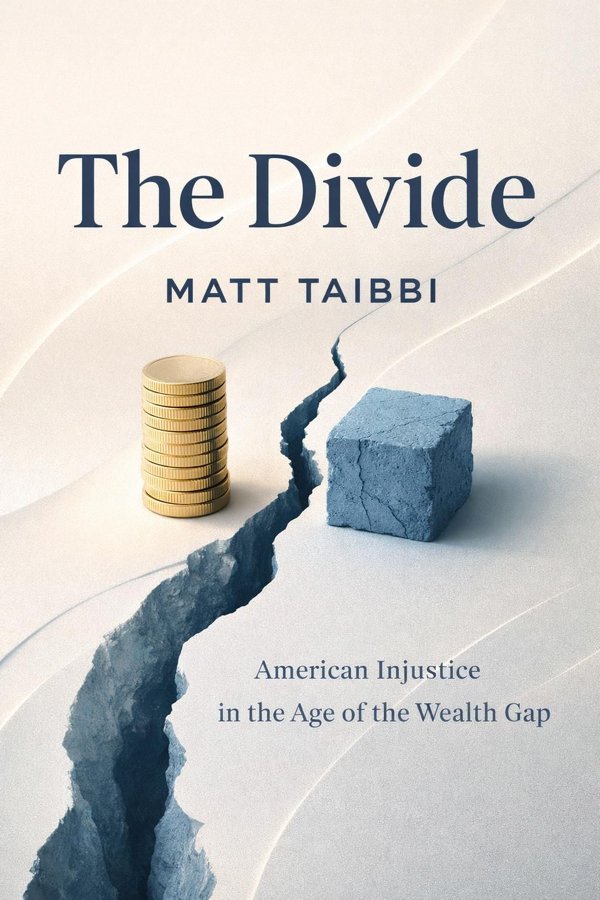
The Divide: American Injustice in the Age of the Wealth Gap: Summary & Key Insights
by Matt Taibbi
 10 min5 chaptersAudio available
What Is The Divide: American Injustice in the Age of the Wealth Gap About?
The Divide: American Injustice in the Age of the Wealth Gap by Matt Taibbi is a politics book spanning 5 pages. In this investigative work, journalist Matt Taibbi explores the growing divide between the rich and the poor in the United States. He examines how the justice system treats financial elites with leniency while punishing the poor with harshness, revealing systemic inequality and corruption. Through detailed reporting and case studies, Taibbi exposes the mechanisms that perpetuate economic and legal injustice.
This FizzRead summary covers all 5 key chapters of The Divide: American Injustice in the Age of the Wealth Gap in approximately 10 minutes, distilling the most important ideas, arguments, and takeaways from Matt Taibbi's work. Also available as an audio summary and Key Quotes Podcast.
The Divide: American Injustice in the Age of the Wealth Gap
In this investigative work, journalist Matt Taibbi explores the growing divide between the rich and the poor in the United States. He examines how the justice system treats financial elites with leniency while punishing the poor with harshness, revealing systemic inequality and corruption. Through detailed reporting and case studies, Taibbi exposes the mechanisms that perpetuate economic and legal injustice.
Who Should Read The Divide: American Injustice in the Age of the Wealth Gap?
This book is perfect for anyone interested in politics and looking to gain actionable insights in a short read. Whether you're a student, professional, or lifelong learner, the key ideas from The Divide: American Injustice in the Age of the Wealth Gap by Matt Taibbi will help you think differently.
- ✓Readers who enjoy politics and want practical takeaways
- ✓Professionals looking to apply new ideas to their work and life
- ✓Anyone who wants the core insights of The Divide: American Injustice in the Age of the Wealth Gap in just 10 minutes
Want the full summary?
Get instant access to this book summary and 100K+ more with Fizz Moment.
Get Free SummaryAvailable on App Store • Free to download
Key Chapters
In the early stages of my research, one truth became unavoidable: America operates not one, but two justice systems. The first belongs to those with resources; it is flexible, negotiable, and ultimately forgiving. The second is reserved for those without power; it is rigid, merciless, and obsessively punitive. Consider how minor infractions — public loitering, missed paperwork, traffic tickets — can cascade into cycles of debt, imprisonment, and surveillance for the poor. Meanwhile, vast corporate crimes — manipulating interest rates, misleading investors, laundering money — end in settlements without admission of guilt. When a poor person steals a sandwich, society sees criminality. When a banker defrauds millions, society sees innovation.
The double standard is legal in form but moral in substance. Prosecutors exercise discretion: they are swamped with petty cases against the poor because these are easy to win. Wealthy defendants, armed with lawyers, stretch cases into endless procedural combat. A rational prosecutor avoids a war he cannot win. Thus, the system becomes one of selective efficiency — crushing the powerless while sidestepping those who can fight back. This isn’t a mere accident; it’s an evolving logic where the justice system itself becomes a mechanism of social sorting.
What I learned was chilling. The appearance of fairness sustains legitimacy, but the machinery below serves class interests. The divide is not an error; it’s a feature.
Nothing illustrates the divide more starkly than the financial crisis of 2008. The collapse destroyed savings, homes, and livelihoods, yet virtually none of its architects faced criminal prosecution. I interviewed regulators, lawyers, and insiders. Each conversation revealed a pattern: complex fraud was tolerated because enforcement agencies feared destabilizing the economy. The rationale was political — too big to fail had become too big to jail.
Banks like HSBC, Citi, and JPMorgan were caught laundering money for drug cartels or committing systematic mortgage fraud. Their punishment? Fines that represented a fraction of annual profits, paid by shareholders rather than executives. When a bank gets caught, the institution absorbs the penalty, and the individuals responsible vanish behind layers of corporate immunity. Compare that to the treatment of a welfare mother who inadvertently fills out an assistance form incorrectly — she faces criminal charges.
Wall Street’s impunity represents more than corruption; it is the transformation of financial crime into a business cost. The law bends upward not because it’s weak, but because it’s complicit. Regulators and politicians rely on finance for campaign money and post-government employment. Enforcement becomes theater — stern press conferences followed by negotiated settlements. The divide here is institutionalized hypocrisy, where risk is privatized upward and punishment downward.
Behind every bailout is a moral decision: to protect wealth from consequence. That decision has reshaped the meaning of justice itself.
+ 3 more chapters — available in the FizzRead app
All Chapters in The Divide: American Injustice in the Age of the Wealth Gap
About the Author
Matt Taibbi is an American author and journalist known for his incisive political and financial reporting. He has written for Rolling Stone and other publications, focusing on corruption, inequality, and media criticism. His works often combine investigative journalism with sharp social commentary.
Get This Summary in Your Preferred Format
Read or listen to the The Divide: American Injustice in the Age of the Wealth Gap summary by Matt Taibbi anytime, anywhere. FizzRead offers multiple formats so you can learn on your terms — all free.
Available formats: App · Audio · PDF · EPUB — All included free with FizzRead
Download The Divide: American Injustice in the Age of the Wealth Gap PDF and EPUB Summary
Key Quotes from The Divide: American Injustice in the Age of the Wealth Gap
“In the early stages of my research, one truth became unavoidable: America operates not one, but two justice systems.”
“Nothing illustrates the divide more starkly than the financial crisis of 2008.”
Frequently Asked Questions about The Divide: American Injustice in the Age of the Wealth Gap
The Divide: American Injustice in the Age of the Wealth Gap by Matt Taibbi is a politics book that explores key ideas across 5 chapters. In this investigative work, journalist Matt Taibbi explores the growing divide between the rich and the poor in the United States. He examines how the justice system treats financial elites with leniency while punishing the poor with harshness, revealing systemic inequality and corruption. Through detailed reporting and case studies, Taibbi exposes the mechanisms that perpetuate economic and legal injustice.
You Might Also Like
Antifa: The Anti-Fascist Handbook
Mark Bray
10 min
Attack from Within: How Disinformation Is Sabotaging America
Barbara McQuade
10 min
Coercion, Capital, and European States, AD 990–1992
Charles Tilly
10 min
Digital Democracy: Concepts, Methodologies, Tools, and Applications
Various Authors
10 min
Fascism
Stanley G. Payne
10 min
Fire And Fury: Inside The Trump White House
Michael Wolff
10 minBrowse by Category
Ready to read The Divide: American Injustice in the Age of the Wealth Gap?
Get the full summary and 100K+ more books with Fizz Moment.