
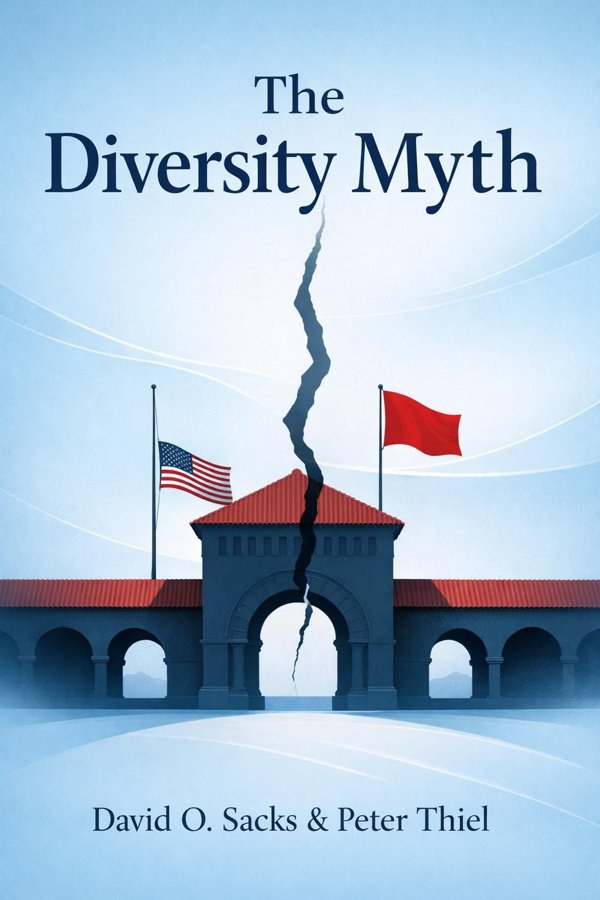
The Diversity Myth: Multiculturalism and the Politics of Intolerance at Stanford: Summary & Key Insights
by David O. Sacks, Peter Thiel
 10 min9 chaptersAudio available
Key Takeaways from The Diversity Myth: Multiculturalism and the Politics of Intolerance at Stanford
Every educational revolution begins by redefining what should no longer be taught.
Campus slogans are often remembered more clearly than committee reports, and at Stanford one chant came to symbolize an era: “Hey hey, ho ho, Western Culture has got to go.
An institution can celebrate difference in theory while punishing it in practice.
The health of a university is revealed not by how loudly it speaks about freedom, but by how it handles offensive or unpopular speech.
Abstract theories become persuasive when readers can see their consequences in concrete episodes.
What Is The Diversity Myth: Multiculturalism and the Politics of Intolerance at Stanford About?
The Diversity Myth: Multiculturalism and the Politics of Intolerance at Stanford by David O. Sacks & Peter Thiel is a politics book spanning 9 pages. The Diversity Myth is a sharp, controversial examination of how a university’s stated commitment to tolerance can evolve into a culture of ideological pressure. Written by David O. Sacks and Peter Thiel, the book focuses on Stanford University in the late 1980s and early 1990s, a period when debates over multiculturalism, curriculum reform, political correctness, and campus speech reached a boiling point. Rather than rejecting diversity as a human good, the authors argue that the institutional version of “diversity” emerging at Stanford often narrowed acceptable opinion, discouraged dissent, and replaced open inquiry with moralized orthodoxy. Their case is built through campus incidents, policy disputes, faculty politics, and the symbolic battle over the Western Civilization requirement. The book matters because it addresses questions that still define higher education today: Who decides what counts as inclusion? Can universities promote social justice without policing thought? And what happens when disagreement itself is treated as harm? Sacks and Thiel write not as distant commentators but as Stanford insiders shaped by the conflicts they describe, giving the book both immediacy and polemical force.
This FizzRead summary covers all 9 key chapters of The Diversity Myth: Multiculturalism and the Politics of Intolerance at Stanford in approximately 10 minutes, distilling the most important ideas, arguments, and takeaways from David O. Sacks & Peter Thiel's work. Also available as an audio summary and Key Quotes Podcast.
The Diversity Myth: Multiculturalism and the Politics of Intolerance at Stanford
The Diversity Myth is a sharp, controversial examination of how a university’s stated commitment to tolerance can evolve into a culture of ideological pressure. Written by David O. Sacks and Peter Thiel, the book focuses on Stanford University in the late 1980s and early 1990s, a period when debates over multiculturalism, curriculum reform, political correctness, and campus speech reached a boiling point. Rather than rejecting diversity as a human good, the authors argue that the institutional version of “diversity” emerging at Stanford often narrowed acceptable opinion, discouraged dissent, and replaced open inquiry with moralized orthodoxy. Their case is built through campus incidents, policy disputes, faculty politics, and the symbolic battle over the Western Civilization requirement. The book matters because it addresses questions that still define higher education today: Who decides what counts as inclusion? Can universities promote social justice without policing thought? And what happens when disagreement itself is treated as harm? Sacks and Thiel write not as distant commentators but as Stanford insiders shaped by the conflicts they describe, giving the book both immediacy and polemical force.
Who Should Read The Diversity Myth: Multiculturalism and the Politics of Intolerance at Stanford?
This book is perfect for anyone interested in politics and looking to gain actionable insights in a short read. Whether you're a student, professional, or lifelong learner, the key ideas from The Diversity Myth: Multiculturalism and the Politics of Intolerance at Stanford by David O. Sacks & Peter Thiel will help you think differently.
- ✓Readers who enjoy politics and want practical takeaways
- ✓Professionals looking to apply new ideas to their work and life
- ✓Anyone who wants the core insights of The Diversity Myth: Multiculturalism and the Politics of Intolerance at Stanford in just 10 minutes
Want the full summary?
Get instant access to this book summary and 100K+ more with Fizz Moment.
Get Free SummaryAvailable on App Store • Free to download
Key Chapters
Every educational revolution begins by redefining what should no longer be taught. Sacks and Thiel argue that to understand Stanford’s embrace of multiculturalism, you first have to understand the role of the Western Civilization requirement it displaced. For years, that core sequence introduced students to major texts, arguments, and traditions that shaped Europe and America. Its defenders saw it not as a celebration of every aspect of the West, but as a common intellectual foundation: a place where students could wrestle with Homer, Plato, Augustine, Shakespeare, Locke, and others in a shared conversation.
The authors contend that critics increasingly treated the requirement as morally suspect because it privileged canonical Western voices. In that reframing, the question shifted from educational coherence to political symbolism. A curriculum was no longer judged mainly by whether it cultivated historical literacy, disciplined reasoning, or familiarity with influential ideas, but by whether it represented identities in the right proportions.
This distinction matters far beyond Stanford. In any institution, once a shared curriculum is interpreted primarily as an instrument of power, intellectual questions become political ones. A business can experience a similar shift when training programs stop asking what employees need to know and start focusing mainly on what messages policies send. The result is often confusion about purpose.
The book does not deny that traditional canons can be expanded or criticized. Its deeper claim is that a university loses something important when it abandons the idea of a common inheritance students should engage, even critically. The practical lesson is simple: when evaluating reforms, ask not only who is newly included, but also what intellectual framework is being lost and whether the replacement truly serves education.
Campus slogans are often remembered more clearly than committee reports, and at Stanford one chant came to symbolize an era: “Hey hey, ho ho, Western Culture has got to go.” Sacks and Thiel treat the controversy over Stanford’s core curriculum as the book’s central turning point because it revealed how educational reform had become a theater for moral struggle. What looked like a debate about reading lists was, in their view, really a debate about legitimacy, authority, and who gets to define culture.
The replacement of the Western Culture requirement with a new course sequence, often described as more inclusive and multicultural, was presented as progress. Supporters argued that the old curriculum excluded non-Western voices, women, and minorities and therefore failed to reflect a pluralistic society. The authors respond that reform did not merely broaden the canon; it subordinated intellectual standards to political activism. Instead of asking which texts best illuminate enduring questions, the institution increasingly asked which identities had been sufficiently represented.
This episode remains relevant because organizations often use symbolic reform to signal virtue while avoiding harder discussions about standards. Consider a school district that redesigns a syllabus for political reasons but offers little guidance on what intellectual skills students should actually gain. Representation may improve on paper, yet coherence may decline in practice.
Sacks and Thiel’s point is not that curricula must remain fixed forever. It is that revision should be governed by educational seriousness rather than by protest pressure or reputational fear. Their actionable takeaway is useful for schools, companies, and civic groups alike: when a core framework is being changed, insist on clear criteria. Ask what the new model teaches better, how success will be measured, and whether dissenting voices are allowed to challenge the reform without being morally discredited.
An institution can celebrate difference in theory while punishing it in practice. One of the book’s most provocative arguments is that Stanford’s version of multiculturalism often produced not intellectual pluralism but ideological conformity. Sacks and Thiel suggest that diversity was increasingly defined less as exposure to many competing viewpoints and more as agreement with a particular moral and political framework about race, gender, culture, and power.
In this framework, some forms of difference counted while others did not. Demographic diversity was elevated, but viewpoint diversity became suspect when it challenged the dominant interpretive lens. Students and faculty could be encouraged to affirm many identities, yet discouraged from questioning the assumptions behind administrative programs, activist narratives, or curricular changes. The paradox, according to the authors, was that a movement publicly dedicated to inclusion became inwardly intolerant of heterodoxy.
This pattern appears whenever ideals become institutional dogma. A company may praise innovation but quietly penalize employees who challenge approved strategies. A nonprofit may celebrate community voices while sidelining any perspective that complicates its preferred moral story. In both cases, the language of openness masks a narrowing of acceptable thought.
The authors do not claim that all multicultural scholarship is empty or authoritarian. Rather, they warn that when a broad concept like diversity is turned into an unquestionable virtue, it becomes difficult to ask what kind of diversity matters most. Their implied answer is that universities should care deeply about intellectual disagreement, because education depends on contestation.
The practical takeaway is to test institutions by their tolerance for dissent. Do they merely display variety, or do they protect argument? If disagreement is consistently interpreted as hostility, then diversity has become performative. Real pluralism requires making room for views that are unpopular, unsettling, or politically inconvenient.
The health of a university is revealed not by how loudly it speaks about freedom, but by how it handles offensive or unpopular speech. Sacks and Thiel devote significant attention to the atmosphere of activism at Stanford, arguing that campus politics increasingly blurred the line between criticism and harm. As a result, speech that challenged prevailing orthodoxies was often treated not as something to answer, but as something to regulate, stigmatize, or suppress.
The authors describe a climate in which student activism did more than advocate causes; it reshaped the moral vocabulary of campus life. Words like “insensitivity,” “harassment,” and “violence” expanded beyond their traditional meanings, allowing controversial expression to be recast as a threat to community well-being. Once that happened, opposition to speech restrictions could be portrayed as indifference to suffering rather than as a defense of liberal principle.
This shift remains familiar today. On social media, in workplaces, and in schools, people often collapse the distinction between disagreement and aggression. That makes institutional restraint difficult. Leaders fear that protecting open debate will be seen as condoning bigotry, while punishing speech wins short-term approval. Yet over time, the cost is a more anxious and less honest culture.
Sacks and Thiel’s concern is not that civility is bad, but that moralized activism can make genuine inquiry impossible. If students learn that some questions cannot be asked without social penalty, they become skilled at self-censorship rather than critical thinking.
The actionable takeaway is to defend procedural clarity. Institutions should distinguish between speech that directly threatens or targets individuals and speech that merely offends, shocks, or dissents. A campus that cannot preserve that distinction may preserve harmony in appearance, but only by sacrificing the intellectual courage education is supposed to build.
Abstract theories become persuasive when readers can see their consequences in concrete episodes. That is why Sacks and Thiel rely heavily on case studies from Stanford life, using controversies over student conduct, campus rhetoric, disciplinary responses, and public shaming to argue that multicultural politics operated through selective enforcement. Their broader claim is that the same standard was not applied equally to everyone; speech or behavior was judged differently depending on who spoke, what cause it served, and whether it aligned with the dominant campus narrative.
The authors present incidents in which conservative, skeptical, or nonconforming views drew intense scrutiny, while inflammatory statements from approved ideological quarters were excused as understandable reactions to oppression. This asymmetry, they argue, created a moral hierarchy. Some groups were treated primarily as vulnerable and therefore granted interpretive charity; others were treated primarily as powerful and therefore presumed guilty or suspect.
Whether one agrees with every example or not, the pattern they identify is important. Institutions often believe they are correcting injustice when they actually replace one bias with another. A manager might enforce civility rules strictly against unpopular employees while overlooking similar conduct from favored performers. A newsroom might demand neutrality from some writers but celebrate activism from others. Such inconsistency quickly destroys trust.
For Sacks and Thiel, the danger lies not only in unfair punishment but in the lesson students absorb: principles are conditional, and rules follow politics. Once that happens, appeals to tolerance lose credibility.
The practical takeaway is to audit institutions for evenhandedness. When controversies arise, ask the same questions regardless of ideology: What happened? What rule applies? Would the response be identical if the political identities were reversed? A culture of fairness depends less on noble mission statements than on equal standards under pressure.
Ideas rarely become institutional power on their own; they need enforcers, interpreters, and protectors. In The Diversity Myth, Sacks and Thiel argue that Stanford’s transformation was driven not just by student activism but by administrators and faculty who legitimized, amplified, and bureaucratized the new moral order. Once official offices, committees, and academic authorities embraced multiculturalism as a governing doctrine, dissent no longer had to be formally banned to be effectively marginalized.
The authors portray university leaders as key actors in redefining campus priorities. Administrators often responded to activist pressure not by defending neutral procedures but by adopting activist language themselves. Faculty members, meanwhile, could frame political commitments as scholarly necessity, making disagreement appear intellectually backward rather than simply contestable. This alliance between bureaucracy and theory gave multicultural politics institutional durability.
The pattern is widely recognizable. In many organizations, cultural shifts become entrenched when middle managers, HR departments, compliance structures, or credentialed experts convert values into policy. What begins as a debate becomes an administrative expectation. Employees or students may still be formally free to object, but everyone understands the reputational risks of doing so.
Sacks and Thiel are especially concerned with how this affects universities, because the academy’s authority rests on its commitment to inquiry. When faculty and administrators become moral gatekeepers rather than facilitators of argument, the university starts behaving less like a forum for truth-seeking and more like a training ground for approved beliefs.
The actionable takeaway is to separate institutional stewardship from ideological supervision. Leaders should protect access, fairness, and safety, but they should hesitate before using administrative power to define contested moral questions. The more an institution centralizes orthodoxy, the less room it leaves for the intellectual experimentation it claims to value.
Campus conflicts are rarely just local accidents; they are usually downstream from larger theories about society and power. Sacks and Thiel argue that the turmoil at Stanford cannot be understood without examining the intellectual assumptions behind multiculturalism. In their telling, the movement drew strength from a set of ideas that viewed knowledge as inseparable from power, Western traditions as inherently oppressive, and neutrality as a disguise for domination. Once these premises took hold, many ordinary academic practices came to seem illegitimate.
If texts are primarily instruments of power, then reading them becomes less about seeking wisdom and more about exposing exclusion. If universal standards are really coded forms of privilege, then merit itself becomes suspect. If language constructs reality in politically loaded ways, then controlling language becomes a moral necessity. The authors see these assumptions as the hidden architecture behind speech codes, curricular revisions, and identity-based politics.
This critique has practical relevance because theoretical ideas often shape institutional behavior long before most people can name them. In a workplace, for example, if leaders adopt the view that all evaluation systems are disguised power plays, performance review will become politicized. In a school, if objectivity is dismissed as domination, teaching may drift from disciplined inquiry into ideological interpretation.
Sacks and Thiel are not simply rejecting theory; they are warning against monoculture. A university should expose students to postmodernism, critical theory, and critiques of the canon, but it should not organize itself around any one framework as if competing traditions have already been refuted.
The actionable takeaway is intellectual self-awareness. When institutions make moral or policy claims, ask which deeper assumptions they rest on. If one theoretical lens is being treated as beyond challenge, pluralism is already in retreat.
Freedom of inquiry is easiest to praise when no one is offended. The real test comes when ideas are unpopular, awkward, or politically inconvenient. A central theme of The Diversity Myth is that academic freedom at Stanford was weakened not only by formal restrictions but by informal pressures: social stigma, administrative signaling, and the growing expectation that responsible members of the community should already know which views were out of bounds.
Sacks and Thiel suggest that this atmosphere changes how students think before it changes what they say. Instead of exploring arguments openly, students learn to anticipate punishment, reputational cost, or moral condemnation. Some become activists; others become silent. In either case, the university’s role as a place of fearless inquiry deteriorates.
This dynamic is not limited to campuses. In many professional settings, employees know there are topics they may discuss only in approved language. They may technically retain freedom of speech, yet self-censorship becomes rational because the social and career risks are obvious. Over time, the institution mistakes this silence for consensus.
The authors insist that academic freedom must include the freedom to be wrong, clumsy, provocative, or deeply unpopular. Otherwise, intellectual life becomes curated performance. That does not mean every opinion is equally sound. It means arguments should be answered through reasoning, evidence, and criticism rather than by procedural or moral exclusion.
The actionable takeaway is to build structures that support dissent in practice: viewpoint-diverse panels, transparent disciplinary rules, faculty who model principled disagreement, and leadership that defends process even under pressure. A university does not protect freedom by celebrating it ceremonially; it protects freedom by refusing to sacrifice it when controversy makes that difficult.
University disputes often look provincial in the moment, yet they frequently preview wider cultural change. Sacks and Thiel present Stanford not merely as one campus with unusual politics, but as an early indicator of a broader transformation in American public life. The struggles over curriculum, identity, speech, and institutional loyalty that unfolded there would later reappear in media, corporations, schools, and national politics.
Their larger warning is that once identity-based moral categories become the dominant way of interpreting institutions, conflict intensifies rather than disappears. Every policy becomes a symbolic statement. Every disagreement becomes evidence of hidden prejudice. Every effort at neutrality is reinterpreted as complicity. In that environment, tolerance becomes less a habit of coexistence than a badge used selectively against opponents.
Seen this way, the book helps explain why debates that begin inside educational institutions often spread outward. Universities train future journalists, teachers, executives, lawyers, and policymakers. When they normalize the idea that protecting inclusion requires managing thought, those assumptions travel. A company’s communication standards, a newsroom’s editorial norms, or a nonprofit’s hiring practices may all reflect habits first established in academic culture.
Even readers who reject the authors’ politics can still appreciate the foresight of the question they raise: can a society remain free if it confuses moral seriousness with ideological uniformity? That question has only grown more urgent.
The actionable takeaway is to treat campus controversies as civic laboratories. Instead of dismissing them as youthful excess, examine what governance style they are rehearsing. If institutions increasingly reward conformity, moral simplification, and selective tolerance, the consequences will not remain confined to universities. They will shape the broader culture that graduates go on to lead.
All Chapters in The Diversity Myth: Multiculturalism and the Politics of Intolerance at Stanford
About the Authors
David O. Sacks and Peter Thiel are American entrepreneurs, investors, and authors whose careers later became closely associated with Silicon Valley. Both studied at Stanford University, where their experience during a turbulent period of campus politics helped shape The Diversity Myth. Sacks went on to become a technology executive, founder, and investor known for leadership roles in software, media, and venture capital. Thiel became one of the most influential figures in technology and finance as a co-founder of PayPal, an early investor in Facebook, and a major venture capitalist. Although they are best known today for business and political commentary, this book reflects their early interest in questions of culture, power, institutions, and intellectual freedom.
Get This Summary in Your Preferred Format
Read or listen to the The Diversity Myth: Multiculturalism and the Politics of Intolerance at Stanford summary by David O. Sacks & Peter Thiel anytime, anywhere. FizzRead offers multiple formats so you can learn on your terms — all free.
Available formats: App · Audio · PDF · EPUB — All included free with FizzRead
Download The Diversity Myth: Multiculturalism and the Politics of Intolerance at Stanford PDF and EPUB Summary
Key Quotes from The Diversity Myth: Multiculturalism and the Politics of Intolerance at Stanford
“Every educational revolution begins by redefining what should no longer be taught.”
“Campus slogans are often remembered more clearly than committee reports, and at Stanford one chant came to symbolize an era: “Hey hey, ho ho, Western Culture has got to go.”
“An institution can celebrate difference in theory while punishing it in practice.”
“The health of a university is revealed not by how loudly it speaks about freedom, but by how it handles offensive or unpopular speech.”
“Abstract theories become persuasive when readers can see their consequences in concrete episodes.”
Frequently Asked Questions about The Diversity Myth: Multiculturalism and the Politics of Intolerance at Stanford
The Diversity Myth: Multiculturalism and the Politics of Intolerance at Stanford by David O. Sacks & Peter Thiel is a politics book that explores key ideas across 9 chapters. The Diversity Myth is a sharp, controversial examination of how a university’s stated commitment to tolerance can evolve into a culture of ideological pressure. Written by David O. Sacks and Peter Thiel, the book focuses on Stanford University in the late 1980s and early 1990s, a period when debates over multiculturalism, curriculum reform, political correctness, and campus speech reached a boiling point. Rather than rejecting diversity as a human good, the authors argue that the institutional version of “diversity” emerging at Stanford often narrowed acceptable opinion, discouraged dissent, and replaced open inquiry with moralized orthodoxy. Their case is built through campus incidents, policy disputes, faculty politics, and the symbolic battle over the Western Civilization requirement. The book matters because it addresses questions that still define higher education today: Who decides what counts as inclusion? Can universities promote social justice without policing thought? And what happens when disagreement itself is treated as harm? Sacks and Thiel write not as distant commentators but as Stanford insiders shaped by the conflicts they describe, giving the book both immediacy and polemical force.
You Might Also Like
Antifa: The Anti-Fascist Handbook
Mark Bray
10 min
Attack from Within: How Disinformation Is Sabotaging America
Barbara McQuade
10 min
Coercion, Capital, and European States, AD 990–1992
Charles Tilly
10 min
Digital Democracy: Concepts, Methodologies, Tools, and Applications
Various Authors
10 min
Fascism
Stanley G. Payne
10 min
Fire And Fury: Inside The Trump White House
Michael Wolff
10 minBrowse by Category
Ready to read The Diversity Myth: Multiculturalism and the Politics of Intolerance at Stanford?
Get the full summary and 100K+ more books with Fizz Moment.