
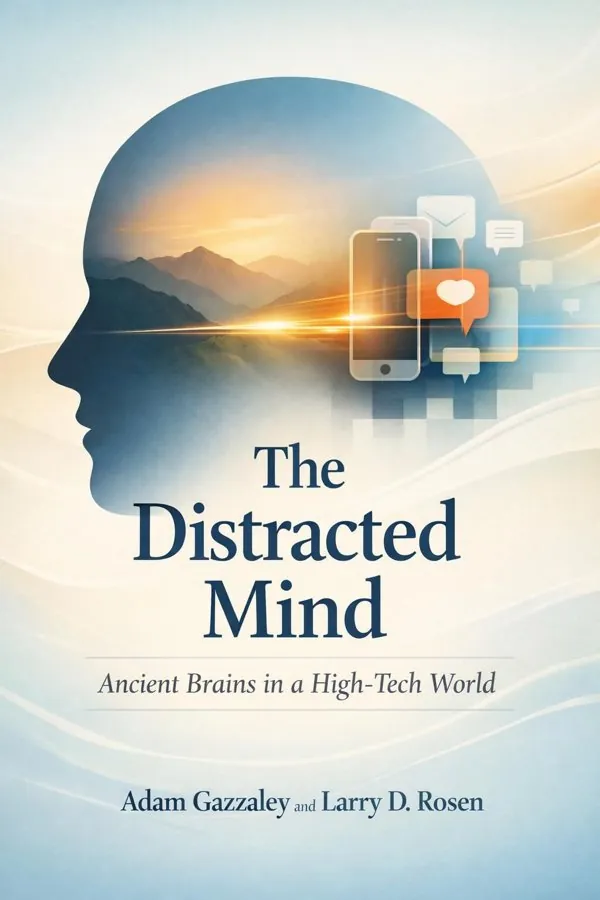
The Distracted Mind: Ancient Brains in a High-Tech World: Summary & Key Insights
by Adam Gazzaley, Larry D. Rosen
 10 min10 chaptersAudio available
Key Takeaways from The Distracted Mind: Ancient Brains in a High-Tech World
The modern attention crisis begins with an uncomfortable truth: our brains are extraordinary, but they were not designed for the digital environments we now inhabit.
We like to imagine that the mind is a strong executive, calmly directing thoughts and actions.
One of the book’s most useful distinctions is that not all attentional failures are identical.
Digital tools promise efficiency, but they often generate a hidden tax on attention.
The idea that skilled people can efficiently multitask is one of modern life’s most persistent myths.
What Is The Distracted Mind: Ancient Brains in a High-Tech World About?
The Distracted Mind: Ancient Brains in a High-Tech World by Adam Gazzaley, Larry D. Rosen is a neuroscience book spanning 10 pages. Why do smart, motivated people so often feel mentally scattered, overwhelmed, and unable to focus? In The Distracted Mind, neuroscientist Adam Gazzaley and psychologist Larry D. Rosen argue that the problem is not simply weak willpower or bad habits. It is a mismatch between an ancient brain and a radically modern environment. Our minds evolved to respond to novelty, social cues, and immediate threats, but today those same tendencies are constantly exploited by emails, alerts, social media, and endless streams of information. Drawing on neuroscience, psychology, and behavioral research, the authors explain how attention, working memory, and goal management actually function—and why they break down under digital pressure. They show that distraction is not a personal flaw but a predictable consequence of cognitive limitations meeting persuasive technology. At the same time, the book is not anti-tech. Gazzaley and Rosen examine how technology can worsen interference, but also how it can be redesigned to support focus, learning, and mental resilience. For anyone struggling to concentrate in a hyperconnected world, this book offers a deeply informed and practical guide to understanding the distracted mind and reclaiming control over it.
This FizzRead summary covers all 10 key chapters of The Distracted Mind: Ancient Brains in a High-Tech World in approximately 10 minutes, distilling the most important ideas, arguments, and takeaways from Adam Gazzaley, Larry D. Rosen's work. Also available as an audio summary and Key Quotes Podcast.
The Distracted Mind: Ancient Brains in a High-Tech World
Why do smart, motivated people so often feel mentally scattered, overwhelmed, and unable to focus? In The Distracted Mind, neuroscientist Adam Gazzaley and psychologist Larry D. Rosen argue that the problem is not simply weak willpower or bad habits. It is a mismatch between an ancient brain and a radically modern environment. Our minds evolved to respond to novelty, social cues, and immediate threats, but today those same tendencies are constantly exploited by emails, alerts, social media, and endless streams of information.
Drawing on neuroscience, psychology, and behavioral research, the authors explain how attention, working memory, and goal management actually function—and why they break down under digital pressure. They show that distraction is not a personal flaw but a predictable consequence of cognitive limitations meeting persuasive technology. At the same time, the book is not anti-tech. Gazzaley and Rosen examine how technology can worsen interference, but also how it can be redesigned to support focus, learning, and mental resilience. For anyone struggling to concentrate in a hyperconnected world, this book offers a deeply informed and practical guide to understanding the distracted mind and reclaiming control over it.
Who Should Read The Distracted Mind: Ancient Brains in a High-Tech World?
This book is perfect for anyone interested in neuroscience and looking to gain actionable insights in a short read. Whether you're a student, professional, or lifelong learner, the key ideas from The Distracted Mind: Ancient Brains in a High-Tech World by Adam Gazzaley, Larry D. Rosen will help you think differently.
- ✓Readers who enjoy neuroscience and want practical takeaways
- ✓Professionals looking to apply new ideas to their work and life
- ✓Anyone who wants the core insights of The Distracted Mind: Ancient Brains in a High-Tech World in just 10 minutes
Want the full summary?
Get instant access to this book summary and 100K+ more with Fizz Moment.
Get Free SummaryAvailable on App Store • Free to download
Key Chapters
The modern attention crisis begins with an uncomfortable truth: our brains are extraordinary, but they were not designed for the digital environments we now inhabit. Human cognitive systems evolved in settings where information was limited, threats were concrete, and social signals came from nearby people rather than from thousands of notifications. In that older world, being sensitive to novelty was adaptive. Quickly shifting attention to a movement in the bushes, a new face, or a sudden sound could help us survive.
Today, that same sensitivity is constantly triggered by devices and platforms engineered to capture us. The brain’s orientation toward novelty, reward, and social relevance makes it especially vulnerable to buzzing phones, unread message counts, breaking news banners, and algorithmically personalized feeds. We often interpret this as a failure of discipline, but Gazzaley and Rosen argue that it is better understood as evolutionary mismatch. Our neural systems are operating in conditions they never evolved to handle.
This perspective matters because it replaces self-blame with insight. If your mind jumps toward distraction, it is not because you are uniquely lazy or weak. It is because your attentional machinery is doing what it was shaped to do—responding to signals that seem important. The problem is that in a high-tech world, too many signals compete for priority at once.
A practical application is to redesign your environment instead of relying on raw willpower. Turn off nonessential alerts, keep your phone out of sight during deep work, and create periods where novelty cannot constantly interrupt you. Actionable takeaway: treat distraction as an environmental design problem, not just a character flaw.
We like to imagine that the mind is a strong executive, calmly directing thoughts and actions. In reality, cognitive control is powerful but limited. This system, heavily involving the prefrontal cortex and related networks, helps us maintain goals, resist impulses, prioritize relevant information, and coordinate behavior across time. It is what allows you to ignore irrelevant chatter while writing a report or remember your purpose when opening a browser.
But cognitive control is not infinite. It weakens under stress, fatigue, emotional strain, sleep deprivation, and overload. It also varies across individuals and changes across the lifespan, often becoming less efficient in older age and still developing in younger people. The authors emphasize that many failures of attention are not mysterious. They happen when the demands placed on control systems exceed their available resources.
One reason modern life is so mentally taxing is that it requires constant self-regulation. We must suppress impulses to check devices, filter irrelevant stimuli, remember multiple commitments, and return to tasks after interruption. Every one of those actions draws on cognitive control. If the day is filled with competing goals and fragmented attention, control systems become strained.
In practical terms, this means productivity should be built around cognitive reality. Schedule demanding work for periods of peak alertness, reduce unnecessary task switching, and avoid assuming that motivation alone can override mental fatigue. Students can study in distraction-free blocks rather than while messaging friends. Managers can protect teams from meeting overload. Actionable takeaway: respect cognitive control as a limited resource and structure your day to conserve it for what matters most.
One of the book’s most useful distinctions is that not all attentional failures are identical. Distraction typically refers to irrelevant information pulling attention away from a current goal, while interruption often involves a break that forces you to suspend one task and switch to another. Add multitasking into the mix—trying to manage multiple goals in rapid succession—and the result is a world full of interference.
This distinction matters because the brain pays different costs in different situations. If you are writing and a social media notification appears, that is distraction. If your boss calls and you must stop writing to answer an urgent question, that is interruption. In both cases, your primary task suffers, but interruption often adds an extra burden: you must later reconstruct where you were, what you intended next, and what mental context you had built.
The authors show that modern technology dramatically increases both forms of interference. Even when we do not respond to a buzz or banner, part of the mind may still orient toward it. Likewise, self-interruption—such as checking a message during a difficult task—breaks continuity and increases the time needed to regain focus. This explains why people can feel busy all day yet accomplish far less than expected.
The practical lesson is to diagnose the source of lost focus more precisely. If distraction is the issue, reduce visual and auditory triggers. If interruption is the issue, create protected blocks of work and communicate clear boundaries. For example, use email windows at fixed times instead of constant monitoring. Actionable takeaway: identify whether your problem is distraction, interruption, or both, then design specific defenses for each.
Digital tools promise efficiency, but they often generate a hidden tax on attention. Smartphones, laptops, messaging platforms, and social media channels collapse many streams of information into a single always-available interface. Work, entertainment, relationships, news, shopping, and self-presentation now compete in the same mental space. The result is cognitive overload: more inputs than the brain can meaningfully prioritize, process, and integrate.
Gazzaley and Rosen argue that overload is not just about volume. It is also about the expectation of immediacy. Many people feel pressure to respond quickly, keep up constantly, and remain available across contexts. A person may be physically present in a meeting, mentally tracking email, emotionally reacting to a text thread, and vaguely aware of online updates—all while trying to think clearly. This fragmented state reduces depth, increases stress, and erodes satisfaction.
The problem is compounded by the persuasive design of technology. Interfaces are built to maximize engagement through novelty, variable rewards, and social feedback loops. Every refresh holds the possibility of something new, important, or rewarding. That uncertainty keeps us checking, often without conscious intention.
A practical response is to shift from reactive use to intentional use. Instead of letting technology dictate the rhythm of your attention, assign tools to specific purposes. Use one app for communication, another for focused creation, and separate times for consumption versus production. Families can create device-free meals; teams can establish communication norms that reduce urgency. Actionable takeaway: use technology by design rather than by default, limiting information streams to what serves your goals.
The idea that skilled people can efficiently multitask is one of modern life’s most persistent myths. In most cognitively demanding situations, what we call multitasking is actually task switching: moving attention back and forth between activities. The brain does not seamlessly process multiple high-level tasks at once. Instead, it reallocates resources, and each switch carries a cost.
Those costs include slower performance, more errors, weaker memory, and reduced comprehension. When you alternate between writing a proposal and checking messages, your mind must unload one goal set, load another, and then reconstruct the first when returning. This reconstruction takes time and energy, even if each switch feels brief. Frequent switching can create the illusion of productivity because you are active and responsive, but output quality often declines.
The authors also note that heavy media multitasking may train the mind toward broader but shallower attentional habits. People who constantly juggle media streams may become more vulnerable to irrelevant stimuli and less able to sustain focus. This is especially concerning in educational settings, where students often assume they can learn while texting, browsing, and listening to lectures simultaneously.
In practical terms, matching tasks to attentional demands is essential. Some low-complexity activities can coexist, like folding laundry while listening to a familiar podcast. But anything requiring analysis, writing, learning, or decision-making deserves focused attention. Professionals can batch communications; students can keep only one study tab open. Actionable takeaway: stop aiming to multitask on important work and instead practice single-tasking in clearly defined focus intervals.
Distraction is not merely annoying; it has measurable consequences for how we think, feel, and live. The book shows that chronic interference undermines productivity, learning, memory, and emotional health. When attention is repeatedly fragmented, comprehension becomes shallower, mistakes increase, and creative thinking suffers because the mind lacks uninterrupted time to build complex ideas.
But the damage extends beyond performance. Constant connectivity can create a baseline state of tension. Many people feel compelled to monitor devices even during rest, meals, conversations, or leisure. This state of partial attention weakens presence and can make recovery more difficult. Instead of helping us feel informed and connected, it may leave us mentally exhausted and socially diluted.
Relationships also suffer when distraction becomes normalized. A parent checking email during playtime, a friend glancing at messages during dinner, or a partner scrolling while listening all send subtle signals about divided priorities. Over time, these micro-fractures in attention can erode trust, empathy, and satisfaction.
There are broader implications too. In classrooms, distraction reduces learning quality. In workplaces, it lowers effectiveness and increases stress. In public safety contexts, such as driving, attentional interference can become dangerous. The cumulative cost of distraction is therefore personal, professional, and social.
A practical application is to define zones of full presence. For example, no phones during important conversations, no messaging while driving, and no passive screen checking during family routines. Build rituals that protect undivided attention where it matters most. Actionable takeaway: treat attention as a core ingredient of performance and human connection, and protect it in your most important roles.
A hopeful message at the center of The Distracted Mind is that cognitive limitations are real, but they are not the end of the story. The brain is plastic. Attention, working memory, and control can be strengthened, supported, and sometimes restored through deliberate practice, better habits, and targeted interventions. The goal is not perfection; it is resilience.
The authors discuss a range of adaptive strategies, including mindfulness, exercise, sleep, stress reduction, and structured focus practices. Mindfulness helps people notice when attention has drifted and gently return it to the present task, which directly trains meta-awareness and control. Physical exercise supports brain health broadly, including executive functions. Sleep enhances memory consolidation and improves the ability to regulate attention. Even small changes in these areas can significantly affect daily performance.
Behavioral strategies are equally important. People can use implementation intentions, such as deciding in advance when they will check email. They can break large projects into smaller milestones, reducing the urge to escape into distraction when work feels overwhelming. They can also create recovery periods between mentally demanding activities, giving the brain time to reset.
Importantly, resilience does not mean becoming immune to interference. It means developing systems that make focus more likely and recovery faster when lapses occur. A student might use 30-minute distraction-free study sprints followed by short breaks. A writer might start each session by defining a single target outcome. Actionable takeaway: build cognitive resilience through sleep, exercise, mindfulness, and simple routines that repeatedly bring your mind back to the task at hand.
It is easy to assume that if technology helps create distraction, the answer must be to reject it. Gazzaley and Rosen take a more nuanced view. The same tools that overload attention can also be redesigned to support cognition. Technology is not inherently harmful; its impact depends on how it is built and used.
The authors are especially interested in digital interventions grounded in neuroscience. This includes software and game-like training tools that aim to improve attention, working memory, and cognitive flexibility. When carefully designed and scientifically tested, such tools may help people strengthen specific mental capacities or compensate for weaknesses. More broadly, apps can support better habits by blocking distracting websites, scheduling focus time, guiding meditation, or prompting intentional breaks.
This perspective shifts the conversation from simplistic screen pessimism to design ethics and evidence-based innovation. Rather than asking whether technology is good or bad, we should ask what goals it serves. Does it exploit attentional vulnerabilities for engagement, or does it help users align behavior with their priorities? Does it fragment the day, or structure it more intelligently?
Practical applications are straightforward. Use focus modes that silence irrelevant alerts. Choose tools that encourage completion rather than endless scrolling. Organizations can invest in communication systems that reduce noise instead of increasing it. Parents can introduce children to technologies that create, teach, or train rather than merely consume attention. Actionable takeaway: select and support technologies that respect your cognitive limits and actively help you protect focus.
A distracted mind is not only an individual problem; it is also shaped by social norms and institutional expectations. Many environments reward immediate responsiveness, constant availability, and visible busyness. In such settings, even people who understand the costs of distraction may feel unable to resist it. If everyone expects an instant reply, the burden of attention protection becomes much harder to carry alone.
The authors suggest that solutions therefore need to extend beyond personal discipline. Families, schools, and workplaces all create attentional cultures. A classroom that permits unrestricted device use during learning sends one message; a classroom that structures technology intentionally sends another. A company that floods employees with after-hours messages normalizes fragmentation. A company that defines response windows and protects deep work encourages sustained thinking.
Children and adolescents are especially affected by these cultural patterns because their control systems are still developing. They need guidance not only in limiting distraction but in learning what focused engagement feels like. Adults need the same reminder. Attention thrives when communities make it easier to be present.
Examples include family charging stations outside bedrooms, meeting policies that reduce multitasking, school discussions about media habits, and leadership practices that value thoughtful work over immediate reaction. The broader point is that attention is not solely private property. It is shaped by the rules, incentives, and values around us.
Actionable takeaway: create shared norms at home, school, or work that make focus socially supported rather than individually heroic.
Perhaps the book’s deepest insight is that attention is one of the most valuable resources we possess because it shapes experience itself. What we attend to influences what we learn, remember, feel, and become. In a world built to compete for that resource, protecting attention is not a narrow productivity tactic; it is a way of defending agency.
The distracted mind often feels as if it is living reactively. One cue triggers another, and the day fills with responses rather than intentions. Reclaiming focus means becoming more deliberate about what deserves entry into consciousness. That does not require abandoning technology or striving for monk-like concentration. It requires noticing the forces acting on your mind and making choices that align with your values.
This can be surprisingly concrete. Ask before opening a device: why am I using it right now? Before switching tasks, ask whether the new demand is truly more important. Before accepting permanent partial attention as normal, ask what kind of life and work it produces. These questions restore a sense of authorship over mental life.
The authors encourage readers to combine self-knowledge with practical structure. Understand your vulnerabilities, identify your highest-value tasks, and build routines that protect them. If your best thinking happens in the morning, defend that time. If social media derails your mood, limit exposure. If boredom triggers checking, learn to tolerate small stretches of mental quiet.
Actionable takeaway: begin each day by choosing one task, one relationship, and one period of time that will receive your full, undivided attention.
All Chapters in The Distracted Mind: Ancient Brains in a High-Tech World
About the Authors
Adam Gazzaley is a neuroscientist, physician, and professor at the University of California, San Francisco, where he has become widely known for his research on attention, memory, aging, and cognitive control. His work often examines how modern technology affects the brain and how digital tools can be designed to improve mental function. Larry D. Rosen is a psychologist and professor emeritus at California State University, Dominguez Hills, recognized for his expertise in the psychology of technology, media use, and digital behavior. Together, Gazzaley and Rosen combine neuroscience and psychology to explain why distraction has become such a defining challenge of contemporary life, and how people can respond more intelligently to it.
Get This Summary in Your Preferred Format
Read or listen to the The Distracted Mind: Ancient Brains in a High-Tech World summary by Adam Gazzaley, Larry D. Rosen anytime, anywhere. FizzRead offers multiple formats so you can learn on your terms — all free.
Available formats: App · Audio · PDF · EPUB — All included free with FizzRead
Download The Distracted Mind: Ancient Brains in a High-Tech World PDF and EPUB Summary
Key Quotes from The Distracted Mind: Ancient Brains in a High-Tech World
“The modern attention crisis begins with an uncomfortable truth: our brains are extraordinary, but they were not designed for the digital environments we now inhabit.”
“We like to imagine that the mind is a strong executive, calmly directing thoughts and actions.”
“One of the book’s most useful distinctions is that not all attentional failures are identical.”
“Digital tools promise efficiency, but they often generate a hidden tax on attention.”
“The idea that skilled people can efficiently multitask is one of modern life’s most persistent myths.”
Frequently Asked Questions about The Distracted Mind: Ancient Brains in a High-Tech World
The Distracted Mind: Ancient Brains in a High-Tech World by Adam Gazzaley, Larry D. Rosen is a neuroscience book that explores key ideas across 10 chapters. Why do smart, motivated people so often feel mentally scattered, overwhelmed, and unable to focus? In The Distracted Mind, neuroscientist Adam Gazzaley and psychologist Larry D. Rosen argue that the problem is not simply weak willpower or bad habits. It is a mismatch between an ancient brain and a radically modern environment. Our minds evolved to respond to novelty, social cues, and immediate threats, but today those same tendencies are constantly exploited by emails, alerts, social media, and endless streams of information. Drawing on neuroscience, psychology, and behavioral research, the authors explain how attention, working memory, and goal management actually function—and why they break down under digital pressure. They show that distraction is not a personal flaw but a predictable consequence of cognitive limitations meeting persuasive technology. At the same time, the book is not anti-tech. Gazzaley and Rosen examine how technology can worsen interference, but also how it can be redesigned to support focus, learning, and mental resilience. For anyone struggling to concentrate in a hyperconnected world, this book offers a deeply informed and practical guide to understanding the distracted mind and reclaiming control over it.
You Might Also Like

Anxious
Joseph LeDoux
10 min
Hallucinations
Oliver Sacks
10 min
The Biological Mind: How Brain, Body, and Environment Collaborate to Make Us Who We Are
Alan Jasanoff
10 min
The Feeling of Life Itself: Why Consciousness Is Widespread but Can't Be Computed
Christof Koch
10 min
The No-Nonsense Meditation Book
Steven Laureys
10 min
A General Theory of Love
Thomas Lewis, Fari Amini, Richard Lannon
10 minBrowse by Category
Ready to read The Distracted Mind: Ancient Brains in a High-Tech World?
Get the full summary and 100K+ more books with Fizz Moment.