
Adam Gazzaley Books
Adam Gazzaley is a neuroscientist and professor at the University of California, San Francisco, known for his research on attention and cognitive control.
Known for: The Distracted Mind: Ancient Brains in a High-Tech World
Books by Adam Gazzaley
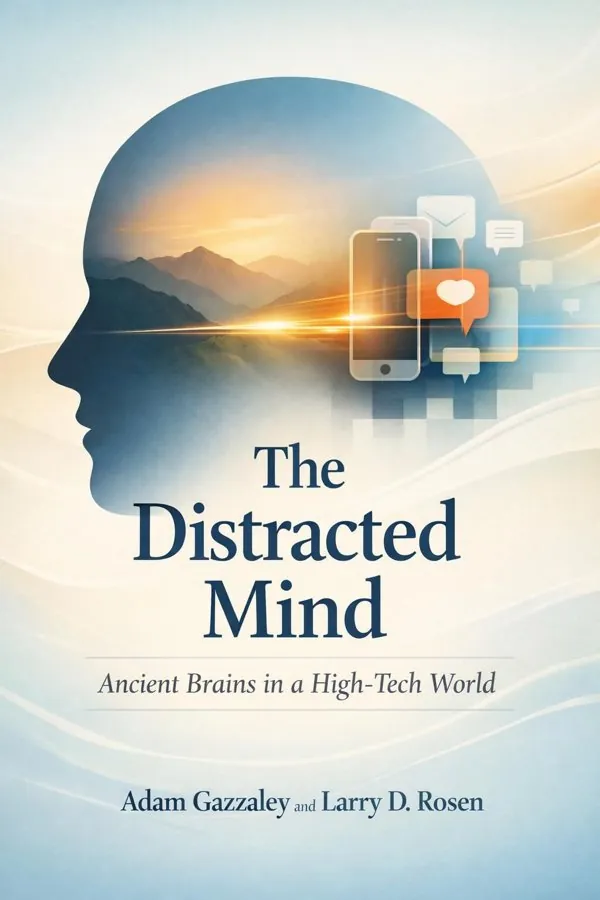
The Distracted Mind: Ancient Brains in a High-Tech World
Why do smart, motivated people so often feel mentally scattered, overwhelmed, and unable to focus? In The Distracted Mind, neuroscientist Adam Gazzaley and psychologist Larry D. Rosen argue that the problem is not simply weak willpower or bad habits. It is a mismatch between an ancient brain and a radically modern environment. Our minds evolved to respond to novelty, social cues, and immediate threats, but today those same tendencies are constantly exploited by emails, alerts, social media, and endless streams of information. Drawing on neuroscience, psychology, and behavioral research, the authors explain how attention, working memory, and goal management actually function—and why they break down under digital pressure. They show that distraction is not a personal flaw but a predictable consequence of cognitive limitations meeting persuasive technology. At the same time, the book is not anti-tech. Gazzaley and Rosen examine how technology can worsen interference, but also how it can be redesigned to support focus, learning, and mental resilience. For anyone struggling to concentrate in a hyperconnected world, this book offers a deeply informed and practical guide to understanding the distracted mind and reclaiming control over it.
Read SummaryKey Insights from Adam Gazzaley
Our brains were not built for this
The modern attention crisis begins with an uncomfortable truth: our brains are extraordinary, but they were not designed for the digital environments we now inhabit. Human cognitive systems evolved in settings where information was limited, threats were concrete, and social signals came from nearby ...
From The Distracted Mind: Ancient Brains in a High-Tech World
Cognitive control has strict limits
We like to imagine that the mind is a strong executive, calmly directing thoughts and actions. In reality, cognitive control is powerful but limited. This system, heavily involving the prefrontal cortex and related networks, helps us maintain goals, resist impulses, prioritize relevant information, ...
From The Distracted Mind: Ancient Brains in a High-Tech World
Distraction and interruption are not the same
One of the book’s most useful distinctions is that not all attentional failures are identical. Distraction typically refers to irrelevant information pulling attention away from a current goal, while interruption often involves a break that forces you to suspend one task and switch to another. Add m...
From The Distracted Mind: Ancient Brains in a High-Tech World
Technology amplifies cognitive overload
Digital tools promise efficiency, but they often generate a hidden tax on attention. Smartphones, laptops, messaging platforms, and social media channels collapse many streams of information into a single always-available interface. Work, entertainment, relationships, news, shopping, and self-presen...
From The Distracted Mind: Ancient Brains in a High-Tech World
Multitasking is mostly rapid switching
The idea that skilled people can efficiently multitask is one of modern life’s most persistent myths. In most cognitively demanding situations, what we call multitasking is actually task switching: moving attention back and forth between activities. The brain does not seamlessly process multiple hig...
From The Distracted Mind: Ancient Brains in a High-Tech World
Interference damages performance and well-being
Distraction is not merely annoying; it has measurable consequences for how we think, feel, and live. The book shows that chronic interference undermines productivity, learning, memory, and emotional health. When attention is repeatedly fragmented, comprehension becomes shallower, mistakes increase, ...
From The Distracted Mind: Ancient Brains in a High-Tech World
About Adam Gazzaley
Adam Gazzaley is a neuroscientist and professor at the University of California, San Francisco, known for his research on attention and cognitive control.


Frequently Asked Questions
Adam Gazzaley is a neuroscientist and professor at the University of California, San Francisco, known for his research on attention and cognitive control.
Read Adam Gazzaley's books in 15 minutes
Get AI-powered summaries with key insights from 1 book by Adam Gazzaley.