
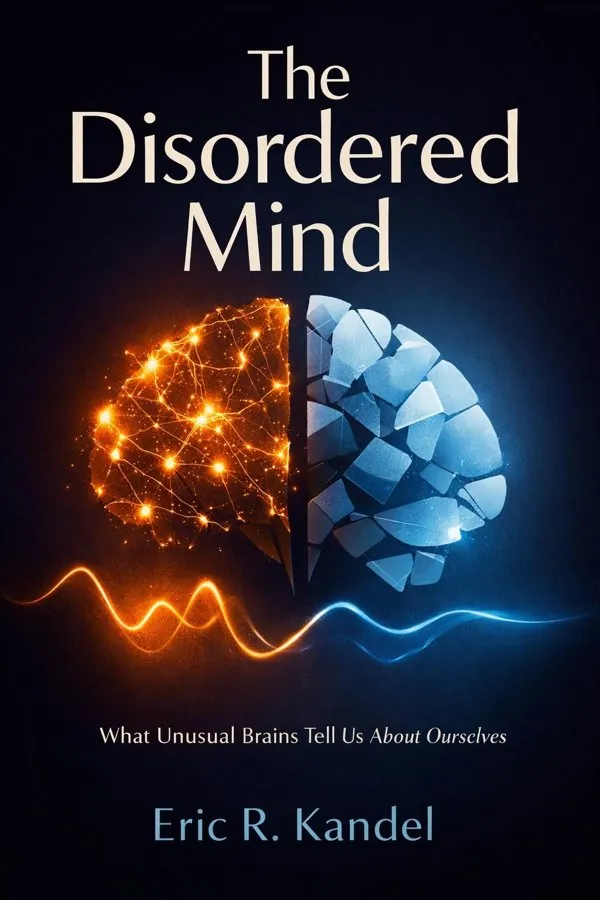
The Disordered Mind: What Unusual Brains Tell Us About Ourselves: Summary & Key Insights
 10 min9 chaptersAudio available
Key Takeaways from The Disordered Mind: What Unusual Brains Tell Us About Ourselves
The most intimate parts of human life—thought, feeling, imagination, and memory—are not separate from biology but expressions of it.
We often notice the social mind most clearly when it struggles to connect.
Depression is not simply sadness; it is a disorder that can alter how a person experiences time, motivation, memory, and even the value of being alive.
Reality feels seamless—until the brain systems that construct it begin to fail.
We tend to think of memory as a storage system, but dementia shows it is much more: memory is the thread that gives continuity to identity.
What Is The Disordered Mind: What Unusual Brains Tell Us About Ourselves About?
The Disordered Mind: What Unusual Brains Tell Us About Ourselves by Eric R. Kandel is a neuroscience book spanning 9 pages. What can mental illness teach us about the healthy mind? In The Disordered Mind, Nobel Prize-winning neuroscientist Eric R. Kandel argues that brain disorders are not only medical problems to diagnose and treat; they are also powerful windows into how the human mind works. By examining conditions such as autism, depression, schizophrenia, addiction, post-traumatic stress, and dementia, Kandel shows that perception, memory, emotion, creativity, and even the sense of self arise from biological processes in the brain. What makes this book especially valuable is Kandel’s ability to connect cutting-edge neuroscience with deep human questions. He explains how genes, neural circuits, life experiences, and social environments interact to shape both ordinary mental life and psychological suffering. Rather than treating psychiatry and neurology as separate worlds, he brings them together into a unified view of mind and brain. Kandel writes with unusual authority. As a Columbia University professor and recipient of the 2000 Nobel Prize for his pioneering research on memory, he has spent decades helping define modern neuroscience. This book distills that knowledge into an accessible, intellectually rich exploration of what unusual brains reveal about all of us.
This FizzRead summary covers all 9 key chapters of The Disordered Mind: What Unusual Brains Tell Us About Ourselves in approximately 10 minutes, distilling the most important ideas, arguments, and takeaways from Eric R. Kandel's work. Also available as an audio summary and Key Quotes Podcast.
The Disordered Mind: What Unusual Brains Tell Us About Ourselves
What can mental illness teach us about the healthy mind? In The Disordered Mind, Nobel Prize-winning neuroscientist Eric R. Kandel argues that brain disorders are not only medical problems to diagnose and treat; they are also powerful windows into how the human mind works. By examining conditions such as autism, depression, schizophrenia, addiction, post-traumatic stress, and dementia, Kandel shows that perception, memory, emotion, creativity, and even the sense of self arise from biological processes in the brain.
What makes this book especially valuable is Kandel’s ability to connect cutting-edge neuroscience with deep human questions. He explains how genes, neural circuits, life experiences, and social environments interact to shape both ordinary mental life and psychological suffering. Rather than treating psychiatry and neurology as separate worlds, he brings them together into a unified view of mind and brain.
Kandel writes with unusual authority. As a Columbia University professor and recipient of the 2000 Nobel Prize for his pioneering research on memory, he has spent decades helping define modern neuroscience. This book distills that knowledge into an accessible, intellectually rich exploration of what unusual brains reveal about all of us.
Who Should Read The Disordered Mind: What Unusual Brains Tell Us About Ourselves?
This book is perfect for anyone interested in neuroscience and looking to gain actionable insights in a short read. Whether you're a student, professional, or lifelong learner, the key ideas from The Disordered Mind: What Unusual Brains Tell Us About Ourselves by Eric R. Kandel will help you think differently.
- ✓Readers who enjoy neuroscience and want practical takeaways
- ✓Professionals looking to apply new ideas to their work and life
- ✓Anyone who wants the core insights of The Disordered Mind: What Unusual Brains Tell Us About Ourselves in just 10 minutes
Want the full summary?
Get instant access to this book summary and 100K+ more with Fizz Moment.
Get Free SummaryAvailable on App Store • Free to download
Key Chapters
The most intimate parts of human life—thought, feeling, imagination, and memory—are not separate from biology but expressions of it. One of Kandel’s central arguments is that the old division between mind and brain no longer holds up. For centuries, philosophers and physicians often treated mental life as something mysterious and immaterial, while the body belonged to medicine. Modern neuroscience has steadily dissolved that split. Every mental event corresponds to activity in cells, circuits, and chemical signals in the brain.
This does not reduce human experience to something trivial. Instead, it gives us a richer way to understand it. Love, grief, attention, fear, and creativity are meaningful precisely because they are embodied in neural systems that evolved, adapt, and sometimes malfunction. Disorders become especially informative here. If damage to a brain region disrupts language, memory, or emotional regulation, that breakdown reveals how normal function is organized. In that sense, pathology becomes a guide to structure.
Kandel also emphasizes that biology is not destiny. Brain function is shaped by genes, development, experience, and culture. A child’s social environment influences neural wiring; therapy can alter emotional responses; learning physically changes synaptic connections. The brain is a living organ that is both constrained and transformed by experience.
In practical terms, this view encourages a more integrated approach to mental health. Instead of separating “psychological” problems from “physical” ones, we can recognize that talk therapy, medication, education, sleep, stress reduction, and relationships all affect the same organ system. The actionable takeaway is simple: treat mental life as real biology with real plasticity, and approach emotional struggles with both scientific seriousness and human compassion.
Depression is not simply sadness; it is a disorder that can alter how a person experiences time, motivation, memory, and even the value of being alive. Kandel presents depression as a powerful example of how mood is rooted in brain biology while also being shaped by personal history and environment. In depression, emotional pain becomes persistent, self-reinforcing, and often disconnected from immediate circumstances. People may lose pleasure, energy, concentration, appetite, and hope. The disorder affects not only feelings but also cognition and bodily rhythms.
Neuroscience has shown that depression involves changes in neural circuits tied to reward, stress, and emotional regulation, as well as the action of neurotransmitters and stress hormones. Genetics can increase vulnerability, but experience matters deeply too. Trauma, chronic stress, isolation, and loss can shift the brain’s balance toward helplessness and negative bias. This helps explain why depression is both a biological illness and a lived human condition.
Kandel’s framework also clarifies why treatment often needs to be plural rather than singular. Medication can help restore more stable neurochemical conditions. Psychotherapy can challenge distorted patterns of thought, strengthen coping, and create new emotional learning. Exercise, sleep, social connection, and purposeful routine can also influence the same circuits. Recovery is rarely about one magic bullet.
An important practical insight is that depression narrows perspective. A person may believe their hopelessness is objective truth, when in fact it is part of the illness. Recognizing that distinction can be life-saving. The actionable takeaway: if low mood becomes persistent, impairing, and hopeless, treat it as a legitimate health condition and seek support early through professional care, social connection, and daily habits that stabilize the brain and body.
Reality feels seamless—until the brain systems that construct it begin to fail. In Kandel’s account, schizophrenia reveals just how actively the brain creates coherent experience. This disorder can involve hallucinations, delusions, disorganized thinking, emotional blunting, and cognitive difficulties. Rather than seeing schizophrenia as a total break from humanity, Kandel treats it as a profound clue to how perception, thought, and self-monitoring normally work.
The brain does not passively record the world. It filters signals, predicts meanings, tags salience, and checks whether thoughts and perceptions correspond to external reality. In schizophrenia, these processes can become dysregulated. Internal thoughts may be experienced as external voices. Irrelevant events may feel highly significant. Associations may loosen so much that language and reasoning fragment. These symptoms suggest that reality testing depends on delicately coordinated circuits involving perception, memory, attention, and dopamine-mediated salience.
Kandel also highlights the interplay of genetics and development. Schizophrenia often has a heritable component, but its emergence may also involve abnormal brain maturation, especially in adolescence and early adulthood, when neural pruning and connectivity are changing. That developmental timing offers important clues about vulnerability and prevention.
For families and clinicians, one of the most useful lessons is that symptoms are meaningful signs of altered brain processing, not moral weakness or willful irrationality. Effective care may include antipsychotic medication, cognitive and social support, structured routines, and family education. The stigma surrounding schizophrenia often causes as much damage as the illness itself. The actionable takeaway: when behavior seems bizarre or detached from reality, interpret it first as a potential disorder of brain function, and respond with early evaluation, calm structure, and informed compassion.
We tend to think of memory as a storage system, but dementia shows it is much more: memory is the thread that gives continuity to identity. Kandel, whose own scientific work transformed our understanding of memory, uses dementia to show how deeply remembering is tied to personhood. Conditions such as Alzheimer’s disease do not simply erase facts. They gradually damage the ability to encode new experiences, retrieve old ones, navigate relationships, and sustain a coherent sense of self across time.
This breakdown reveals that memory is not one thing. There are distinct systems for episodic memory, semantic knowledge, emotional learning, habits, and working memory, each relying on different brain regions and networks. Early Alzheimer’s often affects structures crucial for forming new episodic memories, which is why a person may vividly recall distant events yet forget a conversation from ten minutes ago. As degeneration spreads, language, judgment, orientation, and personality may also change.
Kandel’s larger insight is both scientific and humane: the fragility of memory teaches us what it normally contributes to human life. Memory allows planning, intimacy, moral responsibility, and narrative identity. It connects us to loved ones and to ourselves. Understanding dementia therefore requires more than medical management; it requires preserving dignity in the face of loss.
Practically, this means designing care around remaining strengths. Familiar routines, visual cues, simplified choices, emotionally reassuring interactions, and supportive environments can reduce confusion and distress. Caregivers also need support, because the burden is emotional as well as logistical. The actionable takeaway: protect brain health where possible through exercise, cognitive engagement, sleep, and vascular care, and when memory declines, focus not only on what is lost but also on how structure, patience, and emotional presence can still sustain personhood.
A gene can tilt the odds of suffering without writing the whole script of a life. Kandel repeatedly returns to this principle to explain the genetic and molecular foundations of mental illness. Disorders such as autism, schizophrenia, bipolar disorder, and depression often run in families, showing that heredity matters. But the modern view is more subtle than older deterministic models. Most psychiatric conditions are not caused by a single gene. Instead, many genes each contribute small effects, often interacting with development, stress, trauma, infection, and social experience.
At the molecular level, these genetic differences can influence how neurons form connections, how synapses change with experience, and how neurotransmitter systems regulate mood, attention, and perception. This helps explain why mental illnesses are both biological and highly variable. Two people may receive the same diagnosis yet arrive there through somewhat different pathways. Precision psychiatry aims to understand those pathways more clearly.
This perspective has important social value. It challenges the false choice between “it’s all in your genes” and “it’s all in your head.” Mental illness can be biologically grounded without being fixed, and environmentally influenced without being imaginary. It also helps reduce blame. A person who develops severe depression or psychosis is not failing morally; they may be carrying a set of vulnerabilities that emerged under particular life conditions.
Practically, genetic knowledge is most useful when combined with prevention and early support. Family history can inform vigilance, but it should not create fatalism. Good sleep, stress management, social connection, trauma-informed care, and timely treatment still matter enormously. The actionable takeaway: use biological risk as a reason for proactive care, not resignation—know your vulnerabilities, but invest in the environments and habits that help the brain stay resilient.
The brain is not a rigid machine; it is an organ that rewires itself in response to experience. This is one of the most hopeful themes in Kandel’s work. Brain plasticity means that learning, therapy, rehabilitation, and even repeated habits can reshape synaptic connections and neural circuits. The very science that links mental life to biology also shows that biology can change. Recovery, therefore, is not wishful thinking but a measurable feature of how nervous systems work.
Kandel’s own research on memory helped establish that learning involves physical changes at synapses. That insight extends far beyond laboratory studies. In stroke rehabilitation, repeated practice can recruit new pathways. In psychotherapy, revisiting emotional patterns in a safe setting can weaken old associations and build healthier responses. In exposure therapy for anxiety or trauma, gradual contact with feared cues can retrain the brain’s alarm systems. Medication, too, may help create conditions in which adaptive plasticity becomes more possible.
This matters because many people imagine mental disorders as either purely character-based or permanently fixed. Plasticity offers a middle path. Some conditions are chronic and difficult, but brains remain dynamic throughout life. Improvement often comes slowly, through repetition, environment, and support rather than sudden transformation.
The practical implications are broad. Schools can use structured repetition and emotional safety to support learning differences. Families can reinforce recovery by creating predictable routines. Individuals can strengthen resilience through sleep, exercise, mindfulness, skill practice, and social engagement, all of which influence neural function. The actionable takeaway: trust in gradual change—small, repeated actions are not trivial but one of the main ways the brain rewires itself toward greater stability and function.
We usually experience the self as unified, continuous, and obvious. Kandel shows that this apparent simplicity is deceptive. Consciousness and selfhood emerge from the coordinated activity of many brain systems, and unusual brain states reveal how constructed that unity really is. Disorders affecting memory, perception, emotion, or body awareness can alter the sense of identity in striking ways. A person may fail to recognize a loved one, feel detached from their own actions, or lose continuity with their past. These disruptions expose the scaffolding beneath ordinary self-experience.
Consciousness is not located in a single point in the brain. It depends on integrated processing across networks involved in attention, sensation, memory, and executive control. The self likewise includes multiple layers: bodily self-awareness, autobiographical memory, emotional tone, social identity, and reflective narration. When one layer is disturbed, the whole can feel unstable. This is why disorders such as schizophrenia, dementia, and certain neurological syndromes are so philosophically revealing. They show that the self is both deeply real and biologically assembled.
Kandel’s treatment of these questions is important because it bridges neuroscience and the humanities. Understanding the self biologically does not strip it of dignity or mystery; it places human subjectivity within nature. It suggests that consciousness is not beyond science, even if it remains one of science’s hardest problems.
For everyday life, this perspective invites humility. Our certainty about our perceptions, memories, and motives may be less complete than we imagine. Practices that strengthen attention, reflection, and emotional regulation can help stabilize self-awareness. The actionable takeaway: treat your sense of self as something that can be cultivated—through sleep, reflection, relationships, and mental health care—rather than as a fixed essence beyond influence.
All Chapters in The Disordered Mind: What Unusual Brains Tell Us About Ourselves
About the Author
Eric R. Kandel is an Austrian-American neuroscientist, psychiatrist, and author widely regarded as one of the founders of modern neuroscience. Born in Vienna in 1929, he emigrated to the United States after the Nazi annexation of Austria. He went on to study medicine and pursue groundbreaking research on how learning and memory are stored in the brain. His experiments on synaptic plasticity helped demonstrate that experience can produce lasting physical changes in neural connections. For this work, he received the Nobel Prize in Physiology or Medicine in 2000. Kandel has spent much of his academic career at Columbia University and has written several influential books that connect neuroscience with psychology, psychiatry, art, and human experience.
Get This Summary in Your Preferred Format
Read or listen to the The Disordered Mind: What Unusual Brains Tell Us About Ourselves summary by Eric R. Kandel anytime, anywhere. FizzRead offers multiple formats so you can learn on your terms — all free.
Available formats: App · Audio · PDF · EPUB — All included free with FizzRead
Download The Disordered Mind: What Unusual Brains Tell Us About Ourselves PDF and EPUB Summary
Key Quotes from The Disordered Mind: What Unusual Brains Tell Us About Ourselves
“The most intimate parts of human life—thought, feeling, imagination, and memory—are not separate from biology but expressions of it.”
“We often notice the social mind most clearly when it struggles to connect.”
“Depression is not simply sadness; it is a disorder that can alter how a person experiences time, motivation, memory, and even the value of being alive.”
“Reality feels seamless—until the brain systems that construct it begin to fail.”
“We tend to think of memory as a storage system, but dementia shows it is much more: memory is the thread that gives continuity to identity.”
Frequently Asked Questions about The Disordered Mind: What Unusual Brains Tell Us About Ourselves
The Disordered Mind: What Unusual Brains Tell Us About Ourselves by Eric R. Kandel is a neuroscience book that explores key ideas across 9 chapters. What can mental illness teach us about the healthy mind? In The Disordered Mind, Nobel Prize-winning neuroscientist Eric R. Kandel argues that brain disorders are not only medical problems to diagnose and treat; they are also powerful windows into how the human mind works. By examining conditions such as autism, depression, schizophrenia, addiction, post-traumatic stress, and dementia, Kandel shows that perception, memory, emotion, creativity, and even the sense of self arise from biological processes in the brain. What makes this book especially valuable is Kandel’s ability to connect cutting-edge neuroscience with deep human questions. He explains how genes, neural circuits, life experiences, and social environments interact to shape both ordinary mental life and psychological suffering. Rather than treating psychiatry and neurology as separate worlds, he brings them together into a unified view of mind and brain. Kandel writes with unusual authority. As a Columbia University professor and recipient of the 2000 Nobel Prize for his pioneering research on memory, he has spent decades helping define modern neuroscience. This book distills that knowledge into an accessible, intellectually rich exploration of what unusual brains reveal about all of us.
More by Eric R. Kandel
You Might Also Like
Anxious
Joseph LeDoux
10 min
Hallucinations
Oliver Sacks
10 min
The Biological Mind: How Brain, Body, and Environment Collaborate to Make Us Who We Are
Alan Jasanoff
10 min
The Feeling of Life Itself: Why Consciousness Is Widespread but Can't Be Computed
Christof Koch
10 min
The No-Nonsense Meditation Book
Steven Laureys
10 min
A General Theory of Love
Thomas Lewis, Fari Amini, Richard Lannon
10 minBrowse by Category
Ready to read The Disordered Mind: What Unusual Brains Tell Us About Ourselves?
Get the full summary and 100K+ more books with Fizz Moment.