
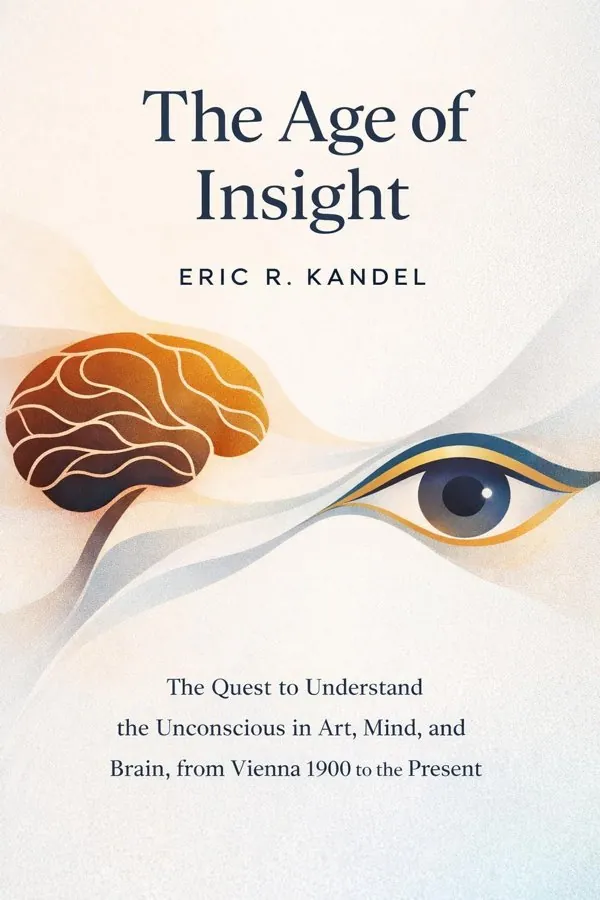
The Age of Insight: The Quest to Understand the Unconscious in Art, Mind, and Brain, from Vienna 1900 to the Present: Summary & Key Insights
 10 min9 chaptersAudio available
What Is The Age of Insight: The Quest to Understand the Unconscious in Art, Mind, and Brain, from Vienna 1900 to the Present About?
The Age of Insight: The Quest to Understand the Unconscious in Art, Mind, and Brain, from Vienna 1900 to the Present by Eric R. Kandel is a neuroscience book spanning 9 pages. This book explores how the intersection of art, science, and medicine in Vienna around 1900 led to groundbreaking insights into the human mind. Nobel laureate Eric R. Kandel examines the work of artists such as Klimt, Schiele, and Kokoschka alongside scientists like Freud and others, tracing how their ideas shaped modern understanding of perception, emotion, and creativity.
This FizzRead summary covers all 9 key chapters of The Age of Insight: The Quest to Understand the Unconscious in Art, Mind, and Brain, from Vienna 1900 to the Present in approximately 10 minutes, distilling the most important ideas, arguments, and takeaways from Eric R. Kandel's work. Also available as an audio summary and Key Quotes Podcast.
The Age of Insight: The Quest to Understand the Unconscious in Art, Mind, and Brain, from Vienna 1900 to the Present
This book explores how the intersection of art, science, and medicine in Vienna around 1900 led to groundbreaking insights into the human mind. Nobel laureate Eric R. Kandel examines the work of artists such as Klimt, Schiele, and Kokoschka alongside scientists like Freud and others, tracing how their ideas shaped modern understanding of perception, emotion, and creativity.
Who Should Read The Age of Insight: The Quest to Understand the Unconscious in Art, Mind, and Brain, from Vienna 1900 to the Present?
This book is perfect for anyone interested in neuroscience and looking to gain actionable insights in a short read. Whether you're a student, professional, or lifelong learner, the key ideas from The Age of Insight: The Quest to Understand the Unconscious in Art, Mind, and Brain, from Vienna 1900 to the Present by Eric R. Kandel will help you think differently.
- ✓Readers who enjoy neuroscience and want practical takeaways
- ✓Professionals looking to apply new ideas to their work and life
- ✓Anyone who wants the core insights of The Age of Insight: The Quest to Understand the Unconscious in Art, Mind, and Brain, from Vienna 1900 to the Present in just 10 minutes
Want the full summary?
Get instant access to this book summary and 100K+ more with Fizz Moment.
Get Free SummaryAvailable on App Store • Free to download
Key Chapters
Vienna at the turn of the twentieth century stood as one of history’s most fertile cultural intersections. Its wealth and cosmopolitan life gave rise to a generation of thinkers who questioned every inherited norm—artistic, moral, and scientific. Here the Secession movement emerged under Gustav Klimt’s leadership, declaring independence from classical tradition and embracing psychological depth and individuality. At the same time, literature and philosophy flourished; Arthur Schnitzler’s tales of desire and repression paralleled Freud’s investigations into the unconscious.
As I trace in this book, the Viennese ethos valued dialogue between disciplines. The coffeehouse was not an idle meeting place—it was a laboratory of ideas. Doctors discussed anatomy next to poets speculating about dreams, and their ideas cross-fertilized in remarkable ways. Medicine advanced from mere anatomy toward pathophysiology and psychology, recognizing that illness could arise as much from inward turmoil as physical dysfunction. Artists mirrored this insight on canvas: the human figure became an expression of invisible forces, not merely external beauty.
In these overlapping conversations, Vienna created a new vocabulary of the mind. Emotion, trauma, creativity, sexuality—all subjects once relegated to private thought—became public and artistic. It is in this atmosphere that the scientific and artistic revolutions joined hands, preparing the ground for Freud’s psychoanalysis and modern neuroscience’s later exploration of emotion and cognition.
Klimt and his younger contemporaries radically altered how the human form was represented. Klimt’s portraits of women, adorned with gold and flowing patterns, were not mere decorative achievements: they visualized sensual desire and introspection. Behind their beauty lies a psychological tension—a suggestion that every outward gesture conceals an inner drama. Egon Schiele carried this further, stripping the human body to its most vulnerable state. His self-portraits, often angular and raw, capture emotional conflict and self-awareness in a way that anticipates our modern understanding of introspection and identity.
As I discuss, Oskar Kokoschka fused bodily gesture with emotional expression, portraying inner turmoil as visible distortion. What united these artists was their fascination with the unseen—how emotion, memory, and inner life might be made visible through form and color. Their art embodied precisely what I call the insight-seeking process: the artistic search for the unconscious, a journey paralleled in Freud’s psychological exploration.
For someone trained in neuroscience, it is striking that these painters intuitively engaged with the same questions we now study experimentally: how emotion shapes perception, how self-awareness emerges, how our brains read faces not only as physical structures but as carriers of meaning. Klimt, Schiele, and Kokoschka thus stand as pioneers of the emotional brain, long before the term existed. Through their vision, viewers were forced to confront their own inner states, experiencing empathy and discomfort simultaneously—the kind of neural engagement modern brain imaging now reveals as fundamental to human social cognition.
+ 7 more chapters — available in the FizzRead app
All Chapters in The Age of Insight: The Quest to Understand the Unconscious in Art, Mind, and Brain, from Vienna 1900 to the Present
About the Author
Eric R. Kandel is an Austrian-American neuroscientist and professor at Columbia University. He received the Nobel Prize in Physiology or Medicine in 2000 for his research on the physiological basis of memory storage in neurons. Kandel is known for his interdisciplinary approach linking neuroscience with art and psychology.
Get This Summary in Your Preferred Format
Read or listen to the The Age of Insight: The Quest to Understand the Unconscious in Art, Mind, and Brain, from Vienna 1900 to the Present summary by Eric R. Kandel anytime, anywhere. FizzRead offers multiple formats so you can learn on your terms — all free.
Available formats: App · Audio · PDF · EPUB — All included free with FizzRead
Download The Age of Insight: The Quest to Understand the Unconscious in Art, Mind, and Brain, from Vienna 1900 to the Present PDF and EPUB Summary
Key Quotes from The Age of Insight: The Quest to Understand the Unconscious in Art, Mind, and Brain, from Vienna 1900 to the Present
“Vienna at the turn of the twentieth century stood as one of history’s most fertile cultural intersections.”
“Klimt and his younger contemporaries radically altered how the human form was represented.”
Frequently Asked Questions about The Age of Insight: The Quest to Understand the Unconscious in Art, Mind, and Brain, from Vienna 1900 to the Present
The Age of Insight: The Quest to Understand the Unconscious in Art, Mind, and Brain, from Vienna 1900 to the Present by Eric R. Kandel is a neuroscience book that explores key ideas across 9 chapters. This book explores how the intersection of art, science, and medicine in Vienna around 1900 led to groundbreaking insights into the human mind. Nobel laureate Eric R. Kandel examines the work of artists such as Klimt, Schiele, and Kokoschka alongside scientists like Freud and others, tracing how their ideas shaped modern understanding of perception, emotion, and creativity.
More by Eric R. Kandel
You Might Also Like
Anxious
Joseph LeDoux
10 min
Hallucinations
Oliver Sacks
10 min
The Biological Mind: How Brain, Body, and Environment Collaborate to Make Us Who We Are
Alan Jasanoff
10 min
The Feeling of Life Itself: Why Consciousness Is Widespread but Can't Be Computed
Christof Koch
10 min
The No-Nonsense Meditation Book
Steven Laureys
10 min
A General Theory of Love
Thomas Lewis, Fari Amini, Richard Lannon
10 minBrowse by Category
Ready to read The Age of Insight: The Quest to Understand the Unconscious in Art, Mind, and Brain, from Vienna 1900 to the Present?
Get the full summary and 100K+ more books with Fizz Moment.