
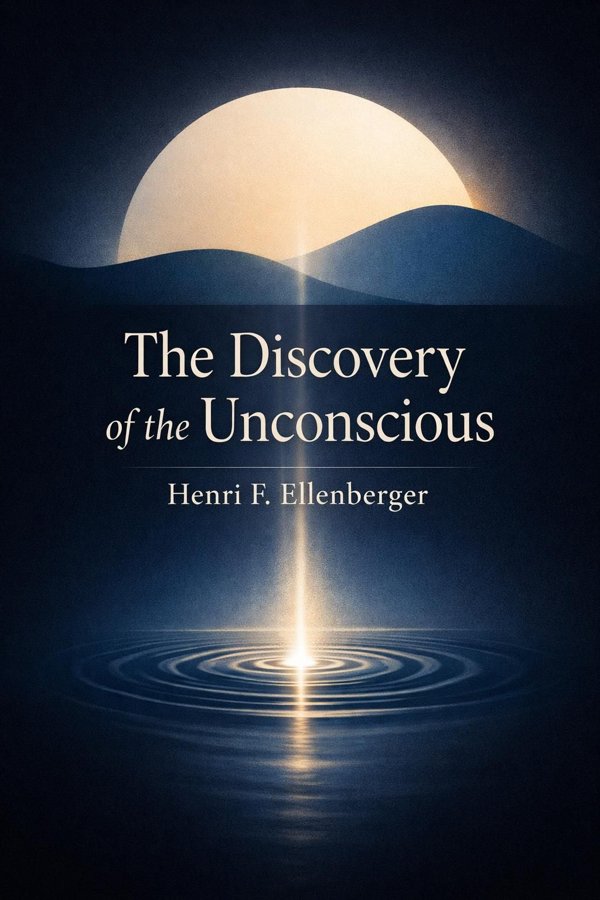
The Discovery of the Unconscious: The History and Evolution of Dynamic Psychiatry: Summary & Key Insights
 10 min6 chaptersAudio available
What Is The Discovery of the Unconscious: The History and Evolution of Dynamic Psychiatry About?
The Discovery of the Unconscious: The History and Evolution of Dynamic Psychiatry by Henri F. Ellenberger is a psychology book spanning 6 pages. This monumental work traces the development of dynamic psychiatry from its origins in mesmerism and hypnotism through the contributions of Freud, Jung, Adler, and others. Ellenberger presents a comprehensive history of the exploration of the unconscious mind, examining the evolution of psychological thought and the cultural contexts that shaped it.
This FizzRead summary covers all 6 key chapters of The Discovery of the Unconscious: The History and Evolution of Dynamic Psychiatry in approximately 10 minutes, distilling the most important ideas, arguments, and takeaways from Henri F. Ellenberger's work. Also available as an audio summary and Key Quotes Podcast.
The Discovery of the Unconscious: The History and Evolution of Dynamic Psychiatry
This monumental work traces the development of dynamic psychiatry from its origins in mesmerism and hypnotism through the contributions of Freud, Jung, Adler, and others. Ellenberger presents a comprehensive history of the exploration of the unconscious mind, examining the evolution of psychological thought and the cultural contexts that shaped it.
Who Should Read The Discovery of the Unconscious: The History and Evolution of Dynamic Psychiatry?
This book is perfect for anyone interested in psychology and looking to gain actionable insights in a short read. Whether you're a student, professional, or lifelong learner, the key ideas from The Discovery of the Unconscious: The History and Evolution of Dynamic Psychiatry by Henri F. Ellenberger will help you think differently.
- ✓Readers who enjoy psychology and want practical takeaways
- ✓Professionals looking to apply new ideas to their work and life
- ✓Anyone who wants the core insights of The Discovery of the Unconscious: The History and Evolution of Dynamic Psychiatry in just 10 minutes
Want the full summary?
Get instant access to this book summary and 100K+ more with Fizz Moment.
Get Free SummaryAvailable on App Store • Free to download
Key Chapters
Long before modern psychiatry existed, humanity had sensed the play of unseen forces within the mind. Ancient physicians and philosophers depicted emotional disturbances as visitations of spirits, divine possession, or imbalances of the vital humors. Yet these explanations, though archaic, already grasped something essential: that mental life extends beyond rational control. In the philosophies of Plato and Aristotle, in the speculations of the Neoplatonists, one finds the seeds of a divided psyche—a tension between reason and passion, consciousness and mystery. The moralists of the Middle Ages reinterpreted these tensions in theological terms, describing inner conflict as a struggle between the will and sin. With the Renaissance came an expansion of introspective curiosity, and thinkers like Paracelsus and van Helmont began to hint at psychodynamic interactions between body and soul.
My narrative begins from these shadows, because they establish a cultural continuity. Ideas of the unconscious did not erupt suddenly with Freud; they evolved from allegories, mystical experiences, and medical attempts to grasp psychosomatic links. In this period we find precursors to later discoveries—the notion that imagination can heal, that suggestion alters bodily states, that dreams possess diagnostic meaning. The physician’s art was still half magic, half science, but the intuition of hidden causes was alive. The road to dynamic psychiatry thus began not in laboratories, but in temples, monasteries, and the chambers of early healers who treated the ‘disordered soul’ as seriously as the diseased flesh.
With Franz Anton Mesmer, the story takes an audacious turn. A physician of the late eighteenth century, Mesmer claimed that all living beings were suffused by an invisible fluid—‘animal magnetism’—whose harmonious flow preserved health. Disease, he believed, arose from blockages in this vital current, and healing could be achieved by re-establishing its rhythm through magnetic passes and suggestion. In Paris his séances became a social spectacle, blending scientific experiment with mystic ritual. Yet beneath the theatricality, Mesmer’s practice embodied a profound intuition: that mind and body communicate through forces beyond conscious understanding.
I portray Mesmer not as a charlatan but as a symbol of a transitional age. His magnetism captured the Enlightenment’s ambivalence: a yearning for rational mastery of nature joined with fascination for the occult. Mesmer’s patients demonstrated striking psychosomatic reactions—crises of emotion, convulsions, later followed by relief. Even when science refuted his ‘fluid,’ his therapeutic method survived, transformed into psychodynamics. The notion that ailments of mind could yield to symbolic influence prepared the ground for hypnosis, suggestion, and, ultimately, psychotherapy itself.
Mesmer’s legacy lies not in his medical accuracy but in his moral imagination. He proposed that healing arises through the reactivation of inner forces—the very principle on which later dynamic psychiatry would thrive.
+ 4 more chapters — available in the FizzRead app
All Chapters in The Discovery of the Unconscious: The History and Evolution of Dynamic Psychiatry
About the Author
Henri F. Ellenberger (1905–1993) was a Swiss psychiatrist, medical historian, and scholar of the history of psychiatry and psychoanalysis. He is best known for his extensive research on the origins and development of dynamic psychiatry and for his critical historical approach to the study of the unconscious.
Get This Summary in Your Preferred Format
Read or listen to the The Discovery of the Unconscious: The History and Evolution of Dynamic Psychiatry summary by Henri F. Ellenberger anytime, anywhere. FizzRead offers multiple formats so you can learn on your terms — all free.
Available formats: App · Audio · PDF · EPUB — All included free with FizzRead
Download The Discovery of the Unconscious: The History and Evolution of Dynamic Psychiatry PDF and EPUB Summary
Key Quotes from The Discovery of the Unconscious: The History and Evolution of Dynamic Psychiatry
“Long before modern psychiatry existed, humanity had sensed the play of unseen forces within the mind.”
“With Franz Anton Mesmer, the story takes an audacious turn.”
Frequently Asked Questions about The Discovery of the Unconscious: The History and Evolution of Dynamic Psychiatry
The Discovery of the Unconscious: The History and Evolution of Dynamic Psychiatry by Henri F. Ellenberger is a psychology book that explores key ideas across 6 chapters. This monumental work traces the development of dynamic psychiatry from its origins in mesmerism and hypnotism through the contributions of Freud, Jung, Adler, and others. Ellenberger presents a comprehensive history of the exploration of the unconscious mind, examining the evolution of psychological thought and the cultural contexts that shaped it.
You Might Also Like
The Body Keeps the Score
Bessel van der Kolk
10 min
Surrounded by Idiots
Thomas Erikson
10 min
Emotional Intelligence
Daniel Goleman
10 min
Attached
Amir Levine
10 min
Why Does He Do That
Lundy Bancroft
10 min
Women Who Run with the Wolves
Clarissa Pinkola Estés
10 minBrowse by Category
Ready to read The Discovery of the Unconscious: The History and Evolution of Dynamic Psychiatry?
Get the full summary and 100K+ more books with Fizz Moment.