
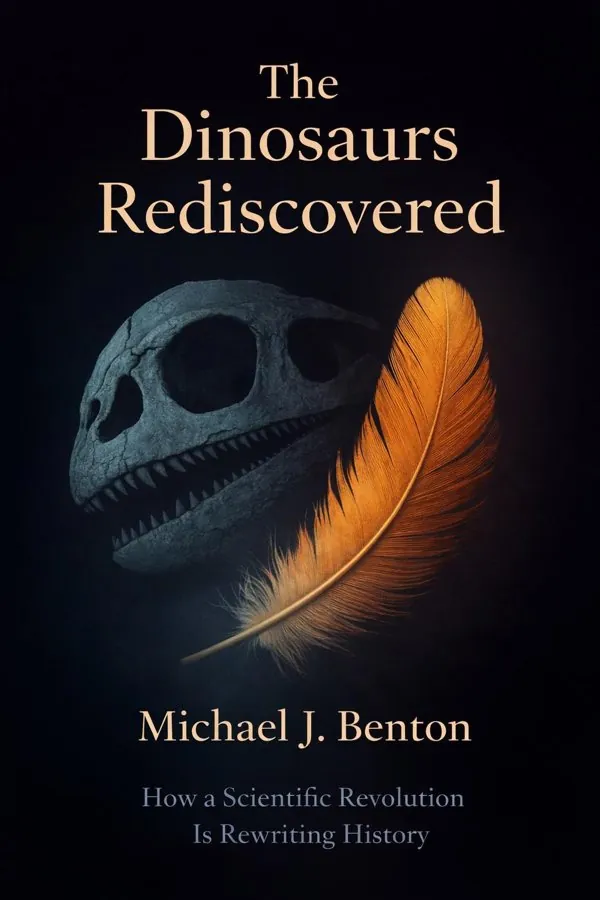
The Dinosaurs Rediscovered: How a Scientific Revolution Is Rewriting History: Summary & Key Insights
 10 min9 chaptersAudio available
Key Takeaways from The Dinosaurs Rediscovered: How a Scientific Revolution Is Rewriting History
The most revealing thing about early dinosaur science is not how much it knew, but how much it guessed.
A scientific revolution often starts with a change in method, not a change in subject.
Sometimes a science advances not because old theories are refined, but because entirely new evidence appears from places once overlooked.
A fossil is not just a stone impression of death; under the right conditions, it can preserve traces of life far more intimately than earlier scientists believed.
If you want to understand an animal, ask how it grew.
What Is The Dinosaurs Rediscovered: How a Scientific Revolution Is Rewriting History About?
The Dinosaurs Rediscovered: How a Scientific Revolution Is Rewriting History by Michael J. Benton is a popular_sci book spanning 12 pages. Dinosaurs have never really left us. They dominate museums, films, children’s imaginations, and scientific debate, yet what we think we know about them has changed dramatically in just a few decades. In The Dinosaurs Rediscovered, leading paleontologist Michael J. Benton explains how a flood of new discoveries and new methods has transformed dinosaur science from a field built largely on bones and speculation into one driven by high-resolution imaging, rigorous evolutionary analysis, biomechanics, chemistry, and global data sharing. The result is a far more vivid picture of dinosaur life: active animals with complex growth patterns, diverse behaviors, sophisticated physiology, and a deep evolutionary connection to modern birds. What makes this book especially valuable is Benton’s ability to combine scientific authority with narrative clarity. As one of the world’s most respected vertebrate paleontologists, he has spent decades studying evolution, extinction, and the history of life. He writes not just as an observer of this revolution, but as a participant in it. This book matters because it shows how science truly works: old certainties are tested, methods improve, and entire histories can be rewritten when evidence deepens.
This FizzRead summary covers all 9 key chapters of The Dinosaurs Rediscovered: How a Scientific Revolution Is Rewriting History in approximately 10 minutes, distilling the most important ideas, arguments, and takeaways from Michael J. Benton's work. Also available as an audio summary and Key Quotes Podcast.
The Dinosaurs Rediscovered: How a Scientific Revolution Is Rewriting History
Dinosaurs have never really left us. They dominate museums, films, children’s imaginations, and scientific debate, yet what we think we know about them has changed dramatically in just a few decades. In The Dinosaurs Rediscovered, leading paleontologist Michael J. Benton explains how a flood of new discoveries and new methods has transformed dinosaur science from a field built largely on bones and speculation into one driven by high-resolution imaging, rigorous evolutionary analysis, biomechanics, chemistry, and global data sharing. The result is a far more vivid picture of dinosaur life: active animals with complex growth patterns, diverse behaviors, sophisticated physiology, and a deep evolutionary connection to modern birds.
What makes this book especially valuable is Benton’s ability to combine scientific authority with narrative clarity. As one of the world’s most respected vertebrate paleontologists, he has spent decades studying evolution, extinction, and the history of life. He writes not just as an observer of this revolution, but as a participant in it. This book matters because it shows how science truly works: old certainties are tested, methods improve, and entire histories can be rewritten when evidence deepens.
Who Should Read The Dinosaurs Rediscovered: How a Scientific Revolution Is Rewriting History?
This book is perfect for anyone interested in popular_sci and looking to gain actionable insights in a short read. Whether you're a student, professional, or lifelong learner, the key ideas from The Dinosaurs Rediscovered: How a Scientific Revolution Is Rewriting History by Michael J. Benton will help you think differently.
- ✓Readers who enjoy popular_sci and want practical takeaways
- ✓Professionals looking to apply new ideas to their work and life
- ✓Anyone who wants the core insights of The Dinosaurs Rediscovered: How a Scientific Revolution Is Rewriting History in just 10 minutes
Want the full summary?
Get instant access to this book summary and 100K+ more with Fizz Moment.
Get Free SummaryAvailable on App Store • Free to download
Key Chapters
The most revealing thing about early dinosaur science is not how much it knew, but how much it guessed. When the first large fossil bones were unearthed in the nineteenth century, scientists and the public struggled to interpret them. Without modern evolutionary theory, complete skeletons, or comparative databases, these remains were often imagined as giant lizards, monstrous reptiles, or evolutionary oddities. Dinosaurs entered public culture as oversized, sluggish, cold-blooded creatures because that was the conceptual framework available at the time.
Benton shows that this early phase of paleontology was important even when it was wrong. Figures like Richard Owen helped define dinosaurs as a meaningful group, and museum reconstructions sparked widespread interest. But these interpretations also hardened into misleading images that lasted for generations. Heavy tails dragged on the ground in old models. Dinosaur posture was often drawn incorrectly. Their behavior was assumed rather than demonstrated. In other words, the first history of dinosaurs was shaped as much by Victorian imagination as by fossil evidence.
This matters because scientific progress often begins with imperfect models. What changes a field is not just finding more specimens, but learning how to ask better questions. As more complete fossils appeared and comparative anatomy improved, paleontologists could begin replacing mythic reconstructions with testable explanations. The same lesson applies beyond paleontology: first impressions are useful starting points, but dangerous endpoints.
A practical way to use this idea is to treat any “classic” scientific image with curiosity rather than reverence. Ask what evidence supported it, what assumptions guided it, and what newer methods might overturn it. Actionable takeaway: when encountering established knowledge, look for the history of revision behind it, because that is often where the real science begins.
A scientific revolution often starts with a change in method, not a change in subject. One of the biggest turning points in dinosaur research was the rise of cladistics, a system for understanding evolutionary relationships by identifying shared derived traits rather than relying on superficial similarity. Before this shift, classification could be inconsistent and heavily influenced by appearance. Animals that looked alike might be grouped together even if they evolved those traits independently.
Benton explains how cladistics brought discipline to dinosaur taxonomy. Instead of asking, “Which fossils resemble one another?” researchers began asking, “Which features were inherited from a common ancestor?” This changed the dinosaur family tree in profound ways. Relationships once treated as settled became open to reevaluation. Whole groups were reorganized. Debates about whether certain fossils belonged inside or outside Dinosauria became sharper and more evidence-based.
The practical significance is enormous. Classification is not just about labeling specimens; it shapes every larger question about origins, adaptation, and extinction. If you misunderstand who is related to whom, you also misunderstand how key traits evolved. For example, the evolutionary path from small theropods to birds only became convincing when researchers could place feathered and birdlike fossils into a robust branching framework.
Cladistics also offers a broader lesson for thinking clearly. Strong classification systems depend on transparent criteria. In daily life, we often sort people, ideas, or trends by vague resemblance instead of underlying structure. Benton’s account reminds us that good analysis depends on defining evidence carefully and testing competing interpretations.
Actionable takeaway: when trying to understand any complex field, focus on relationships and underlying patterns rather than surface appearances. Better categories lead to better conclusions.
Sometimes a science advances not because old theories are refined, but because entirely new evidence appears from places once overlooked. Dinosaur paleontology was transformed by spectacular fossil discoveries across the world, especially from China, South America, Africa, and other regions that expanded the field far beyond its earlier European and North American focus. These finds did not merely add new species; they reshaped the questions scientists could ask.
Benton emphasizes that many of the most important fossils are not the biggest or most dramatic, but the most informative. A beautifully preserved small theropod with skin, feathers, stomach contents, or growth structures can tell us more about dinosaur biology than a giant but fragmentary skeleton. New fossil beds have revealed nesting sites, embryos, trackways, and animals preserved in extraordinary detail. These allow paleontologists to reconstruct life histories, locomotion, habitat, and even aspects of social behavior.
This wave of discovery also corrected major biases in the fossil record. Earlier interpretations were often built from incomplete samples, making dinosaurs seem less diverse and more static than they were. With broader geographic coverage, researchers now see dinosaur evolution as dynamic, regionally varied, and full of experimentation. Some lineages became giants, others stayed small and agile, and many ecosystems were more complex than once assumed.
The broader application is simple: incomplete data can create false certainty. Whether in science, business, or personal judgment, expanding the sample often changes the conclusion. Benton’s narrative shows the power of searching in new places and valuing high-quality evidence over familiar stories.
Actionable takeaway: if your understanding of a subject feels settled, seek out neglected sources, new datasets, or underrepresented perspectives. Fresh evidence often reveals that the real story is larger and more surprising than the inherited one.
A fossil is not just a stone impression of death; under the right conditions, it can preserve traces of life far more intimately than earlier scientists believed. One of the most exciting developments Benton explores is the recovery of soft-tissue evidence and microscopic biological signals from dinosaur fossils. These include impressions of skin, feather structures, blood-vessel-like tissues, melanosomes linked to coloration, and chemical residues that hint at ancient biology.
For decades, dinosaur science relied mainly on hard anatomy because bones preserve best. That approach remains central, but newer tools have widened the evidence base. Scanning electron microscopy, geochemistry, synchrotron imaging, and molecular analysis have allowed scientists to study fossils at astonishing levels of detail. While claims about preserved proteins or original organic material require caution and debate, even the possibility has expanded paleontology’s ambitions. Researchers can now investigate not just what dinosaurs looked like structurally, but how their tissues functioned and how some traits connect to living animals.
This matters because biology is more than skeletons. Skin texture affects thermoregulation and display. Feather microstructure influences insulation and signaling. Tissue organization informs growth, metabolism, and disease. By recovering these traces, paleontologists move from identifying species to reconstructing organisms.
Benton also models scientific balance. He presents these breakthroughs with excitement but not credulity, reminding readers that extraordinary claims demand careful verification. That is a useful habit in any knowledge-rich environment filled with bold headlines and incomplete evidence.
Actionable takeaway: when evaluating new discoveries, stay open to revolutionary possibilities while demanding methodological clarity. Real breakthroughs are most powerful when they survive scrutiny.
If you want to understand an animal, ask how it grew. One of the clearest signs that the old image of dinosaurs as slow, inert reptiles was incomplete came from bone histology, the microscopic study of growth patterns preserved in fossilized tissue. Benton shows how sliced and polished bones reveal growth rings, vascular structure, remodeling, and developmental stages that together provide a biography written inside the skeleton.
These studies indicate that many dinosaurs grew rapidly, often at rates more comparable to birds and mammals than to typical modern reptiles. That finding has major implications. Fast growth requires substantial energy intake, efficient physiology, and ecological strategies suited to active lives. Combined with evidence from trackways, nesting grounds, and predator-prey anatomy, histology supports the view of dinosaurs as dynamic animals rather than evolutionary dead ends.
Behavioral evidence deepens the story. Fossilized nests, brooding postures, herd movement inferred from tracksites, and bite marks on bones all help reconstruct how dinosaurs lived. Some species cared for young. Some moved in groups. Some were highly specialized hunters. Even injuries and bone pathologies reveal survival strategies and environmental stress.
For readers, the practical lesson is that hidden structure often explains visible behavior. We make shallow judgments when we focus only on external form. Benton’s account demonstrates the value of looking inside systems, whether biological, organizational, or personal, to understand performance and change.
Actionable takeaway: when assessing how something functions, examine growth patterns and internal processes, not just outward appearance. The deepest clues to capability are often embedded in development.
The idea that we might know the colors of dinosaurs once sounded like fantasy. Today, it is part of a growing scientific effort to reconstruct dinosaur appearance and physiology using fine-scale fossil evidence. Benton describes how the study of melanosomes, tiny pigment-bearing structures preserved in some feathers and skin impressions, has allowed researchers to make informed inferences about coloration in certain species. Instead of imagining dinosaurs in generic greens and browns, scientists can now discuss patterning, display, camouflage, and signaling with far greater precision.
These discoveries matter because color is not superficial. It connects to ecology and behavior. Stripes may suggest camouflage. Iridescence may point to display or mate choice. Countershading can hint at habitat and predator avoidance. Feather distribution likewise informs insulation, communication, and the evolutionary pathway toward flight. A fuzzy body covering in small theropods supports the idea that some dinosaurs regulated body temperature more actively than once believed.
This feeds into one of the book’s most important themes: dinosaur physiology was varied and more sophisticated than traditional cold-blooded reptile models allowed. The debate over metabolism remains nuanced, with different groups likely occupying different positions on the spectrum. But the evidence increasingly supports the view that many dinosaurs were energetic, adaptive, and ecologically flexible.
Beyond paleontology, this teaches an important analytical principle: details that seem decorative may actually be functionally central. Surface features often encode evolutionary strategy.
Actionable takeaway: pay attention to traits others dismiss as minor. In science and life, small visible details can reveal deep truths about adaptation, performance, and identity.
The most radical shift in dinosaur science may also be the simplest to state: birds are not merely descended from dinosaurs in a loose sense; they are living dinosaurs. Benton explains how this conclusion emerged from a convergence of fossil discovery, comparative anatomy, cladistics, and developmental biology. Features once thought uniquely avian, such as feathers, wishbones, lightweight skeletons, and certain lung-related adaptations, are now recognized as having deeper roots within theropod dinosaurs.
This changes the emotional and scientific meaning of dinosaur extinction. Dinosaurs did not simply vanish. One branch survived and diversified into the thousands of bird species alive today. The robin in a garden, the pigeon on a street, and the eagle overhead are not echoes of dinosaur history; they are part of it.
Benton traces how fossils like Archaeopteryx once dominated the discussion, but newer discoveries of feathered non-avian dinosaurs and birdlike theropods made the transition far richer and less mysterious. Flight itself appears not as a sudden miracle, but as the result of gradual anatomical and behavioral shifts involving feathers, balance, metabolism, and forelimb function.
The broader relevance is profound. Evolution often works by repurposing existing structures. Feathers may have originated for insulation or display before being co-opted for flight. That pattern of exaptation appears throughout natural history and even in human innovation, where tools and ideas often find their greatest use in roles they were not originally designed for.
Actionable takeaway: when studying change, look for continuity inside apparent disruption. Revolutionary outcomes often emerge by reworking older structures rather than inventing entirely new ones from scratch.
Mass extinction is often imagined as a final chapter, but Benton presents it as both an ending and a reset. The asteroid impact at the end of the Cretaceous, together with associated environmental upheaval, destroyed the non-avian dinosaurs and many other forms of life. Yet extinction was not a clean wipeout of “dominant” creatures replaced by superior ones. It was a complex biological crisis that different lineages experienced differently, and its aftermath shaped the modern world.
Benton is especially good at showing that extinction studies are not separate from dinosaur biology. To understand why some groups died and others survived, we must understand ecology, body size, reproduction, habitat, and adaptability. Birds survived where their close relatives did not. Why? The answer likely involves a mix of size, diet, developmental rates, ecological flexibility, and sheer contingency. Science here becomes a study in probabilities rather than simplistic narratives of fitness.
This chapter also broadens the significance of dinosaurs. They are not merely fascinating giants; they are a case study in resilience, vulnerability, and planetary change. Mass extinctions reveal how life responds when conditions shift abruptly. That gives Benton’s work contemporary relevance in an age increasingly aware of climate disruption and biodiversity loss.
The practical lesson is humbling. Success in one environment does not guarantee survival in another. Systems that seem stable can unravel rapidly when conditions cross critical thresholds.
Actionable takeaway: build flexibility into your thinking and planning. Whether considering species, institutions, or careers, long-term survival depends less on current dominance than on adaptability under changing conditions.
Modern paleontology is no longer confined to dusting fossils with brushes and displaying skeletons in museum halls. Benton highlights a technological transformation that has turned dinosaur research into a deeply interdisciplinary science. CT scanning, laser surface mapping, finite element analysis, 3D modeling, biomechanical simulation, and large-scale statistical tools now allow researchers to investigate fossils without destroying them and to test hypotheses that were once inaccessible.
These tools have changed both speed and quality of understanding. A skull can be digitally reconstructed from crushed fragments. Bite force can be estimated through biomechanical models. Joint movement can be simulated to infer locomotion. Internal cavities can be visualized to study brain shape, sinuses, and sensory abilities. Digital archives also let researchers compare specimens across continents without physically transporting rare fossils.
Equally important is the culture of global collaboration and data sharing. Benton shows that the dinosaur revolution is not the achievement of a few isolated geniuses, but a networked effort involving field teams, imaging specialists, evolutionary biologists, geochemists, and museum curators. As datasets become richer, the dinosaur family tree remains dynamic rather than fixed. New analyses can revise old assumptions quickly, which is a sign of scientific vitality rather than weakness.
This idea has applications far beyond paleontology. Better tools do not replace human judgment, but they expand the questions we can ask and the precision with which we can answer them. Fields advance fastest when technology, openness, and cross-disciplinary collaboration reinforce one another.
Actionable takeaway: if you want deeper understanding in any domain, combine new tools with cooperative knowledge-sharing. Innovation becomes transformative when evidence can be reexamined, tested, and improved by many minds.
All Chapters in The Dinosaurs Rediscovered: How a Scientific Revolution Is Rewriting History
About the Author
Michael J. Benton is a British paleontologist and Professor of Vertebrate Palaeontology at the University of Bristol. He is one of the most respected scholars in his field, known for research on vertebrate evolution, fossil history, biodiversity, and mass extinctions. Over a long academic career, Benton has published widely on the history of life and helped shape modern understanding of major evolutionary transitions. He is especially admired for combining rigorous scientific scholarship with the ability to explain complex ideas clearly to general readers. His books and articles have made him a leading public voice in paleontology. In The Dinosaurs Rediscovered, Benton draws on decades of research and firsthand involvement in the field’s recent breakthroughs to explain how new discoveries and new methods have transformed our understanding of dinosaurs.
Get This Summary in Your Preferred Format
Read or listen to the The Dinosaurs Rediscovered: How a Scientific Revolution Is Rewriting History summary by Michael J. Benton anytime, anywhere. FizzRead offers multiple formats so you can learn on your terms — all free.
Available formats: App · Audio · PDF · EPUB — All included free with FizzRead
Download The Dinosaurs Rediscovered: How a Scientific Revolution Is Rewriting History PDF and EPUB Summary
Key Quotes from The Dinosaurs Rediscovered: How a Scientific Revolution Is Rewriting History
“The most revealing thing about early dinosaur science is not how much it knew, but how much it guessed.”
“A scientific revolution often starts with a change in method, not a change in subject.”
“Sometimes a science advances not because old theories are refined, but because entirely new evidence appears from places once overlooked.”
“A fossil is not just a stone impression of death; under the right conditions, it can preserve traces of life far more intimately than earlier scientists believed.”
“If you want to understand an animal, ask how it grew.”
Frequently Asked Questions about The Dinosaurs Rediscovered: How a Scientific Revolution Is Rewriting History
The Dinosaurs Rediscovered: How a Scientific Revolution Is Rewriting History by Michael J. Benton is a popular_sci book that explores key ideas across 9 chapters. Dinosaurs have never really left us. They dominate museums, films, children’s imaginations, and scientific debate, yet what we think we know about them has changed dramatically in just a few decades. In The Dinosaurs Rediscovered, leading paleontologist Michael J. Benton explains how a flood of new discoveries and new methods has transformed dinosaur science from a field built largely on bones and speculation into one driven by high-resolution imaging, rigorous evolutionary analysis, biomechanics, chemistry, and global data sharing. The result is a far more vivid picture of dinosaur life: active animals with complex growth patterns, diverse behaviors, sophisticated physiology, and a deep evolutionary connection to modern birds. What makes this book especially valuable is Benton’s ability to combine scientific authority with narrative clarity. As one of the world’s most respected vertebrate paleontologists, he has spent decades studying evolution, extinction, and the history of life. He writes not just as an observer of this revolution, but as a participant in it. This book matters because it shows how science truly works: old certainties are tested, methods improve, and entire histories can be rewritten when evidence deepens.
You Might Also Like

Structures: Or Why Things Don"t Fall Down
J.E. Gordon
10 min
The Road to Wigan Pier
George Orwell
10 min
Bonk: The Curious Coupling of Science and Sex
Mary Roach
10 min
First Bite: How We Learn to Eat
Bee Wilson
10 min
In Pursuit Of The Unknown: 17 Equations That Changed The World
Ian Stewart
10 min
Napoleon's Buttons: 17 Molecules That Changed History
Penny Le Couteur and Jay Burreson
10 minBrowse by Category
Ready to read The Dinosaurs Rediscovered: How a Scientific Revolution Is Rewriting History?
Get the full summary and 100K+ more books with Fizz Moment.