
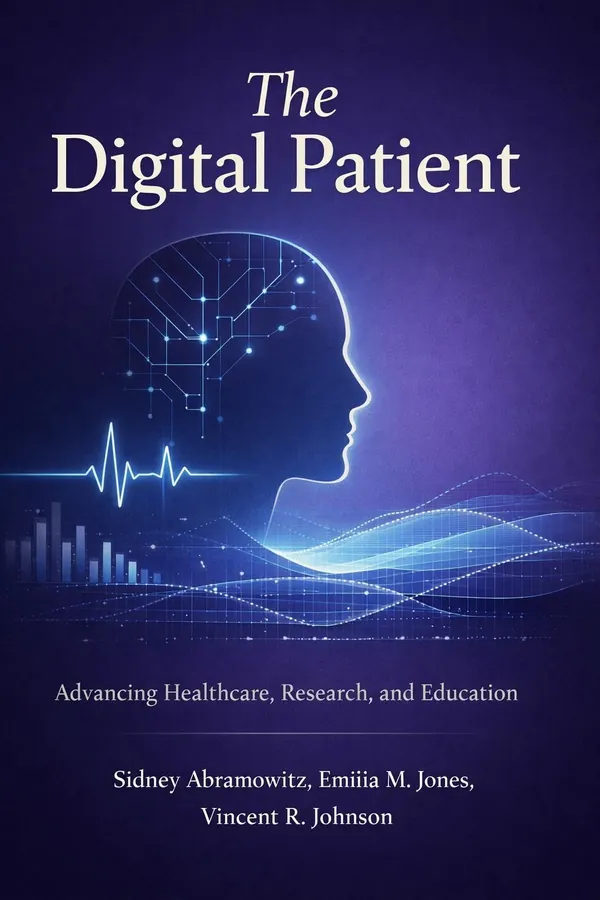
The Digital Patient: Advancing Healthcare, Research, and Education: Summary & Key Insights
by Sidney Abramowitz, Emilia M. Jones, Vincent R. Johnson
 10 min9 chaptersAudio available
Key Takeaways from The Digital Patient: Advancing Healthcare, Research, and Education
A digital patient is only as useful as the data that sustains it.
To model a patient is to turn complexity into something medicine can reason with.
Average medicine works well for populations but often poorly for individuals.
Medicine has always depended on experience, but experience is costly when the lesson comes at a patient’s expense.
The most powerful patient model is not static; it changes as the patient changes.
What Is The Digital Patient: Advancing Healthcare, Research, and Education About?
The Digital Patient: Advancing Healthcare, Research, and Education by Sidney Abramowitz, Emilia M. Jones, Vincent R. Johnson is a health_med book spanning 6 pages. Healthcare is no longer shaped only by physical examinations, laboratory tests, and clinical intuition. In The Digital Patient: Advancing Healthcare, Research, and Education, Sidney Abramowitz, Emilia M. Jones, and Vincent R. Johnson show how medicine is being transformed by computational models, artificial intelligence, connected devices, and data-rich patient records. Their central idea is powerful: by creating digital representations of individual patients, clinicians and researchers can better predict disease, personalize treatment, and improve outcomes across the entire care journey. What makes this book especially important is its breadth. It does not treat digital health as a narrow technology trend, but as a new framework for care, research, and medical training. The authors explain how data from electronic health records, imaging, genomics, wearables, and real-time monitoring can be integrated into living models that evolve with each patient. They also address the practical barriers—ethics, interoperability, trust, and implementation—that determine whether these tools truly help people. Abramowitz, Jones, and Johnson write from a computational medicine and healthcare informatics perspective, giving the book both technical credibility and real-world relevance for clinicians, researchers, educators, and health leaders.
This FizzRead summary covers all 9 key chapters of The Digital Patient: Advancing Healthcare, Research, and Education in approximately 10 minutes, distilling the most important ideas, arguments, and takeaways from Sidney Abramowitz, Emilia M. Jones, Vincent R. Johnson's work. Also available as an audio summary and Key Quotes Podcast.
The Digital Patient: Advancing Healthcare, Research, and Education
Healthcare is no longer shaped only by physical examinations, laboratory tests, and clinical intuition. In The Digital Patient: Advancing Healthcare, Research, and Education, Sidney Abramowitz, Emilia M. Jones, and Vincent R. Johnson show how medicine is being transformed by computational models, artificial intelligence, connected devices, and data-rich patient records. Their central idea is powerful: by creating digital representations of individual patients, clinicians and researchers can better predict disease, personalize treatment, and improve outcomes across the entire care journey.
What makes this book especially important is its breadth. It does not treat digital health as a narrow technology trend, but as a new framework for care, research, and medical training. The authors explain how data from electronic health records, imaging, genomics, wearables, and real-time monitoring can be integrated into living models that evolve with each patient. They also address the practical barriers—ethics, interoperability, trust, and implementation—that determine whether these tools truly help people.
Abramowitz, Jones, and Johnson write from a computational medicine and healthcare informatics perspective, giving the book both technical credibility and real-world relevance for clinicians, researchers, educators, and health leaders.
Who Should Read The Digital Patient: Advancing Healthcare, Research, and Education?
This book is perfect for anyone interested in health_med and looking to gain actionable insights in a short read. Whether you're a student, professional, or lifelong learner, the key ideas from The Digital Patient: Advancing Healthcare, Research, and Education by Sidney Abramowitz, Emilia M. Jones, Vincent R. Johnson will help you think differently.
- ✓Readers who enjoy health_med and want practical takeaways
- ✓Professionals looking to apply new ideas to their work and life
- ✓Anyone who wants the core insights of The Digital Patient: Advancing Healthcare, Research, and Education in just 10 minutes
Want the full summary?
Get instant access to this book summary and 100K+ more with Fizz Moment.
Get Free SummaryAvailable on App Store • Free to download
Key Chapters
A digital patient is only as useful as the data that sustains it. The book begins from a simple but transformative insight: medicine has no shortage of information, but it often lacks connection. Hospitals store clinical notes in one system, imaging in another, lab data in a third, and genomic findings somewhere else entirely. Add wearable devices, pharmacy records, and patient-reported outcomes, and the result is not clarity but fragmentation. The authors argue that the first real step toward digital medicine is not more data collection, but smarter integration.
This means combining diverse streams into a coherent, longitudinal view of a person’s health. A diabetic patient, for example, should not be understood through glucose tests alone. Their digital profile might combine continuous glucose monitor readings, diet logs, retinal scans, medication adherence data, kidney function tests, and cardiovascular risk markers. Taken together, these reveal patterns that no isolated dataset could show.
The authors explain that integration also requires standards, harmonized formats, and semantic consistency. If one system records blood pressure differently from another, or imaging metadata is incomplete, predictive tools become unreliable. Interoperability is therefore not a technical luxury but a clinical necessity.
In practice, integrated patient data can reduce duplicate testing, improve diagnosis, and support earlier interventions. It can also help researchers identify subgroups of patients who respond differently to treatments.
The actionable takeaway is clear: before pursuing advanced AI or simulation, healthcare systems must build trustworthy data pipelines that connect clinical, biological, and behavioral information into a unified patient narrative.
To model a patient is to turn complexity into something medicine can reason with. One of the book’s central themes is that digital patients are not just databases; they are models. These models may represent organs, physiological systems, disease pathways, or whole-person risk profiles. The authors describe an evolution from mechanistic models, grounded in biology and physics, to data-driven models trained on large populations, and increasingly to hybrid systems that combine both approaches.
Mechanistic models are especially useful when causal understanding matters. A cardiovascular simulation, for instance, can estimate how changes in blood flow, vessel stiffness, or heart function might affect a patient after surgery. Data-driven models, by contrast, excel at pattern recognition. They may identify subtle imaging features that predict tumor progression or detect sepsis risk from changing vital signs before clinicians see obvious symptoms.
The most promising future lies in combining these methods. A hybrid cancer model might use known tumor biology while also learning from population-level outcomes. That makes predictions both more interpretable and more adaptive. The authors emphasize that no model is perfect; every model is a selective representation of reality. Its value lies in whether it helps clinicians ask better questions, compare options, and anticipate consequences.
Applications already include surgical planning, cardiac risk assessment, drug response prediction, and rehabilitation modeling. In education, these same models let trainees explore disease progression safely and repeatedly.
The practical takeaway is to treat models as decision-support companions, not oracles. The best digital patient tools are those whose assumptions, limitations, and clinical purpose are understood as clearly as their outputs.
Average medicine works well for populations but often poorly for individuals. The authors make a compelling case that the digital patient is a bridge from generalized treatment protocols to truly personalized care. Traditional clinical guidelines are based on large trials and broad trends, which are essential, but they cannot fully capture the uniqueness of a person’s genes, environment, comorbidities, and lived behavior. Digital patient systems aim to close that gap.
The book explains how predictive analytics can tailor prevention, diagnosis, and therapy. Consider oncology: two patients may carry the same diagnosis on paper, yet have vastly different tumor genetics, treatment tolerances, and recurrence risks. A digital patient model can integrate biopsy findings, imaging, genomic markers, prior treatment history, and even functional status to support a more precise treatment strategy. In cardiology, similar methods can estimate which patient is likely to benefit most from a procedure versus medication alone.
Personalization also extends outside specialized medicine. A patient with hypertension may receive different monitoring schedules, medication choices, and lifestyle recommendations depending on sleep quality, activity data, adherence patterns, and kidney function. The goal is not simply prediction, but better matching between patient and intervention.
The authors also warn that personalization can fail if models are trained on biased or unrepresentative datasets. Precision without fairness can deepen disparities.
The key takeaway is practical: use digital tools to individualize care plans, but always validate whether the recommendation reflects the patient in front of you, not just the statistical tendencies of the dataset behind the model.
Medicine has always depended on experience, but experience is costly when the lesson comes at a patient’s expense. That is why the book gives special attention to simulation as both an educational tool and a clinical resource. The digital patient allows students, trainees, and even seasoned professionals to test decisions in realistic virtual environments before applying them in real life.
The authors describe a spectrum of educational simulation, from anatomy visualizations and procedural trainers to dynamic patient scenarios that evolve based on clinical choices. A medical student might manage a virtual patient with pneumonia and learn how delays in antibiotics alter outcomes. A surgical resident might rehearse a complex operation using a patient-specific 3D model derived from imaging. An emergency team might simulate a deteriorating trauma case to refine communication, speed, and coordination.
These technologies improve more than technical skill. They also sharpen judgment under uncertainty, reveal hidden assumptions, and support reflective learning. Importantly, digital simulation can expose learners to rare or high-risk scenarios they may not encounter often in training but must be prepared to manage.
Beyond education, simulation has growing value in care planning. Clinicians can test treatment strategies virtually, especially in complex cases involving cardiovascular interventions, orthopedic implants, or radiation therapy planning. This creates a safer pathway for exploring options.
The actionable lesson is straightforward: institutions should treat simulation not as an optional teaching enhancement, but as a core part of modern medical education and pre-procedure planning, especially when digital patient models can make training patient-specific and clinically relevant.
The most powerful patient model is not static; it changes as the patient changes. A major contribution of the book is its emphasis on real-time monitoring and adaptive care. Traditional medicine often relies on episodic snapshots: a clinic visit, a hospital admission, a lab panel taken on one day. But health unfolds continuously, and many critical changes happen between appointments. Digital patient systems seek to close that blind spot.
Wearables, bedside monitors, implantable devices, smartphone apps, and remote sensors can feed a constantly updated stream of data into a patient’s digital representation. For a heart failure patient, daily weight, blood pressure, pulse variability, and activity levels may reveal decompensation before symptoms become severe. For someone with chronic obstructive pulmonary disease, changes in oxygen saturation, cough frequency, or sleep disruption might signal an impending exacerbation. In critical care, predictive systems can flag deterioration hours before conventional alarms are triggered.
The authors stress that adaptive care means more than surveillance. It means updating risk estimates, treatment thresholds, and care plans in response to emerging information. If a patient’s digital profile shows declining adherence, rising physiologic stress, and worsening symptoms, the appropriate response may be outreach, medication adjustment, or intensified follow-up rather than waiting for the next formal appointment.
Still, too much data can overwhelm clinicians if systems are poorly designed. Real-time medicine works only when signals are filtered intelligently and integrated into workflow.
The takeaway is to move from periodic assessment to continuous learning: healthcare organizations should invest in monitoring systems that turn live data into timely, actionable interventions rather than passive dashboards.
The excitement around artificial intelligence often creates a false choice between human care and machine-driven medicine. The authors reject that framing. Their view is more practical and more humane: AI matters most when it amplifies clinical judgment rather than pretending to eliminate it. The digital patient becomes valuable not because an algorithm can make decisions alone, but because it can help clinicians see patterns, risks, and possibilities that would otherwise remain hidden.
The book discusses several forms of AI in healthcare, including image analysis, natural language processing, anomaly detection, risk prediction, and treatment recommendation systems. A radiology model might detect subtle features linked to early disease. A language model might extract meaningful trends from years of clinician notes. A predictive model might identify patients at high risk for readmission, medication complications, or sepsis.
Yet the authors repeatedly return to the issue of trust. Clinicians are less likely to rely on tools that provide confident outputs without interpretable reasoning, uncertainty estimates, or evidence of validation across diverse populations. AI can also inherit biases from historical care, reproducing unequal access or inaccurate assessments for underserved groups.
The strongest use cases therefore place AI within a broader decision framework. Rather than saying, “The model has decided,” clinicians should ask, “What is the model suggesting, based on what data, and does it fit this patient’s context?” In that role, AI becomes an assistant that reduces blind spots and cognitive burden.
The practical takeaway is simple: deploy AI where it improves accuracy, speed, or consistency, but always preserve clinical oversight, explainability, and accountability in every decision that affects patient care.
One patient can teach medicine a great deal, but digital representations of many patients can reshape research altogether. The book shows how digital patient frameworks are changing biomedical discovery by making it easier to simulate, compare, and analyze health trajectories at scale. In this context, the digital patient is not only a clinical tool; it is also a research platform.
Researchers can use virtual cohorts assembled from integrated records, imaging, biomarker data, and longitudinal outcomes to test hypotheses faster than would be possible through conventional methods alone. For example, instead of waiting years to observe how a subgroup responds to a treatment, investigators may model likely outcomes using historical and real-time data, then refine those predictions with prospective follow-up. In pharmacology, digital patient models can help estimate dosage responses, adverse-event patterns, or likely responders before broad clinical deployment.
The concept of a digital twin is especially promising. A digital twin is a dynamic computational counterpart of an individual that updates over time. In theory, it allows researchers and clinicians to ask “what if” questions: What if this patient receives therapy A instead of therapy B? What if surgery is delayed? What if a rehabilitation program is intensified? While still evolving, this approach could reduce trial-and-error medicine and improve trial design.
The authors are careful not to overpromise. Simulated outcomes cannot replace rigorous clinical evidence, but they can sharpen research questions, identify target populations, and improve efficiency.
The takeaway is actionable for health systems and researchers alike: build research infrastructure that turns routine clinical data into ethically governed learning systems, where every patient encounter contributes to better science and future care.
A digital patient can only help if patients trust the system that represents them. The authors devote serious attention to ethics, governance, and interoperability, arguing that these are not secondary implementation concerns but the foundation of responsible digital healthcare. The more deeply medicine relies on computational models and data sharing, the more urgent it becomes to protect privacy, ensure fairness, and define accountability.
Privacy is the most visible issue, but not the only one. Patients need confidence that their genomic data, behavioral information, and clinical histories will be used securely and appropriately. Consent becomes more complicated when data are repurposed for research, model training, or cross-institutional exchange. At the same time, overly rigid data silos can prevent beneficial care coordination. The challenge is to create governance models that enable meaningful use without normalizing misuse.
Interoperability is the operational side of trust. If systems cannot communicate, patient data remain fragmented, and the digital patient becomes incomplete or misleading. Standards for coding, record exchange, metadata, and model documentation matter because clinical decisions depend on them.
The book also raises the issue of algorithmic fairness. A system trained mostly on one population may underperform for another, leading to inequitable care. Responsible digital health therefore requires auditing, transparent validation, and continuous monitoring.
The actionable takeaway is that institutions should evaluate digital health tools not only for innovation, but for security, data portability, bias control, consent practices, and governance. Trust is not an accessory to digital medicine; it is the condition that makes adoption possible.
Many healthcare technologies fail not because they are weak in theory, but because they are poorly integrated into real clinical life. One of the book’s most pragmatic lessons is that building digital patient systems is as much an organizational challenge as a technical one. Hospitals may purchase advanced analytics or simulation platforms, yet still see limited impact if workflows, incentives, and professional habits remain unchanged.
The authors emphasize that clinicians already work in environments saturated with alerts, documentation burdens, and time pressure. A digital patient tool that adds complexity without reducing effort is unlikely to succeed, no matter how sophisticated the underlying science. Effective implementation begins with understanding where decisions happen, who needs what information, and how outputs should appear inside existing systems. A risk model buried in a separate dashboard may be ignored; the same model integrated into order entry or rounding workflow may be useful.
Culture matters just as much. Clinicians need training not only in how to use tools, but in how to interpret uncertainty, challenge model outputs, and collaborate across disciplines. IT teams, administrators, researchers, and frontline staff must share ownership of digital transformation. Leadership must also define success realistically: fewer preventable admissions, better treatment matching, faster diagnosis, stronger training outcomes, or improved equity.
Examples include remote monitoring programs that succeed because nurses are empowered to act on alerts, and educational simulations that become transformative only when linked to curriculum and assessment.
The takeaway is practical and often overlooked: implement digital patient systems by redesigning workflow, training people, and measuring outcomes, not merely by acquiring software.
All Chapters in The Digital Patient: Advancing Healthcare, Research, and Education
About the Authors
Sidney Abramowitz is a biomedical engineer and healthcare informatics specialist whose work focuses on how digital systems can improve patient care and clinical decision-making. Emilia M. Jones and Vincent R. Johnson are researchers in computational medicine and data-driven healthcare, with interests spanning predictive modeling, patient simulation, and the design of integrated health technologies. Together, they represent an interdisciplinary perspective that combines engineering, analytics, and medical application. Their collaboration reflects a growing field in which clinicians, technologists, and researchers work side by side to build tools that make medicine more precise, adaptive, and educationally effective. In The Digital Patient, they bring this expertise to a broad audience, explaining both the promise and the practical complexity of using digital models to advance healthcare, research, and professional training.
Get This Summary in Your Preferred Format
Read or listen to the The Digital Patient: Advancing Healthcare, Research, and Education summary by Sidney Abramowitz, Emilia M. Jones, Vincent R. Johnson anytime, anywhere. FizzRead offers multiple formats so you can learn on your terms — all free.
Available formats: App · Audio · PDF · EPUB — All included free with FizzRead
Download The Digital Patient: Advancing Healthcare, Research, and Education PDF and EPUB Summary
Key Quotes from The Digital Patient: Advancing Healthcare, Research, and Education
“A digital patient is only as useful as the data that sustains it.”
“To model a patient is to turn complexity into something medicine can reason with.”
“Average medicine works well for populations but often poorly for individuals.”
“Medicine has always depended on experience, but experience is costly when the lesson comes at a patient’s expense.”
“The most powerful patient model is not static; it changes as the patient changes.”
Frequently Asked Questions about The Digital Patient: Advancing Healthcare, Research, and Education
The Digital Patient: Advancing Healthcare, Research, and Education by Sidney Abramowitz, Emilia M. Jones, Vincent R. Johnson is a health_med book that explores key ideas across 9 chapters. Healthcare is no longer shaped only by physical examinations, laboratory tests, and clinical intuition. In The Digital Patient: Advancing Healthcare, Research, and Education, Sidney Abramowitz, Emilia M. Jones, and Vincent R. Johnson show how medicine is being transformed by computational models, artificial intelligence, connected devices, and data-rich patient records. Their central idea is powerful: by creating digital representations of individual patients, clinicians and researchers can better predict disease, personalize treatment, and improve outcomes across the entire care journey. What makes this book especially important is its breadth. It does not treat digital health as a narrow technology trend, but as a new framework for care, research, and medical training. The authors explain how data from electronic health records, imaging, genomics, wearables, and real-time monitoring can be integrated into living models that evolve with each patient. They also address the practical barriers—ethics, interoperability, trust, and implementation—that determine whether these tools truly help people. Abramowitz, Jones, and Johnson write from a computational medicine and healthcare informatics perspective, giving the book both technical credibility and real-world relevance for clinicians, researchers, educators, and health leaders.
You Might Also Like

On Immunity
Eula Biss
10 min
The Three-Body Problem
Liu Cixin
10 min
Community Health Volunteer Toolkit: Training and Practical Activities
World Health Organization
10 min
Healing Back Pain: The Mind-Body Connection
John E. Sarno
10 min
Health Literacy for All: Practical Guides to Communicate Health Information (Compilations)
World Health Organization
10 min
The Complete Guide to Sports Supplements: An Evidence-Based Review
Anita Bean
10 minBrowse by Category
Ready to read The Digital Patient: Advancing Healthcare, Research, and Education?
Get the full summary and 100K+ more books with Fizz Moment.