
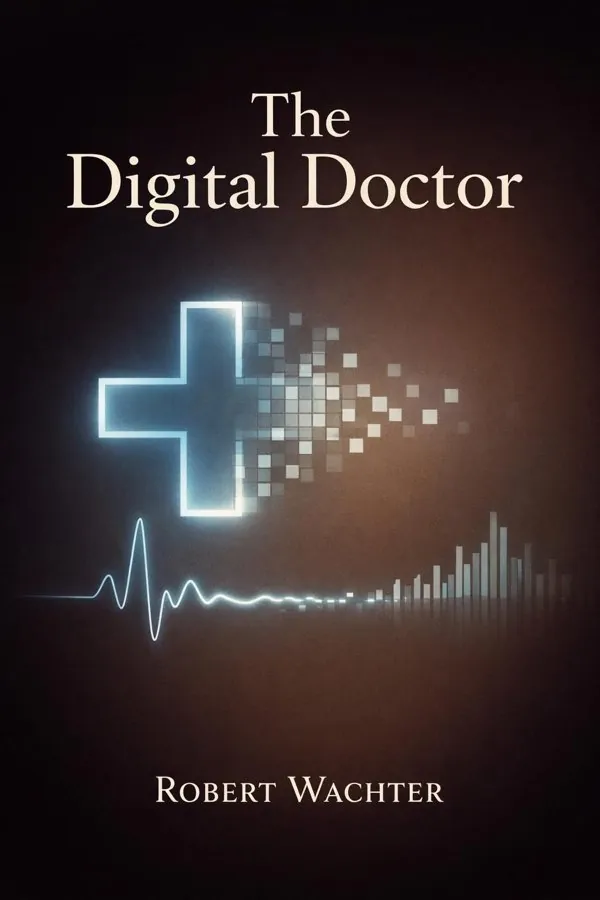
The Digital Doctor: Hope, Hype, and Harm at the Dawn of Medicine’s Computer Age: Summary & Key Insights
 10 min11 chaptersAudio available
What Is The Digital Doctor: Hope, Hype, and Harm at the Dawn of Medicine’s Computer Age About?
The Digital Doctor: Hope, Hype, and Harm at the Dawn of Medicine’s Computer Age by Robert Wachter is a health_med book spanning 11 pages. Written by physician and academic Robert Wachter, this book explores how the digital revolution is transforming healthcare. It examines the promises and pitfalls of electronic health records, big data, and artificial intelligence in medicine, offering a balanced view of how technology can both improve and complicate patient care.
This FizzRead summary covers all 11 key chapters of The Digital Doctor: Hope, Hype, and Harm at the Dawn of Medicine’s Computer Age in approximately 10 minutes, distilling the most important ideas, arguments, and takeaways from Robert Wachter's work. Also available as an audio summary and Key Quotes Podcast.
The Digital Doctor: Hope, Hype, and Harm at the Dawn of Medicine’s Computer Age
Written by physician and academic Robert Wachter, this book explores how the digital revolution is transforming healthcare. It examines the promises and pitfalls of electronic health records, big data, and artificial intelligence in medicine, offering a balanced view of how technology can both improve and complicate patient care.
Who Should Read The Digital Doctor: Hope, Hype, and Harm at the Dawn of Medicine’s Computer Age?
This book is perfect for anyone interested in health_med and looking to gain actionable insights in a short read. Whether you're a student, professional, or lifelong learner, the key ideas from The Digital Doctor: Hope, Hype, and Harm at the Dawn of Medicine’s Computer Age by Robert Wachter will help you think differently.
- ✓Readers who enjoy health_med and want practical takeaways
- ✓Professionals looking to apply new ideas to their work and life
- ✓Anyone who wants the core insights of The Digital Doctor: Hope, Hype, and Harm at the Dawn of Medicine’s Computer Age in just 10 minutes
Want the full summary?
Get instant access to this book summary and 100K+ more with Fizz Moment.
Get Free SummaryAvailable on App Store • Free to download
Key Chapters
For most of its history, medicine operated on paper charts that were messy but fundamentally human. Those handwritten notes encoded stories, quirks, and clinical reasoning that reflected doctors’ individuality. Errors occurred, of course, but they were typically the result of human oversight, not digital complexity. In the late 20th century, as computing power grew and other industries digitized their workflows, medicine appeared ripe for transformation. The promise was seductive: efficiency, connectivity, and data-driven precision.
Early adopters saw electronic health records as a leap into modernity. Yet, as I observed hospitals nationwide, the transition was rarely smooth. Systems designed with billing and compliance in mind often neglected the subtle rhythms of clinical reasoning. Interfaces felt alien, input screens demanded rigid data fields, and workflows bent around the computer rather than the patient. The shift was monumental, not just technologically but philosophically: medicine was moving from narrative care to structured data.
This historical evolution reveals a recurring pattern. Each generation of technology arrives with optimism, and medicine adapts under pressure. But the pace of digital change outstripped medicine’s institutional inertia. Hospitals learned not just new software but new ways of thinking. The learning curve was steep, and unintended consequences rapidly became visible. To understand the present digital turbulence, one must recognize it as the culmination of a long, uneven march toward modernization—a process that changed documentation, communication, and cognition itself.
No revolution in healthcare begins without hope. The rise of electronic health records, predictive algorithms, and big data was heralded as a moral imperative to make medicine safer and more efficient. I share that optimism: the capacity to analyze vast datasets, detect patterns, and foresee disease trajectories is staggering. Computers can cross-check drug interactions instantaneously, aggregate population-level insights, and uncover correlations invisible to the naked eye. When we picture digital medicine at its best, we see clinicians freed from bureaucracy, empowered to make better decisions, and guided by technology that anticipates their needs.
But the promise, I found, is complicated by scale and context. EHRs were sold as tools to reduce error, yet they often replaced old inefficiencies with new ones. Clinicians faced a wall of alerts and data points that blurred the line between essential and irrelevant. The beauty of automation became a burden when systems demanded more clicks than conversations. The technology was brilliant on paper—but medicine lives in moments of intuition and empathy that no code can fully replicate.
In exploring the promise, I realized that digital progress is not about replacing doctors. It is about amplifying judgment through data, creating a team composed of humans and algorithms, each contributing what the other cannot. A future in which technology enriches rather than eclipses human reasoning is possible—but only if we confront the seductive simplicity of technological optimism with the complexity of real-world care.
+ 9 more chapters — available in the FizzRead app
All Chapters in The Digital Doctor: Hope, Hype, and Harm at the Dawn of Medicine’s Computer Age
About the Author
Robert M. Wachter is an American physician, professor, and author known for his work in patient safety and healthcare quality. He serves as Chair of the Department of Medicine at the University of California, San Francisco, and has written extensively on the intersection of medicine and technology.
Get This Summary in Your Preferred Format
Read or listen to the The Digital Doctor: Hope, Hype, and Harm at the Dawn of Medicine’s Computer Age summary by Robert Wachter anytime, anywhere. FizzRead offers multiple formats so you can learn on your terms — all free.
Available formats: App · Audio · PDF · EPUB — All included free with FizzRead
Download The Digital Doctor: Hope, Hype, and Harm at the Dawn of Medicine’s Computer Age PDF and EPUB Summary
Key Quotes from The Digital Doctor: Hope, Hype, and Harm at the Dawn of Medicine’s Computer Age
“For most of its history, medicine operated on paper charts that were messy but fundamentally human.”
“No revolution in healthcare begins without hope.”
Frequently Asked Questions about The Digital Doctor: Hope, Hype, and Harm at the Dawn of Medicine’s Computer Age
The Digital Doctor: Hope, Hype, and Harm at the Dawn of Medicine’s Computer Age by Robert Wachter is a health_med book that explores key ideas across 11 chapters. Written by physician and academic Robert Wachter, this book explores how the digital revolution is transforming healthcare. It examines the promises and pitfalls of electronic health records, big data, and artificial intelligence in medicine, offering a balanced view of how technology can both improve and complicate patient care.
You Might Also Like

On Immunity
Eula Biss
10 min
The Three-Body Problem
Liu Cixin
10 min
Community Health Volunteer Toolkit: Training and Practical Activities
World Health Organization
10 min
Healing Back Pain: The Mind-Body Connection
John E. Sarno
10 min
Health Literacy for All: Practical Guides to Communicate Health Information (Compilations)
World Health Organization
10 min
The Complete Guide to Sports Supplements: An Evidence-Based Review
Anita Bean
10 minBrowse by Category
Ready to read The Digital Doctor: Hope, Hype, and Harm at the Dawn of Medicine’s Computer Age?
Get the full summary and 100K+ more books with Fizz Moment.