
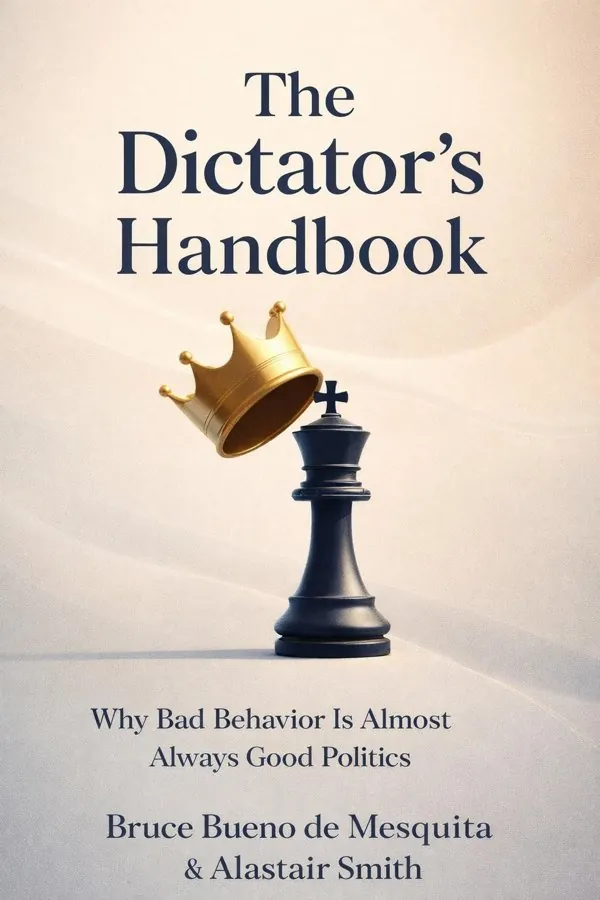
The Dictator’s Handbook: Why Bad Behavior Is Almost Always Good Politics: Summary & Key Insights
by Bruce Bueno de Mesquita, Alastair Smith
 10 min5 chaptersAudio available
What Is The Dictator’s Handbook: Why Bad Behavior Is Almost Always Good Politics About?
The Dictator’s Handbook: Why Bad Behavior Is Almost Always Good Politics by Bruce Bueno de Mesquita & Alastair Smith is a politics book spanning 5 pages. This book explores the logic of political survival, arguing that leaders—whether dictators or democrats—act primarily to maintain power rather than to serve the public good. Using a rational-choice framework, the authors explain how political systems incentivize self-serving behavior and why corruption and manipulation often underpin stable governance.
This FizzRead summary covers all 5 key chapters of The Dictator’s Handbook: Why Bad Behavior Is Almost Always Good Politics in approximately 10 minutes, distilling the most important ideas, arguments, and takeaways from Bruce Bueno de Mesquita & Alastair Smith's work. Also available as an audio summary and Key Quotes Podcast.
The Dictator’s Handbook: Why Bad Behavior Is Almost Always Good Politics
This book explores the logic of political survival, arguing that leaders—whether dictators or democrats—act primarily to maintain power rather than to serve the public good. Using a rational-choice framework, the authors explain how political systems incentivize self-serving behavior and why corruption and manipulation often underpin stable governance.
Who Should Read The Dictator’s Handbook: Why Bad Behavior Is Almost Always Good Politics?
This book is perfect for anyone interested in politics and looking to gain actionable insights in a short read. Whether you're a student, professional, or lifelong learner, the key ideas from The Dictator’s Handbook: Why Bad Behavior Is Almost Always Good Politics by Bruce Bueno de Mesquita & Alastair Smith will help you think differently.
- ✓Readers who enjoy politics and want practical takeaways
- ✓Professionals looking to apply new ideas to their work and life
- ✓Anyone who wants the core insights of The Dictator’s Handbook: Why Bad Behavior Is Almost Always Good Politics in just 10 minutes
Want the full summary?
Get instant access to this book summary and 100K+ more with Fizz Moment.
Get Free SummaryAvailable on App Store • Free to download
Key Chapters
The key to understanding political stability lies not in ideology or morality, but in mathematics—the arithmetic of loyalty. Every regime operates through a stratified population divided into distinct groups that we call the selectorate, the real selectorate, and the winning coalition.
The selectorate is everyone who has nominal influence over leadership choice—citizens who vote, party members who participate, military officers who could potentially back a coup. In a democracy, that’s millions of voters; in a dictatorship, it might be a party elite or a small cadre of generals.
The real selectorate, however, is smaller—it is those people who actually have a realistic chance of determining the outcome. In autocracies, many within the nominal selectorate are powerless; only insiders, loyalists, or those with control over key institutions truly matter.
Finally, the winning coalition is the critical core—the handful of individuals whose support decides whether a leader stays or falls. It may be a few dozen generals in a junta, or millions of swing voters in an electoral democracy. Our entire framework pivots on one simple observation: leaders must satisfy this group, and only this group, to remain in power.
Once you view political systems through this triad, everything becomes transparent. The smaller the winning coalition, the larger the private rewards each member can expect for loyalty. When loyalty depends on selective payments—like bribes, tax exemptions, or military privileges—leaders favor private goods over public ones. Conversely, when coalitions are large, private rewards become costly, and leaders find it cheaper to produce public goods—clean water, roads, education—that benefit everyone. Thus, democracy’s comparative virtue arises not from moral superiority but from mathematical necessity. Leaders must reach broadly for survival.
Example after example—Saddam Hussein’s patronage of his family and tribal network, Mao’s use of party purges to tighten elite dependence, and democratic leaders using welfare programs for electoral payoff—illustrates that the logic of political survival cuts across culture and ideology. Leaders survive when they control pivotal resources and allocate them strategically to keep their coalition loyal. Lose control of the resources, or fail to meet the coalition’s needs, and even the mightiest regime can crumble overnight.
By stripping politics down to this core logic, we see democratic and autocratic governments not as opposites, but as points on a continuum defined by coalition size. Every policy choice, every act of repression or generosity, can ultimately be traced back to this formula of survival.
If you want to know what keeps leaders secure, look not at constitutions or speeches—look at money. Resources are the lifeblood of loyalty. In the political survival game, leaders use resources—material, institutional, or symbolic—to keep their coalition close and dependent.
In small-coalition systems, loyalty payments take direct forms: cash transfers, monopolies, privileges, and protection from accountability. A dictator does not need to build hospitals for the masses; he needs to ensure that generals, financiers, and cronies receive enough to remain dependent on him. The moment their share shrinks, their loyalty wavers, and the system collapses. Thus, corruption is not a flaw—it’s a survival mechanism.
Consider Mobutu Sese Seko’s Zaire or North Korea under Kim Jong Il. In each, political stability rested not on public prosperity but on the ruler’s control of private wealth distribution. A loyal elite receives just enough to prosper, but never enough to challenge the throne. The leader becomes the indispensable center of fortune.
Democracies, though broader in coalition, follow similar principles—only their loyalty payments come through public goods and policy favors. A democratic leader who fails to deliver results, to keep the economy growing or social programs functioning, risks electoral punishment. Here, the resource logic encourages efficiency and welfare provision, but not because leaders are altruistic—it’s simply that losing office entails personal ruin.
Throughout our research, we found that leaders act rationally within these economic constraints. The more resources under a leader’s direct control, the more absolute their power. The more resources distributed publicly, the more vulnerable they become to shifts in coalition loyalty. Thus, every system balances between two fears: providing too little and losing loyalty, or providing too much and empowering potential rivals. Political systems endure when leaders master that equilibrium.
+ 3 more chapters — available in the FizzRead app
All Chapters in The Dictator’s Handbook: Why Bad Behavior Is Almost Always Good Politics
About the Authors
Bruce Bueno de Mesquita is a political scientist known for his work on game theory and international relations. Alastair Smith is a political economist specializing in political survival and leadership strategies. Both are professors at New York University and have collaborated on several influential works in political science.
Get This Summary in Your Preferred Format
Read or listen to the The Dictator’s Handbook: Why Bad Behavior Is Almost Always Good Politics summary by Bruce Bueno de Mesquita & Alastair Smith anytime, anywhere. FizzRead offers multiple formats so you can learn on your terms — all free.
Available formats: App · Audio · PDF · EPUB — All included free with FizzRead
Download The Dictator’s Handbook: Why Bad Behavior Is Almost Always Good Politics PDF and EPUB Summary
Key Quotes from The Dictator’s Handbook: Why Bad Behavior Is Almost Always Good Politics
“The key to understanding political stability lies not in ideology or morality, but in mathematics—the arithmetic of loyalty.”
“If you want to know what keeps leaders secure, look not at constitutions or speeches—look at money.”
Frequently Asked Questions about The Dictator’s Handbook: Why Bad Behavior Is Almost Always Good Politics
The Dictator’s Handbook: Why Bad Behavior Is Almost Always Good Politics by Bruce Bueno de Mesquita & Alastair Smith is a politics book that explores key ideas across 5 chapters. This book explores the logic of political survival, arguing that leaders—whether dictators or democrats—act primarily to maintain power rather than to serve the public good. Using a rational-choice framework, the authors explain how political systems incentivize self-serving behavior and why corruption and manipulation often underpin stable governance.
You Might Also Like
Antifa: The Anti-Fascist Handbook
Mark Bray
10 min
Attack from Within: How Disinformation Is Sabotaging America
Barbara McQuade
10 min
Coercion, Capital, and European States, AD 990–1992
Charles Tilly
10 min
Digital Democracy: Concepts, Methodologies, Tools, and Applications
Various Authors
10 min
Fascism
Stanley G. Payne
10 min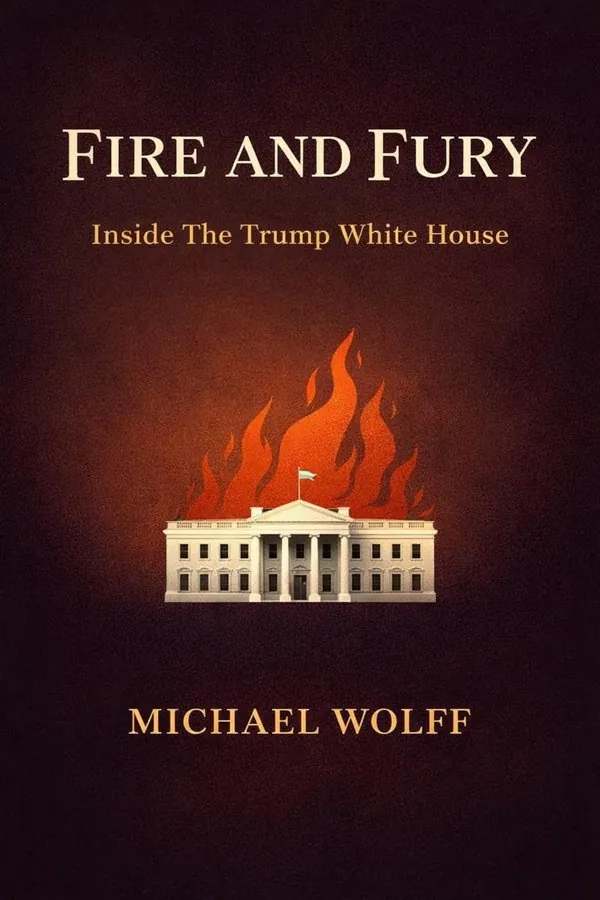
Fire And Fury: Inside The Trump White House
Michael Wolff
10 minBrowse by Category
Ready to read The Dictator’s Handbook: Why Bad Behavior Is Almost Always Good Politics?
Get the full summary and 100K+ more books with Fizz Moment.