
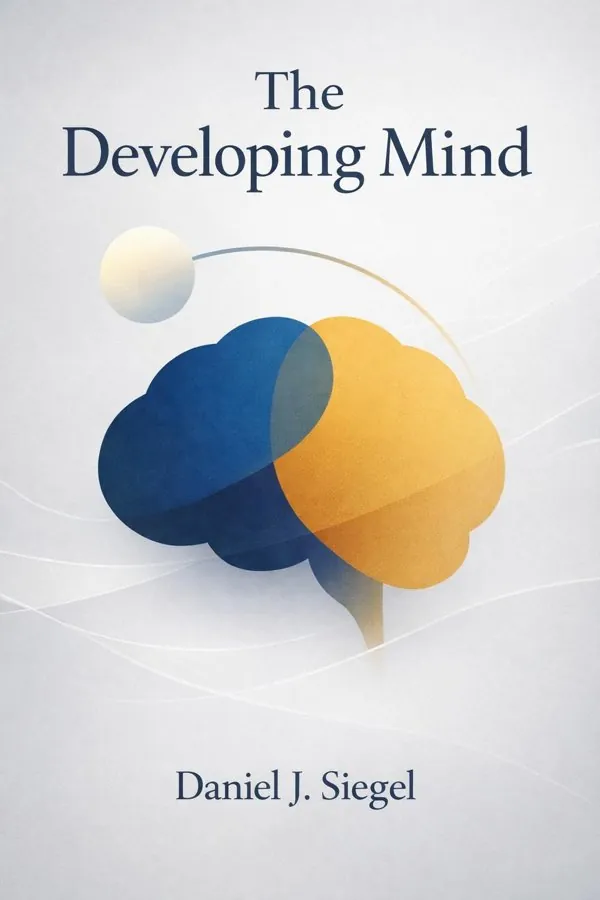
The Developing Mind: How Relationships and the Brain Interact to Shape Who We Are: Summary & Key Insights
 10 min4 chaptersAudio available
What Is The Developing Mind: How Relationships and the Brain Interact to Shape Who We Are About?
The Developing Mind: How Relationships and the Brain Interact to Shape Who We Are by Daniel J. Siegel is a neuroscience book spanning 4 pages. This foundational work explores how interpersonal experiences influence the development of the brain and mind. Siegel integrates neuroscience, psychology, and attachment theory to explain how relationships shape emotional regulation, memory, and identity throughout life.
This FizzRead summary covers all 4 key chapters of The Developing Mind: How Relationships and the Brain Interact to Shape Who We Are in approximately 10 minutes, distilling the most important ideas, arguments, and takeaways from Daniel J. Siegel's work. Also available as an audio summary and Key Quotes Podcast.
The Developing Mind: How Relationships and the Brain Interact to Shape Who We Are
This foundational work explores how interpersonal experiences influence the development of the brain and mind. Siegel integrates neuroscience, psychology, and attachment theory to explain how relationships shape emotional regulation, memory, and identity throughout life.
Who Should Read The Developing Mind: How Relationships and the Brain Interact to Shape Who We Are?
This book is perfect for anyone interested in neuroscience and looking to gain actionable insights in a short read. Whether you're a student, professional, or lifelong learner, the key ideas from The Developing Mind: How Relationships and the Brain Interact to Shape Who We Are by Daniel J. Siegel will help you think differently.
- ✓Readers who enjoy neuroscience and want practical takeaways
- ✓Professionals looking to apply new ideas to their work and life
- ✓Anyone who wants the core insights of The Developing Mind: How Relationships and the Brain Interact to Shape Who We Are in just 10 minutes
Want the full summary?
Get instant access to this book summary and 100K+ more with Fizz Moment.
Get Free SummaryAvailable on App Store • Free to download
Key Chapters
As I began my journey to bridge the gap between disciplines, one insight became clear: mind, brain, and relationships are not separate entities; they are aspects of a single, integrated process. The mind, as I define it, is an emergent, self-organizing process that regulates the flow of energy and information within and between people. Neuroscientifically, energy and information are transmitted through patterns of firing neurons. Psychologically, these patterns translate into thoughts, feelings, and perceptions. Relationally, the same flow extends beyond the boundaries of the skull into the space between individuals—through gaze, tone, gesture, and the attunement that forms the foundation of human connection.
This understanding dissolves the old dualism that separated biology from experience. Our neural circuits are sculpted by interactions; our internal world is carved by the presence or absence of attuned relational communication. Think of a mother’s soothing voice calming a distressed infant: in that moment, patterns of neural firing inside the child’s brain are literally reorganized by the caregiver’s emotional resonance. The mind is, therefore, both embodied and relational. It exists within the coordinated dance between our internal neural processes and the social world that enfolds us.
This integrated view opens a new horizon for self-understanding. It means that to cultivate mental health we must foster integration across all domains of our lives—neural, interpersonal, and cultural. Harmony, flexibility, adaptability, and coherence emerge when differentiated parts of a system are linked; chaos or rigidity arise when those parts fail to communicate. In this sense, psychotherapy, education, and parenting all share a common purpose: to help minds—and therefore relationships—move toward greater integration and complexity, the hallmarks of a well-functioning living system.
Our earliest relationships with caregivers serve as the laboratory of emotional life. In my clinical and scientific work, I have seen over and over how early attachment experiences mold the architecture of the brain, particularly the circuits governing emotional regulation and stress response. Through the pioneering research of Bowlby, Ainsworth, and others, we know that secure attachment arises when caregivers are consistently attuned—able to perceive and respond to a child’s internal states with empathy and reliability. Such experiences wire the child’s neural networks for integration, leading to emotional balance, resilience, and a coherent sense of self.
In contrast, when caregiving is neglectful, inconsistent, or frightening, the developing brain adapts in defensive ways. Circuits in the limbic system, especially the amygdala and hippocampus, become sensitized to threat; the prefrontal cortex, which mediates emotional regulation and empathy, may fail to fully integrate with subcortical structures. The result is vulnerability to dysregulation—the storms of impulsivity, fear, or dissociation that often echo through adulthood.
Yet the beauty of the developing mind lies in its plasticity. Secure attachments later in life—from therapists, friends, or partners—can rewire neural pathways initially shaped by insecurity. In this way, relationships remain both sculptors and healers of the brain. We come to realize that emotional intelligence is not an innate gift but a learned capacity, born from the experience of being understood. When we feel truly felt, the dissonant patterns of the past begin to harmonize; neurons that once fired in isolation begin to connect in synchrony. Integration is restored, and the self becomes more coherent, flexible, and courageous.
+ 2 more chapters — available in the FizzRead app
All Chapters in The Developing Mind: How Relationships and the Brain Interact to Shape Who We Are
About the Author
Daniel J. Siegel, M.D., is a clinical professor of psychiatry at the UCLA School of Medicine and the founding co-director of the Mindful Awareness Research Center. He is known for his pioneering work in interpersonal neurobiology and for authoring influential books on mindfulness and mental health.
Get This Summary in Your Preferred Format
Read or listen to the The Developing Mind: How Relationships and the Brain Interact to Shape Who We Are summary by Daniel J. Siegel anytime, anywhere. FizzRead offers multiple formats so you can learn on your terms — all free.
Available formats: App · Audio · PDF · EPUB — All included free with FizzRead
Download The Developing Mind: How Relationships and the Brain Interact to Shape Who We Are PDF and EPUB Summary
Key Quotes from The Developing Mind: How Relationships and the Brain Interact to Shape Who We Are
“As I began my journey to bridge the gap between disciplines, one insight became clear: mind, brain, and relationships are not separate entities; they are aspects of a single, integrated process.”
“Our earliest relationships with caregivers serve as the laboratory of emotional life.”
Frequently Asked Questions about The Developing Mind: How Relationships and the Brain Interact to Shape Who We Are
The Developing Mind: How Relationships and the Brain Interact to Shape Who We Are by Daniel J. Siegel is a neuroscience book that explores key ideas across 4 chapters. This foundational work explores how interpersonal experiences influence the development of the brain and mind. Siegel integrates neuroscience, psychology, and attachment theory to explain how relationships shape emotional regulation, memory, and identity throughout life.
More by Daniel J. Siegel

Aware: The Science and Practice of Presence: The Groundbreaking Meditation Practice
Daniel J. Siegel
10 min
Mindsight: The New Science of Personal Transformation
Daniel J. Siegel
10 min
The Whole-Brain Child: 12 Revolutionary Strategies to Nurture Your Child's Developing Mind
Daniel J. Siegel, Tina Payne Bryson
10 min
No-Drama Discipline: The Whole-Brain Way to Calm the Chaos and Nurture Your Child's Developing Mind
Daniel J. Siegel, Tina Payne Bryson
10 minYou Might Also Like
Anxious
Joseph LeDoux
10 min
Hallucinations
Oliver Sacks
10 min
The Biological Mind: How Brain, Body, and Environment Collaborate to Make Us Who We Are
Alan Jasanoff
10 min
The Feeling of Life Itself: Why Consciousness Is Widespread but Can't Be Computed
Christof Koch
10 min
The No-Nonsense Meditation Book
Steven Laureys
10 min
A General Theory of Love
Thomas Lewis, Fari Amini, Richard Lannon
10 minBrowse by Category
Ready to read The Developing Mind: How Relationships and the Brain Interact to Shape Who We Are?
Get the full summary and 100K+ more books with Fizz Moment.