
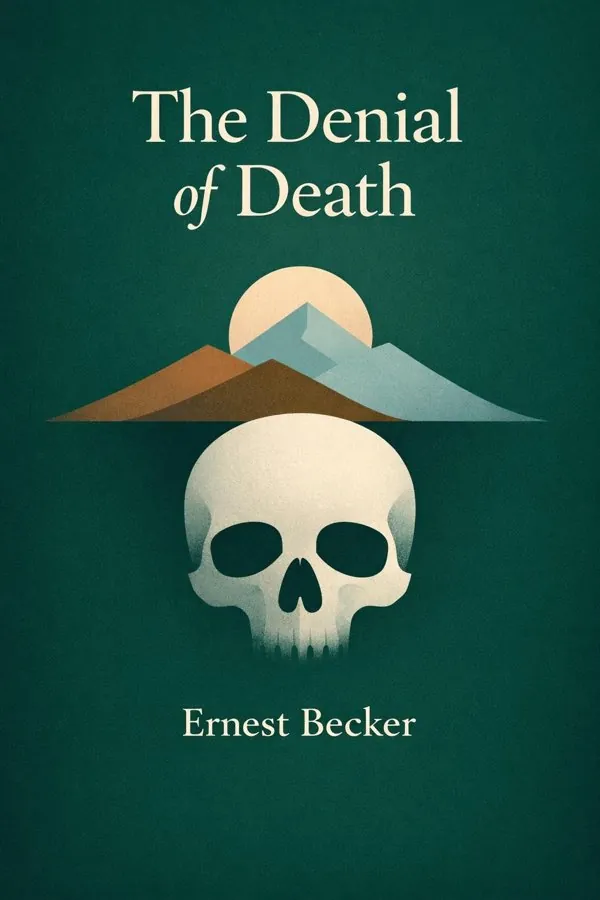
The Denial of Death: Summary & Key Insights
 10 min10 chaptersAudio available
Key Takeaways from The Denial of Death
One of Becker’s most important starting points is this: before we can understand society, we must understand the buried fears inside the individual.
Becker argues that what makes human beings unique is not merely intelligence but symbolic consciousness.
The deepest human paradox, according to Becker, is that we are gods with anuses: beings capable of imagination, transcendence, and self-reflection, yet trapped in decaying bodies.
Becker’s famous idea of the “hero system” explains why people need more than survival or pleasure.
A striking claim in The Denial of Death is that culture itself functions as a collective defense mechanism.
What Is The Denial of Death About?
The Denial of Death by Ernest Becker is a psychology book spanning 10 pages. Originally published in 1973 and awarded the Pulitzer Prize shortly after Ernest Becker’s death, The Denial of Death is one of the most influential books ever written about the hidden forces shaping human behavior. Becker’s central claim is bold and unsettling: much of what people do—whether they seek love, status, achievement, morality, religion, or even distraction—is driven by a need to manage the terror of mortality. Human beings are unique not simply because we think, but because we know we will die. That knowledge creates a deep psychological conflict, and culture itself becomes a defense against it. Drawing on Freud, Kierkegaard, Otto Rank, Erich Fromm, theology, anthropology, and clinical psychology, Becker builds an ambitious account of why people cling to identities, belief systems, and “hero projects” that make life feel meaningful and enduring. The book matters because it connects private anxiety to public life, showing how personal insecurity, social conformity, ambition, and even violence can emerge from the same existential source. Becker writes with rare intellectual range and emotional seriousness, making this book essential for anyone interested in psychology, meaning, fear, or the problem of how to live honestly under the shadow of death.
This FizzRead summary covers all 10 key chapters of The Denial of Death in approximately 10 minutes, distilling the most important ideas, arguments, and takeaways from Ernest Becker's work. Also available as an audio summary and Key Quotes Podcast.
The Denial of Death
Originally published in 1973 and awarded the Pulitzer Prize shortly after Ernest Becker’s death, The Denial of Death is one of the most influential books ever written about the hidden forces shaping human behavior. Becker’s central claim is bold and unsettling: much of what people do—whether they seek love, status, achievement, morality, religion, or even distraction—is driven by a need to manage the terror of mortality. Human beings are unique not simply because we think, but because we know we will die. That knowledge creates a deep psychological conflict, and culture itself becomes a defense against it.
Drawing on Freud, Kierkegaard, Otto Rank, Erich Fromm, theology, anthropology, and clinical psychology, Becker builds an ambitious account of why people cling to identities, belief systems, and “hero projects” that make life feel meaningful and enduring. The book matters because it connects private anxiety to public life, showing how personal insecurity, social conformity, ambition, and even violence can emerge from the same existential source. Becker writes with rare intellectual range and emotional seriousness, making this book essential for anyone interested in psychology, meaning, fear, or the problem of how to live honestly under the shadow of death.
Who Should Read The Denial of Death?
This book is perfect for anyone interested in psychology and looking to gain actionable insights in a short read. Whether you're a student, professional, or lifelong learner, the key ideas from The Denial of Death by Ernest Becker will help you think differently.
- ✓Readers who enjoy psychology and want practical takeaways
- ✓Professionals looking to apply new ideas to their work and life
- ✓Anyone who wants the core insights of The Denial of Death in just 10 minutes
Want the full summary?
Get instant access to this book summary and 100K+ more with Fizz Moment.
Get Free SummaryAvailable on App Store • Free to download
Key Chapters
Becker argues that what makes human beings unique is not merely intelligence but symbolic consciousness. We do not only live in the physical world; we live in a world of names, stories, values, reputations, rituals, and imagined futures. A person can suffer over an insult, sacrifice for a flag, work for a title, or die for an idea because symbols matter to us as much as material reality.
This symbolic capacity is both a gift and a burden. It allows us to create civilization, art, morality, science, religion, and historical memory. At the same time, it lifts us out of simple animal life and confronts us with abstraction, especially the idea of death. Animals perish, but human beings anticipate their own end. To survive that knowledge psychologically, we embed ourselves in symbolic systems that promise continuity: family legacy, national identity, religious salvation, career distinction, or contribution to a cause.
This is why people care so deeply about recognition. A diploma, a job title, a social media following, a marriage ceremony, or a published book can feel emotionally powerful because each confirms that one’s life matters within a larger symbolic order. Becker is not mocking this; he is explaining it. Humans need meaning structures because raw existence without significance becomes unbearable.
In everyday life, this insight helps us understand why transitions can feel destabilizing. Losing a job, moving to a new city, retiring, or going through divorce does not only change circumstances—it can wound the symbolic framework that told us who we were.
Actionable takeaway: Identify the symbolic systems you rely on for self-worth, and ask whether they genuinely support your life or merely protect you from feeling insignificant.
The deepest human paradox, according to Becker, is that we are gods with anuses: beings capable of imagination, transcendence, and self-reflection, yet trapped in decaying bodies. We can contemplate eternity, but we also get sick, age, and die. This dual condition creates unbearable tension. We experience ourselves as special, inwardly limitless, and full of possibility, yet reality continually reminds us that we are finite organisms subject to time.
Becker believes this tension lies at the center of anxiety. Death is not terrifying only as a future event; it is terrifying because it exposes the fragility of the self we try to sustain every day. The body reminds us that we are not pure spirit, not fully in control, not invulnerable. Much of ordinary life becomes a way of keeping this realization at bay.
That is why routines matter so much. A stable schedule, social role, personal style, or achievement path can create a buffer against chaos. So can health obsessions, productivity rituals, and carefully managed identities. These are not always unhealthy, but they can become rigid when they serve as shields against existential dread.
Becker’s insight also explains why reminders of death—serious illness, funerals, aging parents, accidents, or even birthdays—can provoke strange reactions. Some people become more spiritual, others more ambitious, others more avoidant. The underlying issue is the same: the mind tries to preserve a coherent self in the face of finitude.
Actionable takeaway: Instead of fleeing every reminder of mortality, use one small reminder—such as journaling after a loss or milestone—to clarify what truly deserves your limited time and energy.
Becker’s famous idea of the “hero system” explains why people need more than survival or pleasure. We want to feel that our lives matter in a larger, enduring way. A hero system is any cultural framework that tells us what counts as valuable, admirable, and significant. It gives us a script for becoming somebody rather than nobody.
In traditional societies, heroism might come through religion, warfare, ancestry, or communal duty. In modern life, it often appears through career achievement, artistic success, political commitment, parenting, activism, wealth, fitness, or personal branding. The specific content changes, but the psychological function remains the same: hero systems allow individuals to transcend death symbolically by participating in something seen as lasting or meaningful.
This is why people can become fiercely attached to goals that appear excessive from the outside. The executive who sacrifices relationships for status, the activist who burns out for a cause, the artist who needs immortality through work, or the parent who lives entirely through a child may all be pursuing symbolic heroism. These projects can create discipline and purpose, but they can also generate conflict, self-deception, and cruelty when one’s identity depends on them absolutely.
Becker does not say we should abandon striving. Rather, he warns that when we mistake our hero system for ultimate truth, we become fragile and defensive. Criticism feels intolerable; competing values look like threats; failure becomes existential collapse.
Actionable takeaway: Examine your main “hero project” and ask, “If this failed, would I still believe my life has worth?” If the answer is no, your identity may be too narrowly invested.
A striking claim in The Denial of Death is that culture itself functions as a collective defense mechanism. Laws, rituals, customs, institutions, myths, and moral systems do more than organize society; they help people endure the knowledge of death. Culture tells us who we are, what matters, how to behave, and what our suffering means. In that sense, it protects us from existential chaos.
Religion is the clearest example. It often offers literal immortality through an afterlife, resurrection, union with the divine, or participation in eternal truth. But secular cultures do something similar. Nations promise historical continuity. Universities promise intellectual legacy. Families promise generational endurance. Companies promise mission and impact. Even lifestyle communities can provide a sense of belonging to something greater than the isolated self.
Becker’s insight helps explain why attacks on culture feel so emotionally charged. When people feel their beliefs, traditions, or institutions are being mocked or dismantled, the reaction is often stronger than disagreement alone would justify. What is threatened is not only opinion but one’s defense against insignificance and death.
This idea remains highly relevant. Political polarization, identity conflicts, and moral tribalism often intensify when people treat their worldview as sacred. The stronger the hidden fear beneath it, the more absolute the defense may become.
Still, Becker does not suggest that culture is merely illusion and therefore worthless. We need shared meaning. The challenge is to participate in culture without becoming blindly possessed by it.
Actionable takeaway: Respect the cultural systems that give your life meaning, but practice holding them with humility by asking, “What human need does this belief serve, and how might others meet that need differently?”
Becker turns to psychopathology not to stigmatize suffering but to illuminate normal life. His argument is unsettling: the defenses seen dramatically in mental illness also exist in everyday personality. The difference is often one of degree, rigidity, and effectiveness. Neurosis, psychosis, and extreme dependency expose the same underlying problem all humans face—how to manage terror, helplessness, and mortality.
A neurotic person may cling to compulsions, approval, perfection, or fantasy in order to maintain a stable self. A depressed person may experience the collapse of a hero project and feel the world has lost meaning. A psychotic person may construct a radically private reality when shared symbolic order no longer feels tolerable. Becker’s point is not that all distress reduces to death anxiety in a simplistic way, but that mortality and vulnerability are central to why the ego needs such elaborate protection.
This perspective can deepen compassion. Instead of asking only, “What is wrong with this person?” Becker invites us to ask, “What unbearable reality is this person trying to defend against?” The same question can be directed inward. Why do we overwork, obsess over health, need admiration, or avoid intimacy? Often because some part of us fears collapse, exposure, or finitude.
In practical terms, Becker’s framework can be useful in therapy, self-reflection, and relationships. It encourages us to look beyond symptoms to the deeper need for meaning and security. It also reminds us that complete fearlessness is not the goal. More realistic is becoming less trapped by the defenses that narrow our lives.
Actionable takeaway: The next time you notice a compulsive pattern, ask not only “How do I stop this?” but also “What fear or vulnerability is this pattern trying to protect me from?”
Becker draws especially heavily on Otto Rank and Erich Fromm because he believes they moved beyond Freud toward a fuller understanding of the human condition. Rank emphasized the trauma of separation, the need for individuation, and the creative struggle to become a self. Fromm explored how people escape freedom by submitting to authority, conforming, or destructiveness when independence feels too frightening. Together, they helped Becker articulate a richer psychology of fear, dependence, and meaning.
Rank is especially important for Becker’s idea that life itself is a creative project. To become an individual is to separate from comforting dependencies and take responsibility for one’s own symbolic existence. But that process is terrifying. It exposes the person to guilt, uncertainty, and death. As a result, many people seek safety in borrowed identities or external approval rather than creating a life they genuinely own.
Fromm adds a social dimension. Modern individuals may appear free, yet they often flee freedom through conformity, ideology, or submission to systems that tell them who to be. This is highly relevant today. Consumer culture, online trends, and political tribes all offer ready-made identities that reduce anxiety while limiting genuine selfhood.
Becker uses these thinkers to show that psychological maturity is not simply self-expression. It is the difficult balance of accepting vulnerability while still creating meaning. That is why growth often feels risky: it threatens old defenses before new forms of grounding have developed.
Actionable takeaway: Notice where you may be choosing comfort over authenticity, and take one small step—an honest conversation, a creative act, or a boundary—that reflects a self you are actively creating rather than passively inheriting.
Becker believes modernity creates a special crisis. Traditional religious and communal systems once gave many people a shared map of meaning, moral order, and transcendence. As those structures weaken, individuals are left more alone with freedom, doubt, and mortality. Modern society offers endless choice, but not necessarily a convincing answer to why life matters.
The result is often a frantic search for substitute hero systems. People chase fame, romantic idealization, productivity, wealth, ideological certainty, or self-optimization as ways to fend off inner emptiness. Yet because these substitutes are unstable, they require constant reinforcement. Success quickly fades into anxiety about maintaining status. Pleasure turns into distraction. Personal identity becomes a performance that must be continually managed.
This diagnosis feels strikingly contemporary. Social media intensifies comparison and symbolic competition. Consumer culture promises significance through lifestyle. Work culture often treats career as a total identity. Many people are materially comfortable yet existentially adrift. Becker helps explain why: a society can provide stimulation and opportunity while failing to satisfy the deeper need for meaningful participation in something enduring.
He does not argue for a naive return to the past. Rather, he highlights the cost of losing sacred frameworks without developing mature alternatives. Without such alternatives, people become vulnerable to fanaticism, narcissism, or despair.
For readers today, this is a warning against confusing visibility with value or achievement with transcendence. A busy life is not necessarily a meaningful one. The challenge is to build commitments strong enough to orient life without turning them into idols.
Actionable takeaway: Audit your major pursuits and ask which ones generate durable meaning versus temporary validation, then rebalance your time toward the former.
Becker respects scientific inquiry, but he argues that science alone cannot answer the deepest human problem. Science can explain mechanisms, predict outcomes, classify disorders, and describe behavior. What it cannot do, by itself, is tell us how to live under the knowledge of death. It may reduce superstition, but it does not remove existential anxiety. In some ways, a purely reductive worldview can intensify the problem by stripping away comforting narratives without replacing them with sustaining meaning.
This is one reason Becker challenges overly mechanistic views of human beings. If people are treated only as biological systems or behavioral machines, something central is missed: our longing for significance, dignity, transcendence, and symbolic immortality. A person does not suffer merely from chemical imbalance or environmental conditioning, but from being a meaning-seeking creature aware of finitude.
In practical life, this matters whenever technical solutions are expected to solve spiritual distress. Better productivity tools may not cure emptiness. Health optimization may not remove fear of death. Data about well-being may not give a reason to endure suffering. Becker insists that the question of meaning is not an optional luxury layered on top of life; it is fundamental to psychological stability.
This does not require rejecting science. It requires humility about its scope. Human beings need truth, but they also need orientation, purpose, and symbols that make existence livable.
Actionable takeaway: Use science for clarity and competence, but do not expect it to answer your ultimate questions; deliberately cultivate sources of meaning such as service, devotion, creativity, or moral commitment.
Becker’s final challenge is not to eliminate denial altogether—that would be impossible—but to become more conscious of it and less ruled by it. The courageous person is not someone who no longer fears death. It is someone who can acknowledge mortality, limitation, and vulnerability without collapsing into paralysis or hiding entirely behind defensive illusions.
This is what Becker means by becoming more “real.” A real life is not one built on total certainty, endless distraction, or compulsive heroism. It is a life that accepts ambiguity and finitude while still choosing commitment. Such maturity may involve religious faith, artistic devotion, ethical responsibility, love, or service, but these are approached with greater honesty. One no longer expects a role, ideology, or success story to make oneself invulnerable.
In personal terms, this can change how we love, work, and decide. We may become less controlling because we accept uncertainty. Less vain because we accept impermanence. Less cruel because we recognize others are defending against the same terror. More selective with time because life is short. More grateful because ordinary existence is fragile.
Becker offers no easy comfort. His vision is sobering, but it is also liberating. Once we see how much of life is spent trying not to die psychologically, we can begin to choose projects that are life-giving rather than merely defensive.
Actionable takeaway: Pick one area of life where fear of insignificance drives you, and replace one defensive behavior this week with a value-based action rooted in honesty, connection, or service.
All Chapters in The Denial of Death
About the Author
Ernest Becker (1924–1974) was an American cultural anthropologist and original interdisciplinary thinker whose work explored fear, meaning, religion, and the psychological consequences of mortality. Educated in the social sciences but deeply influenced by psychoanalysis, philosophy, and theology, Becker resisted narrow academic boundaries and wrote for readers concerned with the human condition as a whole. His best-known book, The Denial of Death, published in 1973, won the Pulitzer Prize and became a landmark in existential psychology. Becker argued that much of human behavior is shaped by the need to deny or manage awareness of death, a theme he continued in later work such as Escape from Evil. Though he died young, his ideas have had lasting influence on psychology, psychotherapy, cultural criticism, leadership studies, and modern discussions of meaning and anxiety.
Get This Summary in Your Preferred Format
Read or listen to the The Denial of Death summary by Ernest Becker anytime, anywhere. FizzRead offers multiple formats so you can learn on your terms — all free.
Available formats: App · Audio · PDF · EPUB — All included free with FizzRead
Download The Denial of Death PDF and EPUB Summary
Key Quotes from The Denial of Death
“One of Becker’s most important starting points is this: before we can understand society, we must understand the buried fears inside the individual.”
“Becker argues that what makes human beings unique is not merely intelligence but symbolic consciousness.”
“The deepest human paradox, according to Becker, is that we are gods with anuses: beings capable of imagination, transcendence, and self-reflection, yet trapped in decaying bodies.”
“Becker’s famous idea of the “hero system” explains why people need more than survival or pleasure.”
“A striking claim in The Denial of Death is that culture itself functions as a collective defense mechanism.”
Frequently Asked Questions about The Denial of Death
The Denial of Death by Ernest Becker is a psychology book that explores key ideas across 10 chapters. Originally published in 1973 and awarded the Pulitzer Prize shortly after Ernest Becker’s death, The Denial of Death is one of the most influential books ever written about the hidden forces shaping human behavior. Becker’s central claim is bold and unsettling: much of what people do—whether they seek love, status, achievement, morality, religion, or even distraction—is driven by a need to manage the terror of mortality. Human beings are unique not simply because we think, but because we know we will die. That knowledge creates a deep psychological conflict, and culture itself becomes a defense against it. Drawing on Freud, Kierkegaard, Otto Rank, Erich Fromm, theology, anthropology, and clinical psychology, Becker builds an ambitious account of why people cling to identities, belief systems, and “hero projects” that make life feel meaningful and enduring. The book matters because it connects private anxiety to public life, showing how personal insecurity, social conformity, ambition, and even violence can emerge from the same existential source. Becker writes with rare intellectual range and emotional seriousness, making this book essential for anyone interested in psychology, meaning, fear, or the problem of how to live honestly under the shadow of death.
You Might Also Like
The Body Keeps the Score
Bessel van der Kolk
10 min
Surrounded by Idiots
Thomas Erikson
10 min
Emotional Intelligence
Daniel Goleman
10 min
Attached
Amir Levine
10 min
Why Does He Do That
Lundy Bancroft
10 min
Women Who Run with the Wolves
Clarissa Pinkola Estés
10 minBrowse by Category
Ready to read The Denial of Death?
Get the full summary and 100K+ more books with Fizz Moment.