
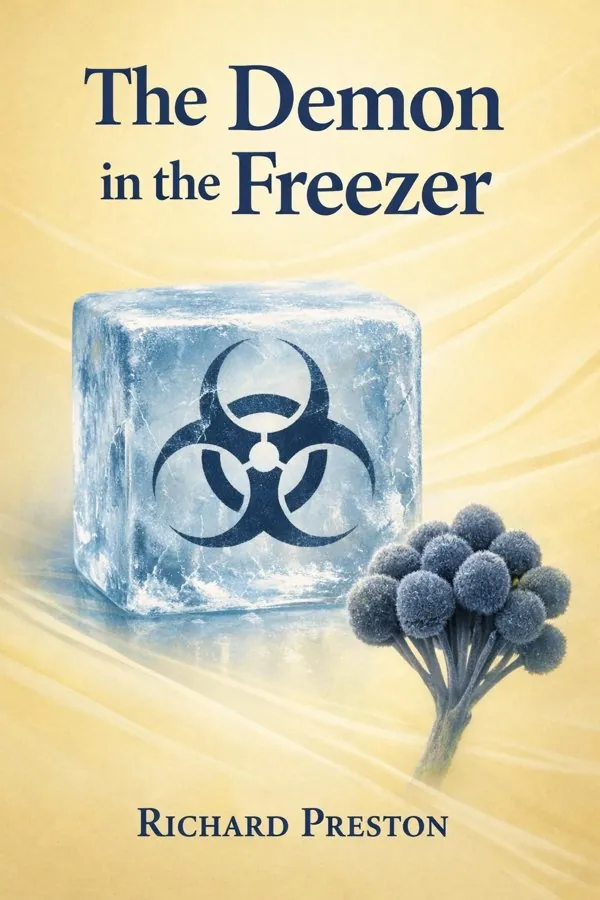
The Demon in the Freezer: Summary & Key Insights
 10 min7 chaptersAudio available
What Is The Demon in the Freezer About?
The Demon in the Freezer by Richard Preston is a popular_sci book spanning 7 pages. The Demon in the Freezer is a nonfiction work by Richard Preston that explores the history and potential dangers of smallpox and anthrax as biological weapons. The book recounts the eradication of smallpox, the retention of virus samples in high-security labs, and the events surrounding the 2001 anthrax attacks in the United States. It delves into the scientific, political, and ethical dilemmas of bioterrorism preparedness and the risks of weaponized pathogens.
This FizzRead summary covers all 7 key chapters of The Demon in the Freezer in approximately 10 minutes, distilling the most important ideas, arguments, and takeaways from Richard Preston's work. Also available as an audio summary and Key Quotes Podcast.
The Demon in the Freezer
The Demon in the Freezer is a nonfiction work by Richard Preston that explores the history and potential dangers of smallpox and anthrax as biological weapons. The book recounts the eradication of smallpox, the retention of virus samples in high-security labs, and the events surrounding the 2001 anthrax attacks in the United States. It delves into the scientific, political, and ethical dilemmas of bioterrorism preparedness and the risks of weaponized pathogens.
Who Should Read The Demon in the Freezer?
This book is perfect for anyone interested in popular_sci and looking to gain actionable insights in a short read. Whether you're a student, professional, or lifelong learner, the key ideas from The Demon in the Freezer by Richard Preston will help you think differently.
- ✓Readers who enjoy popular_sci and want practical takeaways
- ✓Professionals looking to apply new ideas to their work and life
- ✓Anyone who wants the core insights of The Demon in the Freezer in just 10 minutes
Want the full summary?
Get instant access to this book summary and 100K+ more with Fizz Moment.
Get Free SummaryAvailable on App Store • Free to download
Key Chapters
When smallpox was declared eradicated, it was the first—and remains the only—human disease wiped from nature by deliberate human effort. The World Health Organization’s campaign spanned continents and decades, fueled by field workers and scientists who chased the virus to its remotest strongholds. In India, Bangladesh, and the Horn of Africa, smallpox fighters walked into war zones and famine, risking their lives to trace every potential case.
The last known natural case of smallpox—a young hospital cook named Ali Maow Maalin—appeared in 1977 in Somalia. His recovery marked the death cry of a monster. By 1980, the world celebrated the official eradication. Smallpox had killed more people than all the wars of the 20th century combined. Its eradication was thus not only a scientific milestone but a moral one: proof that nations could unite against a microscopic enemy.
But victory sowed new fear. The eradication effort had relied on collecting and preserving virus samples for study. With the disease gone, these samples, kept in laboratories across the world, became relics of power. The WHO ordered nearly all samples destroyed, yet two nations—the United States and the Soviet Union—argued that preservation was essential for research into vaccines and antidotes should smallpox ever reappear. Thus, the virus that had haunted humanity for centuries found a new, paradoxical home—not in the wild, but behind locks and barbed wire.
After smallpox’s eradication, the remaining virus samples were consolidated into two high-security laboratories: the Centers for Disease Control and Prevention (CDC) in Atlanta and the State Research Center of Virology and Biotechnology in Koltsovo, Russia. These facilities were designed to be impervious fortresses, guarded not only by technology but by international trust.
I spoke with scientists who worked within these walls, men and women who felt the weight of history each time they opened a freezer door. The virus rested in glass vials, looking almost innocent, yet capable of reigniting a global nightmare. The debates over destruction versus preservation flared periodically. Advocates for destruction argued that keeping the virus was madness—an invitation to disaster. Those for preservation countered that modern science still had unanswered questions: Could engineered smallpox behave differently? Could its immune-evading genes teach us how to combat future viruses?
In truth, behind the rhetoric lay deeper unease. What if the Soviet Union—or any rogue nation—had secretly retained hidden stocks? Destroying the known samples would then only eliminate our ability to respond. The freezer debate was not about virology; it was about trust in a world where secrecy was currency.
+ 5 more chapters — available in the FizzRead app
All Chapters in The Demon in the Freezer
About the Author
Richard Preston is an American journalist and author known for his works on infectious diseases and biological threats. He has written several bestsellers, including The Hot Zone and The Cobra Event, and is recognized for his ability to translate complex scientific topics into compelling narratives.
Get This Summary in Your Preferred Format
Read or listen to the The Demon in the Freezer summary by Richard Preston anytime, anywhere. FizzRead offers multiple formats so you can learn on your terms — all free.
Available formats: App · Audio · PDF · EPUB — All included free with FizzRead
Download The Demon in the Freezer PDF and EPUB Summary
Key Quotes from The Demon in the Freezer
“When smallpox was declared eradicated, it was the first—and remains the only—human disease wiped from nature by deliberate human effort.”
“These facilities were designed to be impervious fortresses, guarded not only by technology but by international trust.”
Frequently Asked Questions about The Demon in the Freezer
The Demon in the Freezer by Richard Preston is a popular_sci book that explores key ideas across 7 chapters. The Demon in the Freezer is a nonfiction work by Richard Preston that explores the history and potential dangers of smallpox and anthrax as biological weapons. The book recounts the eradication of smallpox, the retention of virus samples in high-security labs, and the events surrounding the 2001 anthrax attacks in the United States. It delves into the scientific, political, and ethical dilemmas of bioterrorism preparedness and the risks of weaponized pathogens.
More by Richard Preston
The Cobra Event
Richard Preston
10 min
The Wild Trees: A Story of Passion and Daring
Richard Preston
10 min
Crisis in the Red Zone: The Story of the Deadliest Ebola Outbreak in History, and of the Outbreaks to Come
Richard Preston
10 min
The Hot Zone: The Terrifying True Story of the Origins of the Ebola Virus
Richard Preston
10 minYou Might Also Like

Structures: Or Why Things Don"t Fall Down
J.E. Gordon
10 min
The Road to Wigan Pier
George Orwell
10 min
Bonk: The Curious Coupling of Science and Sex
Mary Roach
10 min
First Bite: How We Learn to Eat
Bee Wilson
10 min
In Pursuit Of The Unknown: 17 Equations That Changed The World
Ian Stewart
10 min
Napoleon's Buttons: 17 Molecules That Changed History
Penny Le Couteur and Jay Burreson
10 minBrowse by Category
Ready to read The Demon in the Freezer?
Get the full summary and 100K+ more books with Fizz Moment.