
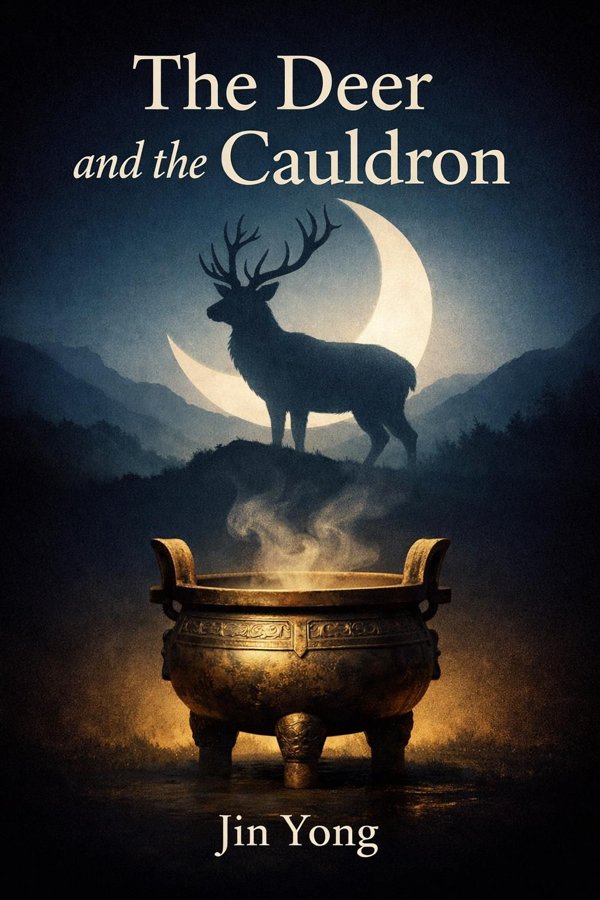
The Deer and the Cauldron: Summary & Key Insights
by Jin Yong
 10 min8 chapters
Key Takeaways from The Deer and the Cauldron
Character is often forged long before ambition arrives.
Power becomes most dangerous when it wears the face of intimacy.
Raw force may seize a room, but intelligence decides who leaves it alive.
A divided heart often reveals more truth than a pure ideology.
The surest way to reveal false grandeur is to laugh at it.
What Is The Deer and the Cauldron About?
The Deer and the Cauldron by Jin Yong is a classics book spanning 7 pages. The Deer and the Cauldron is Jin Yong’s final novel, and in many ways his boldest. Set during the early Qing dynasty, it follows Wei Xiaobao, a boy raised in the rough, deceptive world of a Yangzhou brothel who improbably rises through the imperial court, secret societies, and dangerous political intrigues. Unlike Jin Yong’s earlier martial-arts heroes, Wei Xiaobao is not noble, disciplined, or physically formidable. He survives through nerve, humor, improvisation, and an almost supernatural ability to read people’s desires. That choice transforms the novel into something more than an adventure story: it becomes a brilliant satire of heroism, power, and moral certainty. What makes the book endure is its refusal to separate comedy from insight. Through Wei Xiaobao’s scandals, friendships, and betrayals, Jin Yong examines loyalty, ambition, corruption, and the absurd theater of politics. The novel questions whether success belongs to the righteous or merely to the adaptable. Jin Yong writes with exceptional authority as both a master storyteller and a deeply informed interpreter of Chinese history and culture, creating a work that is at once entertaining, historical, ironic, and profoundly human.
This FizzRead summary covers all 8 key chapters of The Deer and the Cauldron in approximately 10 minutes, distilling the most important ideas, arguments, and takeaways from Jin Yong's work.
The Deer and the Cauldron
The Deer and the Cauldron is Jin Yong’s final novel, and in many ways his boldest. Set during the early Qing dynasty, it follows Wei Xiaobao, a boy raised in the rough, deceptive world of a Yangzhou brothel who improbably rises through the imperial court, secret societies, and dangerous political intrigues. Unlike Jin Yong’s earlier martial-arts heroes, Wei Xiaobao is not noble, disciplined, or physically formidable. He survives through nerve, humor, improvisation, and an almost supernatural ability to read people’s desires. That choice transforms the novel into something more than an adventure story: it becomes a brilliant satire of heroism, power, and moral certainty.
What makes the book endure is its refusal to separate comedy from insight. Through Wei Xiaobao’s scandals, friendships, and betrayals, Jin Yong examines loyalty, ambition, corruption, and the absurd theater of politics. The novel questions whether success belongs to the righteous or merely to the adaptable. Jin Yong writes with exceptional authority as both a master storyteller and a deeply informed interpreter of Chinese history and culture, creating a work that is at once entertaining, historical, ironic, and profoundly human.
Who Should Read The Deer and the Cauldron?
This book is perfect for anyone interested in classics and looking to gain actionable insights in a short read. Whether you're a student, professional, or lifelong learner, the key ideas from The Deer and the Cauldron by Jin Yong will help you think differently.
- ✓Readers who enjoy classics and want practical takeaways
- ✓Professionals looking to apply new ideas to their work and life
- ✓Anyone who wants the core insights of The Deer and the Cauldron in just 10 minutes
Want the full summary?
Get instant access to this book summary and 100K+ more with Fizz Moment.
Get Free SummaryAvailable on App Store • Free to download
Key Chapters
Character is often forged long before ambition arrives. Jin Yong begins Wei Xiaobao’s story in the brothel district of Yangzhou because that environment teaches him the central skill that will define his life: survival through observation. He grows up among performers, gamblers, clients, cheats, and women who must constantly read mood, status, danger, and opportunity. In such a world, innocence is not a virtue one can afford. Wei Xiaobao learns how language can flatter, distract, seduce, or protect; how appearances conceal motives; and how people are moved less by truth than by vanity, fear, and desire.
This origin matters because it overturns the traditional wuxia model. Most martial heroes are trained in discipline and moral codes. Wei Xiaobao is trained in improvisation. He is not shaped by a monastery or a martial clan, but by a marketplace of illusions. That background explains both his flexibility and his moral ambiguity. He lies easily, but he also understands suffering from below. He is vulgar, but he is rarely naive. His instincts are practical rather than idealistic.
In modern terms, Wei Xiaobao resembles someone who grows up in uncertainty and develops emotional radar stronger than formal credentials. A person from a chaotic family, unstable workplace, or harsh social environment may learn to spot danger, negotiate power, and adapt quickly. Those skills can become strengths, but without reflection they can also turn into manipulation or avoidance.
Jin Yong shows that the same world that coarsens Wei Xiaobao also equips him to survive institutions that would crush more innocent people. His rise begins not with glory, but with street education.
Actionable takeaway: Pay attention to the hidden skills your background gave you. What once helped you survive may also be your greatest advantage—if you learn to use it consciously rather than defensively.
Power becomes most dangerous when it wears the face of intimacy. One of the novel’s most fascinating relationships is the bond between Wei Xiaobao and the young Kangxi Emperor. Their friendship begins almost playfully, before court hierarchy fully hardens the space between them. Wei Xiaobao’s spontaneity and irreverence make him unlike the flatterers and ritual-bound officials surrounding the emperor, while Kangxi’s intelligence and burdened solitude make him receptive to genuine companionship. Their connection gives the novel much of its emotional tension.
Yet this friendship is never simple. Kangxi is both a boy and the Son of Heaven; Wei Xiaobao is both loyal companion and instinctive opportunist. Each trusts the other, but each also belongs to systems that make trust unstable. Kangxi needs capable allies to consolidate rule. Wei Xiaobao needs proximity to power to survive and advance. Their affection is real, but it is constantly tested by secrets, political demands, and divided allegiances.
Jin Yong uses this bond to ask whether personal loyalty can survive institutional power. In everyday life, similar tensions arise when friendship overlaps with hierarchy: a founder and early employee, a politician and longtime adviser, a manager and trusted confidant. Warmth may exist, but roles distort honesty. The person with less power may protect themselves through concealment; the person with more power may mistake loyalty for consent.
Wei Xiaobao’s relationship with Kangxi is compelling because it remains human even when politics intrudes. He is one of the few people who can speak to the emperor as a person, but he can never forget that this person can command death. That tremor beneath trust gives the friendship its complexity.
Actionable takeaway: When friendship and power intersect, name the imbalance honestly. Real trust depends not only on affection, but on recognizing what each side can risk, lose, or conceal.
Raw force may seize a room, but intelligence decides who leaves it alive. The confrontation involving Oboi, the powerful regent-like figure whose influence threatens Kangxi’s authority, demonstrates one of the novel’s governing principles: political victory often belongs not to the strongest, but to the one who best understands timing, ego, and leverage. Wei Xiaobao is no warrior in the classic sense. He cannot defeat giants through superior martial arts. Instead, he survives by reading currents others dismiss.
The struggle around Oboi reveals the difference between visible power and actual control. Oboi represents blunt authority, backed by intimidation and status. Wei Xiaobao contributes not by overpowering him, but by operating within gaps that stronger men ignore. He becomes useful because he is underestimated. That is one of Jin Yong’s recurring insights: systems often protect themselves against open enemies while remaining vulnerable to the quick-witted insider who appears harmless.
This lesson extends well beyond imperial politics. In organizations, the loudest person is not always the most influential. A junior employee who knows information flows, personal incentives, and unspoken tensions may shape outcomes more effectively than a domineering executive. In negotiations, understanding what the other side fears may matter more than asserting your own position. In conflict, flexibility often defeats rigidity.
Jin Yong does not romanticize cleverness, however. Cunning can preserve justice in one moment and excuse moral compromise in the next. Wei Xiaobao’s talent is effective precisely because it is morally flexible. That makes him powerful, but not entirely admirable.
The Oboi episode shows a world where institutions are unstable and survival depends on reading power as performance. Strength impresses. Cleverness endures.
Actionable takeaway: In any conflict, look beyond who seems strongest. Ask who controls information, timing, and perception. Those hidden advantages usually determine the outcome.
A divided heart often reveals more truth than a pure ideology. Wei Xiaobao’s involvement with the Heaven and Earth Society places him at the center of one of the novel’s deepest conflicts: competing loyalties that cannot be reconciled without betrayal. The society represents anti-Qing resistance and a moral claim rooted in Han Chinese restoration. At the same time, Wei Xiaobao serves the Qing emperor personally and with genuine attachment. He is caught between political righteousness and human relationship.
Jin Yong uses this conflict to move beyond simple patriotism. In a more conventional story, the hero would discover the “correct” side and sacrifice everything for it. Wei Xiaobao cannot do that, partly because he lacks ideological purity, but also because real life is rarely so tidy. He sees virtue and danger on both sides. The secret society can be brave, loyal, and principled, yet also rigid and conspiratorial. The imperial court can be oppressive and corrupt, yet also contain intelligence, reform, and personal bonds. Wei Xiaobao survives because he refuses to become entirely possessed by any single doctrine.
This tension feels modern. Many people live within overlapping identities: loyalty to family versus profession, nation versus conscience, political ideals versus personal relationships. The pressure to choose a side completely can flatten reality. Jin Yong suggests that moral life is often less about total purity than about navigating competing obligations without becoming spiritually numb.
Wei Xiaobao’s balancing act is risky and ethically unstable. He often avoids catastrophe through improvisation rather than principle. But his predicament exposes a truth: institutions demand total loyalty most loudly when reality is morally mixed.
Actionable takeaway: When torn between groups or values, resist the urge to simplify too quickly. Write down your actual obligations, the human stakes on each side, and the harms each choice creates before deciding where you stand.
The surest way to reveal false grandeur is to laugh at it. The Deer and the Cauldron is often remembered for adventure and intrigue, but its deepest force comes from satire. Jin Yong dismantles the solemnity of political authority, martial heroism, and moral posturing by placing at the center of the story a protagonist who is unrefined, opportunistic, and comically practical. Through Wei Xiaobao, grand institutions are shown to be run not by pure ideals, but by insecurity, appetite, ritual, vanity, and accident.
This satirical lens distinguishes the novel from more straightforward wuxia narratives. Officials speak of loyalty while pursuing self-interest. rebels invoke justice while maneuvering for advantage. Warriors cling to codes that reality constantly humiliates. Even success often looks accidental from the inside. The world is full of titles, ceremonies, and reputations, yet beneath them people remain startlingly ordinary: frightened, desirous, greedy, sentimental, and inconsistent.
Satire here is not mere mockery. It is diagnosis. By refusing to idealize power, Jin Yong teaches readers to look at institutions with clear eyes. In modern life, this skill matters everywhere: in politics, corporate culture, academia, even activism. Slogans may conceal incentives. Prestige may hide incompetence. Public morality may coexist with private absurdity. Humor can become a tool for intellectual honesty.
At the same time, the novel never suggests that nothing matters. Satire is not nihilism. Human bonds still matter. Consequences are still real. Laughter strips away illusion so we can see the moral stakes more clearly, not less.
By making his least heroic protagonist the perfect guide to elite hypocrisy, Jin Yong accomplishes something rare: he entertains the reader while educating their skepticism.
Actionable takeaway: The next time an institution presents itself as noble and unquestionable, ask what human motives might be operating underneath. A little honest humor can protect you from blind reverence.
Romantic abundance does not simplify the heart; it exposes its contradictions. Wei Xiaobao’s relationships with multiple women are often read as comic, scandalous, or purely entertaining, but Jin Yong uses them to explore desire, status, tenderness, and the instability of loyalty. Each woman in Wei Xiaobao’s life reflects a different social world, emotional need, or aspect of his identity. These relationships are not interchangeable trophies. Together they reveal the fragmented self of a man who adapts constantly and belongs nowhere completely.
Wei Xiaobao is affectionate, impulsive, evasive, and often selfish. He can inspire devotion without offering moral consistency. That is precisely the point. Love in this novel is not a reward for virtue, nor a clean expression of destiny. It is entangled with class mobility, protection, fantasy, survival, and emotional hunger. Some relationships carry sincerity; others are shaped by deception, chance, or circumstance. Yet the accumulation of these bonds creates responsibility, and responsibility gradually limits Wei Xiaobao’s freedom.
In practical terms, the novel reminds us that every relationship generates duties, whether or not we formally acknowledge them. A person who says yes too often—to romance, collaboration, friendship, or family obligation—may feel powerful in the moment, but later discover they are carrying incompatible expectations. Modern readers can recognize this in overcommitted emotional lives, blurred boundaries, or the desire to be everything to everyone.
Jin Yong neither simply celebrates nor condemns Wei Xiaobao’s romantic world. Instead, he shows how desire complicates identity. The more attachments one has, the harder it becomes to act with clarity, because every decision affects multiple people differently.
Actionable takeaway: Treat affection as a source of responsibility, not just pleasure. Before making promises, ask whether you can honor the obligations your closeness creates.
Sometimes the clearest sign of wisdom is knowing when success has become a trap. After navigating court politics, secret societies, danger, wealth, and personal entanglements, Wei Xiaobao moves toward retreat rather than triumph. This ending matters because it rejects the fantasy that endless ascent brings fulfillment. He has gained what many people chase—access, influence, riches, notoriety—yet the novel suggests that accumulation eventually produces exhaustion, exposure, and inner emptiness.
Wei Xiaobao’s retreat is not the serene enlightenment of a saint. It is more practical, almost instinctive, and therefore more believable. He senses that the worlds he has managed to balance cannot remain balanced forever. Political systems grow more demanding. Secrets become heavier. Personal networks become harder to maintain. The skills that enabled his rise—evasiveness, improvisation, duplicity—cannot guarantee peace. Withdrawal becomes a form of self-preservation and, perhaps, his closest approach to wisdom.
This resonates strongly today. Many people spend years chasing advancement only to discover that each new success expands their obligations faster than their freedom. Promotions bring surveillance, prestige brings pressure, and influence attracts enemies. A strategic retreat—a career shift, slower pace, changed ambition, or refusal of one more ladder—can be an intelligent response rather than a failure.
Jin Yong does not idealize retirement into purity. Wei Xiaobao remains himself, with all his contradictions. But the novel’s ending asks a serious question: what is the point of winning if winning destroys the possibility of living? In that sense, retreat becomes the final critique of power.
Actionable takeaway: Define in advance what “enough” looks like for you. If you never set a limit to ambition, success can quietly turn into captivity.
A genre reveals its deepest assumptions when someone breaks its rules. One of Jin Yong’s most radical achievements in The Deer and the Cauldron is his creation of a protagonist who overturns the classic wuxia ideal. Wei Xiaobao is not a disciplined martial artist, a righteous avenger, or a seeker of transcendence through combat. He avoids danger when possible, cheats when useful, flatters strategically, and values comfort more than heroic sacrifice. Yet he remains irresistibly compelling.
By making such a character central, Jin Yong questions the mythology of heroism that his own earlier novels helped define. What if moral grandeur is less common than stories pretend? What if history is shaped not only by warriors and sages, but by hustlers, survivors, and socially intelligent opportunists? Wei Xiaobao’s success suggests that in unstable times, adaptability may be more realistic than purity.
This antiheroic turn has broad relevance. Modern audiences are often suspicious of flawless protagonists because real life rarely rewards ideal behavior cleanly. We recognize people who survive through humor, networking, emotional intelligence, and strategic compromise. Wei Xiaobao feels psychologically true even when his adventures are extravagant. He embodies a world where good outcomes may emerge from bad habits and where charm can substitute for virtue.
Importantly, Jin Yong does not fully endorse him. The antihero lens illuminates social reality, but it also leaves moral discomfort in place. Readers are invited to enjoy Wei Xiaobao while questioning what his success says about the world around him.
That tension is the novel’s brilliance. It expands wuxia from a celebration of honor into a meditation on survival, performance, and compromised humanity.
Actionable takeaway: When evaluating success—your own or others’—distinguish between effectiveness and virtue. The fact that a strategy works does not automatically make it admirable.
All Chapters in The Deer and the Cauldron
About the Author
Jin Yong (1924–2018), born Louis Cha Leung-yung in Hangzhou, was a towering Chinese novelist, editor, and cultural intellectual whose works transformed wuxia from popular entertainment into a respected literary genre. Writing with a rare blend of narrative excitement, historical learning, philosophical depth, and emotional intelligence, he created some of the most beloved novels in modern Chinese literature, including The Legend of the Condor Heroes, The Return of the Condor Heroes, Demi-Gods and Semi-Devils, and The Smiling, Proud Wanderer. He also had a major career in journalism and founded influential newspapers in Hong Kong. His fiction has been adapted countless times for television, film, comics, and games. The Deer and the Cauldron, his final novel, is often regarded as his most satirical and formally daring work.
Get This Summary in Your Preferred Format
Read or listen to the The Deer and the Cauldron summary by Jin Yong anytime, anywhere. FizzRead offers multiple formats so you can learn on your terms — all free.
Available formats: App · Audio · PDF · EPUB — All included free with FizzRead
Download The Deer and the Cauldron PDF and EPUB Summary
Key Quotes from The Deer and the Cauldron
“Character is often forged long before ambition arrives.”
“Power becomes most dangerous when it wears the face of intimacy.”
“Raw force may seize a room, but intelligence decides who leaves it alive.”
“A divided heart often reveals more truth than a pure ideology.”
“The surest way to reveal false grandeur is to laugh at it.”
Frequently Asked Questions about The Deer and the Cauldron
The Deer and the Cauldron by Jin Yong is a classics book that explores key ideas across 8 chapters. The Deer and the Cauldron is Jin Yong’s final novel, and in many ways his boldest. Set during the early Qing dynasty, it follows Wei Xiaobao, a boy raised in the rough, deceptive world of a Yangzhou brothel who improbably rises through the imperial court, secret societies, and dangerous political intrigues. Unlike Jin Yong’s earlier martial-arts heroes, Wei Xiaobao is not noble, disciplined, or physically formidable. He survives through nerve, humor, improvisation, and an almost supernatural ability to read people’s desires. That choice transforms the novel into something more than an adventure story: it becomes a brilliant satire of heroism, power, and moral certainty. What makes the book endure is its refusal to separate comedy from insight. Through Wei Xiaobao’s scandals, friendships, and betrayals, Jin Yong examines loyalty, ambition, corruption, and the absurd theater of politics. The novel questions whether success belongs to the righteous or merely to the adaptable. Jin Yong writes with exceptional authority as both a master storyteller and a deeply informed interpreter of Chinese history and culture, creating a work that is at once entertaining, historical, ironic, and profoundly human.
More by Jin Yong
You Might Also Like






Browse by Category
Ready to read The Deer and the Cauldron?
Get the full summary and 100K+ more books with Fizz Moment.