
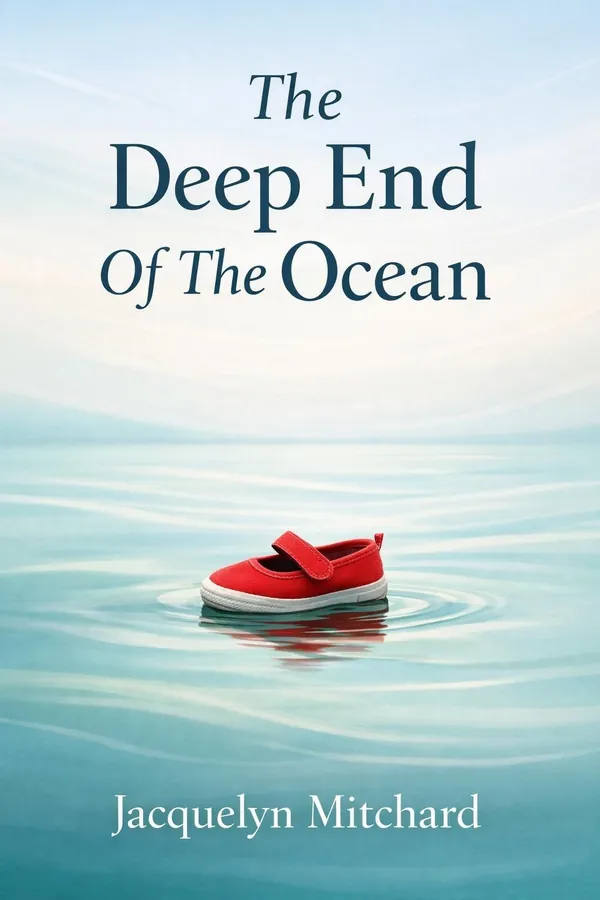
The Deep End Of The Ocean: Summary & Key Insights
 10 min9 chaptersAudio available
Key Takeaways from The Deep End Of The Ocean
The most unsettling stories are often the ones that begin in ordinary life, because they remind us how fragile ordinary life really is.
A life can change in the span of a heartbeat, and the cruelest part is that nothing announces the moment beforehand.
Some tragedies explode loudly, but the deepest ones settle into daily life and stay there.
Loss is unbearable enough, but guilt often turns suffering into self-punishment.
When one family member becomes the center of tragedy, the pain of everyone else can disappear from view.
What Is The Deep End Of The Ocean About?
The Deep End Of The Ocean by Jacquelyn Mitchard is a fiction book. What happens to a family when a single ordinary moment becomes the dividing line between before and after? In The Deep End Of The Ocean, Jacquelyn Mitchard begins with every parent’s private nightmare: a child lost in a crowd. Beth Cappadora turns away for only seconds in a busy hotel lobby, and her three-year-old son Ben disappears. From that devastating premise, Mitchard builds a deeply emotional novel about grief, guilt, marriage, sibling bonds, and the fragile, stubborn resilience of family life. This is not just a mystery about what happened to Ben; it is a portrait of what happens to everyone left behind. The novel matters because it refuses easy answers. It shows how trauma ripples through years, shaping identity, memory, and love in ways that are both painful and recognizably human. Mitchard writes with the authority of a seasoned journalist and storyteller, grounding high-stakes emotion in intimate domestic detail. As her debut novel and the first selection of Oprah’s Book Club, The Deep End Of The Ocean became a landmark work of contemporary fiction because it asks difficult questions many families quietly live with: Can loss ever be repaired? And when the impossible happens, what does healing actually look like?
This FizzRead summary covers all 9 key chapters of The Deep End Of The Ocean in approximately 10 minutes, distilling the most important ideas, arguments, and takeaways from Jacquelyn Mitchard's work. Also available as an audio summary and Key Quotes Podcast.
The Deep End Of The Ocean
What happens to a family when a single ordinary moment becomes the dividing line between before and after? In The Deep End Of The Ocean, Jacquelyn Mitchard begins with every parent’s private nightmare: a child lost in a crowd. Beth Cappadora turns away for only seconds in a busy hotel lobby, and her three-year-old son Ben disappears. From that devastating premise, Mitchard builds a deeply emotional novel about grief, guilt, marriage, sibling bonds, and the fragile, stubborn resilience of family life. This is not just a mystery about what happened to Ben; it is a portrait of what happens to everyone left behind.
The novel matters because it refuses easy answers. It shows how trauma ripples through years, shaping identity, memory, and love in ways that are both painful and recognizably human. Mitchard writes with the authority of a seasoned journalist and storyteller, grounding high-stakes emotion in intimate domestic detail. As her debut novel and the first selection of Oprah’s Book Club, The Deep End Of The Ocean became a landmark work of contemporary fiction because it asks difficult questions many families quietly live with: Can loss ever be repaired? And when the impossible happens, what does healing actually look like?
Who Should Read The Deep End Of The Ocean?
This book is perfect for anyone interested in fiction and looking to gain actionable insights in a short read. Whether you're a student, professional, or lifelong learner, the key ideas from The Deep End Of The Ocean by Jacquelyn Mitchard will help you think differently.
- ✓Readers who enjoy fiction and want practical takeaways
- ✓Professionals looking to apply new ideas to their work and life
- ✓Anyone who wants the core insights of The Deep End Of The Ocean in just 10 minutes
Want the full summary?
Get instant access to this book summary and 100K+ more with Fizz Moment.
Get Free SummaryAvailable on App Store • Free to download
Key Chapters
The most unsettling stories are often the ones that begin in ordinary life, because they remind us how fragile ordinary life really is. The Deep End Of The Ocean is built on that tension: the comfort of family routines set against the sudden, shattering rupture of loss. Jacquelyn Mitchard is not merely telling the story of a missing child; she is examining what happens when love is forced to coexist with absence, guilt, anger, and the impossible demand to keep living.
At the center of the novel is the Cappadora family, whose lives are split into two eras by Ben’s disappearance. Mitchard treats this event not as a plot device but as an emotional earthquake. Beth’s grief is not tidy or noble. Pat’s steadiness is not simple strength. Their surviving children are not untouched witnesses. Each family member becomes a case study in how trauma reshapes identity. In this sense, the novel is less about a crime than about the anatomy of endurance.
What makes the book especially powerful is its refusal to offer sentimental shortcuts. Love does not erase blame. Time does not fully heal. Reunion does not magically restore what was lost. Instead, Mitchard explores how families reinvent themselves in order to survive. This is why the novel continues to resonate: it captures the messy truth that loving deeply also means risking devastation.
In practical terms, the book invites readers to think about their own relationships. How do families carry pain differently? How does silence become part of survival? And how can compassion exist without perfect resolution? Whether in parenting, marriage, or friendship, the novel suggests that crises do not only reveal who we are; they force us to become someone new.
Actionable takeaway: Reflect on one relationship in your life that has been shaped by unspoken pain, and begin one honest conversation that replaces assumption with empathy.
A life can change in the span of a heartbeat, and the cruelest part is that nothing announces the moment beforehand. Beth Cappadora arrives at her high school reunion in Chicago with her children, tired but buoyed by the ordinary chaos of motherhood. Then, in the crowded hotel lobby, she turns away briefly, and Ben is gone. Mitchard renders the scene with devastating realism: no melodrama, no grand warning, just the banal conditions in which catastrophe often occurs.
This opening matters because it captures a truth many people resist: disaster often enters through normality. Beth is not reckless or unloving. She is distracted for seconds, as any parent might be. That is exactly why the novel hits so hard. It dismantles the comforting belief that terrible things happen only to careless people. By doing so, Mitchard places readers in a morally uncomfortable but emotionally honest position. We cannot distance ourselves from Beth; we can imagine being her.
The disappearance also creates the emotional architecture for everything that follows. The family’s future is defined not just by Ben’s absence but by the unresolved questions surrounding that absence. Where is he? Is he alive? Could Beth have prevented it? These questions become more than plot engines; they become emotional prisons.
Beyond fiction, this scene offers a broader insight into how humans respond to sudden loss. In the immediate aftermath of crisis, people often replay the event obsessively, searching for the one altered choice that might have changed everything. Mitchard understands this instinct and portrays it with painful accuracy. Beth’s memory of those seconds becomes both evidence and torment.
Actionable takeaway: When judging your own past mistakes, resist the illusion that hindsight makes you morally clearer than you were in the moment; practice self-compassion alongside accountability.
Some tragedies explode loudly, but the deepest ones settle into daily life and stay there. After Ben disappears, the Cappadoras endure not only the immediate horror of searching, police attention, and false leads, but also the slower devastation of years without answers. Mitchard is especially perceptive about this stage of grief: the point at which public urgency fades, while private suffering becomes permanent.
Beth and Pat eventually return to Wisconsin, but home no longer feels like home. The loss has changed the emotional temperature of every room. Beth becomes increasingly unreachable, numbing herself and drifting through maternal duties with a mixture of shame and emotional exhaustion. Pat tries to keep the family functioning, yet his competence cannot repair what is broken. Their marriage survives, but survival itself becomes the measure, replacing joy with endurance.
One of the novel’s most important contributions is its portrayal of ambiguous loss, the kind of grief that has no conclusion. Because Ben is missing, not confirmed dead, the family cannot fully mourn or fully hope. This unresolved state affects everyone differently. The surviving children, especially Vincent, are forced to grow up in the shadow of a sibling they cannot compete with because he has become an idealized absence. Mitchard shows how silence enters family life: not because people have nothing to say, but because every conversation seems too painful to finish.
This insight applies well beyond the story. Many families live with forms of emotional ambiguity: estrangement, addiction, disappearance, mental illness, or unresolved betrayal. The pain persists precisely because there is no clean ending. The novel demonstrates that unhealed wounds do not remain still; they shape habits, moods, and roles over time.
Actionable takeaway: If you are living with unresolved grief, create one small ritual of acknowledgment, such as journaling, therapy, or a shared family remembrance, so silence does not become your only coping mechanism.
Loss is unbearable enough, but guilt often turns suffering into self-punishment. In Beth’s case, Ben’s disappearance is followed by a corrosive belief that she failed in the most basic duty of motherhood: to protect her child. Mitchard portrays this guilt as something larger than regret. It becomes an identity, a lens through which Beth interprets her marriage, her parenting, and even her right to be comforted.
This is one of the novel’s most psychologically accurate insights. People affected by trauma frequently create narratives of personal responsibility, even when circumstances were chaotic and beyond their control. Doing so can feel perversely comforting because blame offers an illusion of order. If I caused it, then perhaps the world is not random. Mitchard exposes the cost of that logic. Beth’s guilt isolates her from Pat, distances her from her remaining children, and traps her in a version of motherhood defined by failure rather than love.
The novel also shows how guilt affects relationships. Loved ones often want the grieving person to let go, but guilt can become entwined with loyalty. To forgive oneself may feel like betraying the missing child. Beth’s struggle therefore is not just emotional but moral in her own mind. She believes pain is the price she must continue to pay.
Readers can recognize this pattern in everyday life, even outside extreme tragedy. A parent blames themselves for a child’s struggles. A partner rewrites a breakup as entirely their fault. A family member relives a final conversation after someone dies. While responsibility matters, obsessive self-condemnation rarely produces healing.
Mitchard’s deeper point is that guilt can honor the past only up to a point. After that, it begins to consume the living. Recovery requires distinguishing between grief, which acknowledges love, and guilt, which often distorts it.
Actionable takeaway: When guilt follows a painful event, write down what was truly within your control and what was not; this simple boundary can interrupt destructive self-blame.
When one family member becomes the center of tragedy, the pain of everyone else can disappear from view. One of the most quietly powerful aspects of The Deep End Of The Ocean is its attention to the surviving children, especially Vincent. Mitchard understands that trauma does not affect only the person most obviously wounded. It radiates outward, reorganizing family roles and emotional attention.
Vincent, Ben’s older brother, carries a particularly painful burden. He was with Ben in the hotel before the disappearance, and he grows up under a cloud of indirect association with the event. Whether or not anyone openly blames him, he internalizes the family’s tension. At the same time, he must live with the impossible fact that the missing child becomes emotionally larger than the children who remain. In many grieving families, the absent person occupies a sacred place that no living sibling can safely challenge.
Mitchard’s portrayal of Vincent reveals how children adapt to instability. Some become high achievers. Some act out. Some learn to disappear emotionally because they sense there is no room for their needs. Vincent’s struggles remind readers that children are acutely sensitive to what adults do not say. They notice the comparison, the silence, the parental distance, and the uneven distribution of grief.
This theme has broad relevance. In families dealing with illness, addiction, divorce, or loss, the “well” child or the “easy” child is often expected to cope quietly. But unaddressed pain does not vanish. It often returns later as resentment, anxiety, or fractured identity.
By widening the emotional frame beyond Beth and Ben, Mitchard makes the novel more truthful. Family trauma is never singular. Even when one event dominates the narrative, every member lives a different version of the same catastrophe.
Actionable takeaway: If your family has been shaped by crisis, check in intentionally with the people who seemed to manage best; they may be carrying the most invisible grief.
We often imagine reunion as the end of suffering, but Mitchard’s boldest insight is that getting someone back does not return the life that was lost. Years after Ben’s disappearance, a boy living in the Cappadoras’ neighborhood appears to be connected to the child they lost. What follows is not simple joy but emotional confusion, because the recovered child is no longer the toddler who vanished. He has grown into another identity, under another name, within another family structure.
This part of the novel refuses the sentimental fantasy of perfect recovery. Ben’s return forces everyone to confront a painful truth: time has continued for all of them, but in different ways. Beth has spent years longing for her son. The boy himself has spent years becoming someone else. Pat, Vincent, and the rest of the family have built coping mechanisms around absence. Reunion threatens those mechanisms as much as it fulfills longing.
Mitchard is especially strong in showing that love alone cannot solve the problem. Biology matters, memory matters, and attachment matters too. The child’s sense of self has been shaped by the life he remembers, not the one the Cappadoras remember for him. In other words, family is not only a fact of blood; it is also a history of daily care.
This idea applies widely. People often believe that when a relationship is repaired, things should return to normal. But after betrayal, estrangement, or long separation, normal no longer exists. The goal cannot be restoration of the past. It must be the creation of a new relationship that acknowledges what happened.
The novel’s honesty here is what makes it lasting. It tells readers that miracle moments still arrive with grief attached. Healing is not reversal.
Actionable takeaway: When rebuilding an important relationship after long distance or rupture, focus less on getting back what was and more on learning who the other person is now.
Blood creates ties, but everyday care gives those ties meaning. One of the central moral tensions in The Deep End Of The Ocean lies in the question of what makes a family legitimate. When Ben reenters the orbit of the Cappadoras, he does so not as a blank slate but as a child formed by years of routine, attachment, and memory outside their home. Mitchard uses this conflict to challenge simplistic ideas about belonging.
For Beth, motherhood has always been rooted in birth, memory, and longing. For Ben, however, family has been defined by who packed his lunch, kissed his injuries, corrected his homework, and tucked him in at night. These two truths collide painfully. The novel does not dismiss biological connection; instead, it insists that emotional bonds built over time are equally real. That is what makes the situation so heartbreaking. No resolution can fully honor one truth without injuring another.
This theme broadens the novel’s relevance beyond its plot. Many modern families are formed through adoption, remarriage, guardianship, fostering, step-parenting, and chosen kinship. Mitchard’s story speaks to anyone who has wrestled with the difference between legal, biological, and emotional parenthood. It reminds readers that love is not abstract. It is enacted repeatedly through presence.
The book also warns against possessiveness disguised as love. Beth’s challenge is not simply to reclaim Ben, but to love him in a way that recognizes his lived experience. True family feeling demands humility: the willingness to accept that someone you love has attachments you did not create.
In daily life, this insight encourages a more generous view of caregiving. The people who show up consistently often become central to our emotional lives, whether or not they fit conventional definitions.
Actionable takeaway: Strengthen your closest relationships by practicing one concrete form of dependable presence each week, because trust grows more through repetition than declaration.
Shared suffering does not automatically unite people; sometimes it drives them into separate emotional countries. The marriage between Beth and Pat Cappadora is one of the novel’s most compelling undercurrents because it shows how partners can love each other deeply and still grieve in ways that feel mutually alien. Mitchard understands that after trauma, intimacy becomes harder not only because pain is intense, but because pain is differently expressed.
Beth’s grief is erratic, consuming, and often self-destructive. Pat’s is quieter, more functional, and directed toward stability. Neither response is inherently right or wrong, yet their differences create misunderstanding. Beth may experience Pat’s steadiness as emotional distance. Pat may experience Beth’s volatility as abandonment of the family still present. The marriage becomes another site where the central question of the novel plays out: how do people remain connected when they no longer inhabit the same emotional reality?
This portrayal is realistic and useful because many couples assume love should produce synchronized healing. In fact, one partner may want to talk constantly while the other withdraws. One may seek therapy, faith, or medication; the other may focus on work and routine. Trouble begins when differing coping styles are interpreted as lack of care.
Mitchard does not romanticize the strain. She shows the resentment, fatigue, and loneliness that grief introduces into marriage. Yet she also suggests that endurance is possible when partners make room for each other’s imperfect survival strategies. The strongest relationships are not those untouched by crisis, but those willing to renegotiate what support looks like.
Outside the novel, this is an important lesson for any long-term partnership facing illness, loss, or upheaval. Emotional compatibility is not sameness. It is the ability to stay curious about each other under pressure.
Actionable takeaway: In difficult seasons, ask your partner directly, “What does support look like for you right now?” rather than assuming your own coping style is universal.
The hardest truth in The Deep End Of The Ocean is that healing does not mean returning to innocence. By the end of the novel, what emerges is not a repaired family in the traditional sense, but a family learning to live with what cannot be undone. Mitchard’s final emotional argument is that survival depends on accepting complexity rather than chasing impossible purity: joy mixed with grief, reunion mixed with estrangement, love mixed with anger.
This matters because many stories about trauma promise catharsis through closure. Mitchard offers something more mature. Closure, in the complete sense, is unavailable. Ben cannot become the child he was. Beth cannot become the mother she was before the loss. Vincent cannot recover the childhood lived under absence. Even justice cannot erase the years that shaped all of them. What remains possible is not erasure, but integration.
To integrate trauma is to stop measuring healing by how closely life resembles the past. Instead, healing becomes the capacity to hold contradictory truths without collapsing. Beth can love Ben and still grieve the years lost. Ben can care for the Cappadoras and still feel loyalty to the life he knew. Family members can move forward without pretending they are unscarred.
This insight has practical power. Whether dealing with bereavement, divorce, illness, migration, or personal failure, people often delay recovery by waiting to feel “normal” again. The novel suggests a different path: build a meaningful life that includes the wound rather than denying it.
That is the book’s enduring wisdom. Some experiences permanently alter us. The task is not to become untouched, but to become whole in a new way.
Actionable takeaway: Redefine healing in your own life by asking not “How do I get back to who I was?” but “How do I live fully as who I am now?”
All Chapters in The Deep End Of The Ocean
About the Author
Jacquelyn Mitchard is an American novelist, journalist, and screenwriter whose work often explores the emotional fault lines of family life. She rose to international prominence with her debut novel, The Deep End Of The Ocean, which became a bestseller and was chosen as the very first selection of Oprah’s Book Club. The novel established her reputation for blending page-turning premises with psychological depth and compassionate realism. Before her success in fiction, Mitchard worked extensively in journalism, a background that sharpened her observational skill and grounded narrative style. Over the course of her career, she has written numerous novels, essays, and books for young adult readers, often returning to themes of loss, resilience, motherhood, and redemption. Her storytelling is known for its emotional intensity and strong sense of human complexity.
Get This Summary in Your Preferred Format
Read or listen to the The Deep End Of The Ocean summary by Jacquelyn Mitchard anytime, anywhere. FizzRead offers multiple formats so you can learn on your terms — all free.
Available formats: App · Audio · PDF · EPUB — All included free with FizzRead
Download The Deep End Of The Ocean PDF and EPUB Summary
Key Quotes from The Deep End Of The Ocean
“The most unsettling stories are often the ones that begin in ordinary life, because they remind us how fragile ordinary life really is.”
“A life can change in the span of a heartbeat, and the cruelest part is that nothing announces the moment beforehand.”
“Some tragedies explode loudly, but the deepest ones settle into daily life and stay there.”
“Loss is unbearable enough, but guilt often turns suffering into self-punishment.”
“When one family member becomes the center of tragedy, the pain of everyone else can disappear from view.”
Frequently Asked Questions about The Deep End Of The Ocean
The Deep End Of The Ocean by Jacquelyn Mitchard is a fiction book that explores key ideas across 9 chapters. What happens to a family when a single ordinary moment becomes the dividing line between before and after? In The Deep End Of The Ocean, Jacquelyn Mitchard begins with every parent’s private nightmare: a child lost in a crowd. Beth Cappadora turns away for only seconds in a busy hotel lobby, and her three-year-old son Ben disappears. From that devastating premise, Mitchard builds a deeply emotional novel about grief, guilt, marriage, sibling bonds, and the fragile, stubborn resilience of family life. This is not just a mystery about what happened to Ben; it is a portrait of what happens to everyone left behind. The novel matters because it refuses easy answers. It shows how trauma ripples through years, shaping identity, memory, and love in ways that are both painful and recognizably human. Mitchard writes with the authority of a seasoned journalist and storyteller, grounding high-stakes emotion in intimate domestic detail. As her debut novel and the first selection of Oprah’s Book Club, The Deep End Of The Ocean became a landmark work of contemporary fiction because it asks difficult questions many families quietly live with: Can loss ever be repaired? And when the impossible happens, what does healing actually look like?
You Might Also Like





Browse by Category
Ready to read The Deep End Of The Ocean?
Get the full summary and 100K+ more books with Fizz Moment.