
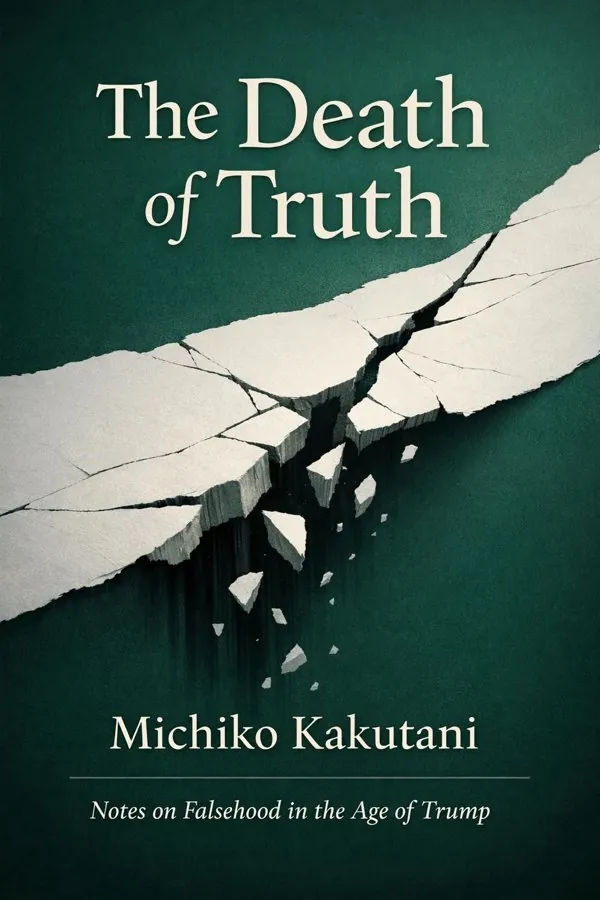
The Death of Truth: Notes on Falsehood in the Age of Trump: Summary & Key Insights
 10 min7 chaptersAudio available
What Is The Death of Truth: Notes on Falsehood in the Age of Trump About?
The Death of Truth: Notes on Falsehood in the Age of Trump by Michiko Kakutani is a politics book spanning 7 pages. In this incisive work, Pulitzer Prize–winning critic Michiko Kakutani examines the erosion of truth in contemporary American society. She explores how political propaganda, social media, and cultural relativism have undermined objective reality, leading to a crisis of trust and reason. Through historical and literary analysis, Kakutani warns of the dangers posed by misinformation and the abandonment of rational discourse.
This FizzRead summary covers all 7 key chapters of The Death of Truth: Notes on Falsehood in the Age of Trump in approximately 10 minutes, distilling the most important ideas, arguments, and takeaways from Michiko Kakutani's work. Also available as an audio summary and Key Quotes Podcast.
The Death of Truth: Notes on Falsehood in the Age of Trump
In this incisive work, Pulitzer Prize–winning critic Michiko Kakutani examines the erosion of truth in contemporary American society. She explores how political propaganda, social media, and cultural relativism have undermined objective reality, leading to a crisis of trust and reason. Through historical and literary analysis, Kakutani warns of the dangers posed by misinformation and the abandonment of rational discourse.
Who Should Read The Death of Truth: Notes on Falsehood in the Age of Trump?
This book is perfect for anyone interested in politics and looking to gain actionable insights in a short read. Whether you're a student, professional, or lifelong learner, the key ideas from The Death of Truth: Notes on Falsehood in the Age of Trump by Michiko Kakutani will help you think differently.
- ✓Readers who enjoy politics and want practical takeaways
- ✓Professionals looking to apply new ideas to their work and life
- ✓Anyone who wants the core insights of The Death of Truth: Notes on Falsehood in the Age of Trump in just 10 minutes
Want the full summary?
Get instant access to this book summary and 100K+ more with Fizz Moment.
Get Free SummaryAvailable on App Store • Free to download
Key Chapters
Long before the age of Trump, the philosophical soil had been loosened for a crisis of truth. In the latter half of the twentieth century, academic movements like postmodernism and cultural relativism questioned whether objective reality even existed. Scholars and theorists argued that all knowledge is mediated by perspective, that facts are linguistic constructs shaped by power, and that truth itself is contingent. These ideas were initially meant to liberate marginalized voices—to challenge dominant narratives and expose ideological biases hidden in claims of universality.
But in their most radical forms, these theories encouraged cynicism. When every statement becomes rhetorically negotiable, every truth collapses into opinion. I trace how these currents drifted from academia into the wider culture, distorting the line between critical thinking and nihilism. The notion that all perspectives are equally valid undermined the very idea of evidence. Once that skepticism escaped the seminar room, it became a cultural habit—a readiness to treat inconvenient facts as just another viewpoint.
I am not condemning intellectual complexity; questioning authority is vital to democracy. Yet there is a difference between examining assumptions and dismantling the concept of truth itself. The unintended consequence was a society that doubted not only power but reality, paving the way for leaders who could mold information into weapon and spectacle.
As cultural relativism spread, subjectivity became celebrated—the self’s perceptions and feelings elevated as the ultimate authority. In literature and art, this produced rich introspection. In politics, it encouraged confusion between emotion and evidence. When I describe the rise of subjectivity in *The Death of Truth*, I point out how media and technology began rewarding personal narratives over verifiable information. The marketplace of ideas no longer asked, 'Is it true?' but 'Does it resonate?'
This shift blurred categories that once provided civic coherence. Journalistic standards weakened under pressure to entertain; political discourse devolved into slogans designed to please echo chambers. The conviction that one’s own feelings were tantamount to truth mutated into the populist battle cry of 'alternative facts.' In such a climate, persuasion no longer rested on proof but on performance.
I illustrate how this trend mirrors the cultural mood of narcissism identified decades ago by Christopher Lasch—a fixation on self-affirmation rather than common reality. The rise of social media magnified this exponentially: the screen became mirror and megaphone, confirming biases and shaming dissent. To counter this drift, we must rediscover humility before evidence—the recognition that truth does not bend to emotion, that empathy requires understanding, not just validation.
+ 5 more chapters — available in the FizzRead app
All Chapters in The Death of Truth: Notes on Falsehood in the Age of Trump
About the Author
Michiko Kakutani is an American literary critic and author, best known for her long tenure as chief book critic for The New York Times, where she won the Pulitzer Prize for Criticism in 1998. Her writing is noted for its clarity, insight, and cultural relevance.
Get This Summary in Your Preferred Format
Read or listen to the The Death of Truth: Notes on Falsehood in the Age of Trump summary by Michiko Kakutani anytime, anywhere. FizzRead offers multiple formats so you can learn on your terms — all free.
Available formats: App · Audio · PDF · EPUB — All included free with FizzRead
Download The Death of Truth: Notes on Falsehood in the Age of Trump PDF and EPUB Summary
Key Quotes from The Death of Truth: Notes on Falsehood in the Age of Trump
“Long before the age of Trump, the philosophical soil had been loosened for a crisis of truth.”
“As cultural relativism spread, subjectivity became celebrated—the self’s perceptions and feelings elevated as the ultimate authority.”
Frequently Asked Questions about The Death of Truth: Notes on Falsehood in the Age of Trump
The Death of Truth: Notes on Falsehood in the Age of Trump by Michiko Kakutani is a politics book that explores key ideas across 7 chapters. In this incisive work, Pulitzer Prize–winning critic Michiko Kakutani examines the erosion of truth in contemporary American society. She explores how political propaganda, social media, and cultural relativism have undermined objective reality, leading to a crisis of trust and reason. Through historical and literary analysis, Kakutani warns of the dangers posed by misinformation and the abandonment of rational discourse.
You Might Also Like
Antifa: The Anti-Fascist Handbook
Mark Bray
10 min
Attack from Within: How Disinformation Is Sabotaging America
Barbara McQuade
10 min
Coercion, Capital, and European States, AD 990–1992
Charles Tilly
10 min
Digital Democracy: Concepts, Methodologies, Tools, and Applications
Various Authors
10 min
Fascism
Stanley G. Payne
10 min
Fire And Fury: Inside The Trump White House
Michael Wolff
10 minBrowse by Category
Ready to read The Death of Truth: Notes on Falsehood in the Age of Trump?
Get the full summary and 100K+ more books with Fizz Moment.