
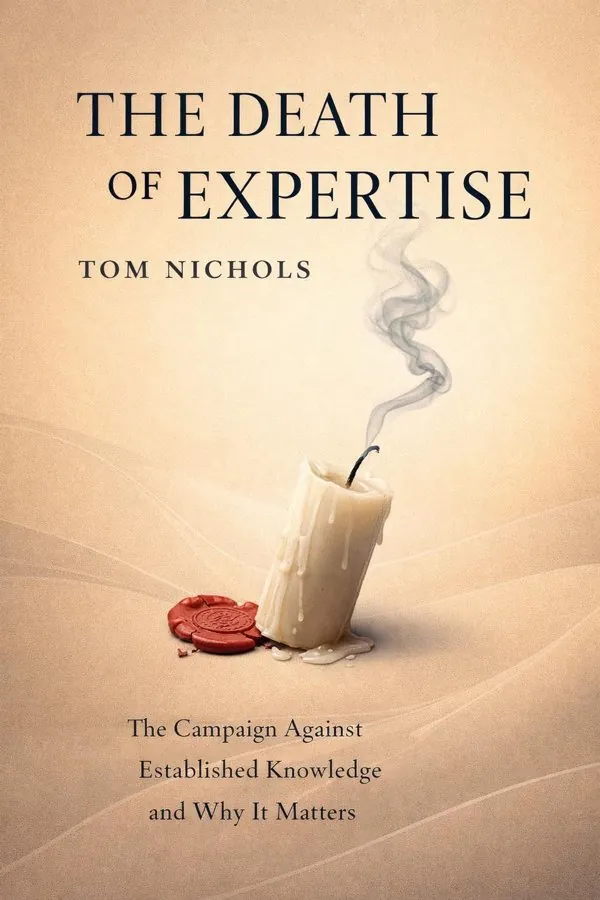
The Death of Expertise: The Campaign Against Established Knowledge and Why It Matters: Summary & Key Insights
by Tom Nichols
 10 min8 chaptersAudio available
What Is The Death of Expertise: The Campaign Against Established Knowledge and Why It Matters About?
The Death of Expertise: The Campaign Against Established Knowledge and Why It Matters by Tom Nichols is a sociology book spanning 8 pages. The Death of Expertise explores the growing rejection of expert knowledge in modern society. Tom Nichols argues that the rise of misinformation, social media, and anti-intellectualism has led to a dangerous erosion of trust in professionals and institutions. The book examines how this phenomenon undermines democracy, public discourse, and decision-making, urging readers to reconsider the value of expertise in an age of opinion-driven culture.
This FizzRead summary covers all 8 key chapters of The Death of Expertise: The Campaign Against Established Knowledge and Why It Matters in approximately 10 minutes, distilling the most important ideas, arguments, and takeaways from Tom Nichols's work. Also available as an audio summary and Key Quotes Podcast.
The Death of Expertise: The Campaign Against Established Knowledge and Why It Matters
The Death of Expertise explores the growing rejection of expert knowledge in modern society. Tom Nichols argues that the rise of misinformation, social media, and anti-intellectualism has led to a dangerous erosion of trust in professionals and institutions. The book examines how this phenomenon undermines democracy, public discourse, and decision-making, urging readers to reconsider the value of expertise in an age of opinion-driven culture.
Who Should Read The Death of Expertise: The Campaign Against Established Knowledge and Why It Matters?
This book is perfect for anyone interested in sociology and looking to gain actionable insights in a short read. Whether you're a student, professional, or lifelong learner, the key ideas from The Death of Expertise: The Campaign Against Established Knowledge and Why It Matters by Tom Nichols will help you think differently.
- ✓Readers who enjoy sociology and want practical takeaways
- ✓Professionals looking to apply new ideas to their work and life
- ✓Anyone who wants the core insights of The Death of Expertise: The Campaign Against Established Knowledge and Why It Matters in just 10 minutes
Want the full summary?
Get instant access to this book summary and 100K+ more with Fizz Moment.
Get Free SummaryAvailable on App Store • Free to download
Key Chapters
To understand the death of expertise, we must first grasp how expertise was born—and how societies once treated it as sacred. For centuries, professional knowledge evolved as a response to complexity. In medicine, law, engineering, or governance, specialized education emerged because no single person could master all fields. Expertise was not an assertion of superiority but a division of intellectual labor in service of the common good.
Democratic societies, especially in the West, traditionally sustained a healthy respect for such authority. In earlier decades, doctors were trusted to diagnose, scientists were admired for their discoveries, and educators were regarded as custodians of truth. Citizens questioned experts, yes, but with deference and an understanding that argument required grounding in evidence.
However, democracy always carried within it a paradox—the tension between equality and knowledge. The American ideal of egalitarianism insisted that all people are created equal, but that notion slowly transformed into the mistaken belief that all opinions are equal too. When people began conflating political equality with intellectual equality, expertise lost its moral standing. This misunderstanding paved the way for populism, where suspicion of elites evolved into hostility toward knowledge itself.
Today, we are living in the culmination of that tension. The respect that earlier generations had for professional insight—a respect earned through study and experience—has been replaced by rampant skepticism. Why? Because in a culture that celebrates individualism, admitting ignorance feels like weakness. And yet, paradoxically, knowledge expands exponentially, making specialized understanding more essential than ever. That irony defines our age: the more we need experts, the more we reject them.
Anti-intellectualism isn’t a modern invention; it’s woven into the fabric of American life. Our cultural heroes are often self-made, pragmatic, skeptical of the ivory tower. We romanticize the inventor tinkering in his workshop or the entrepreneur who “trusts his gut.” This cultural narrative, while celebrating ingenuity, simultaneously nurtures a suspicion of formal learning.
From early populist movements to contemporary politics, the idea that “book smarts” can disconnect a person from common sense has persisted. Yet today, this skepticism has intensified. Americans once distrusted academics but still valued achievement. Now, distrust has evolved into resentment. Expertise is perceived not as service but as exclusion. Specialists are seen as gatekeepers, and every correction offered by a professional is taken as an insult or conspiracy.
I don’t argue that experts are infallible. I readily admit that we make mistakes—sometimes catastrophic ones—and that intellectual arrogance can alienate the public. But there’s a crucial distinction between criticizing expertise and rejecting its very legitimacy. Anti-intellectualism thrives when people stop judging arguments by their content and start evaluating them by how they make us feel. Once emotion replaces reason, truth becomes negotiable.
This cultural evolution didn’t happen in isolation. Television and talk radio encouraged it, simplifying complex ideas into entertainment bites. Politicians exploited it, turning anti-expert rage into electoral fuel. Universities bent under pressure to produce satisfaction rather than enlightenment. It’s a pattern that reshaped the public mind, replacing curiosity with cynicism and humility with defiance. The result is a civic culture that prizes confidence over competence—and that, I believe, is the most dangerous delusion of all.
+ 6 more chapters — available in the FizzRead app
All Chapters in The Death of Expertise: The Campaign Against Established Knowledge and Why It Matters
About the Author
Tom Nichols is an American author, academic, and specialist in international affairs. He is a professor at the U.S. Naval War College and an adjunct professor at Harvard Extension School. Nichols is known for his commentary on political and cultural issues, particularly concerning expertise, democracy, and civic responsibility.
Get This Summary in Your Preferred Format
Read or listen to the The Death of Expertise: The Campaign Against Established Knowledge and Why It Matters summary by Tom Nichols anytime, anywhere. FizzRead offers multiple formats so you can learn on your terms — all free.
Available formats: App · Audio · PDF · EPUB — All included free with FizzRead
Download The Death of Expertise: The Campaign Against Established Knowledge and Why It Matters PDF and EPUB Summary
Key Quotes from The Death of Expertise: The Campaign Against Established Knowledge and Why It Matters
“To understand the death of expertise, we must first grasp how expertise was born—and how societies once treated it as sacred.”
“Anti-intellectualism isn’t a modern invention; it’s woven into the fabric of American life.”
Frequently Asked Questions about The Death of Expertise: The Campaign Against Established Knowledge and Why It Matters
The Death of Expertise: The Campaign Against Established Knowledge and Why It Matters by Tom Nichols is a sociology book that explores key ideas across 8 chapters. The Death of Expertise explores the growing rejection of expert knowledge in modern society. Tom Nichols argues that the rise of misinformation, social media, and anti-intellectualism has led to a dangerous erosion of trust in professionals and institutions. The book examines how this phenomenon undermines democracy, public discourse, and decision-making, urging readers to reconsider the value of expertise in an age of opinion-driven culture.
You Might Also Like
Between the World and Me
Ta-Nehisi Coates
10 min
Half the Sky
Nicholas D. Kristof, Sheryl WuDunn
10 min
Men Explain Things To Me
Rebecca Solnit
10 min
Rational Ritual
Michael Suk-Young Chwe
10 min
The New Jim Crow
Michelle Alexander
10 min
Beyond Culture
Edward T. Hall
10 minBrowse by Category
Ready to read The Death of Expertise: The Campaign Against Established Knowledge and Why It Matters?
Get the full summary and 100K+ more books with Fizz Moment.