
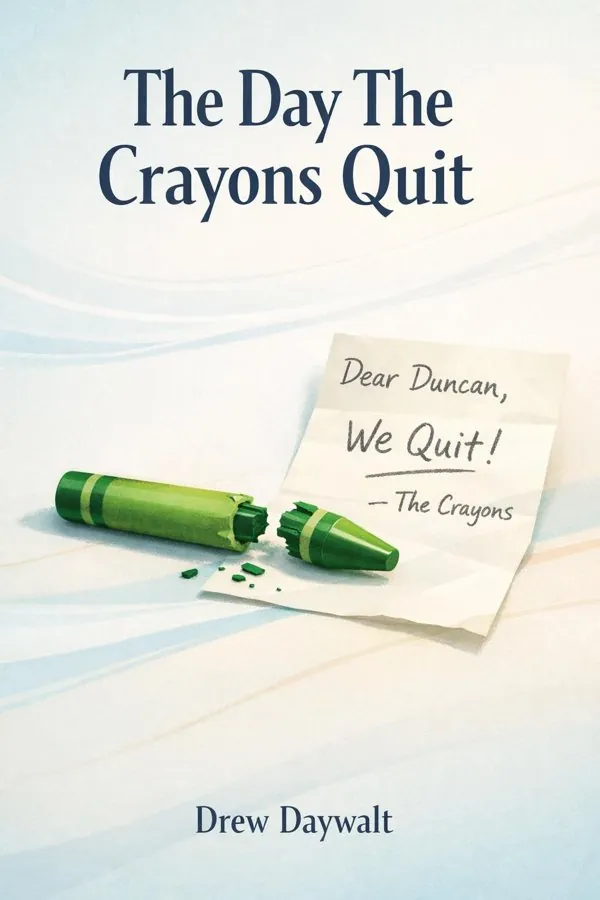
The Day The Crayons Quit: Summary & Key Insights
by Drew Daywalt
 10 min9 chaptersAudio available
Key Takeaways from The Day The Crayons Quit
Every conflict becomes more meaningful when each side gets to speak for itself.
Disagreement is not always a sign of division; often, it reveals how deeply people care about identity and recognition.
Real creativity often begins not with self-expression alone, but with listening.
People are often most willing to confront difficult truths when those truths arrive with a smile.
One of the smartest lessons in the book is that fairness does not mean giving everyone the exact same treatment.
What Is The Day The Crayons Quit About?
The Day The Crayons Quit by Drew Daywalt is a bestsellers book spanning 3 pages. What happens when the tools of creativity decide they are tired of being taken for granted? In The Day The Crayons Quit, Drew Daywalt turns an ordinary crayon box into a miniature workplace rebellion, where every color has a grievance, a personality, and a dream of better treatment. Duncan, a young boy who simply wants to color, opens his box and discovers letters instead of ready-to-use crayons. One by one, the crayons explain why they are frustrated: some are overworked, some feel neglected, and some are upset about how they are used. What begins as a hilarious premise quickly becomes a clever lesson in empathy, fairness, and creative problem-solving. The book matters because it speaks to children in a language they instantly understand—play, color, and imagination—while quietly teaching emotional intelligence and perspective-taking. It shows that even simple conflicts can hold many sides, and that listening is often the first step toward resolution. Drew Daywalt, celebrated for his inventive storytelling and sharp humor, gives each crayon a distinct voice, while Oliver Jeffers’ illustrations make their personalities unforgettable. Together, they create a picture book that is funny enough for children and insightful enough for adults.
This FizzRead summary covers all 9 key chapters of The Day The Crayons Quit in approximately 10 minutes, distilling the most important ideas, arguments, and takeaways from Drew Daywalt's work. Also available as an audio summary and Key Quotes Podcast.
The Day The Crayons Quit
What happens when the tools of creativity decide they are tired of being taken for granted? In The Day The Crayons Quit, Drew Daywalt turns an ordinary crayon box into a miniature workplace rebellion, where every color has a grievance, a personality, and a dream of better treatment. Duncan, a young boy who simply wants to color, opens his box and discovers letters instead of ready-to-use crayons. One by one, the crayons explain why they are frustrated: some are overworked, some feel neglected, and some are upset about how they are used. What begins as a hilarious premise quickly becomes a clever lesson in empathy, fairness, and creative problem-solving.
The book matters because it speaks to children in a language they instantly understand—play, color, and imagination—while quietly teaching emotional intelligence and perspective-taking. It shows that even simple conflicts can hold many sides, and that listening is often the first step toward resolution. Drew Daywalt, celebrated for his inventive storytelling and sharp humor, gives each crayon a distinct voice, while Oliver Jeffers’ illustrations make their personalities unforgettable. Together, they create a picture book that is funny enough for children and insightful enough for adults.
Who Should Read The Day The Crayons Quit?
This book is perfect for anyone interested in bestsellers and looking to gain actionable insights in a short read. Whether you're a student, professional, or lifelong learner, the key ideas from The Day The Crayons Quit by Drew Daywalt will help you think differently.
- ✓Readers who enjoy bestsellers and want practical takeaways
- ✓Professionals looking to apply new ideas to their work and life
- ✓Anyone who wants the core insights of The Day The Crayons Quit in just 10 minutes
Want the full summary?
Get instant access to this book summary and 100K+ more with Fizz Moment.
Get Free SummaryAvailable on App Store • Free to download
Key Chapters
Every conflict becomes more meaningful when each side gets to speak for itself. That is the brilliant engine of The Day The Crayons Quit: instead of presenting crayons as passive tools, Drew Daywalt gives them voices, opinions, and handwritten letters full of frustration, pride, jealousy, and hope. Duncan expects to spend the day coloring, but instead he finds a stack of notes from his crayons, each explaining why it has quit. Red is exhausted from constant use on fire trucks, apples, and holiday decorations. Beige feels overlooked. Pink wonders why it is barely included at all. Through these letters, the book transforms ordinary colors into fully realized characters.
This structure does more than create humor. It teaches readers that every object, person, or role we take for granted may hold a hidden story. The crayons are not simply colors; they are stand-ins for people who feel overused, underappreciated, ignored, or misrepresented. Children learn that frustration often comes from unmet needs, while adults recognize a sharp satire of workplace complaints and family dynamics.
The letter format also makes the book highly accessible. Each message is short, distinct, and emotionally clear. Young readers can compare tones, identify feelings, and notice how different personalities express themselves. One crayon is dramatic, another insecure, another angry, another politely disappointed. This helps children begin to understand that communication styles vary, even when everyone wants the same basic thing: to be heard.
A practical way to apply this idea is to invite children to imagine what their own belongings might say if they could write letters. A backpack might complain about being stuffed too full. A soccer ball might wish to be used more often. This playful exercise builds empathy by encouraging perspective-taking. The actionable takeaway: when conflict appears, pause and ask what each voice would say if it had the chance to write its own letter.
Disagreement is not always a sign of division; often, it reveals how deeply people care about identity and recognition. In the book, one of the most memorable rivalries appears between Yellow and Orange, both of whom insist that they are the true color of the sun. Their quarrel is funny because it is so familiar: two voices making confident claims, both wanting ownership of something bright, important, and symbolic. Children laugh at the argument, but they also recognize the tension of competing for credit.
This conflict works because it is small enough to understand and large enough to reflect real life. Siblings argue over whose turn it is. Classmates debate who had an idea first. Team members want acknowledgment for their contribution. Yellow and Orange capture that universal need to be seen as special. At the same time, their disagreement reminds readers that many conflicts come from overlap rather than opposition. Both colors belong in the world of sunlight, warmth, and brightness. Their similarity, not their difference, fuels the tension.
The genius of the scene is that it makes room for both competition and companionship. Yellow and Orange are not enemies in a lasting sense. They are colors in the same box, part of the same creative set, forced to coexist. That mirrors many real relationships: we do not get to remove everyone who irritates us, so we must learn to share space with dignity. The book invites readers to understand conflict not as catastrophe but as something that can be navigated with humor and imagination.
A useful application is to ask children after a disagreement, “What does each person want to be recognized for?” This shifts the conversation away from blame and toward underlying needs. The actionable takeaway: when two people are fighting for credit, look for the shared value beneath the argument and name it out loud.
Real creativity often begins not with self-expression alone, but with listening. Duncan starts the story with a simple goal: he wants to color. Yet his crayons interrupt that routine by presenting him with a problem he did not know existed. As he reads their complaints, he is pushed out of a self-centered perspective and into a more thoughtful role. He has to consider how Red feels being overworked, how Black feels confined to outlines, and how Peach feels exposed after losing its paper wrapper. Duncan’s task becomes more than finishing a picture; it becomes understanding the needs of his tools.
This is the emotional turning point of the story. Duncan does not solve the problem by dismissing the crayons, replacing them, or insisting that coloring should continue as usual. Instead, he absorbs their concerns and responds creatively. That combination matters. Empathy without action can remain sentimental, while creativity without empathy can ignore the needs of others. Duncan succeeds because he brings both together.
For young readers, this models a powerful habit: paying attention before solving. In classrooms, children are often encouraged to share, cooperate, and be kind, but this book goes a step further by showing that kindness can lead to innovation. Duncan’s final artwork works precisely because he stops treating the crayons as interchangeable and starts seeing them as individuals with preferences and limitations.
Adults can apply this lesson in collaborative settings. A teacher redesigns a group project after noticing one child dominates while another withdraws. A manager reallocates tasks after hearing that one employee feels overloaded and another underused. Better solutions emerge when people feel understood.
The actionable takeaway: before trying to fix a problem, ask what each person involved is experiencing, then build your solution around those realities instead of around convenience.
People are often most willing to confront difficult truths when those truths arrive with a smile. One reason The Day The Crayons Quit works so beautifully is that its emotional lessons are wrapped in absurdity and comedy. A blue crayon worn down to a nub from coloring oceans and skies is funny. A black crayon annoyed that it is only used for outlines is funny. A peach crayon refusing to come out of the box because its paper wrapper has been peeled off is especially funny. Yet each joke carries a real emotional parallel: burnout, lack of recognition, embarrassment, exclusion.
Humor lowers defenses. Instead of presenting a heavy lecture about feelings, fairness, and self-expression, Daywalt creates delight first. Children laugh at the idea of rebellious crayons, and in that laughter they become open to the deeper message. Adults experience the same effect. We recognize office politics, sibling dynamics, and social hierarchies hidden in the waxy complaints. The humor makes the message memorable instead of preachy.
This is a useful lesson for parents, teachers, and leaders. Difficult conversations do not always need a solemn tone. Sometimes a playful analogy, a gentle joke, or a lighthearted story helps people hear what would otherwise feel like criticism. A child may respond better to “Your shoes are writing me a letter saying they want to be put away” than to repeated scolding. A team may discuss workload more honestly if the issue is introduced with wit rather than accusation.
The book also teaches children that feelings can be expressed without cruelty. The crayons complain strongly, but their voices remain playful, distinctive, and understandable. That balance is important in emotional development.
The actionable takeaway: when addressing frustration or unfairness, try using humor as a bridge—make the truth easier to hear without hiding it.
One of the smartest lessons in the book is that fairness does not mean giving everyone the exact same treatment. Each crayon is unhappy for a different reason. Red wants rest because it is overused. Pink wants more opportunity because it is underused. Black wants a broader role beyond outlining. Beige wants recognition apart from Brown. Peach wants dignity restored after losing its wrapper. If Duncan responded by simply using every crayon for the same amount of time in the same way, he would not actually solve the problem. Their needs are different, so a fair response must be flexible.
This idea is especially valuable for children, who often equate fairness with strict equality. “Why does she get more?” or “Why do I have to do that too?” are common reactions. The crayons offer a vivid way to show that fairness is contextual. A tired crayon does not need more work. An ignored crayon does not need less. What helps one may frustrate another.
In real life, this principle applies everywhere. In classrooms, some students need more encouragement to participate while others need guidance in making room for peers. In families, one child may need extra help with homework while another needs more independence. In workplaces, one team member might thrive with structure while another performs best with autonomy. Good leadership pays attention to differences rather than assuming sameness is always just.
The story normalizes individualized care without making it seem unfair. Duncan’s eventual solution succeeds because he responds to each crayon’s concern in a creative, personalized way. That is a subtle but powerful model of inclusion.
The actionable takeaway: the next time fairness becomes an issue, stop asking whether everyone got the same thing and start asking whether each person got what they actually needed.
Being useful is not the same as being understood. Every crayon in the book has a specific job in Duncan’s world, but the letters reveal that each one also has a sense of identity that goes beyond function. Blue does not only fill oceans; it feels physically worn out. White does not simply disappear on white paper; it feels invisible. Green is proud of getting along and doing its work well. Purple cares deeply about staying inside the lines. These are not generic complaints. They are expressions of personality.
This matters because the story helps children see that roles can become limiting when they ignore individuality. Someone may be known as “the smart kid,” “the quiet one,” or “the athletic one,” but no person wants to be reduced to a single label. The crayons show that even being valued for one’s usefulness can become frustrating if it leaves no room for complexity. Red is appreciated, but exhausted. Pink is appealing, but sidelined. Black is needed, but not fully seen.
The book therefore offers an early lesson in identity and dignity. It tells readers that everyone wants both contribution and recognition. We want to do meaningful work, but we also want our fuller selves acknowledged. This is true in childhood and adulthood. A reliable employee may want to be seen as creative too. A responsible sibling may want time to be silly. A child praised for neatness may want permission to experiment.
One practical application is to ask children and adults alike, “Is there something people expect from you all the time that you wish could be different?” This opens space for more honest self-expression.
The actionable takeaway: look beyond what someone is usually used for and ask who they are, what they enjoy, and what other possibilities they may be longing to explore.
The most satisfying solutions often come from refusing to choose between competing needs. At the end of the book, Duncan does not settle the crayon strike through argument or authority. He creates a new drawing that uses each crayon in surprising ways, honoring their complaints while expanding the possibilities of art itself. The result is not merely a compromise; it is a more imaginative vision. Colors are reassigned, expectations are loosened, and the final picture becomes more original precisely because Duncan listened.
This is a profound lesson in creative problem-solving. Too often, people assume that conflict limits innovation. The book suggests the opposite: when dissatisfaction is examined honestly, it can generate better ideas. Red’s overwork, Pink’s neglect, Black’s frustration, and Orange and Yellow’s rivalry all become sources of new thinking. Duncan’s masterpiece is stronger than his original plan because it incorporates more perspectives.
Children can apply this lesson in art, play, and social situations. If two children both want to lead a game, perhaps they can invent one with alternating roles. If a class project feels unbalanced, responsibilities can be redesigned to match interests and energy levels. Adults can use the same principle in meetings, family planning, and creative work. Instead of asking, “How do we end this complaint?” ask, “What better system could this complaint help us design?”
The book also reinforces that creativity is not just about producing something novel; it is about making room for more voices. Inclusive imagination is often richer than individual control.
The actionable takeaway: when a problem seems full of competing demands, treat those demands as design clues and ask what new solution could satisfy more people rather than forcing a simple win-lose outcome.
Feelings become easier to understand when they are attached to characters children enjoy. One of the great strengths of The Day The Crayons Quit is how naturally it builds emotional literacy. Without using clinical language or explicit instruction, the book introduces frustration, embarrassment, jealousy, exhaustion, pride, loneliness, and hope. Each crayon embodies a feeling in a way that is concrete and memorable. A child may not yet say, “I feel underappreciated,” but they can understand Beige’s complaint about being overlooked next to Brown.
This is why picture books are such powerful teaching tools. They let children explore emotional complexity at a safe distance. It is easier to discuss a peach crayon feeling exposed than to begin with a direct question about a child’s own vulnerability. Once the emotional idea is visible in the story, it can be gently connected to real life. “Have you ever felt left out like Pink?” “Have you ever been tired of always doing the same thing like Red?” These conversations help children build vocabulary for inner experiences.
The book also teaches that emotions are not problems to erase but signals to interpret. The crayons are upset for reasons. Their feelings point to conditions that need attention. This helps children move away from viewing strong feelings as bad behavior and toward understanding them as information.
Teachers and parents can extend this learning through simple activities: matching crayons to emotions, writing response letters to a favorite crayon, or drawing scenes where each color gets a new role. Such exercises blend literacy, art, and social-emotional learning.
The actionable takeaway: use stories as emotional mirrors—after reading, name the feelings each character shows and help children connect those feelings to their own everyday experiences.
Inclusion does not dilute creativity; it deepens it. By the time Duncan responds to the crayons’ strike, the book has quietly built an argument about belonging. Each crayon wants not only fair treatment but meaningful inclusion in Duncan’s artistic world. Some want less pressure, some want more opportunity, and some simply want to be seen differently. Duncan’s final drawing becomes successful because it invites every crayon into the picture with renewed purpose.
This ending carries a larger message about communities of any kind. Classrooms, families, and teams function best when people feel that their differences are not obstacles but contributions. The crayons are varied in personality, status, and usage, yet the most beautiful outcome arrives when their individuality is respected rather than flattened. That idea is simple enough for children and resonant enough for adults.
In practice, this can change how we think about participation. In a classroom, a child who rarely speaks may contribute beautifully through drawing or writing. In a family, one member may be the planner while another brings humor and emotional warmth. In a workplace, a quiet colleague may offer the most original solution once space is made for reflection. The goal is not to make everyone the same kind of contributor but to build a picture large enough for many forms of contribution.
The book reminds us that belonging often begins with invitation and grows through thoughtful use of differences. Art, learning, and relationships all improve when people are allowed to show up as themselves.
The actionable takeaway: in any group project or shared activity, ask whose strengths are being overlooked and redesign the experience so more people can contribute in ways that feel true to them.
All Chapters in The Day The Crayons Quit
About the Author
Drew Daywalt is an American author and filmmaker known for his imaginative, funny, and emotionally sharp storytelling for children. He gained international recognition with The Day The Crayons Quit, a bestselling picture book that turned an everyday box of crayons into a cast of memorable personalities. His work is celebrated for blending child-friendly humor with themes that resonate deeply with adults, including fairness, identity, creativity, and communication. Before becoming widely known as a children’s author, Daywalt worked in film, an experience that helped shape his strong sense of character and comic timing. He has since written sequels and other popular books that continue his playful approach to storytelling. Daywalt stands out for treating young readers as thoughtful, curious people and giving them stories that are as clever as they are entertaining.
Get This Summary in Your Preferred Format
Read or listen to the The Day The Crayons Quit summary by Drew Daywalt anytime, anywhere. FizzRead offers multiple formats so you can learn on your terms — all free.
Available formats: App · Audio · PDF · EPUB — All included free with FizzRead
Download The Day The Crayons Quit PDF and EPUB Summary
Key Quotes from The Day The Crayons Quit
“Every conflict becomes more meaningful when each side gets to speak for itself.”
“Disagreement is not always a sign of division; often, it reveals how deeply people care about identity and recognition.”
“Real creativity often begins not with self-expression alone, but with listening.”
“People are often most willing to confront difficult truths when those truths arrive with a smile.”
“One of the smartest lessons in the book is that fairness does not mean giving everyone the exact same treatment.”
Frequently Asked Questions about The Day The Crayons Quit
The Day The Crayons Quit by Drew Daywalt is a bestsellers book that explores key ideas across 9 chapters. What happens when the tools of creativity decide they are tired of being taken for granted? In The Day The Crayons Quit, Drew Daywalt turns an ordinary crayon box into a miniature workplace rebellion, where every color has a grievance, a personality, and a dream of better treatment. Duncan, a young boy who simply wants to color, opens his box and discovers letters instead of ready-to-use crayons. One by one, the crayons explain why they are frustrated: some are overworked, some feel neglected, and some are upset about how they are used. What begins as a hilarious premise quickly becomes a clever lesson in empathy, fairness, and creative problem-solving. The book matters because it speaks to children in a language they instantly understand—play, color, and imagination—while quietly teaching emotional intelligence and perspective-taking. It shows that even simple conflicts can hold many sides, and that listening is often the first step toward resolution. Drew Daywalt, celebrated for his inventive storytelling and sharp humor, gives each crayon a distinct voice, while Oliver Jeffers’ illustrations make their personalities unforgettable. Together, they create a picture book that is funny enough for children and insightful enough for adults.
More by Drew Daywalt
You Might Also Like
The Godfather
Mario Puzo
10 min
The Handmaid's Tale
Margaret Atwood
10 min
The Hunger Games
Suzanne Collins
10 min
The Nightingale
Kristin Hannah
10 min
The Seven Husbands of Evelyn Hugo
Taylor Jenkins Reid
10 min
Backwater Justice
Fern Michaels
10 minBrowse by Category
Ready to read The Day The Crayons Quit?
Get the full summary and 100K+ more books with Fizz Moment.