
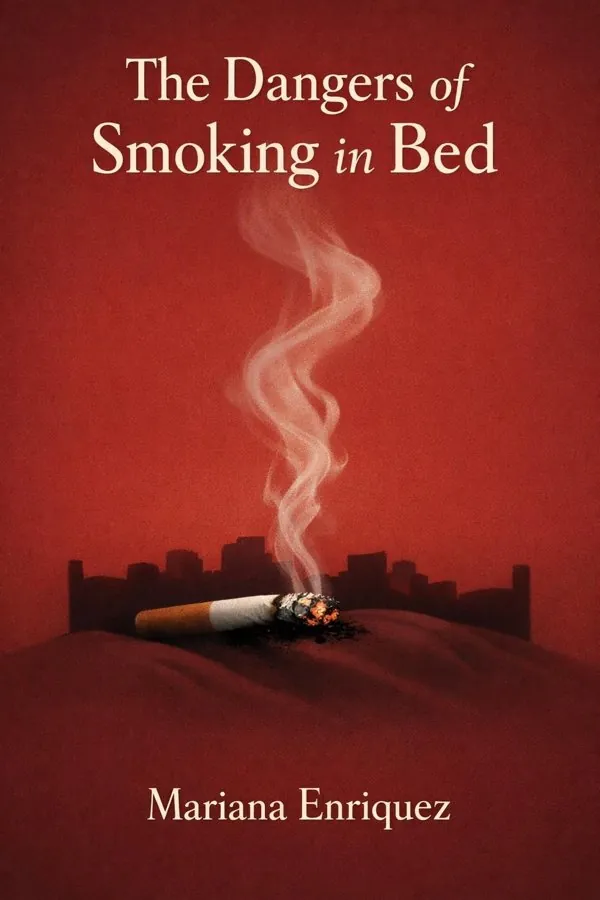
The Dangers of Smoking in Bed: Summary & Key Insights
 10 min10 chaptersAudio available
Key Takeaways from The Dangers of Smoking in Bed
A city can remember what its people try to forget.
What if our deepest fascinations reveal wounds we do not know how to name?
Some ghosts are created by the violence that society normalizes.
Modern fame promises immortality, yet Enriquez shows how quickly it decays into loneliness and grotesque fantasy.
The most frightening house is often the one called home.
What Is The Dangers of Smoking in Bed About?
The Dangers of Smoking in Bed by Mariana Enriquez is a bestsellers book spanning 10 pages. The Dangers of Smoking in Bed is a fiercely atmospheric collection of short stories in which Mariana Enriquez turns everyday Argentina into a landscape of dread. Set largely in Buenos Aires and its neglected outskirts, these stories blend ghosts, urban legends, obsession, poverty, violence, and desire into a form of horror that feels intimate rather than escapist. Enriquez is not interested in monsters that live far away; her monsters emerge from apartment blocks, family homes, train lines, hospitals, cemeteries, and the emotional wreckage left by inequality and cruelty. The result is a book in which the supernatural never distracts from reality but exposes it more sharply. What makes this collection so powerful is the way it uses fear to illuminate social truths. Missing women, damaged children, decaying neighborhoods, class divisions, and inherited trauma all become part of the haunting. Enriquez, one of the most important voices in contemporary Latin American literature, writes with the authority of both a novelist and a journalist attentive to the political textures of modern life. This book matters because it shows that horror can be more than a thrill: it can be a language for grief, memory, and the violence societies try to bury.
This FizzRead summary covers all 10 key chapters of The Dangers of Smoking in Bed in approximately 10 minutes, distilling the most important ideas, arguments, and takeaways from Mariana Enriquez's work. Also available as an audio summary and Key Quotes Podcast.
The Dangers of Smoking in Bed
The Dangers of Smoking in Bed is a fiercely atmospheric collection of short stories in which Mariana Enriquez turns everyday Argentina into a landscape of dread. Set largely in Buenos Aires and its neglected outskirts, these stories blend ghosts, urban legends, obsession, poverty, violence, and desire into a form of horror that feels intimate rather than escapist. Enriquez is not interested in monsters that live far away; her monsters emerge from apartment blocks, family homes, train lines, hospitals, cemeteries, and the emotional wreckage left by inequality and cruelty. The result is a book in which the supernatural never distracts from reality but exposes it more sharply.
What makes this collection so powerful is the way it uses fear to illuminate social truths. Missing women, damaged children, decaying neighborhoods, class divisions, and inherited trauma all become part of the haunting. Enriquez, one of the most important voices in contemporary Latin American literature, writes with the authority of both a novelist and a journalist attentive to the political textures of modern life. This book matters because it shows that horror can be more than a thrill: it can be a language for grief, memory, and the violence societies try to bury.
Who Should Read The Dangers of Smoking in Bed?
This book is perfect for anyone interested in bestsellers and looking to gain actionable insights in a short read. Whether you're a student, professional, or lifelong learner, the key ideas from The Dangers of Smoking in Bed by Mariana Enriquez will help you think differently.
- ✓Readers who enjoy bestsellers and want practical takeaways
- ✓Professionals looking to apply new ideas to their work and life
- ✓Anyone who wants the core insights of The Dangers of Smoking in Bed in just 10 minutes
Want the full summary?
Get instant access to this book summary and 100K+ more with Fizz Moment.
Get Free SummaryAvailable on App Store • Free to download
Key Chapters
A city can remember what its people try to forget. In The Dangers of Smoking in Bed, Buenos Aires is not simply a backdrop for strange events; it is a breathing archive of neglect, suffering, and restless memory. Streets, apartment buildings, train stations, and abandoned spaces seem to hold the residue of those who were ignored, disappeared, or left behind. Enriquez transforms the modern city into a graveyard without fences, where history leaks into ordinary life.
This matters because the book suggests that urban fear is rarely irrational. People are unsettled not just by darkness or isolation but by what a city conceals beneath its daily routine. Enriquez shows how beauty and decay coexist: elegant neighborhoods stand beside ruins, and normal domestic life unfolds beside old violence. The supernatural becomes a way of making visible what political language and polite society often suppress. Ghosts in these stories do not feel imported from folklore for decoration; they feel native to the cracks of the city itself.
Readers can see this idea as a broader lesson about place. Environments shape emotional life. A neighborhood marked by poverty, corruption, or unresolved history affects how people move, love, fear, and remember. In real life, too, cities carry collective trauma in their architecture, institutions, and silences.
An actionable takeaway is to pay attention to the emotional atmosphere of places you inhabit. Ask what histories your surroundings contain, what stories remain untold, and how physical spaces influence your sense of safety, belonging, and memory.
What if our deepest fascinations reveal wounds we do not know how to name? Several stories in this collection focus on characters drawn toward bones, corpses, cemeteries, and physical traces of death. Enriquez treats this attraction not as cheap shock but as a disturbing form of desire, a longing that blurs curiosity, loneliness, eroticism, and spiritual hunger. The living do not merely fear death here; they circle it, touch it, and sometimes seek intimacy with it.
This obsession works on multiple levels. On the surface, it is macabre and transgressive. Beneath that, it exposes emotional emptiness and alienation. Characters who gravitate toward the dead are often searching for intensity in lives numbed by neglect, boredom, or emotional deprivation. Death offers what the ordinary world withholds: mystery, permanence, and the illusion of closeness. In Enriquez's fiction, morbidity can become a substitute for connection.
That makes these stories psychologically sharp. Many people do not pursue literal bones or graves, but they do become attached to destructive fixations: toxic relationships, self-endangering fantasies, compulsive curiosity about suffering, or aestheticized darkness. Enriquez asks us to consider when fascination stops being insight and becomes surrender.
The practical application is to examine your obsessions honestly. Notice what repeated attractions say about unmet needs. If you are drawn again and again to damaging people, disturbing content, or self-destructive intensity, ask what form of comfort or meaning you are trying to obtain.
The actionable takeaway is simple: treat fascination as information. Instead of romanticizing harmful fixations, use them to identify loneliness, grief, or unmet desire before those emotions harden into self-damaging behavior.
Some ghosts are created by the violence that society normalizes. One of Enriquez's most powerful recurring concerns is the vulnerability of women in a culture shaped by misogyny, predation, and indifference. In these stories, female bodies are threatened, exploited, fetishized, and erased, yet the women often return in uncanny forms. Their spectral presence suggests that violence does not end when the news cycle does. The dead do not stay buried because the injustice done to them remains unresolved.
Enriquez's horror is especially effective because it mirrors real social conditions. Latin America, including Argentina, has long struggled with femicide, disappearances, and public anxiety around gendered violence. Rather than offering a sociological essay, the author channels this reality through disturbing narrative images: women who haunt, women who refuse silence, women whose suffering lingers in places and people. The supernatural becomes a moral force, insisting that brutality leaves consequences beyond the immediate act.
Readers can apply this insight beyond fiction. Violence often persists through memory, fear, and institutional failure. When societies fail to acknowledge harm, survivors and communities carry its ghostly afterlife. Enriquez's stories remind us that what is unspoken does not vanish; it mutates.
A practical example is how we respond to stories of abuse or disappearance in real life. Indifference, sensationalism, and passive consumption all reinforce erasure. Attention, accountability, and community support interrupt it.
The actionable takeaway is to resist forgetting. Take seriously the stories of women harmed by violence, support institutions and voices that seek justice, and remember that silence is often one more layer of the haunting.
Modern fame promises immortality, yet Enriquez shows how quickly it decays into loneliness and grotesque fantasy. In stories involving dead idols, celebrity fixation, and disturbed attachments, she explores the strange intimacy people feel with public figures they do not know. This intimacy becomes especially unsettling when filtered through death, decay, and erotic obsession. The glamorous surface of celebrity culture gives way to a necrotic underside.
The deeper idea is that fame can function like a ghost. Public figures circulate as images detached from human reality, and fans project desire, grief, resentment, and longing onto them. In Enriquez's world, that process becomes literalized through corpse-like imagery and obsessive behavior. The result is not just horror but a critique of emotional isolation. Characters cling to dead icons because mediated fantasy feels more manageable than living relationships.
This has practical relevance in a digital age dominated by parasocial bonds. People increasingly invest emotional energy in influencers, celebrities, and distant online figures. These attachments are not inherently wrong, but they can become substitutes for mutual, embodied connection. When admiration becomes possession or dependency, something has gone badly off balance.
A useful application is to reflect on how media consumption shapes emotional life. Do public figures inspire you, or are they filling a void that real relationships should address? Are you engaging with art, or escaping intimacy through fantasy?
The actionable takeaway is to keep admiration grounded. Enjoy cultural icons without mistaking them for companionship, and strengthen real-life relationships so that fascination with images does not eclipse connection with living people.
The most frightening house is often the one called home. Enriquez repeatedly turns domestic space into a source of dread, showing that horror does not need castles or remote mansions to thrive. Family homes in this collection hold resentment, inherited pain, class anxiety, and unresolved secrets. Walls absorb history. Rooms preserve emotional violence. The result is a form of terror rooted in intimacy: the place designed to protect us becomes the place that knows exactly how to wound us.
This idea is central to the book's treatment of generational trauma. Families pass down more than possessions and stories; they also transmit fear, shame, cruelty, silence, and patterns of denial. The haunted house becomes a metaphor for what descendants inherit without choosing. People live inside structures built by others, both literally and psychologically. Enriquez suggests that the past is not behind us if it still governs the emotional architecture of the present.
In practical terms, many readers will recognize some version of this dynamic without any supernatural elements. A childhood home can remain psychologically active long after someone leaves it. Certain family rituals, phrases, or expectations continue to shape adult behavior. We may repeat habits we despise because they feel structurally inevitable.
A useful application is to notice which aspects of your emotional life feel inherited rather than chosen. Are there fears, loyalties, or forms of silence that belong more to family history than to your own values?
The actionable takeaway is to inventory your inheritance. Identify one family pattern that causes harm, name it clearly, and take one concrete step toward interrupting it, whether through conversation, boundaries, reflection, or professional support.
Grief becomes monstrous when love refuses to accept finality. In some of the collection's most devastating stories, Enriquez explores mothers confronting loss so severe that the boundary between mourning and madness begins to dissolve. Dead children, endangered children, and maternal desperation appear not as sentimental material but as sources of existential terror. The desire to reverse death or undo suffering opens the door to the uncanny.
What makes these stories resonate is their emotional honesty. Parenthood is often idealized in literature as pure tenderness or sacrifice, but Enriquez portrays it as vulnerable to obsession, guilt, and terror. A mother's love can become so absolute that it rejects the natural limits of the world. Resurrection, whether literal or imagined, is therefore not a miracle here but a dangerous temptation. To demand the return of the dead may invite something malformed in their place.
This theme applies more broadly to anyone struggling with loss. Grief frequently includes impossible wishes: one more conversation, one reversal, one loophole in reality. The book pushes that impulse into horror to show both its humanity and its danger. Refusing the reality of loss can trap a person in emotional suspension.
A practical example is how people sometimes preserve grief through rituals that no longer comfort them, or seek signs and certainties where ambiguity must be endured. Memory is necessary; possession is not.
The actionable takeaway is to let grief be real without demanding that it become reversible. Honor loss through remembrance, support, and ritual, but resist fantasies that prevent acceptance and keep pain permanently alive.
Teenagers often seek intensity because ordinary life feels too small for their emotions. Enriquez captures this brilliantly through stories of adolescents experimenting with occult practices, dangerous games, and forms of self-invention that drift toward the supernatural. Youth in this collection is not innocent; it is porous, reckless, lonely, and hungry for meaning. The occult offers structure, rebellion, and the thrill of entering a hidden order.
These stories work because they understand adolescence as a spiritually volatile phase. Young people are testing limits, craving belonging, and trying to transform pain into identity. When society offers little hope, little tenderness, or little future, rituals of darkness become seductive. The occult here is rarely about theology; it is about power, community, and the desire to feel special in a world that treats many young people as disposable.
This theme has clear real-world parallels. Not everyone turns to séances or spells, but many adolescents become involved in intense subcultures, harmful online communities, self-destructive aesthetics, or dangerous dares. What looks irrational from the outside often answers a need for recognition and control.
For parents, teachers, and mentors, the lesson is not simply to condemn the behavior. The deeper question is what emotional vacuum these practices fill. Fear-based responses may drive vulnerable young people further toward risk.
The actionable takeaway is to look beneath rebellious rituals and ask what hunger they express. If a young person is chasing danger, help them find safer ways to access belonging, mystery, creativity, and a sense of power over their own life.
Nothing is more haunting than a society that treats some children as disposable. Among Enriquez's darkest achievements is her portrayal of vulnerable children whose lives are shaped by neglect, hunger, violence, and invisibility. When ghostly or uncanny child figures appear, they do not merely frighten; they indict. They remind readers that poverty produces its own form of haunting because ignored suffering does not disappear simply because the comfortable look away.
This theme sharpens the political edge of the collection. Horror here is not reserved for extraordinary evil. It emerges from structural inequality, from neighborhoods deprived of care, from institutions that fail to protect, and from adults who become numb to misery. The ghost child is powerful because it fuses innocence with accusation. The figure asks who was responsible, who looked away, and why some deaths matter less publicly than others.
Readers can apply this lesson directly. Social invisibility is one of the most damaging forms of dehumanization. When communities normalize child poverty, abandonment, or exploitation, they create conditions in which tragedy feels ordinary. Enriquez refuses that normalization by making the forgotten return in unforgettable form.
A practical example is how literature can restore moral attention where public systems fail. It does not replace policy, but it can renew perception. Once we truly see neglected children as full human beings rather than background statistics, indifference becomes harder to maintain.
The actionable takeaway is to turn sympathy into attention and attention into support. Learn about child poverty where you live, support credible local organizations, and resist the habit of treating suffering at the margins as inevitable scenery.
The final terror in this collection is that the supernatural may be less frightening than the society that summons it. Across these stories, Enriquez links uncanny events to corruption, brutality, inequality, and moral exhaustion. Ghosts, possessions, curses, and strange apparitions often feel like symptoms rather than causes. They erupt where institutions are broken, where violence is routine, and where the living have learned to coexist with the intolerable.
This gives the book its distinctive power. Traditional horror often asks whether the monster is real. Enriquez asks a harder question: what kind of world makes the monster plausible? Her fiction does not offer neat resolutions because the conditions generating fear remain in place. The reader leaves not with the comfort of explanation but with the recognition that social decay itself produces a supernatural atmosphere. When cruelty becomes ordinary, reality begins to feel haunted.
This insight has practical value beyond literature. Many people try to separate personal fear from social structure, imagining anxiety as an individual problem. But fear also emerges from institutions, media, memory, and public life. Unsafe systems create private dread. Enriquez pushes us to see that emotional climates are political.
A practical application is to read horror not just as entertainment but as diagnosis. Ask what each frightening image reveals about class, gender, power, and neglect. In your own world, ask which anxieties are rooted not only in personal psychology but in collective conditions.
The actionable takeaway is to read symptoms systemically. When something feels haunted in social life, look for the structural wound beneath it, and direct your attention not only to fear itself but to the corruption and violence that keep producing it.
All Chapters in The Dangers of Smoking in Bed
About the Author
Mariana Enriquez was born in Buenos Aires in 1973 and is one of the leading contemporary writers in Argentine and Latin American literature. A novelist, short story writer, and journalist, she is especially known for revitalizing horror and gothic fiction by linking supernatural dread with social and political realities. Her work frequently explores violence, poverty, memory, class, and the lingering effects of Argentina's historical traumas. In addition to her fiction, Enriquez has built a respected career in cultural journalism and has served as deputy editor of Radar, the cultural supplement of Página/12. Her international acclaim has grown through works such as The Dangers of Smoking in Bed and Our Share of Night, which showcase her signature blend of eerie atmosphere, psychological intensity, and sharp social insight.
Get This Summary in Your Preferred Format
Read or listen to the The Dangers of Smoking in Bed summary by Mariana Enriquez anytime, anywhere. FizzRead offers multiple formats so you can learn on your terms — all free.
Available formats: App · Audio · PDF · EPUB — All included free with FizzRead
Download The Dangers of Smoking in Bed PDF and EPUB Summary
Key Quotes from The Dangers of Smoking in Bed
“A city can remember what its people try to forget.”
“What if our deepest fascinations reveal wounds we do not know how to name?”
“Some ghosts are created by the violence that society normalizes.”
“Modern fame promises immortality, yet Enriquez shows how quickly it decays into loneliness and grotesque fantasy.”
“The most frightening house is often the one called home.”
Frequently Asked Questions about The Dangers of Smoking in Bed
The Dangers of Smoking in Bed by Mariana Enriquez is a bestsellers book that explores key ideas across 10 chapters. The Dangers of Smoking in Bed is a fiercely atmospheric collection of short stories in which Mariana Enriquez turns everyday Argentina into a landscape of dread. Set largely in Buenos Aires and its neglected outskirts, these stories blend ghosts, urban legends, obsession, poverty, violence, and desire into a form of horror that feels intimate rather than escapist. Enriquez is not interested in monsters that live far away; her monsters emerge from apartment blocks, family homes, train lines, hospitals, cemeteries, and the emotional wreckage left by inequality and cruelty. The result is a book in which the supernatural never distracts from reality but exposes it more sharply. What makes this collection so powerful is the way it uses fear to illuminate social truths. Missing women, damaged children, decaying neighborhoods, class divisions, and inherited trauma all become part of the haunting. Enriquez, one of the most important voices in contemporary Latin American literature, writes with the authority of both a novelist and a journalist attentive to the political textures of modern life. This book matters because it shows that horror can be more than a thrill: it can be a language for grief, memory, and the violence societies try to bury.
More by Mariana Enriquez
You Might Also Like

The Godfather
Mario Puzo
10 min
The Handmaid's Tale
Margaret Atwood
10 min
The Hunger Games
Suzanne Collins
10 min
The Nightingale
Kristin Hannah
10 min
The Seven Husbands of Evelyn Hugo
Taylor Jenkins Reid
10 min
Backwater Justice
Fern Michaels
10 minBrowse by Category
Ready to read The Dangers of Smoking in Bed?
Get the full summary and 100K+ more books with Fizz Moment.