
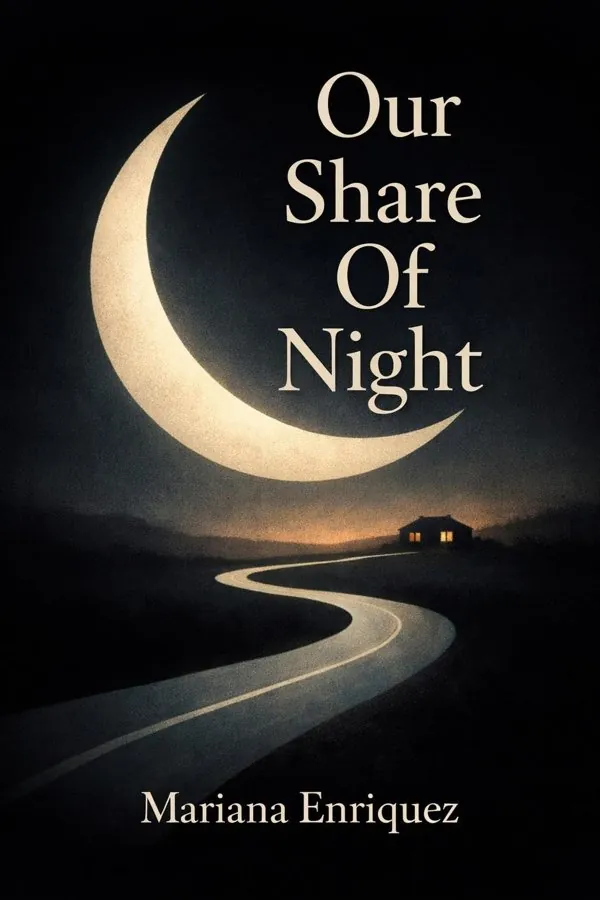
Our Share Of Night: Summary & Key Insights
 10 min9 chaptersAudio available
Key Takeaways from Our Share Of Night
A child’s inheritance is often decided long before he understands its cost.
The most dangerous families are often the ones that call domination tradition.
Not every doorway should be opened, especially when power demands a human price.
The deepest question in the novel is not whether evil exists, but whether inheritance can be interrupted.
History does not stay outside the home; it enters through silence, fear, and disappearance.
What Is Our Share Of Night About?
Our Share Of Night by Mariana Enriquez is a bestsellers book spanning 4 pages. Mariana Enriquez’s Our Share Of Night is a sweeping literary horror novel about a father and son caught inside a terrifying inheritance. Set mainly in Argentina during and after the military dictatorship, the book follows Juan, a medium whose body is being consumed by the supernatural force he serves, and Gaspar, the son he desperately wants to protect from the same fate. What begins as a road story shaped by grief gradually opens into a vast narrative of secret societies, family violence, political terror, class privilege, and the seduction of forbidden power. Enriquez turns gothic fiction into something historically grounded and emotionally devastating: the monsters are real, but so are the systems that enable them. The novel matters because it fuses intimate human pain with national trauma. It asks how power survives across generations, how children inherit wounds they did not choose, and whether love can interrupt a cycle built to consume them. Enriquez, one of contemporary Latin America’s most acclaimed writers, brings journalistic sharpness, gothic imagination, and deep historical awareness to a novel that feels both haunted and urgently alive.
This FizzRead summary covers all 9 key chapters of Our Share Of Night in approximately 10 minutes, distilling the most important ideas, arguments, and takeaways from Mariana Enriquez's work. Also available as an audio summary and Key Quotes Podcast.
Our Share Of Night
Mariana Enriquez’s Our Share Of Night is a sweeping literary horror novel about a father and son caught inside a terrifying inheritance. Set mainly in Argentina during and after the military dictatorship, the book follows Juan, a medium whose body is being consumed by the supernatural force he serves, and Gaspar, the son he desperately wants to protect from the same fate. What begins as a road story shaped by grief gradually opens into a vast narrative of secret societies, family violence, political terror, class privilege, and the seduction of forbidden power. Enriquez turns gothic fiction into something historically grounded and emotionally devastating: the monsters are real, but so are the systems that enable them.
The novel matters because it fuses intimate human pain with national trauma. It asks how power survives across generations, how children inherit wounds they did not choose, and whether love can interrupt a cycle built to consume them. Enriquez, one of contemporary Latin America’s most acclaimed writers, brings journalistic sharpness, gothic imagination, and deep historical awareness to a novel that feels both haunted and urgently alive.
Who Should Read Our Share Of Night?
This book is perfect for anyone interested in bestsellers and looking to gain actionable insights in a short read. Whether you're a student, professional, or lifelong learner, the key ideas from Our Share Of Night by Mariana Enriquez will help you think differently.
- ✓Readers who enjoy bestsellers and want practical takeaways
- ✓Professionals looking to apply new ideas to their work and life
- ✓Anyone who wants the core insights of Our Share Of Night in just 10 minutes
Want the full summary?
Get instant access to this book summary and 100K+ more with Fizz Moment.
Get Free SummaryAvailable on App Store • Free to download
Key Chapters
A child’s inheritance is often decided long before he understands its cost. In Our Share Of Night, Gaspar’s story begins under the shadow of his mother Rosario’s death and his father Juan’s failing health. As they travel through rural Argentina, the journey feels at first like an escape, but Enriquez makes it clear that roads do not always lead away from danger. Sometimes they simply delay it. Juan is not just a grieving widower; he is a medium tied to a secret Order that worships a terrifying supernatural force known as the Darkness. His body is deteriorating because of what it channels, and he knows Gaspar may be destined to replace him.
This creates the emotional core of the novel: a father who loves his son deeply but cannot fully free him from the machinery of inheritance. Juan’s burden is double. He carries the physical consequences of his role, and he carries the knowledge that his son is wanted by powerful people who view human lives as instruments. The trip through dusty landscapes becomes a portrait of parental desperation. Juan tries to buy time, hide truths, and teach Gaspar how to survive without fully initiating him into horror.
In practical terms, the novel captures a familiar human reality inside an extraordinary plot: parents often struggle to protect children from family histories, harmful expectations, or systems larger than themselves. The supernatural frame intensifies a common question: what do we pass on, and what can we refuse to pass on?
Actionable takeaway: Pay attention to the inheritances shaping your life—family roles, fears, loyalties, and secrets—and ask which ones deserve protection and which ones must be broken.
The most dangerous families are often the ones that call domination tradition. As the novel moves backward in time, Rosario Reyes emerges as far more than a lost mother or tragic wife. She belongs to the Reyes family, a wealthy dynasty whose influence rests on occult knowledge, social privilege, and a ruthless belief that power justifies any sacrifice. Through Rosario, Enriquez shows that love inside such a system is never free of calculation. Even tenderness can become another mechanism of control.
The Reyes family represents inherited power in its most chilling form. They possess land, money, access, and the confidence of people who believe history belongs to them. Their relationship to the Order is not merely spiritual curiosity; it is an extension of elite entitlement. They do not approach the supernatural with humility but with ownership. Rosario’s life reveals how individuals raised inside such structures may both benefit from and suffer under them. She is shaped by her family’s expectations, trapped by their ambitions, and unable to escape the violence beneath their refinement.
This part of the novel also broadens the story beyond Juan and Gaspar. It explains why Gaspar is not only a son but an asset. The family sees bloodline as destiny, and destiny as property. Enriquez connects aristocratic lineage, political influence, and ritual cruelty in a way that exposes how institutions preserve themselves by transforming people into functions.
Readers can recognize a real-world pattern here: families, corporations, and political systems often survive by masking exploitation as legacy. The language changes, but the logic remains familiar.
Actionable takeaway: When tradition is used to silence doubt or excuse harm, examine who benefits most. Legacy should be questioned, not automatically obeyed.
Not every doorway should be opened, especially when power demands a human price. One of the novel’s most unforgettable ideas is the Darkness itself: a supernatural realm or entity sought by the Order as a source of transcendence, communication, and immortality. Yet Enriquez refuses to present it as a simple fantasy device. The Darkness is desire without moral limit. It offers access to what lies beyond ordinary reality, but every encounter deforms bodies, relationships, and conscience.
Juan, as a medium, is the clearest example of this cost. His role gives others proximity to the unspeakable, while his own body is steadily consumed by it. The Darkness turns spiritual longing into extraction. Those with wealth and status remain insulated from the worst consequences, while mediums, servants, and vulnerable people absorb the damage. This mirrors many real-world systems where elite fascination is subsidized by someone else’s suffering.
The idea also works psychologically. Human beings are often drawn to what promises total knowledge, permanent control, or escape from death. The novel asks what happens when the wish to overcome mortality becomes more important than ordinary human care. Instead of wisdom, the pursuit produces hierarchy, dependency, and cruelty. The Order calls its rituals necessary; Enriquez shows they are also addictive.
In everyday life, the Darkness can be read as any obsession that begins as a search for meaning and ends by consuming the self or harming others—status, ideology, control, even personal ambition without ethical limits. The warning is not against mystery itself, but against surrendering morality in exchange for access.
Actionable takeaway: Be wary of any pursuit—spiritual, personal, or professional—that promises extraordinary rewards while normalizing harm as the cost of greatness.
The deepest question in the novel is not whether evil exists, but whether inheritance can be interrupted. Gaspar grows up surrounded by forces that want to define him before he becomes himself. He is a child of grief, privilege, secrecy, and supernatural expectation. Others project a future onto him: he is meant to continue the work of the Order, to become useful to their rituals, to fulfill the destiny his bloodline seems to promise. Yet Enriquez builds his story around the possibility that being chosen is not the same as consenting.
Gaspar’s development turns the novel from pure inheritance into a study of resistance. He is sensitive, vulnerable, and shaped by trauma, but he is not empty. As he grows, he begins to understand that the adults around him—loving and monstrous alike—have constructed competing versions of his life. Juan wants to protect him, though imperfectly. The Reyes family wants to own him. Friends and relationships offer glimpses of another kind of belonging, one not governed by ritual or lineage. This creates the emotional and ethical tension of the novel: can a person raised inside violence still build a self not defined by it?
This is one reason the book resonates beyond horror. Many readers know what it means to inherit roles, fears, or identities they did not choose. Gaspar’s struggle reflects anyone trying to separate family expectation from personal desire. Enriquez does not offer easy liberation; damage leaves marks. But she insists that awareness matters. Naming the structure is the first step toward escaping it.
Actionable takeaway: If your life feels shaped by expectations that are not truly yours, identify one inherited script you can question today and replace it with a conscious choice.
History does not stay outside the home; it enters through silence, fear, and disappearance. One of the novel’s greatest achievements is the way it intertwines supernatural horror with Argentina’s political history, especially the era of dictatorship and state violence. Enriquez does not treat the historical setting as background decoration. Instead, she shows that occult secrecy and political repression speak the same language: both depend on hidden power, disposable bodies, and the normalization of terror.
The wealthy and well-connected characters are not floating above history. They are often protected by it, allied with it, or skilled at moving through it without consequence. The Order’s rituals become a distorted mirror of state violence. People vanish. Suffering is managed behind closed doors. Those with influence treat others as expendable. In this way, the novel argues that horror is not separate from politics. Supernatural dread becomes a way of making visible the emotional truth of living under systems where death can be organized and denied.
For readers, this fusion matters because it demonstrates how literature can carry historical memory without becoming didactic. Enriquez captures what official narratives often miss: the atmosphere of fear, the corrosion of trust, the way children inherit trauma from events they did not directly witness. The personal and the political remain inseparable.
This idea has broad application. In any society, large-scale violence leaves intimate residues—in parenting, class relations, public memory, and private shame. To understand a family story fully, we often need to understand the regime, institution, or social order surrounding it.
Actionable takeaway: When examining personal or family trauma, also ask what historical forces shaped it. Private pain often has political roots.
Love can save us, but it can also become a form of possession when fear takes over. Throughout Our Share Of Night, Enriquez presents love as a deeply ambivalent force. Juan loves Gaspar with fierce sincerity, and much of the novel’s emotional power comes from his desire to spare his son from the Order. Yet his protection is incomplete and often controlling. He withholds information, makes unilateral decisions, and uses secrecy as a shield. The result is heartbreaking: even loving concealment can reproduce the very structures it hopes to resist.
This complexity extends beyond Juan. Families in the novel often justify manipulation in the language of care. Rosario is shaped by a world where affection, duty, and ownership blur together. The Reyes family’s concern for lineage is dressed up as responsibility, but beneath it lies domination. Enriquez repeatedly asks whether love can remain ethical when one person assumes the right to decide another’s fate.
That question reaches beyond fiction. Parents, partners, and institutions often defend restrictive behavior as necessary protection. Sometimes it is genuinely motivated by care; sometimes it masks anxiety, status, or the inability to let another person become independent. The novel does not deny the reality of protective love. Instead, it warns that love without honesty can become another prison.
What makes the book so moving is that these failures do not erase feeling. Juan’s flaws are inseparable from his devotion. Enriquez understands that people can do harm while trying to prevent greater harm. That moral tension is what makes the relationships feel painfully true.
Actionable takeaway: In your closest relationships, ask whether your care creates freedom or dependency. Real protection should make another person more capable, not more controlled.
Power often looks abstract until we see what it does to a body. Enriquez’s horror is intensely physical: illness, exhaustion, ritual damage, pain, vulnerability, and decay are not incidental details but central truths of the novel. Juan’s body is especially important. As a medium, he is treated as an instrument, valued for what can pass through him, even as the process destroys him. The body becomes the ledger where invisible systems keep their account.
This focus gives the novel unusual force. Instead of portraying supernatural power as glamorous, Enriquez insists on consequence. Rituals leave scars. Desire leaves residue. Class privilege allows some characters to outsource bodily risk to others. The elites pursue immortality, but the labor of approaching it falls on flesh that can break. In this sense, the novel is not only about magic; it is about exploitation. Who gets to seek transcendence, and who absorbs the suffering required to sustain that search?
The body also carries trauma in less literal ways. Fear changes behavior. Grief alters appetite, sleep, and perception. Children learn danger through sensation before they can explain it. By grounding horror in embodied experience, Enriquez makes the novel emotionally credible even at its most fantastical.
Readers can apply this insight widely. Any system—workplace, family, religion, politics—that speaks grandly about purpose while ignoring physical and emotional cost should be examined closely. If the body is always the site of sacrifice, someone else is likely benefiting.
Actionable takeaway: Measure power not by its promises but by its effects on real bodies. Ask who is thriving, who is deteriorating, and why.
Some landscapes do not simply contain stories; they shape what stories become possible. In Our Share Of Night, roads, estates, jungles, cities, and decaying interiors are never neutral settings. Enriquez uses place as an active force, turning Argentina’s geography into a map of class divisions, historical wounds, and supernatural threshold spaces. The movement from urban life into isolated regions creates a sense that reality is thinning, but the novel also reminds us that menace exists in mansions, schools, and family homes. Horror is environmental before it becomes visible.
The gothic atmosphere works because it is rooted in material detail. Dust, heat, rot, shadows, architecture, distance, and enclosure all contribute to the feeling that characters inhabit worlds built by the dead and maintained by the powerful. The landscapes carry memory. Estates evoke dynastic control. Roads suggest transition but also pursuit. Dense natural spaces hint at forces beyond human mastery, while curated elite spaces reveal how violence can hide behind beauty and order.
This attention to place deepens the novel’s themes. Environment becomes a language for emotional states: grief feels empty and wide, fear claustrophobic, inheritance inescapable. It also reflects social structure. Who owns land, who travels safely, and who is trapped in certain spaces are political questions as much as aesthetic ones.
For readers and writers alike, Enriquez offers a lesson in how setting can do intellectual and emotional work. A meaningful location should reveal power relations, mood, and memory at once.
Actionable takeaway: Notice how the spaces around you influence feeling and behavior. Environments are not passive; they often reinforce the stories people live inside.
Horror is sometimes dismissed as exaggeration, but in the best hands it becomes a tool for telling the truth. Our Share Of Night demonstrates why literary horror matters: it can expose hidden structures of violence more vividly than realism alone. Enriquez uses ghosts, rituals, and cosmic dread not as escapist spectacle but as methods for exploring grief, class, dictatorship, colonial residue, sexuality, and family trauma. The genre allows her to make invisible systems feel immediate.
What makes the novel literary is not that it avoids horror conventions, but that it uses them with thematic precision. The supernatural is inseparable from psychology and history. Fear is not random; it is organized by social power. The result is a book that satisfies as gothic fiction while also rewarding readers interested in politics, memory, and form. Enriquez proves that horror can carry intellectual seriousness without losing its unsettling energy.
This has practical relevance for readers. Genre fiction often helps people approach difficult realities indirectly. A secret cult may reveal more about elite impunity than a straightforward essay. A monstrous inheritance may illuminate family trauma more effectively than a clinical description. Horror translates abstract dread into felt experience.
For anyone who thinks serious literature must remain emotionally restrained, this novel offers a correction. Disturbance can be a mode of insight. To be unsettled is sometimes to recognize a truth that ordinary language has softened.
Actionable takeaway: Don’t dismiss uncomfortable art too quickly. If a story disturbs you, ask what reality it is helping you perceive more clearly.
All Chapters in Our Share Of Night
About the Author
Mariana Enriquez is an Argentine novelist, short story writer, and journalist born in Buenos Aires in 1973. She is widely recognized as one of the leading contemporary voices in literary horror, known for combining gothic atmosphere with social realism, political memory, and psychological intensity. Her fiction often explores violence, urban unease, class divisions, and the lingering effects of Argentina’s history, especially the dictatorship era. Enriquez first gained major international attention through her short stories, which introduced many readers to her distinctive blend of the macabre and the everyday. In both fiction and nonfiction, she writes with a sharp awareness of how horror lives inside ordinary life. Our Share Of Night stands as one of her most ambitious and acclaimed works, confirming her reputation as a major figure in contemporary world literature.
Get This Summary in Your Preferred Format
Read or listen to the Our Share Of Night summary by Mariana Enriquez anytime, anywhere. FizzRead offers multiple formats so you can learn on your terms — all free.
Available formats: App · Audio · PDF · EPUB — All included free with FizzRead
Download Our Share Of Night PDF and EPUB Summary
Key Quotes from Our Share Of Night
“A child’s inheritance is often decided long before he understands its cost.”
“The most dangerous families are often the ones that call domination tradition.”
“Not every doorway should be opened, especially when power demands a human price.”
“The deepest question in the novel is not whether evil exists, but whether inheritance can be interrupted.”
“History does not stay outside the home; it enters through silence, fear, and disappearance.”
Frequently Asked Questions about Our Share Of Night
Our Share Of Night by Mariana Enriquez is a bestsellers book that explores key ideas across 9 chapters. Mariana Enriquez’s Our Share Of Night is a sweeping literary horror novel about a father and son caught inside a terrifying inheritance. Set mainly in Argentina during and after the military dictatorship, the book follows Juan, a medium whose body is being consumed by the supernatural force he serves, and Gaspar, the son he desperately wants to protect from the same fate. What begins as a road story shaped by grief gradually opens into a vast narrative of secret societies, family violence, political terror, class privilege, and the seduction of forbidden power. Enriquez turns gothic fiction into something historically grounded and emotionally devastating: the monsters are real, but so are the systems that enable them. The novel matters because it fuses intimate human pain with national trauma. It asks how power survives across generations, how children inherit wounds they did not choose, and whether love can interrupt a cycle built to consume them. Enriquez, one of contemporary Latin America’s most acclaimed writers, brings journalistic sharpness, gothic imagination, and deep historical awareness to a novel that feels both haunted and urgently alive.
More by Mariana Enriquez
You Might Also Like

The Godfather
Mario Puzo
10 min
The Handmaid's Tale
Margaret Atwood
10 min
The Hunger Games
Suzanne Collins
10 min
The Nightingale
Kristin Hannah
10 min
The Seven Husbands of Evelyn Hugo
Taylor Jenkins Reid
10 min
Backwater Justice
Fern Michaels
10 minBrowse by Category
Ready to read Our Share Of Night?
Get the full summary and 100K+ more books with Fizz Moment.