
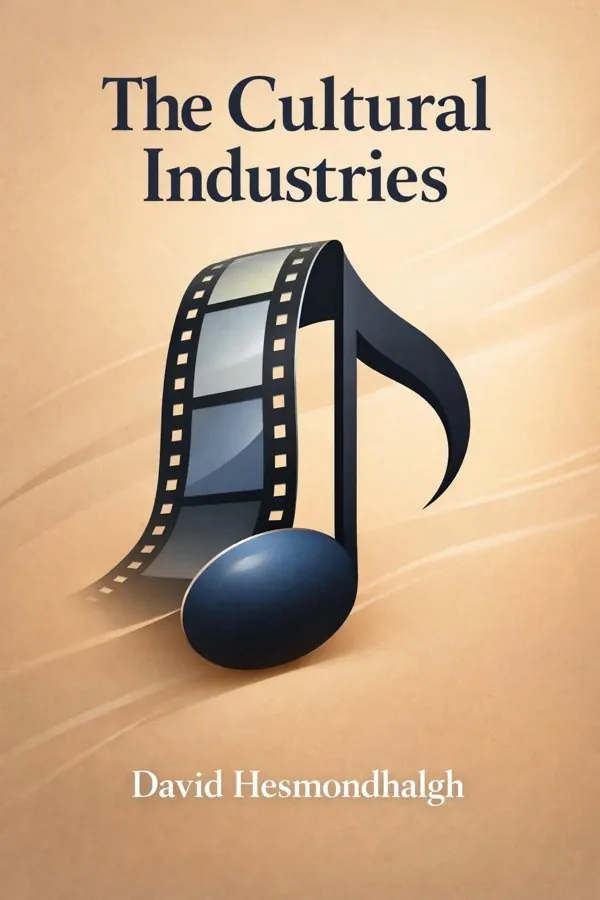
The Cultural Industries: Summary & Key Insights
 10 min9 chaptersAudio available
Key Takeaways from The Cultural Industries
What looks natural today was historically built.
The most influential forces in culture are often the least visible.
Creative work may look glamorous from the outside, but it is often precarious, unequal, and tightly managed.
Who owns media organizations helps determine which voices are amplified, which risks are tolerated, and which stories are considered valuable.
Cultural industries sell uncertainty for a living.
What Is The Cultural Industries About?
The Cultural Industries by David Hesmondhalgh is a sociology book spanning 11 pages. Culture often feels spontaneous, personal, and expressive, but David Hesmondhalgh shows that it is also organized, financed, managed, and sold. In The Cultural Industries, he examines the systems behind music, television, film, publishing, radio, magazines, and digital media, revealing how culture is produced within capitalist economies shaped by power, inequality, and competition. Rather than treating art and media as purely creative or purely commercial, Hesmondhalgh develops a more balanced view: cultural goods are made through a constant tension between imagination and industrial control. What makes this book so important is its refusal to simplify. It does not romanticize artists, demonize audiences, or reduce media to profit alone. Instead, it explains how ownership, labor, technology, regulation, and globalization influence what gets produced, who gets heard, and how cultural value is assigned. Hesmondhalgh is one of the most respected scholars in media and cultural studies, and his work has become foundational for anyone trying to understand how modern culture actually works. This book matters because it helps readers see that culture is never just entertainment; it is a site where economics, identity, politics, and everyday life all meet.
This FizzRead summary covers all 9 key chapters of The Cultural Industries in approximately 10 minutes, distilling the most important ideas, arguments, and takeaways from David Hesmondhalgh's work. Also available as an audio summary and Key Quotes Podcast.
The Cultural Industries
Culture often feels spontaneous, personal, and expressive, but David Hesmondhalgh shows that it is also organized, financed, managed, and sold. In The Cultural Industries, he examines the systems behind music, television, film, publishing, radio, magazines, and digital media, revealing how culture is produced within capitalist economies shaped by power, inequality, and competition. Rather than treating art and media as purely creative or purely commercial, Hesmondhalgh develops a more balanced view: cultural goods are made through a constant tension between imagination and industrial control.
What makes this book so important is its refusal to simplify. It does not romanticize artists, demonize audiences, or reduce media to profit alone. Instead, it explains how ownership, labor, technology, regulation, and globalization influence what gets produced, who gets heard, and how cultural value is assigned. Hesmondhalgh is one of the most respected scholars in media and cultural studies, and his work has become foundational for anyone trying to understand how modern culture actually works. This book matters because it helps readers see that culture is never just entertainment; it is a site where economics, identity, politics, and everyday life all meet.
Who Should Read The Cultural Industries?
This book is perfect for anyone interested in sociology and looking to gain actionable insights in a short read. Whether you're a student, professional, or lifelong learner, the key ideas from The Cultural Industries by David Hesmondhalgh will help you think differently.
- ✓Readers who enjoy sociology and want practical takeaways
- ✓Professionals looking to apply new ideas to their work and life
- ✓Anyone who wants the core insights of The Cultural Industries in just 10 minutes
Want the full summary?
Get instant access to this book summary and 100K+ more with Fizz Moment.
Get Free SummaryAvailable on App Store • Free to download
Key Chapters
What looks natural today was historically built. One of Hesmondhalgh’s central insights is that the cultural industries are not timeless expressions of human creativity; they emerged through specific social and economic changes linked to capitalism, urbanization, technological innovation, and mass markets. Newspapers, recorded music, cinema, broadcasting, and publishing did not simply appear because people wanted culture. They developed because new technologies made reproduction possible, expanding populations created larger audiences, and investors recognized culture as a profitable industry.
This historical perspective matters because it changes how we interpret contemporary media. If cultural industries were built under particular conditions, they can also be reorganized, challenged, and transformed. Hesmondhalgh shows that industrialized culture arose from the combination of artistic production and systems of distribution, management, and commodification. Over time, media industries became increasingly professionalized, with firms trying to manage risk while maintaining audience interest.
Consider the music industry. Live performance existed for centuries, but recording technologies, copyright systems, radio promotion, and global distribution networks turned music into an industry of repeatable products. The same pattern applies to film studios, television networks, and large publishing houses: creative work became embedded in institutions designed to reproduce, market, and monetize symbolic goods.
For readers today, this historical lens is practical. It helps explain why streaming platforms, social media, and algorithmic discovery are not entirely new worlds, but new phases in a longer process of industrializing culture. The takeaway is simple: when analyzing any media form, ask what historical forces made it possible, profitable, and powerful.
Creative work may look glamorous from the outside, but it is often precarious, unequal, and tightly managed. Hesmondhalgh challenges the romantic image of artists and media workers as completely free individuals expressing pure originality. In reality, creativity in the cultural industries is organized through workplaces, contracts, deadlines, hierarchies, and market demands. This does not eliminate imagination, but it does mean that creativity is socially structured.
A key theme in the book is that cultural labor is marked by both autonomy and insecurity. Many workers are attracted to these industries because they promise expressive freedom, status, and meaningful work. Yet these same industries frequently rely on freelancing, informal recruitment, long hours, unstable employment, and self-exploitation. People may accept poor conditions because they care deeply about the work or hope for future success.
Think about television production, game design, music, or journalism. Workers may endure unpaid overtime, temporary contracts, and constant networking because these fields reward passion while normalizing instability. Those with family wealth, strong social networks, or urban access often have an advantage, which means cultural industries can reproduce class and social inequality even while celebrating merit and talent.
This idea has practical relevance for anyone entering creative fields. Success is not only about talent; it also depends on institutions, resources, and labor structures. Managers and policymakers can use Hesmondhalgh’s framework to improve working conditions, diversify recruitment, and support sustainable careers. The actionable takeaway: do not judge creative industries by their public image alone—look closely at how work is organized, who gets opportunities, and what hidden costs workers pay.
Who owns media organizations helps determine which voices are amplified, which risks are tolerated, and which stories are considered valuable. Hesmondhalgh emphasizes that ownership and control are central to understanding cultural industries because symbolic production is never separate from institutional power. While cultural products may appear diverse, they are often generated within systems where a relatively small number of firms control financing, distribution, and access to audiences.
This does not mean owners dictate every lyric, script, or headline. Hesmondhalgh avoids simplistic claims about total control. Instead, he shows how ownership matters structurally. Large firms seek profit, try to reduce uncertainty, and develop strategies that balance novelty with familiarity. As a result, companies often favor sequels, proven genres, celebrity-led projects, and formats that can travel across markets. Diversity exists, but usually within commercially manageable boundaries.
The concentration of ownership can be seen in film studios, music labels, publishing conglomerates, and digital platforms. A platform that controls recommendation systems, audience data, and monetization rules does not just distribute culture; it shapes the conditions under which culture is made. Even independent creators often depend on infrastructure owned by powerful intermediaries.
For citizens and consumers, this insight encourages media literacy. A news outlet, streaming catalog, or publishing list should not be understood only by looking at visible content. It should also be understood in terms of corporate structure, investor pressure, and strategic priorities. The practical takeaway is clear: if you want to understand culture, follow ownership, because control over infrastructure often matters as much as control over ideas.
Cultural industries sell uncertainty for a living. Hesmondhalgh explains that making cultural goods is unusually risky because no one can reliably predict which song, film, book, or show will succeed. Unlike standardized industrial products, cultural goods depend on taste, timing, mood, and social trends. Because of this uncertainty, cultural industries develop routines and production systems to manage risk rather than eliminate it.
These routines include genre conventions, audience research, pilot testing, star systems, franchising, formatting, and layered decision-making. Producers rarely gamble on pure originality. Instead, they combine familiar elements with selective novelty. This is why so much cultural output feels both repetitive and slightly fresh. Firms need enough innovation to attract attention, but enough predictability to reassure investors and distributors.
A film studio may back a superhero sequel because it already knows the brand, international market potential, and merchandising options. A publisher may seek books that fit established categories while still appearing distinctive. A music label may use songwriting camps, image consultants, and algorithmic data to improve the odds of commercial success. These are not signs of a lack of creativity; they are industrial responses to uncertainty.
This idea helps explain the structure of contemporary media choices. Consumers often complain that culture is repetitive, but Hesmondhalgh shows why repetition is a rational business strategy in unstable markets. For creators, this means understanding the system can be empowering. Originality often succeeds when it is framed in recognizable forms. The actionable takeaway: when you notice repetition in culture, ask what risks producers are trying to manage and how standardization helps them survive.
A cultural product is not valuable simply because it exists; it becomes valuable when systems of distribution connect it to audiences. Hesmondhalgh stresses that production is only one part of the cultural industries. Distribution, marketing, circulation, and consumption are equally important in shaping success, meaning, and visibility. A brilliant album, film, or book can disappear without the channels that bring it to people’s attention.
This is why intermediaries matter so much. Retailers, broadcasters, cinemas, critics, playlists, recommendation systems, social media feeds, and publicity networks all influence what audiences encounter. Distribution is not neutral. It organizes access, filters abundance, and often privileges those who already possess visibility or institutional backing. In a crowded marketplace, discoverability becomes a form of power.
Audiences are not passive in this process. Hesmondhalgh rejects the idea that consumers simply absorb whatever industries give them. People interpret, share, ignore, remix, and discuss cultural goods in ways that shape their afterlife. Word-of-mouth, fandom, niche communities, and online participation can all alter the fortunes of a product. Still, audience agency operates within unequal systems where some content is easier to find and promote than others.
This framework applies directly to today’s platform economy. On streaming services, recommendation tools and interface design affect what gets watched or heard. On social media, engagement metrics influence cultural visibility. For creators and marketers, the lesson is practical: making good work is not enough; circulation strategy matters. The actionable takeaway: evaluate culture by studying not only what is produced, but also how it reaches audiences and how audiences help produce value.
Culture now travels farther and faster than ever, but global circulation does not mean equal exchange. Hesmondhalgh examines globalization as a process that increases the movement of media products, capital, formats, and labor across borders while also reproducing major asymmetries of power. Some countries, companies, and languages dominate global flows, while others struggle for visibility.
This global dimension helps explain why certain music genres become worldwide trends, why Hollywood has such enduring influence, and why media firms seek transnational scale. Large companies benefit from exporting content, exploiting intellectual property across multiple markets, and adapting successful formats for local audiences. At the same time, local cultures do not simply disappear. They often hybridize, adapt, and resist, producing mixtures of global influence and regional specificity.
For example, a reality TV format may originate in one country, be sold internationally, and then be reshaped to fit local norms. A music style may blend global pop conventions with local languages and traditions. Streaming has accelerated these exchanges, making cross-border circulation more common. Yet visibility still depends on infrastructure, investment, translation, and platform priorities, which means not all cultural producers enter the global market on equal terms.
Hesmondhalgh’s point is not that globalization is purely harmful or purely liberating. It creates opportunities for circulation and recognition, but it also strengthens powerful corporations and deepens competition. Readers can use this idea to better understand cultural diversity in an interconnected world. The actionable takeaway: when encountering global culture, look for both connection and imbalance—ask who benefits from circulation, whose voices travel most easily, and what gets lost in translation.
Digital technology promised a cultural revolution, but revolutions often inherit the structures they claim to replace. Hesmondhalgh approaches digital transformation with caution and clarity. He recognizes that digital tools lower barriers to creation, enable faster distribution, and allow new forms of participation. At the same time, he argues that older issues—ownership, labor exploitation, inequality, and market concentration—remain deeply embedded in the digital era.
The rise of platforms, streaming, file sharing, social media, and user-generated content changed how culture is produced and consumed, but not always in democratic ways. Digital systems can empower independent creators, yet they also create dependence on infrastructures controlled by large technology companies. Platforms collect data, set monetization rules, rank visibility, and decide what kinds of content are rewarded. As a result, apparent openness can coexist with new forms of control.
Digital labor also complicates traditional distinctions between producer and consumer. Users create content, promote brands, build audiences, and generate valuable data, often without stable compensation. Musicians may reach listeners directly online, but they may also earn less per stream and feel pressured to constantly market themselves. Journalists can publish instantly, yet compete in attention economies driven by speed and metrics.
Hesmondhalgh’s analysis is especially relevant for understanding today’s cultural environment. Digital media has transformed access, but it has not removed structural inequality. For creators, educators, and policymakers, the implication is to look beyond technological optimism. The actionable takeaway: treat digital innovation as a change in industrial form, not an automatic solution—always ask who controls the platform, who does the work, and who captures the value.
Markets do not decide cultural life fairly on their own. Hesmondhalgh argues that the cultural industries raise urgent questions about regulation, public policy, ethics, and cultural value. Because culture affects democracy, identity, public knowledge, and social belonging, it cannot be treated as just another commodity. Decisions about copyright, media ownership, public broadcasting, labor rights, education, and subsidy shape not only economic outcomes but also what kinds of societies we inhabit.
A major strength of the book is its moral seriousness. Hesmondhalgh asks what cultural industries ought to do, not only how they operate. He is concerned with questions of justice: Who gets represented? Who gets access to creative careers? Who benefits from cultural wealth? What kinds of media environments support public debate and human flourishing? This ethical orientation distinguishes his work from purely descriptive accounts.
The issue of cultural value is especially important. Value cannot be reduced to sales figures or popularity. Some works matter because they deepen understanding, strengthen communities, challenge power, or preserve memory. Public institutions, independent producers, and nonprofit organizations often play vital roles in sustaining forms of culture that markets alone would neglect.
This idea has practical implications for voters, teachers, policymakers, and cultural workers. Supporting public media, fair labor standards, arts funding, diverse ownership, and accessible cultural education can improve cultural systems, not just individual products. The actionable takeaway: judge cultural industries not only by efficiency or profit, but by whether they expand democratic participation, protect workers, and enrich collective life.
All Chapters in The Cultural Industries
About the Author
David Hesmondhalgh is a British scholar of media, music, and culture and one of the leading voices in the study of cultural industries. He is a professor at the University of Leeds, where his research has focused on media production, creative labor, popular music, and the sociology of culture. Hesmondhalgh is especially known for analyzing how cultural goods are created within systems shaped by capitalism, institutional power, and technological change. His work stands out for combining political economy with cultural theory, allowing him to address both industrial structures and questions of meaning, ethics, and value. Widely taught and cited in universities around the world, he has made a major contribution to how scholars and readers understand modern media, creativity, and the organization of cultural life.
Get This Summary in Your Preferred Format
Read or listen to the The Cultural Industries summary by David Hesmondhalgh anytime, anywhere. FizzRead offers multiple formats so you can learn on your terms — all free.
Available formats: App · Audio · PDF · EPUB — All included free with FizzRead
Download The Cultural Industries PDF and EPUB Summary
Key Quotes from The Cultural Industries
“What looks natural today was historically built.”
“The most influential forces in culture are often the least visible.”
“Creative work may look glamorous from the outside, but it is often precarious, unequal, and tightly managed.”
“Who owns media organizations helps determine which voices are amplified, which risks are tolerated, and which stories are considered valuable.”
“Cultural industries sell uncertainty for a living.”
Frequently Asked Questions about The Cultural Industries
The Cultural Industries by David Hesmondhalgh is a sociology book that explores key ideas across 9 chapters. Culture often feels spontaneous, personal, and expressive, but David Hesmondhalgh shows that it is also organized, financed, managed, and sold. In The Cultural Industries, he examines the systems behind music, television, film, publishing, radio, magazines, and digital media, revealing how culture is produced within capitalist economies shaped by power, inequality, and competition. Rather than treating art and media as purely creative or purely commercial, Hesmondhalgh develops a more balanced view: cultural goods are made through a constant tension between imagination and industrial control. What makes this book so important is its refusal to simplify. It does not romanticize artists, demonize audiences, or reduce media to profit alone. Instead, it explains how ownership, labor, technology, regulation, and globalization influence what gets produced, who gets heard, and how cultural value is assigned. Hesmondhalgh is one of the most respected scholars in media and cultural studies, and his work has become foundational for anyone trying to understand how modern culture actually works. This book matters because it helps readers see that culture is never just entertainment; it is a site where economics, identity, politics, and everyday life all meet.
More by David Hesmondhalgh

You Might Also Like
Between the World and Me
Ta-Nehisi Coates
10 min
Half the Sky
Nicholas D. Kristof, Sheryl WuDunn
10 min
Men Explain Things To Me
Rebecca Solnit
10 min
Rational Ritual
Michael Suk-Young Chwe
10 min
The New Jim Crow
Michelle Alexander
10 min
Beyond Culture
Edward T. Hall
10 minBrowse by Category
Ready to read The Cultural Industries?
Get the full summary and 100K+ more books with Fizz Moment.