
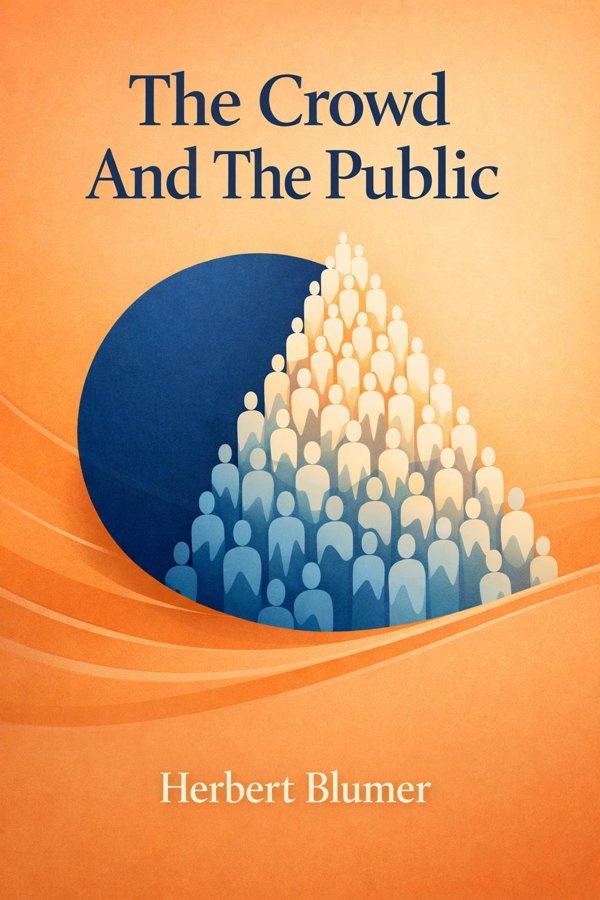
The Crowd And The Public: Summary & Key Insights
 10 min4 chaptersAudio available
What Is The Crowd And The Public About?
The Crowd And The Public by Herbert Blumer is a sociology book spanning 4 pages. In this sociological essay, Herbert Blumer explores the nature of collective behavior, distinguishing between crowds, publics, and mass movements. He analyzes how individuals act within groups, how opinions form and spread, and how social influence shapes public life. The work is foundational in symbolic interactionism and collective behavior theory.
This FizzRead summary covers all 4 key chapters of The Crowd And The Public in approximately 10 minutes, distilling the most important ideas, arguments, and takeaways from Herbert Blumer's work. Also available as an audio summary and Key Quotes Podcast.
The Crowd And The Public
In this sociological essay, Herbert Blumer explores the nature of collective behavior, distinguishing between crowds, publics, and mass movements. He analyzes how individuals act within groups, how opinions form and spread, and how social influence shapes public life. The work is foundational in symbolic interactionism and collective behavior theory.
Who Should Read The Crowd And The Public?
This book is perfect for anyone interested in sociology and looking to gain actionable insights in a short read. Whether you're a student, professional, or lifelong learner, the key ideas from The Crowd And The Public by Herbert Blumer will help you think differently.
- ✓Readers who enjoy sociology and want practical takeaways
- ✓Professionals looking to apply new ideas to their work and life
- ✓Anyone who wants the core insights of The Crowd And The Public in just 10 minutes
Want the full summary?
Get instant access to this book summary and 100K+ more with Fizz Moment.
Get Free SummaryAvailable on App Store • Free to download
Key Chapters
Let us begin where social immediacy burns brightest: in the crowd. A crowd, as I conceive it, is not merely a gathering of people. It is a temporary social organism, fused by heightened emotion and united by a common object of attention. Here, individuality recedes before collective excitement. Reason gives way to impulse, and personal inhibitions fall away.
What happens to the person in a crowd? He or she becomes engrossed in a field of mutual stimulation. Each gesture, cry, or movement bolsters others. Suggestibility runs high. Emotional contagion passes swiftly, sweeping participants into collective action that none could have planned or endorsed alone. The result is a form of behavior that is organic but not organized, impulsive yet intensely unified. In the crowd, people experience a moral transformation — they may feel heroic, avenged, exalted, or violently righteous, depending on the circumstances that brought them together.
Crowds seldom arise from tranquility. They germinate where social tension simmers — where grievances, hopes, and anxieties lie in wait for a precipitating event. A disputed election result, a police confrontation, a shared outrage can strike the spark. Once ignited, attention narrows to the common object; participants act as if moved by one will.
Not all crowds are alike. Some are acting crowds, bent on direct, often destructive action; others are expressive, formed to release feeling, whether in jubilation or mourning; still others are conventional, bound by situational expectations as in religious gatherings or spectacles. Each type reveals different dimensions of collective behavior — from aggression to solidarity to ritual catharsis.
In contrast to stable institutions, crowds are fleeting. Their unity dissolves as quickly as it forms, but their effects can outlast their moment. Revolutions and reforms often trace their emotional beginnings to crowd experience. Thus, to understand crowds is to understand the emotional dynamics that underlie social change.
The movement from crowd to public marks a shift from immediacy to reflection, from emotion to deliberation. Where the crowd fuses bodies in a shared moment, the public connects minds dispersed across space. The public is born wherever an issue calls forth discussion, wherever people consider, debate, and take stances directed toward collective judgment.
A public, then, is not bound by physical proximity. Its members may never meet, yet they are joined by mutual concern about a matter of social import — a policy, belief, or controversy. Communication holds the public together, not bodily presence. It is the conversation — printed, spoken, or transmitted — that gives it shape. In this sense, the newspaper, the pamphlet, and now newer forms of media are the lifeblood of the public realm.
Within the public, individuals do not lose their identities as they do in the crowd. Rather, their individuality finds expression through opinion. To participate in the public is to take part in a process of defining an issue, evaluating arguments, persuading and being persuaded. Public opinion, as I understand it, is never a mere aggregate of private thoughts; it emerges from social interaction — from the exchange and testing of ideas.
The health of a society depends greatly on the vigor of its publics. When communication is open and the means of participation widely distributed, the public functions as an organ of social intelligence. It brings reasoned criticism to bear on policy, restrains tyranny, and guides collective adjustment. But when communication narrows or becomes monopolized, the public weakens; what remains may resemble a public only in name, incapable of genuine dialogue. The crowd may then return, filling the void with passion instead of discourse.
Thus, the public represents the higher form of collective behavior — not in a moral sense, but because it mediates between emotion and reason, between the private and the collective. It shows that society can think about itself.
+ 2 more chapters — available in the FizzRead app
All Chapters in The Crowd And The Public
About the Author
Herbert Blumer (1900–1987) was an American sociologist best known for developing the theory of symbolic interactionism. A student of George Herbert Mead, Blumer taught at the University of Chicago and later at the University of California, Berkeley. His research focused on social movements, public opinion, and the dynamics of collective behavior.
Get This Summary in Your Preferred Format
Read or listen to the The Crowd And The Public summary by Herbert Blumer anytime, anywhere. FizzRead offers multiple formats so you can learn on your terms — all free.
Available formats: App · Audio · PDF · EPUB — All included free with FizzRead
Download The Crowd And The Public PDF and EPUB Summary
Key Quotes from The Crowd And The Public
“Let us begin where social immediacy burns brightest: in the crowd.”
“The movement from crowd to public marks a shift from immediacy to reflection, from emotion to deliberation.”
Frequently Asked Questions about The Crowd And The Public
The Crowd And The Public by Herbert Blumer is a sociology book that explores key ideas across 4 chapters. In this sociological essay, Herbert Blumer explores the nature of collective behavior, distinguishing between crowds, publics, and mass movements. He analyzes how individuals act within groups, how opinions form and spread, and how social influence shapes public life. The work is foundational in symbolic interactionism and collective behavior theory.
You Might Also Like
Between the World and Me
Ta-Nehisi Coates
10 min
Half the Sky
Nicholas D. Kristof, Sheryl WuDunn
10 min
Men Explain Things To Me
Rebecca Solnit
10 min
Rational Ritual
Michael Suk-Young Chwe
10 min
The New Jim Crow
Michelle Alexander
10 min
Beyond Culture
Edward T. Hall
10 minBrowse by Category
Ready to read The Crowd And The Public?
Get the full summary and 100K+ more books with Fizz Moment.