
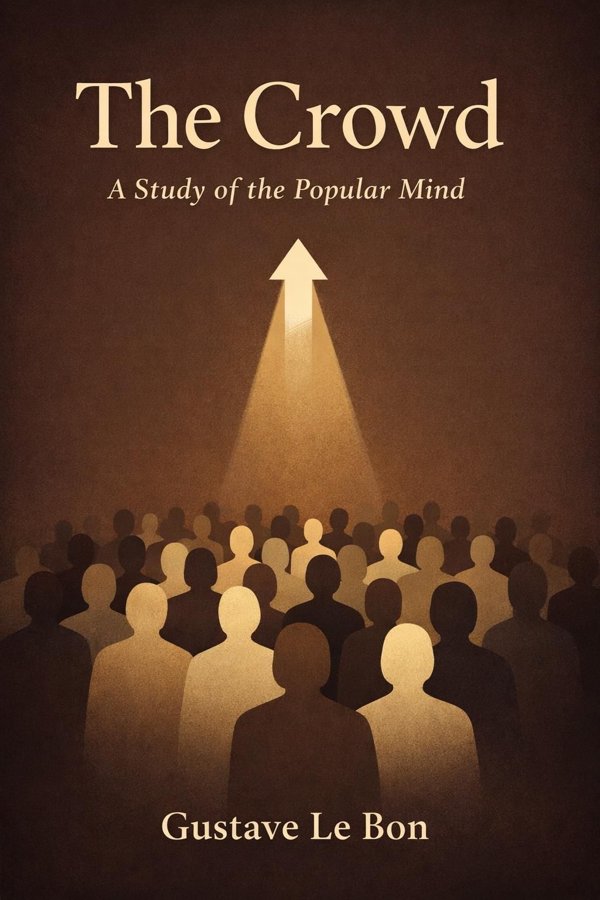
The Crowd: A Study of the Popular Mind: Summary & Key Insights
 10 min5 chaptersAudio available
What Is The Crowd: A Study of the Popular Mind About?
The Crowd: A Study of the Popular Mind by Gustave Le Bon is a sociology book spanning 5 pages. First published in 1895, Gustave Le Bon’s classic work 'The Crowd: A Study of the Popular Mind' explores how individual behavior changes when people become part of a crowd. Le Bon analyzes the psychological mechanisms of contagion, suggestion, and collective irrationality, showing how crowds can be swayed by emotion and charismatic leaders. The book laid the foundation for modern social psychology and remains influential in understanding mass movements and group dynamics.
This FizzRead summary covers all 5 key chapters of The Crowd: A Study of the Popular Mind in approximately 10 minutes, distilling the most important ideas, arguments, and takeaways from Gustave Le Bon's work. Also available as an audio summary and Key Quotes Podcast.
The Crowd: A Study of the Popular Mind
First published in 1895, Gustave Le Bon’s classic work 'The Crowd: A Study of the Popular Mind' explores how individual behavior changes when people become part of a crowd. Le Bon analyzes the psychological mechanisms of contagion, suggestion, and collective irrationality, showing how crowds can be swayed by emotion and charismatic leaders. The book laid the foundation for modern social psychology and remains influential in understanding mass movements and group dynamics.
Who Should Read The Crowd: A Study of the Popular Mind?
This book is perfect for anyone interested in sociology and looking to gain actionable insights in a short read. Whether you're a student, professional, or lifelong learner, the key ideas from The Crowd: A Study of the Popular Mind by Gustave Le Bon will help you think differently.
- ✓Readers who enjoy sociology and want practical takeaways
- ✓Professionals looking to apply new ideas to their work and life
- ✓Anyone who wants the core insights of The Crowd: A Study of the Popular Mind in just 10 minutes
Want the full summary?
Get instant access to this book summary and 100K+ more with Fizz Moment.
Get Free SummaryAvailable on App Store • Free to download
Key Chapters
When individuals come together, something remarkable occurs: they cease to be themselves. Their conscious personality fades, and in its place arises a collective mind—a crowd soul—animated by emotions, instincts, and impulses beyond any single participant’s control. This transformation is voluntary yet invisible. The individual no longer acts as one person among many, but as an organ of a larger being.
In my research, I found that the mental unity of a crowd does not depend on physical proximity alone; it rests on shared excitement and suggestibility. Within the crowd, rational faculties diminish while emotional contagion takes over. The person becomes as impressionable as iron under the magnet’s pull. It is a fusion of feelings and desires that gives the crowd its distinctive power—and its peril.
The laws of mental unity show that the crowd behaves, not as a collection of many independent minds, but as one organism obeying its own primitive impulses. The moral level of the crowd is usually lower than that of its members, despite occasional acts of generosity or heroism. In times of emotion, crowds can swing from acts of sublime devotion to outbursts of ferocity within an instant.
Yet these same irrational traits allow crowds to perform extraordinary deeds. They topple tyrannies, build nations, and spark revolutions. They are the engines of civilization’s transformation, for better or worse. When we behold a crowd, we are witnessing humanity stripped of its intellectual complexity—reduced to its most elemental and instinctive nature.
If reason fades in a crowd, what then governs its behavior? Emotion. The crowd feels before it thinks and often does not think at all. Its sentiments are intense, simple, and exaggerated. Love turns into fanaticism; hatred becomes unbridled rage. The crowd’s sense of morality operates on an entirely different plane from that of individuals. It is impulsive, generous in one moment and cruel in the next.
The first characteristic of the crowd’s sentiment is suggestibility. An idea, once introduced with sufficient emphasis, takes root instantly, bypassing critical scrutiny. A cry of danger may be enough to unleash panic; a noble call can send thousands to self-sacrifice. Crowds do not weigh arguments; they are moved by images, formulas, and slogans. Their judgments are black or white—heroes or villains, saints or demons.
But it would be wrong to regard the crowd as purely malevolent. Its morality is instinctive and emotional rather than reflective. It may, under noble suggestion, perform acts of immense devotion and courage. The same mind that commits atrocities in one hour may save lives the next. This duality is not contradiction—it is nature unshackled by reason. The morality of crowds, therefore, is primitive, like that of early humanity. They blow hot and cold with equal vigor, acting under the immediate empire of their sensations.
In dealing with the crowd, reasoning is futile; one must appeal to its passions. The leader who understands this secret becomes its master, while the one who attempts to instruct it through logic fails utterly.
+ 3 more chapters — available in the FizzRead app
All Chapters in The Crowd: A Study of the Popular Mind
About the Author
Gustave Le Bon (1841–1931) was a French physician, anthropologist, sociologist, and psychologist. Best known for his pioneering work on crowd psychology and social behavior, his ideas influenced thinkers such as Sigmund Freud, Wilfred Trotter, and even political leaders. His writings continue to shape discussions on collective behavior and social influence.
Get This Summary in Your Preferred Format
Read or listen to the The Crowd: A Study of the Popular Mind summary by Gustave Le Bon anytime, anywhere. FizzRead offers multiple formats so you can learn on your terms — all free.
Available formats: App · Audio · PDF · EPUB — All included free with FizzRead
Download The Crowd: A Study of the Popular Mind PDF and EPUB Summary
Key Quotes from The Crowd: A Study of the Popular Mind
“When individuals come together, something remarkable occurs: they cease to be themselves.”
“If reason fades in a crowd, what then governs its behavior?”
Frequently Asked Questions about The Crowd: A Study of the Popular Mind
The Crowd: A Study of the Popular Mind by Gustave Le Bon is a sociology book that explores key ideas across 5 chapters. First published in 1895, Gustave Le Bon’s classic work 'The Crowd: A Study of the Popular Mind' explores how individual behavior changes when people become part of a crowd. Le Bon analyzes the psychological mechanisms of contagion, suggestion, and collective irrationality, showing how crowds can be swayed by emotion and charismatic leaders. The book laid the foundation for modern social psychology and remains influential in understanding mass movements and group dynamics.
You Might Also Like

Between the World and Me
Ta-Nehisi Coates
10 min
Half the Sky
Nicholas D. Kristof, Sheryl WuDunn
10 min
Men Explain Things To Me
Rebecca Solnit
10 min
Rational Ritual
Michael Suk-Young Chwe
10 min
The New Jim Crow
Michelle Alexander
10 min
Beyond Culture
Edward T. Hall
10 minBrowse by Category
Ready to read The Crowd: A Study of the Popular Mind?
Get the full summary and 100K+ more books with Fizz Moment.