
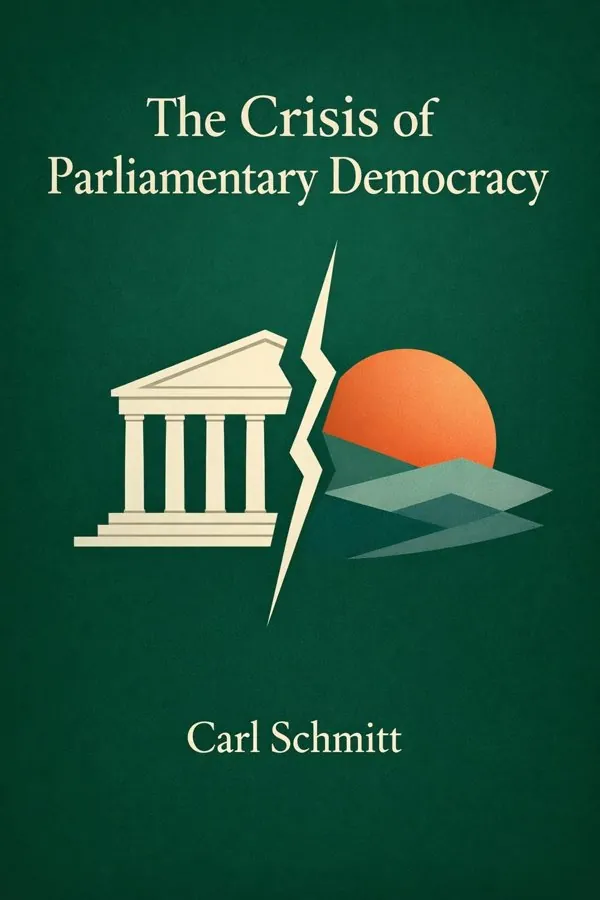
The Crisis of Parliamentary Democracy: Summary & Key Insights
by Carl Schmitt
 10 min7 chaptersAudio available
What Is The Crisis of Parliamentary Democracy About?
The Crisis of Parliamentary Democracy by Carl Schmitt is a politics book spanning 7 pages. First published in 1923, this classic work by Carl Schmitt examines the structural and ideological foundations of parliamentary democracy. Schmitt argues that the liberal ideal of open discussion and public deliberation has lost its legitimacy, and that the parliamentary form has entered a crisis in an age of political polarization and mass movements. The book remains a key text in twentieth-century political theory, offering a critical analysis of liberal democracy from a conservative perspective.
This FizzRead summary covers all 7 key chapters of The Crisis of Parliamentary Democracy in approximately 10 minutes, distilling the most important ideas, arguments, and takeaways from Carl Schmitt's work. Also available as an audio summary and Key Quotes Podcast.
The Crisis of Parliamentary Democracy
First published in 1923, this classic work by Carl Schmitt examines the structural and ideological foundations of parliamentary democracy. Schmitt argues that the liberal ideal of open discussion and public deliberation has lost its legitimacy, and that the parliamentary form has entered a crisis in an age of political polarization and mass movements. The book remains a key text in twentieth-century political theory, offering a critical analysis of liberal democracy from a conservative perspective.
Who Should Read The Crisis of Parliamentary Democracy?
This book is perfect for anyone interested in politics and looking to gain actionable insights in a short read. Whether you're a student, professional, or lifelong learner, the key ideas from The Crisis of Parliamentary Democracy by Carl Schmitt will help you think differently.
- ✓Readers who enjoy politics and want practical takeaways
- ✓Professionals looking to apply new ideas to their work and life
- ✓Anyone who wants the core insights of The Crisis of Parliamentary Democracy in just 10 minutes
Want the full summary?
Get instant access to this book summary and 100K+ more with Fizz Moment.
Get Free SummaryAvailable on App Store • Free to download
Key Chapters
In its origin, parliamentarism carried a noble faith: that truth emerges from the confrontation of opinions and that reason governs when discussion is free and public. I traced this idea to the eighteenth and nineteenth centuries, when liberal thinkers associated openness and transparency with the moral superiority of law over violence. Parliament was conceived as a stage where competing interests could be reconciled through rational discourse. Publicity and accountability ensured that deliberation would serve truth rather than power.
Yet, this vision presupposed a homogeneous moral and intellectual world — a bourgeois society bound by shared norms and belief in the persuasive force of reason. The parliamentary system functioned only as long as its members respected these unwritten assumptions. Once politics became a struggle of organized interests, this foundation cracked. Parliamentary sessions no longer embodied open exploration but became theatres of party discipline, where outcomes were decided beforehand.
To understand the crisis, one must see that parliamentarism’s legitimacy rests on discussion as a moral act. When publicity ceases to illuminate debate and becomes mere spectacle, the core ideal collapses. Thus the concept, which once expressed freedom of thought, degenerates into ritual: discussions occur, but they are neither genuine nor transformative. The institution survives; its spirit dies. That death marks the true crisis of parliamentary democracy.
Liberalism, which supplied the philosophical lifeblood to parliamentarism, rests on faith in the individual and rational discourse. Its values — freedom of opinion, tolerance, and pluralism — are defensible as moral ideals, yet politically they dissolve unity. Where liberalism insists on safeguarding individual freedoms, it resists any decisive act that might bind a collective will. In situations demanding decision, liberalism hesitates — preferring compromise to clarity, procedure to substance.
This hesitation reveals the core contradiction: liberalism cannot provide the cohesion required for political action. It is a theory of negation, concerned with limiting power rather than exercising it. Therefore, it produces governments that deliberate endlessly but rarely act decisively. I described liberal parliamentarism as a government of endless discussion — an order that believes in truth-by-dialogue but is unable to command loyalty in times of crisis.
Freedom of discussion is valuable in a tranquil society; it becomes fatal in moments demanding unity. War and revolution expose the impotence of liberal institutions because liberalism mistakes the state for an association of private interests rather than a unity of decision. When the challenges of mass democracy arise, liberalism’s insistence on pluralism erodes its own foundation, transforming rational discourse into mere negotiation among factions. The liberal faith that procedure alone confers legitimacy becomes untenable when decisions are required, not merely debated.
+ 5 more chapters — available in the FizzRead app
All Chapters in The Crisis of Parliamentary Democracy
About the Author
Carl Schmitt (1888–1985) was a German jurist, constitutional theorist, and political philosopher. He is regarded as one of the most influential and controversial thinkers in modern political theory. His writings on sovereignty, the state of exception, and political theology have profoundly shaped debates on law and politics.
Get This Summary in Your Preferred Format
Read or listen to the The Crisis of Parliamentary Democracy summary by Carl Schmitt anytime, anywhere. FizzRead offers multiple formats so you can learn on your terms — all free.
Available formats: App · Audio · PDF · EPUB — All included free with FizzRead
Download The Crisis of Parliamentary Democracy PDF and EPUB Summary
Key Quotes from The Crisis of Parliamentary Democracy
“In its origin, parliamentarism carried a noble faith: that truth emerges from the confrontation of opinions and that reason governs when discussion is free and public.”
“Liberalism, which supplied the philosophical lifeblood to parliamentarism, rests on faith in the individual and rational discourse.”
Frequently Asked Questions about The Crisis of Parliamentary Democracy
The Crisis of Parliamentary Democracy by Carl Schmitt is a politics book that explores key ideas across 7 chapters. First published in 1923, this classic work by Carl Schmitt examines the structural and ideological foundations of parliamentary democracy. Schmitt argues that the liberal ideal of open discussion and public deliberation has lost its legitimacy, and that the parliamentary form has entered a crisis in an age of political polarization and mass movements. The book remains a key text in twentieth-century political theory, offering a critical analysis of liberal democracy from a conservative perspective.
You Might Also Like
Antifa: The Anti-Fascist Handbook
Mark Bray
10 min
Attack from Within: How Disinformation Is Sabotaging America
Barbara McQuade
10 min
Coercion, Capital, and European States, AD 990–1992
Charles Tilly
10 min
Digital Democracy: Concepts, Methodologies, Tools, and Applications
Various Authors
10 min
Fascism
Stanley G. Payne
10 min
Fire And Fury: Inside The Trump White House
Michael Wolff
10 minBrowse by Category
Ready to read The Crisis of Parliamentary Democracy?
Get the full summary and 100K+ more books with Fizz Moment.