
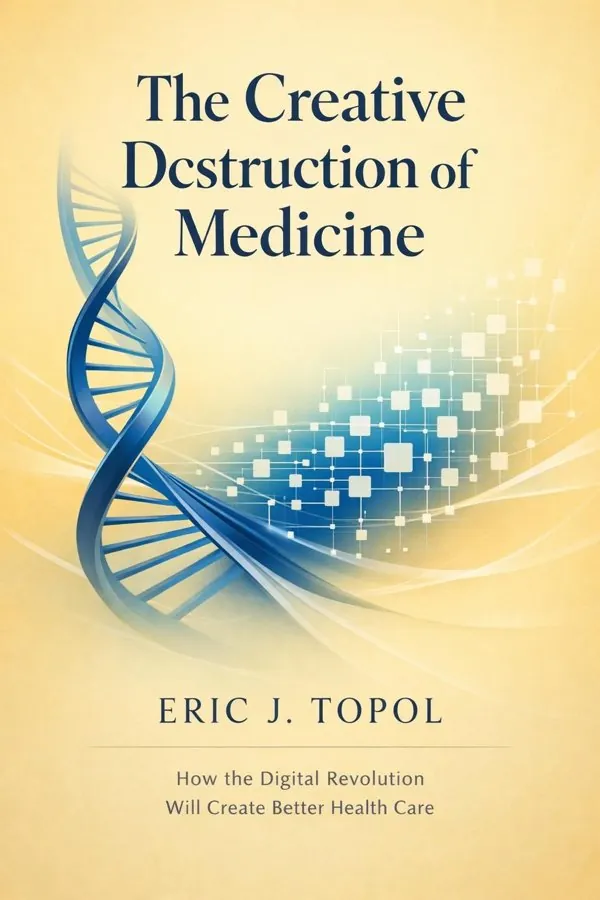
The Creative Destruction of Medicine: How the Digital Revolution Will Create Better Health Care: Summary & Key Insights
 10 min5 chaptersAudio available
What Is The Creative Destruction of Medicine: How the Digital Revolution Will Create Better Health Care About?
The Creative Destruction of Medicine: How the Digital Revolution Will Create Better Health Care by Eric J. Topol is a health_med book spanning 5 pages. In this groundbreaking work, cardiologist and digital medicine pioneer Eric J. Topol explores how genomics, big data, and digital technology are transforming every aspect of medicine. He argues that the convergence of these innovations will empower patients, personalize treatment, and revolutionize healthcare delivery. The book calls for a new era of consumer-driven medicine where individuals take control of their health data and decisions.
This FizzRead summary covers all 5 key chapters of The Creative Destruction of Medicine: How the Digital Revolution Will Create Better Health Care in approximately 10 minutes, distilling the most important ideas, arguments, and takeaways from Eric J. Topol's work. Also available as an audio summary and Key Quotes Podcast.
The Creative Destruction of Medicine: How the Digital Revolution Will Create Better Health Care
In this groundbreaking work, cardiologist and digital medicine pioneer Eric J. Topol explores how genomics, big data, and digital technology are transforming every aspect of medicine. He argues that the convergence of these innovations will empower patients, personalize treatment, and revolutionize healthcare delivery. The book calls for a new era of consumer-driven medicine where individuals take control of their health data and decisions.
Who Should Read The Creative Destruction of Medicine: How the Digital Revolution Will Create Better Health Care?
This book is perfect for anyone interested in health_med and looking to gain actionable insights in a short read. Whether you're a student, professional, or lifelong learner, the key ideas from The Creative Destruction of Medicine: How the Digital Revolution Will Create Better Health Care by Eric J. Topol will help you think differently.
- ✓Readers who enjoy health_med and want practical takeaways
- ✓Professionals looking to apply new ideas to their work and life
- ✓Anyone who wants the core insights of The Creative Destruction of Medicine: How the Digital Revolution Will Create Better Health Care in just 10 minutes
Want the full summary?
Get instant access to this book summary and 100K+ more with Fizz Moment.
Get Free SummaryAvailable on App Store • Free to download
Key Chapters
The catalyst for this transformation is digital technology itself. Never before have we had the means to capture continuous, high-fidelity data about every dimension of human physiology. Mobile phones, sensors, and wireless networks have brought healthcare out of the clinic and into our daily lives. What once required specialized equipment—ECG monitors, ultrasound machines, even genetic testing—now fits in our palm.
In my daily practice, I began witnessing how smartphones could serve as diagnostic allies. A phone equipped with a sensor can monitor glucose levels, detect heart rhythm anomalies, or even produce a live echocardiogram. For the first time, patients could collect medical-quality data without a doctor present. This isn’t just convenience—it’s empowerment. It externalizes the walls of the hospital and redefines what medical engagement looks like.
Yet, this revolution is not just about gadgets. It’s about redefining relationships. The physician is no longer the sole gatekeeper of knowledge. Data travels faster than bureaucracy, and patients are becoming active participants. When a patient brings their own health analytics to a consultation, the dynamic evolves: collaboration replaces compliance. That’s the essence of creative destruction—technology shatters outdated hierarchies and forces every player to adapt.
Still, I acknowledge that this change unsettles many professionals. After all, medicine has functioned for centuries with a top-down model. But history teaches us that revolutions never unfold gently. The digital upheaval in medicine will, in time, prove as defining as the printing press was for knowledge itself.
Perhaps nowhere has digital transformation been more profound than in genomics. When the Human Genome Project completed in 2003, it cost billions and took years. Today, full sequencing costs less than a thousand dollars and can be done in days. This collapse in cost and time is more than technical progress—it’s the foundation of personalized medicine.
For most of human history, medicine has been based on population averages. We prescribed medications that worked for some, trialed therapies that failed others, and accepted side effects as unavoidable. But your genome tells a different story. It’s the ultimate instruction manual for your health, revealing your susceptibilities, metabolic quirks, and therapeutic sensitivities. When we have your genomic data aligned with your digital medical record, treatment becomes not just reactive but predictive.
As a cardiologist, I’ve seen how genomic information can prevent tragedy. Certain mutations predispose individuals to fatal arrhythmias or drug-induced complications; knowing this in advance can literally save lives. Similarly, in oncology, sequencing tumor DNA allows targeted therapies to strike cancer’s unique vulnerabilities. Every patient becomes a data-rich narrative, not an anonymous datapoint.
Yet for personalized medicine to thrive, we must break data silos. Genomic insights unattached to mobile and clinical data lose much of their potential. True personalization requires continuous, integrative data flow—what I call an ‘ome-enabled’ ecosystem. It’s not just genomics but proteomics, metabolomics, and even microbiomics—each layer contributing to a holistic map of human health.
Our challenge lies in translating this wealth into wisdom. Data itself doesn’t heal; interpretation does. And that means a radical shift toward computational literacy and cross-disciplinary collaboration in medicine.
+ 3 more chapters — available in the FizzRead app
All Chapters in The Creative Destruction of Medicine: How the Digital Revolution Will Create Better Health Care
About the Author
Eric J. Topol, M.D., is a leading cardiologist, geneticist, and digital medicine researcher. He is the founder and director of the Scripps Research Translational Institute and has been recognized as one of the most influential physicians in the United States for his work in genomics and digital health innovation.
Get This Summary in Your Preferred Format
Read or listen to the The Creative Destruction of Medicine: How the Digital Revolution Will Create Better Health Care summary by Eric J. Topol anytime, anywhere. FizzRead offers multiple formats so you can learn on your terms — all free.
Available formats: App · Audio · PDF · EPUB — All included free with FizzRead
Download The Creative Destruction of Medicine: How the Digital Revolution Will Create Better Health Care PDF and EPUB Summary
Key Quotes from The Creative Destruction of Medicine: How the Digital Revolution Will Create Better Health Care
“The catalyst for this transformation is digital technology itself.”
“Perhaps nowhere has digital transformation been more profound than in genomics.”
Frequently Asked Questions about The Creative Destruction of Medicine: How the Digital Revolution Will Create Better Health Care
The Creative Destruction of Medicine: How the Digital Revolution Will Create Better Health Care by Eric J. Topol is a health_med book that explores key ideas across 5 chapters. In this groundbreaking work, cardiologist and digital medicine pioneer Eric J. Topol explores how genomics, big data, and digital technology are transforming every aspect of medicine. He argues that the convergence of these innovations will empower patients, personalize treatment, and revolutionize healthcare delivery. The book calls for a new era of consumer-driven medicine where individuals take control of their health data and decisions.
You Might Also Like
On Immunity
Eula Biss
10 min
The Three-Body Problem
Liu Cixin
10 min
Community Health Volunteer Toolkit: Training and Practical Activities
World Health Organization
10 min
Healing Back Pain: The Mind-Body Connection
John E. Sarno
10 min
Health Literacy for All: Practical Guides to Communicate Health Information (Compilations)
World Health Organization
10 min
The Complete Guide to Sports Supplements: An Evidence-Based Review
Anita Bean
10 minBrowse by Category
Ready to read The Creative Destruction of Medicine: How the Digital Revolution Will Create Better Health Care?
Get the full summary and 100K+ more books with Fizz Moment.