
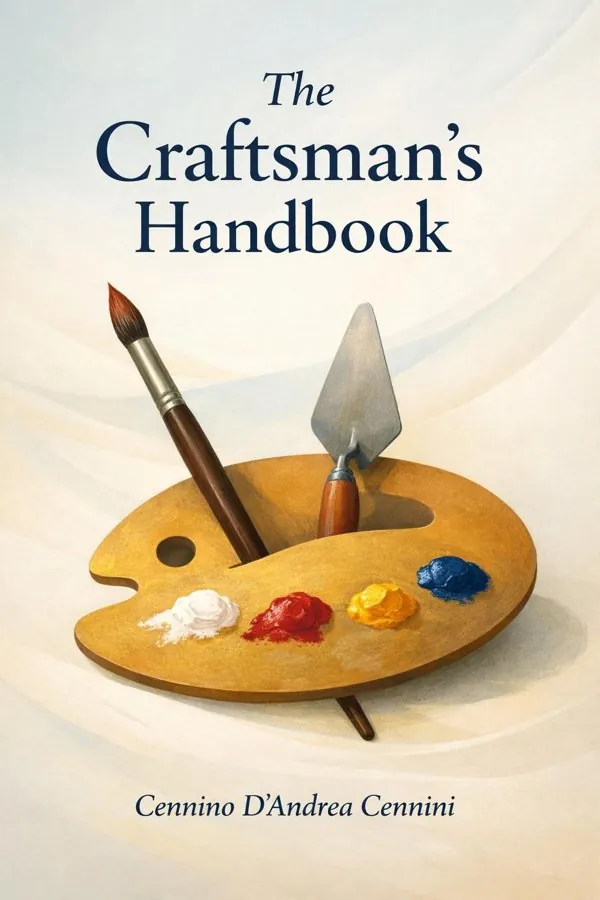
The Craftsman's Handbook: Summary & Key Insights
 10 min11 chaptersAudio available
What Is The Craftsman's Handbook About?
The Craftsman's Handbook by Cennino D'Andrea Cennini is a art_history book spanning 11 pages. The Craftsman's Handbook, originally written by Cennino Cennini in the late 14th century, is one of the most important sources for understanding the artistic techniques of the Italian Renaissance. This English edition, published by Dover Publications, provides detailed instructions on pigment preparation, tempera painting, fresco, and other craft practices, offering a direct insight into the training and work of medieval artists.
This FizzRead summary covers all 11 key chapters of The Craftsman's Handbook in approximately 10 minutes, distilling the most important ideas, arguments, and takeaways from Cennino D'Andrea Cennini's work. Also available as an audio summary and Key Quotes Podcast.
The Craftsman's Handbook
The Craftsman's Handbook, originally written by Cennino Cennini in the late 14th century, is one of the most important sources for understanding the artistic techniques of the Italian Renaissance. This English edition, published by Dover Publications, provides detailed instructions on pigment preparation, tempera painting, fresco, and other craft practices, offering a direct insight into the training and work of medieval artists.
Who Should Read The Craftsman's Handbook?
This book is perfect for anyone interested in art_history and looking to gain actionable insights in a short read. Whether you're a student, professional, or lifelong learner, the key ideas from The Craftsman's Handbook by Cennino D'Andrea Cennini will help you think differently.
- ✓Readers who enjoy art_history and want practical takeaways
- ✓Professionals looking to apply new ideas to their work and life
- ✓Anyone who wants the core insights of The Craftsman's Handbook in just 10 minutes
Want the full summary?
Get instant access to this book summary and 100K+ more with Fizz Moment.
Get Free SummaryAvailable on App Store • Free to download
Key Chapters
Before the painter takes up his brush, he must shape his life. A painter who chases vanity or luxury will find his hand falters. I have seen men gifted with skill lose their art because they lacked temperance. Therefore I say: keep your mind humble. Avoid excess, idle talk, and indulgence. Eat simply; work each day as if in service. Let your heart be pure, for all beauty flows from purity of purpose.
The painter must treat his tools and materials as sacred things. To grind pigments with haste or neglect is to dishonor creation; every stone and root you use has come from the earth’s mystery. Approach your work with reverence, and let solitude become your teacher. Keep good company, but avoid envy or deceit. Remember that art is not made for pride but for devotion, whether to the subject, the guild, or the divine itself.
Virtue builds the hand’s stability. Patience, moderation, and faith shape the artist more deeply than technique. In this sense, the craftsman’s life mirrors the monastic order: study, silence, repetition, and contemplation are the stones upon which mastery rests. As your eyes learn to see, so too your spirit must learn to wait. Only through the harmony of conduct and craft can painting become revelation.
The foundation of painting is drawing. Without mastery of line, the colors will wander. In my youth, when apprenticed to Gaddi, I was taught first to handle silverpoint upon a prepared panel. Silverpoint demands control — each stroke permanent, each correction impossible. I instruct you to prepare your surface with fine bone ash and ground parchment glue, polished to a delicate tooth. Only then will the silver leave its trace, a luminous gray as quiet as thought itself.
Charcoal is your other companion, born of fire and air. Seek vine charcoal for soft study, willow for sharper edge. Fix your work with gentle glue water, lest it vanish under touch. Ink drawing follows — the mark of confidence. Grind your ink from gallnuts, mix with gum, and allow it to rest until its black shines with depth. The pen, made from reed or feather, must be cut with precision; an ill-cut pen betrays the hand.
Through drawing you learn discipline in proportion, rhythm, and grace. It is the first dialogue between mind and matter. I urge you to draw daily, not seeking beauty at first but control. Drawing is the root that feeds painting. Neglect it, and your colors will lack structure; cherish it, and you will find all other arts rest upon its strength.
+ 9 more chapters — available in the FizzRead app
All Chapters in The Craftsman's Handbook
About the Author
Cennino D'Andrea Cennini (c. 1360–1427) was an Italian painter and writer, a student of Agnolo Gaddi and influenced by Giotto’s school. He is best known for his treatise 'Il Libro dell'Arte', which documents the artistic techniques of his time and serves as a key testimony to the craft and painting traditions of the Renaissance.
Get This Summary in Your Preferred Format
Read or listen to the The Craftsman's Handbook summary by Cennino D'Andrea Cennini anytime, anywhere. FizzRead offers multiple formats so you can learn on your terms — all free.
Available formats: App · Audio · PDF · EPUB — All included free with FizzRead
Download The Craftsman's Handbook PDF and EPUB Summary
Key Quotes from The Craftsman's Handbook
“Before the painter takes up his brush, he must shape his life.”
“Without mastery of line, the colors will wander.”
Frequently Asked Questions about The Craftsman's Handbook
The Craftsman's Handbook by Cennino D'Andrea Cennini is a art_history book that explores key ideas across 11 chapters. The Craftsman's Handbook, originally written by Cennino Cennini in the late 14th century, is one of the most important sources for understanding the artistic techniques of the Italian Renaissance. This English edition, published by Dover Publications, provides detailed instructions on pigment preparation, tempera painting, fresco, and other craft practices, offering a direct insight into the training and work of medieval artists.
You Might Also Like
Studies In Impressionism
John Rewald
10 min
Art Since 1900: Modernism, Antimodernism, Postmodernism
Hal Foster, Rosalind E. Krauss, Yve-Alain Bois, Benjamin H. D. Buchloh
10 min
Art Since 1940: Strategies of Being
Jonathan Fineberg
10 min
Color and Meaning: Art, Science, and Symbolism
John Gage
10 min
Color: Travels Through the Paintbox
Victoria Finlay
10 min
Curatorial Activism: Towards an Ethics of Curating
Maura Reilly
10 minBrowse by Category
Ready to read The Craftsman's Handbook?
Get the full summary and 100K+ more books with Fizz Moment.