
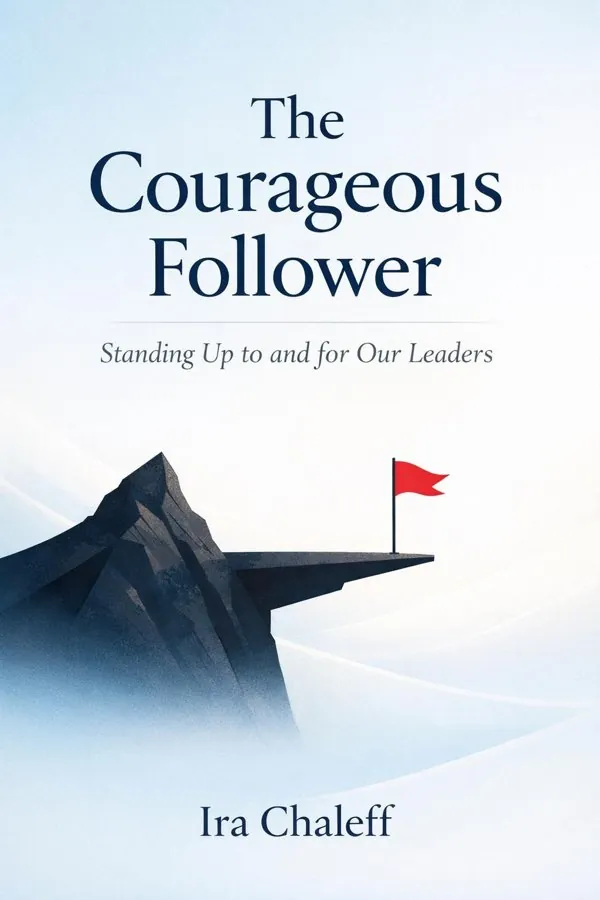
The Courageous Follower: Standing Up to and for Our Leaders: Summary & Key Insights
by Ira Chaleff
 10 min9 chaptersAudio available
Key Takeaways from The Courageous Follower: Standing Up to and for Our Leaders
One of the book’s most important insights is that leadership is never a solo performance.
Courage often begins before conflict begins.
Real service is stronger than obedience.
Silence can be more dangerous than disobedience.
Bad systems are rarely changed by criticism alone.
What Is The Courageous Follower: Standing Up to and for Our Leaders About?
The Courageous Follower: Standing Up to and for Our Leaders by Ira Chaleff is a leadership book spanning 9 pages. Most leadership books assume the real action happens at the top. Ira Chaleff challenges that assumption with a powerful idea: leaders and followers shape one another, and the health of any organization depends as much on courageous followership as on strong leadership. In The Courageous Follower, Chaleff argues that followers are not passive subordinates or mere implementers. They are responsible partners in a shared mission, capable of supporting leaders, correcting them, and, when necessary, resisting them. This perspective matters deeply in workplaces, governments, nonprofits, and communities where silence, compliance, and fear can allow poor decisions to spread unchecked. Chaleff offers a practical framework built around different dimensions of courage, showing how followers can serve loyally without becoming servile and challenge authority without becoming destructive. His authority comes from decades of leadership consulting, teaching, and pioneering work in the field of followership. The result is a timely, ethically grounded guide for anyone who has ever worked under a leader and wondered how to contribute with integrity, influence decisions from below, and act responsibly when power goes wrong.
This FizzRead summary covers all 9 key chapters of The Courageous Follower: Standing Up to and for Our Leaders in approximately 10 minutes, distilling the most important ideas, arguments, and takeaways from Ira Chaleff's work. Also available as an audio summary and Key Quotes Podcast.
The Courageous Follower: Standing Up to and for Our Leaders
Most leadership books assume the real action happens at the top. Ira Chaleff challenges that assumption with a powerful idea: leaders and followers shape one another, and the health of any organization depends as much on courageous followership as on strong leadership. In The Courageous Follower, Chaleff argues that followers are not passive subordinates or mere implementers. They are responsible partners in a shared mission, capable of supporting leaders, correcting them, and, when necessary, resisting them. This perspective matters deeply in workplaces, governments, nonprofits, and communities where silence, compliance, and fear can allow poor decisions to spread unchecked. Chaleff offers a practical framework built around different dimensions of courage, showing how followers can serve loyally without becoming servile and challenge authority without becoming destructive. His authority comes from decades of leadership consulting, teaching, and pioneering work in the field of followership. The result is a timely, ethically grounded guide for anyone who has ever worked under a leader and wondered how to contribute with integrity, influence decisions from below, and act responsibly when power goes wrong.
Who Should Read The Courageous Follower: Standing Up to and for Our Leaders?
This book is perfect for anyone interested in leadership and looking to gain actionable insights in a short read. Whether you're a student, professional, or lifelong learner, the key ideas from The Courageous Follower: Standing Up to and for Our Leaders by Ira Chaleff will help you think differently.
- ✓Readers who enjoy leadership and want practical takeaways
- ✓Professionals looking to apply new ideas to their work and life
- ✓Anyone who wants the core insights of The Courageous Follower: Standing Up to and for Our Leaders in just 10 minutes
Want the full summary?
Get instant access to this book summary and 100K+ more with Fizz Moment.
Get Free SummaryAvailable on App Store • Free to download
Key Chapters
Courage often begins before conflict begins. Chaleff’s first dimension of courageous followership is assuming responsibility, and this means far more than completing assigned tasks. It means taking ownership for the organization’s purpose, for the quality of the team’s functioning, and for one’s own development as a thoughtful moral agent. Passive followers wait to be told. Courageous followers step forward when they see a need.
This idea pushes against a common workplace mindset: “That’s above my pay grade” or “That’s management’s problem.” Chaleff does not suggest followers overreach or undermine structure. Rather, he argues that responsible followers understand they are custodians of the mission. They anticipate problems, identify opportunities, and contribute to a healthy culture without waiting for permission at every turn.
In practice, this may mean raising a risk before it becomes a crisis, volunteering to help solve a cross-functional problem, mentoring a struggling colleague, or preparing more thoroughly so the leader can make better decisions. A responsible follower manages up as well as down and across. For example, if a project is drifting, a courageous follower might prepare a short diagnostic memo outlining bottlenecks and options instead of merely complaining about confusion.
Assuming responsibility also means not becoming emotionally dependent on authority. Chaleff urges followers to develop their own judgment, values, and competence. That independence is what later makes real courage possible when disagreement arises.
The actionable lesson is to adopt a stewardship mindset. Ask yourself regularly: “If I were fully responsible for the success and integrity of this mission, what would I do differently today?” Then do one concrete thing that reflects that answer.
Real service is stronger than obedience. Chaleff’s second dimension of courage focuses on serving with dedication and integrity. Followers often hear that they should be loyal, but loyalty can become dangerous when it is directed toward a personality instead of a purpose. Courageous followers serve the mission, the values, and the legitimate responsibilities of leadership without surrendering conscience or self-respect.
This distinction is essential. Many people confuse service with subservience. Chaleff rejects that view. Effective followers bring energy, competence, and discipline to their role. They do their part exceptionally well. They help leaders succeed, not because they crave approval, but because the shared purpose matters. At the same time, their service remains grounded in integrity. They do not flatter, hide information, or support actions they believe are unethical merely to appear loyal.
Imagine an executive assistant who knows a leader’s schedule, priorities, and pressures intimately. In a subservient mode, that person might protect the leader from all discomfort and filter out dissent. In a courageous mode, the same person might ensure the leader receives critical information, hears from affected stakeholders, and has the space to reflect before making a hasty decision. That is genuine service.
Serving with integrity also requires competence. Followers who want influence must earn credibility through reliable performance. It is easier to challenge authority effectively when others know you are deeply committed and consistently excellent.
The takeaway is practical: ask whether your daily work strengthens the mission or merely protects hierarchy. Serve with excellence, but draw a clear line between supporting leadership and feeding ego. The most valuable followers are not the most agreeable; they are the most trustworthy.
Silence can be more dangerous than disobedience. Chaleff’s third dimension of courageous followership is the courage to challenge the leader when behavior, judgment, or decisions threaten the mission or violate values. This is the heart of the book, because many organizational disasters happen not only because leaders err, but because followers notice the problem and say nothing.
Challenging a leader is difficult for obvious reasons. There may be fear of retaliation, damaged relationships, lost opportunities, or social isolation. Yet Chaleff argues that withholding honest feedback is often a form of abandonment. If followers truly support the leader and the purpose, they must intervene when they see drift, blind spots, or ethical danger.
Effective challenge is neither reckless nor self-righteous. Timing, tone, evidence, and intent all matter. A follower should clarify the issue, gather facts, choose an appropriate setting, and frame concerns in terms of shared goals. Instead of saying, “You always ignore people,” one might say, “I’m concerned this decision was made without critical input, and that could create resistance and blind spots.” The aim is to correct, not humiliate.
In some cases, challenge escalates gradually: private conversation, documented concerns, broader consultation, or formal reporting. In others, urgent moral stakes require immediate resistance. What matters is not comfort, but responsibility. Chaleff reminds us that leaders can become isolated by status, and followers may be the only people positioned to interrupt a dangerous pattern.
A useful takeaway is to prepare for dissent before you need it. Build credibility, document concerns, practice respectful candor, and know the channels available in your organization. Courage is easier to exercise when you have both principle and method.
Bad systems are rarely changed by criticism alone. Chaleff’s fourth dimension, participating in transformation, expands the follower’s role beyond individual moments of challenge. Courageous followers do not simply point out what is wrong; they contribute to changing the conditions that produce poor leadership and weak followership in the first place.
This is a crucial shift from reaction to co-creation. Organizations often fall into destructive patterns: leaders become controlling, followers become dependent, dissent gets punished, and innovation declines. If followers only complain in private, the system persists. Transformation requires people at every level to help build healthier norms, structures, and relationships.
Participation in transformation may involve improving communication channels, encouraging reflective practices, designing better decision processes, or helping a leader navigate a transition. For example, after a period of crisis command-and-control, a team might need to consciously reintroduce dialogue, delegation, and learning. A courageous follower can facilitate that by inviting retrospective reviews, proposing meeting changes, or helping establish clearer accountability.
Chaleff also recognizes that leaders themselves may be trapped in role expectations. A follower who understands this can become an ally in change rather than a mere critic. That might mean giving a leader honest feedback along with practical support, such as helping gather employee input, piloting a new process, or modeling a healthier style of collaboration.
Transformation is not naïve optimism. Some systems resist change. But Chaleff insists that followers have more influence than they often assume, especially when they act collectively and constructively.
The practical takeaway is to identify one recurring dysfunction in your team and address the pattern, not just the incident. Ask what structure, norm, or habit keeps recreating the problem, and propose a concrete improvement.
There are moments when support and dialogue are no longer enough. Chaleff’s fifth dimension of courage is moral action: the willingness to take a stand when a leader’s behavior crosses ethical lines or endangers others. This is the most demanding form of followership because it may require personal sacrifice, public dissent, refusal, whistleblowing, or exit.
The central idea is that followers cannot outsource morality upward. Obedience does not erase responsibility. History, business failures, and institutional scandals repeatedly show what happens when people say, “I was just following orders.” Chaleff argues that courageous followers must develop a moral compass strong enough to withstand pressure, ambiguity, and the seduction of belonging.
Moral action is not impulsive rebellion. It requires discernment. A follower must separate mere disagreement from genuine ethical breach. That means examining facts, motives, consequences, and standards. Once the issue is clear, the follower should seek the least destructive path that still honors conscience: raising concerns internally, refusing participation, seeking allies, documenting evidence, using formal ethics channels, or, when necessary, going outside the system.
Examples are everywhere: an accountant asked to manipulate numbers, a healthcare worker pressured to ignore safety procedures, a public servant told to conceal information, or an employee expected to harass or discriminate in the name of performance. In such situations, neutrality is often complicity.
Chaleff is realistic about the cost. Moral action may threaten careers and relationships. But the cost of silence can be far greater for victims, institutions, and the follower’s own integrity.
The takeaway is to define your nonnegotiables before you are tested. Write down the ethical lines you will not cross and the steps you will take if asked to cross them. Prepared conscience is stronger than improvised conscience.
Most failures of courage do not come from ignorance; they come from fear. Chaleff devotes significant attention to the barriers that prevent followers from acting responsibly. These barriers can be external, such as punitive cultures, unclear authority, political risk, and economic dependence. They can also be internal, including insecurity, conflict avoidance, hero worship, desire for approval, and learned helplessness.
Understanding these barriers is liberating because it replaces self-condemnation with diagnosis. People often know what should be said or done, yet remain frozen. Why? Because the system teaches them that dissent is dangerous, because they underestimate their influence, or because they have been conditioned to treat authority as inherently superior. In some environments, followers fear being labeled difficult, disloyal, or not a team player. In others, they simply do not know how to voice concern effectively.
Chaleff encourages followers to examine the stories they tell themselves. “If I speak up, I’ll be punished.” “It’s not my place.” “Someone else will say something.” These beliefs may contain some truth, but they can also become excuses that protect comfort while exposing the mission to harm.
A practical example is a team member who notices bias in hiring decisions but stays quiet because senior people seem aligned. Naming the barrier helps: fear of exclusion, uncertainty about evidence, and lack of language. Once identified, the follower can plan a response, perhaps by gathering examples, consulting HR policy, and raising the issue with an ally.
The actionable lesson is to conduct a courage audit. Identify one situation where you are staying silent, list the external and internal barriers involved, and decide which one you can reduce first through preparation, support, or skill-building.
Courage is rarely a single dramatic act; more often, it is a trained capacity. Chaleff emphasizes that courageous followership depends on personal development. Followers need resilience, self-awareness, emotional regulation, and confidence in their values if they hope to remain steady under pressure. Without these inner resources, even people with good intentions may retreat when stakes rise.
This perspective is encouraging because it means courage can be cultivated. Small acts of honesty strengthen one’s ability to make larger interventions later. Clarifying values, reflecting on past compromises, learning communication skills, and building supportive relationships all expand a follower’s range of action. Chaleff suggests that moral courage grows when people practice responsibility in ordinary situations, not just extraordinary ones.
Resilience also matters because standing up to authority can be exhausting. Followers may face defensiveness, denial, or backlash. To persist, they need ways to recover and remain grounded. That may include mentors, peer networks, journaling, coaching, spiritual practice, or deliberate routines that restore clarity and composure. Courage without resilience burns out; resilience without courage becomes accommodation.
Consider a mid-level manager who needs to challenge a senior executive repeatedly on unrealistic targets. Success will depend not only on having data, but on managing anxiety, staying non-defensive, and recovering after hard conversations. Personal steadiness makes principled action sustainable.
The takeaway is to train for courage before crisis arrives. Strengthen your capacity through regular reflection, difficult but respectful conversations, and supportive relationships. Ask yourself each week: what truth did I avoid, and what small next step would help me speak it with greater skill and calm?
The healthiest organizations do not depend on flawless leaders. They depend on cultures where truth can travel upward. Chaleff’s broader contribution is to show that ethical leadership is inseparable from courageous followership. Leaders may set direction and tone, but followers determine whether reality reaches the top, whether values are defended in practice, and whether power remains accountable.
This has major implications for culture. If organizations want ethical leaders, they cannot merely train leaders in vision and strategy. They must also create environments where followers can question decisions, report concerns, admit mistakes, and contribute ideas without disproportionate fear. Ethical systems normalize candor. Dysfunctional systems personalize dissent.
Chaleff’s framework helps explain why otherwise decent organizations drift into wrongdoing. It is not always because leaders are uniquely malicious. Often, a combination of status, pressure, incentives, and follower silence creates a moral fog. Courageous followers act as an early warning system and a stabilizing force. They remind leaders that authority does not erase accountability.
For example, a board that only praises a CEO may enable strategic recklessness. A medical team that avoids questioning a senior physician may endanger patients. A military or public institution that confuses unity with unquestioning compliance may invite abuse. In each case, the ethics of the whole system depend on whether followers engage responsibly.
The practical takeaway is to help build a speak-up culture wherever you are. Reward honesty, invite dissent, separate disagreement from disloyalty, and model respectful challenge. Ethical leadership is not the product of a heroic individual; it is the outcome of a community that treats truth as everyone’s job.
All Chapters in The Courageous Follower: Standing Up to and for Our Leaders
About the Author
Ira Chaleff is a leadership author, educator, and consultant widely recognized for developing the modern concept of courageous followership. His work has helped shift leadership studies beyond a leader-only focus by showing how followers shape organizational ethics, accountability, and performance. Over the course of his career, Chaleff has advised organizations across business, government, education, and the nonprofit sector on leadership culture, power dynamics, and responsible action within hierarchies. He is especially known for encouraging individuals at every level to combine support for leaders with the willingness to challenge them when necessary. Through speaking, teaching, and writing, he has influenced leadership development programs around the world and remains a key voice in conversations about integrity, authority, and the shared responsibility required for healthy institutions.
Get This Summary in Your Preferred Format
Read or listen to the The Courageous Follower: Standing Up to and for Our Leaders summary by Ira Chaleff anytime, anywhere. FizzRead offers multiple formats so you can learn on your terms — all free.
Available formats: App · Audio · PDF · EPUB — All included free with FizzRead
Download The Courageous Follower: Standing Up to and for Our Leaders PDF and EPUB Summary
Key Quotes from The Courageous Follower: Standing Up to and for Our Leaders
“One of the book’s most important insights is that leadership is never a solo performance.”
“Courage often begins before conflict begins.”
“Real service is stronger than obedience.”
“Silence can be more dangerous than disobedience.”
“Bad systems are rarely changed by criticism alone.”
Frequently Asked Questions about The Courageous Follower: Standing Up to and for Our Leaders
The Courageous Follower: Standing Up to and for Our Leaders by Ira Chaleff is a leadership book that explores key ideas across 9 chapters. Most leadership books assume the real action happens at the top. Ira Chaleff challenges that assumption with a powerful idea: leaders and followers shape one another, and the health of any organization depends as much on courageous followership as on strong leadership. In The Courageous Follower, Chaleff argues that followers are not passive subordinates or mere implementers. They are responsible partners in a shared mission, capable of supporting leaders, correcting them, and, when necessary, resisting them. This perspective matters deeply in workplaces, governments, nonprofits, and communities where silence, compliance, and fear can allow poor decisions to spread unchecked. Chaleff offers a practical framework built around different dimensions of courage, showing how followers can serve loyally without becoming servile and challenge authority without becoming destructive. His authority comes from decades of leadership consulting, teaching, and pioneering work in the field of followership. The result is a timely, ethically grounded guide for anyone who has ever worked under a leader and wondered how to contribute with integrity, influence decisions from below, and act responsibly when power goes wrong.
More by Ira Chaleff

You Might Also Like

Extreme Ownership
Jocko Willink
10 min
Dare to Lead
Brene Brown
10 min
Leaders Eat Last
Simon Sinek
10 min
The 21 Irrefutable Laws of Leadership
John Maxwell
10 min
Start With Why
Simon Sinek
10 min
How to Lead When You're Not in Charge
Clay Scroggins
10 minBrowse by Category
Ready to read The Courageous Follower: Standing Up to and for Our Leaders?
Get the full summary and 100K+ more books with Fizz Moment.