
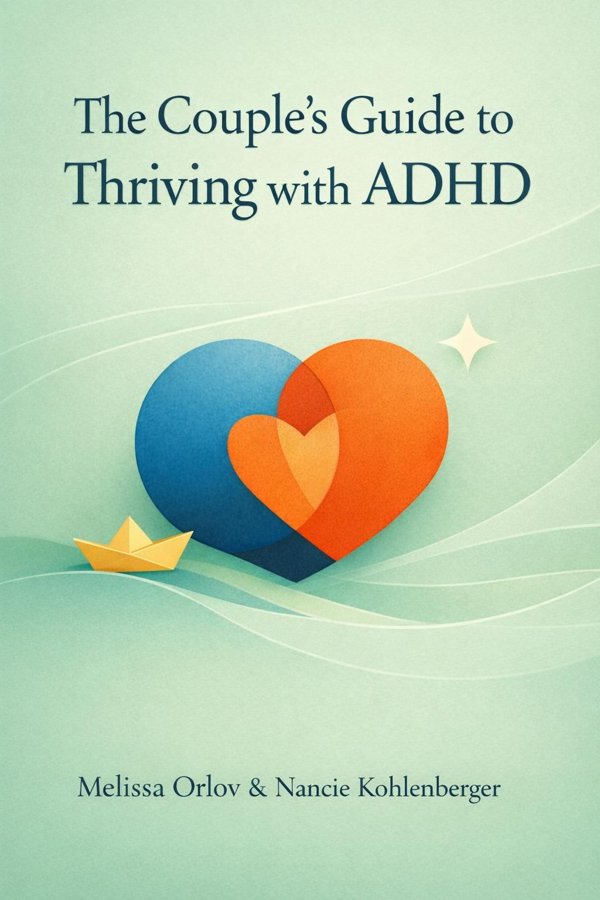
The Couple's Guide to Thriving with ADHD: Summary & Key Insights
by Melissa Orlov, Nancie Kohlenberger
 10 min9 chaptersAudio available
Key Takeaways from The Couple's Guide to Thriving with ADHD
Many couples think they are arguing about chores, lateness, or forgotten promises, when they are actually struggling with the invisible effects of ADHD.
Resentment rarely appears overnight; it is usually the result of many small disappointments left unaddressed.
Most couples assume that if they love each other enough, communication should come naturally.
A diagnosis alone does not transform a relationship; treatment and teamwork do.
When ADHD repeatedly disrupts promises, schedules, emotional presence, or sexual connection, trust often erodes quietly before couples fully notice it.
What Is The Couple's Guide to Thriving with ADHD About?
The Couple's Guide to Thriving with ADHD by Melissa Orlov & Nancie Kohlenberger is a relationships book spanning 5 pages. ADHD does not only affect the person who has it; it often shapes the entire emotional climate of a relationship. In The Couple's Guide to Thriving with ADHD, Melissa Orlov and Nancie Kohlenberger show how patterns such as forgetfulness, inconsistent follow-through, emotional reactivity, and chronic frustration can quietly turn love into conflict. Rather than framing these struggles as personal failures or signs of incompatibility, the book explains how ADHD symptoms can distort communication, responsibilities, intimacy, and trust between partners. What makes this book especially valuable is its blend of lived experience and clinical insight. Melissa Orlov is widely known for her work on ADHD-impacted marriages, while therapist Nancie Kohlenberger brings counseling expertise to the discussion. Together, they offer a practical roadmap for couples who feel stuck in cycles of blame, resentment, and misunderstanding. Their message is both compassionate and empowering: ADHD can create real relationship challenges, but those challenges can be understood, treated, and managed. For couples willing to learn new skills and work as a team, this book offers not just survival strategies, but a path toward a stronger, more connected partnership.
This FizzRead summary covers all 9 key chapters of The Couple's Guide to Thriving with ADHD in approximately 10 minutes, distilling the most important ideas, arguments, and takeaways from Melissa Orlov & Nancie Kohlenberger's work. Also available as an audio summary and Key Quotes Podcast.
The Couple's Guide to Thriving with ADHD
ADHD does not only affect the person who has it; it often shapes the entire emotional climate of a relationship. In The Couple's Guide to Thriving with ADHD, Melissa Orlov and Nancie Kohlenberger show how patterns such as forgetfulness, inconsistent follow-through, emotional reactivity, and chronic frustration can quietly turn love into conflict. Rather than framing these struggles as personal failures or signs of incompatibility, the book explains how ADHD symptoms can distort communication, responsibilities, intimacy, and trust between partners.
What makes this book especially valuable is its blend of lived experience and clinical insight. Melissa Orlov is widely known for her work on ADHD-impacted marriages, while therapist Nancie Kohlenberger brings counseling expertise to the discussion. Together, they offer a practical roadmap for couples who feel stuck in cycles of blame, resentment, and misunderstanding. Their message is both compassionate and empowering: ADHD can create real relationship challenges, but those challenges can be understood, treated, and managed. For couples willing to learn new skills and work as a team, this book offers not just survival strategies, but a path toward a stronger, more connected partnership.
Who Should Read The Couple's Guide to Thriving with ADHD?
This book is perfect for anyone interested in relationships and looking to gain actionable insights in a short read. Whether you're a student, professional, or lifelong learner, the key ideas from The Couple's Guide to Thriving with ADHD by Melissa Orlov & Nancie Kohlenberger will help you think differently.
- ✓Readers who enjoy relationships and want practical takeaways
- ✓Professionals looking to apply new ideas to their work and life
- ✓Anyone who wants the core insights of The Couple's Guide to Thriving with ADHD in just 10 minutes
Want the full summary?
Get instant access to this book summary and 100K+ more with Fizz Moment.
Get Free SummaryAvailable on App Store • Free to download
Key Chapters
Resentment rarely appears overnight; it is usually the result of many small disappointments left unaddressed. The book describes a common emotional cycle in ADHD-affected relationships. Early on, the partner with ADHD may bring energy, spontaneity, and intense attention, creating a powerful sense of connection. But over time, missed responsibilities, inconsistency, and emotional misunderstandings begin to accumulate. The non-ADHD partner starts compensating, managing details, and carrying more of the mental load. Eventually, one partner feels controlled and criticized, while the other feels abandoned and overburdened.
This cycle is especially destructive because both partners often believe they are reacting reasonably. The non-ADHD partner may become more supervisory because things keep falling through the cracks. The ADHD partner may pull away because constant correction feels shaming. The more one pursues control, the more the other resists. This can harden into a parent-child dynamic, where equality and romance begin to disappear.
The authors argue that resentment must be addressed as a system, not as one person’s fault. The over-functioning partner needs to stop solving everything alone, even if that feels temporarily efficient. The ADHD partner needs to take visible, consistent ownership of symptoms and responsibilities. Healing begins when both partners step out of their reactive roles.
A useful application is to name the cycle together. For example: “When deadlines are missed, I step in. When I step in, you feel criticized. When you feel criticized, you avoid the issue. Then I become even more resentful.” Naming the loop turns conflict into a shared problem.
Actionable takeaway: Write out your relationship’s resentment cycle in four to six steps. Once you can see the pattern clearly, you can begin interrupting it deliberately.
Most couples assume that if they love each other enough, communication should come naturally. This book challenges that idea by showing that in ADHD-affected relationships, good intentions are often not enough. Conversations can derail because one partner forgets details, becomes distracted, reacts impulsively, or feels overwhelmed by criticism. The other partner may over-explain, repeat themselves, or raise the emotional intensity in order to finally feel heard. The result is not just poor communication, but repeated emotional injury.
Orlov and Kohlenberger stress that successful communication often depends on structure. That means using clear timing, agreed-upon methods, and concise language rather than relying on spontaneous, emotionally loaded conversations. Couples may do better with scheduled check-ins than with ambush discussions late at night. They may also need rules such as one person speaks at a time, both summarize what they heard, and difficult topics pause if either person becomes flooded.
Practical strategies can make a dramatic difference. For instance, a non-ADHD partner who says, “You never listen and you never follow through,” will likely trigger defensiveness. A more effective version is, “We agreed the bill would be paid by Tuesday. It wasn’t, and I felt anxious. Can we decide on a system that prevents this next month?” Specificity reduces shame and increases problem-solving.
The book also highlights emotional regulation as part of communication. If one or both people are dysregulated, no technique will work well. Taking a timed break, writing thoughts down first, or returning to the issue after calming down can protect the relationship.
Actionable takeaway: Create one weekly 20-minute relationship meeting with a simple agenda: logistics, appreciation, one challenge, and one next step. Consistency matters more than perfection.
A diagnosis alone does not transform a relationship; treatment and teamwork do. One of the book’s strongest arguments is that couples thrive when ADHD is addressed directly through informed, sustained, and multi-layered support. Medication can help many people improve attention, impulse control, and emotional steadiness, but it is not a complete fix. Therapy, coaching, education, sleep, exercise, and practical systems often matter just as much.
The authors emphasize that treatment should not be viewed as the ADHD partner’s private issue while the relationship simply waits for improvement. Because the symptoms affect both partners, both need to understand the condition and take part in creating solutions. This does not mean equal responsibility for having ADHD. It means shared responsibility for building a life that works in reality.
For example, medication may help someone focus better, but if the couple still has no system for bill paying, planning, or conflict repair, old wounds can continue. Likewise, a non-ADHD partner may benefit from therapy or support of their own to process resentment, reduce over-functioning, and learn how to stop reinforcing unhealthy dynamics. Couples therapy can be especially helpful when the clinician understands adult ADHD and can distinguish symptom-driven patterns from general relationship conflict.
A practical approach might include a medical evaluation, agreed-upon household systems, individual skill-building, and periodic couple check-ins on what is working. Progress often comes from the combined effect of many improvements rather than one dramatic breakthrough.
Actionable takeaway: Build a treatment map with four categories—medical, emotional, behavioral, and relational—and list one concrete action under each. Small, coordinated steps produce more change than vague hopes.
When ADHD repeatedly disrupts promises, schedules, emotional presence, or sexual connection, trust often erodes quietly before couples fully notice it. The book makes an encouraging but demanding claim: trust and intimacy can be rebuilt, but not through reassurance alone. A relationship heals when reliability becomes visible, empathy deepens, and both partners feel emotionally safer.
Trust is damaged when words and outcomes no longer match. A partner says they will be home on time, call the doctor, fix the issue, or remember an anniversary, and then they do not. Over time, the non-ADHD partner stops depending on promises. The ADHD partner may feel unfairly judged by past mistakes, but trust cannot be restored through defensiveness. It returns through repetition, accountability, and changed behavior.
Intimacy suffers for related reasons. Resentment dampens affection. A parent-child dynamic kills erotic energy. Emotional unpredictability makes vulnerability harder. To reconnect, couples often need to repair the foundation before expecting effortless romance. That may mean apologizing well, acknowledging pain without minimizing it, creating rituals of appreciation, and setting up practical systems that reduce chaos.
For example, if one partner has a history of forgetting important plans, a shared digital calendar with alerts is not just an organizational tool; it becomes a trust-building device. If emotional distance has grown, a nightly 10-minute no-device conversation can slowly restore closeness. The point is not grand gestures but consistency.
Actionable takeaway: Choose one domain where trust is weak—time, money, parenting, sex, or communication—and define one repeatable behavior that would make trust more tangible over the next 30 days.
One of the most painful shifts in ADHD-affected relationships is the move from partnership to hierarchy. Without intending to, couples can slide into a parent-child dynamic where one person monitors, reminds, organizes, and corrects, while the other resists, forgets, hides mistakes, or waits to be managed. This pattern may keep life barely functioning in the short term, but it corrodes equality, attraction, and mutual respect.
The authors explain that this trap often grows out of desperation. The non-ADHD partner takes over because important things are being missed. The ADHD partner withdraws or becomes defensive because constant oversight feels humiliating. Each person’s coping strategy then reinforces the other’s worst role. The more one manages, the less the other initiates. The less the other initiates, the more management seems necessary.
Escaping this dynamic requires both partners to give up familiar but damaging behaviors. The over-functioning partner must stop rescuing every failure and allow more natural consequences where appropriate. The ADHD partner must step into adult responsibility with systems that support success: alarms, lists, routines, visual cues, or accountability check-ins. Equality returns when responsibility becomes visible and dependable.
A practical example is household management. Instead of one partner repeatedly reminding the other to do tasks, each person can own specific domains from start to finish. Ownership means not just completing the task, but tracking it without external prompting. This changes the emotional meaning of responsibility.
Actionable takeaway: Identify one area where reminders dominate your relationship. Transfer full ownership of that area to one partner, define what success looks like, and stop using nagging as the primary management tool.
Couples often overestimate motivation and underestimate the value of systems. In relationships touched by ADHD, relying on memory, intention, or verbal agreements alone is a recipe for repeated disappointment. The book encourages couples to externalize what the brain struggles to hold internally. When routines, reminders, checklists, and shared tools are used consistently, conflict often decreases not because people care more, but because the environment supports follow-through.
This is a crucial shift. Willpower is unreliable, especially under stress, fatigue, or distraction. Systems, by contrast, reduce decision-making and make expectations visible. A shared calendar can prevent fights about forgotten appointments. Auto-pay can reduce financial stress caused by missed bills. A whiteboard by the door can capture errands before they vanish from working memory. Morning and evening routines can lower chaos around parenting and schedules.
The emotional benefit is just as important as the practical one. When systems work, partners stop having the same argument over and over. The non-ADHD partner feels less pressure to monitor. The ADHD partner experiences more success and less shame. The relationship gains stability.
That said, systems must be realistic. A complicated organizational method that depends on perfect consistency will likely fail. The best systems are simple, visible, and easy to repeat. They should be reviewed and adjusted without blame. If one reminder method does not work, the answer is redesign, not character judgment.
Actionable takeaway: Pick the one recurring problem that causes the most friction—lateness, bills, chores, or forgotten plans—and build a single external system for it this week. Make it simple enough to use even on a bad day.
ADHD can intensify not only distraction but also emotional reactions, and that can make relationships feel unpredictably volatile. A small comment may trigger defensiveness, shame, anger, or withdrawal. The non-ADHD partner, already carrying frustration, may respond sharply in return. Soon the original issue disappears beneath emotional escalation. The book highlights emotional regulation as one of the most underappreciated relationship skills for couples dealing with ADHD.
Emotional dysregulation does not mean a person is uncaring or intentionally dramatic. It often means their reactions rise quickly and are harder to modulate in the moment. Unfortunately, partners tend to personalize these outbursts. One sees criticism everywhere; the other sees irresponsibility everywhere. Without regulation tools, each conversation becomes vulnerable to becoming a referendum on the entire relationship.
The authors recommend practical methods for slowing this process down. These include recognizing early signs of flooding, using agreed-upon time-outs, avoiding high-stakes discussions when tired or rushed, and returning to the conversation with a specific goal rather than a need to win. It also helps to separate feeling from fact: “I feel dismissed” is different from “You do not care about me.”
For example, if a discussion about spending starts escalating, either partner might say, “I’m too activated to be helpful right now. Let’s pause for 20 minutes and come back with one solution each.” This preserves the issue without sacrificing emotional safety.
Actionable takeaway: Create a shared conflict pause plan with three elements: a signal phrase, a standard break length, and a commitment to return. Regulation is not avoidance when re-engagement is built in.
All Chapters in The Couple's Guide to Thriving with ADHD
About the Authors
Melissa Orlov is a marriage consultant, speaker, and author best known for her work on relationships affected by ADHD. She has helped many couples understand how adult ADHD can reshape communication, trust, emotional balance, and day-to-day partnership. Her writing is widely valued for translating complex relationship dynamics into practical advice. Nancie Kohlenberger is a licensed marriage and family therapist with extensive experience supporting couples and families, including those navigating ADHD-related challenges. She brings a clinical perspective on emotional regulation, conflict patterns, and therapeutic change. Together, Orlov and Kohlenberger combine hands-on relational expertise with therapeutic insight, making their collaboration especially effective for couples seeking clear, compassionate, and realistic guidance on building stronger relationships in the presence of ADHD.
Get This Summary in Your Preferred Format
Read or listen to the The Couple's Guide to Thriving with ADHD summary by Melissa Orlov & Nancie Kohlenberger anytime, anywhere. FizzRead offers multiple formats so you can learn on your terms — all free.
Available formats: App · Audio · PDF · EPUB — All included free with FizzRead
Download The Couple's Guide to Thriving with ADHD PDF and EPUB Summary
Key Quotes from The Couple's Guide to Thriving with ADHD
“Many couples think they are arguing about chores, lateness, or forgotten promises, when they are actually struggling with the invisible effects of ADHD.”
“Resentment rarely appears overnight; it is usually the result of many small disappointments left unaddressed.”
“Most couples assume that if they love each other enough, communication should come naturally.”
“A diagnosis alone does not transform a relationship; treatment and teamwork do.”
“When ADHD repeatedly disrupts promises, schedules, emotional presence, or sexual connection, trust often erodes quietly before couples fully notice it.”
Frequently Asked Questions about The Couple's Guide to Thriving with ADHD
The Couple's Guide to Thriving with ADHD by Melissa Orlov & Nancie Kohlenberger is a relationships book that explores key ideas across 9 chapters. ADHD does not only affect the person who has it; it often shapes the entire emotional climate of a relationship. In The Couple's Guide to Thriving with ADHD, Melissa Orlov and Nancie Kohlenberger show how patterns such as forgetfulness, inconsistent follow-through, emotional reactivity, and chronic frustration can quietly turn love into conflict. Rather than framing these struggles as personal failures or signs of incompatibility, the book explains how ADHD symptoms can distort communication, responsibilities, intimacy, and trust between partners. What makes this book especially valuable is its blend of lived experience and clinical insight. Melissa Orlov is widely known for her work on ADHD-impacted marriages, while therapist Nancie Kohlenberger brings counseling expertise to the discussion. Together, they offer a practical roadmap for couples who feel stuck in cycles of blame, resentment, and misunderstanding. Their message is both compassionate and empowering: ADHD can create real relationship challenges, but those challenges can be understood, treated, and managed. For couples willing to learn new skills and work as a team, this book offers not just survival strategies, but a path toward a stronger, more connected partnership.
You Might Also Like

The 5 Love Languages
Gary Chapman
10 min
Men Are from Mars, Women Are from Venus
John Gray
10 min
She Comes First
Ian Kerner
10 min
No More Mr Nice Guy
Robert Glover
10 min
Hold Me Tight
Sue Johnson
10 min
Mating in Captivity
Esther Perel
10 minBrowse by Category
Ready to read The Couple's Guide to Thriving with ADHD?
Get the full summary and 100K+ more books with Fizz Moment.