
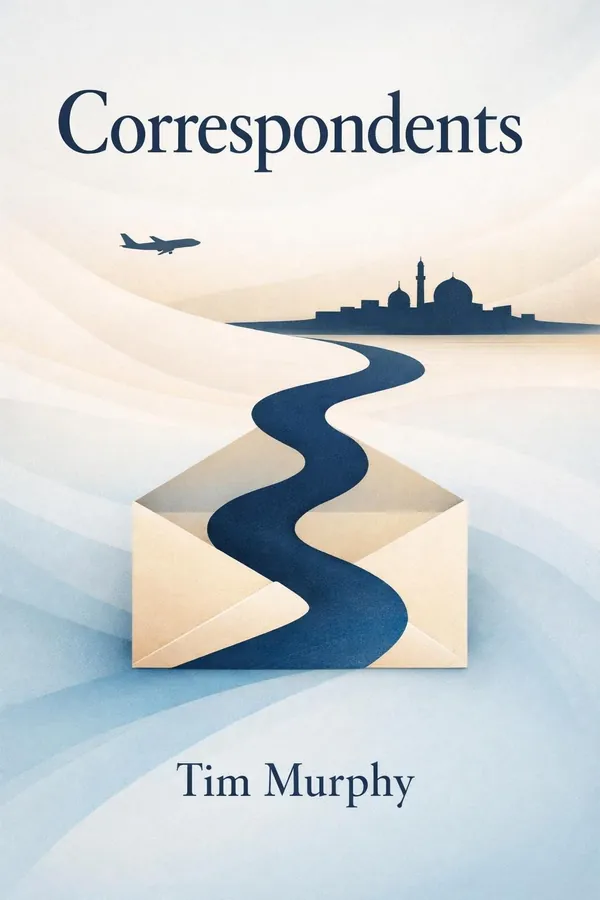
Correspondents: Summary & Key Insights
by Tim Murphy
 10 min9 chaptersAudio available
Key Takeaways from Correspondents
A nation’s border may define a map, but it rarely contains a person’s emotional life.
Long before Rita enters a newsroom, she has already learned that identity is often an argument carried inside the self.
To report on suffering is never a neutral act.
The most devastating effects of war often appear far from the place where bombs fall.
Every act of translation carries a risk: something essential may be lost, softened, distorted, or strategically withheld.
What Is Correspondents About?
Correspondents by Tim Murphy is a fiction book. Correspondents is an ambitious, emotionally layered novel about war, migration, media, and the fragile ways people try to belong to more than one world at once. Tim Murphy follows Rita Khoury, an Iraqi American journalist whose reporting on the Iraq War places her in the uneasy space between witness and participant, observer and inheritor. As her life intersects with soldiers, civilians, translators, and scattered family members, the novel builds a wide-angle portrait of how conflict travels far beyond the battlefield and into homes, memories, languages, and identities. What makes the book matter is not only its geopolitical scope, but its moral intimacy. Murphy shows that war is never a distant event for those whose family histories, ethnic identities, or professional obligations tie them to its outcomes. The novel also asks urgent questions about journalism itself: who gets to tell a story, what is lost in translation, and whether bearing witness can ever be enough. Drawing on his long experience as a journalist, Murphy brings sharp realism, empathy, and narrative discipline to a work of fiction that feels both expansive and deeply human.
This FizzRead summary covers all 9 key chapters of Correspondents in approximately 10 minutes, distilling the most important ideas, arguments, and takeaways from Tim Murphy's work. Also available as an audio summary and Key Quotes Podcast.
Correspondents
Correspondents is an ambitious, emotionally layered novel about war, migration, media, and the fragile ways people try to belong to more than one world at once. Tim Murphy follows Rita Khoury, an Iraqi American journalist whose reporting on the Iraq War places her in the uneasy space between witness and participant, observer and inheritor. As her life intersects with soldiers, civilians, translators, and scattered family members, the novel builds a wide-angle portrait of how conflict travels far beyond the battlefield and into homes, memories, languages, and identities. What makes the book matter is not only its geopolitical scope, but its moral intimacy. Murphy shows that war is never a distant event for those whose family histories, ethnic identities, or professional obligations tie them to its outcomes. The novel also asks urgent questions about journalism itself: who gets to tell a story, what is lost in translation, and whether bearing witness can ever be enough. Drawing on his long experience as a journalist, Murphy brings sharp realism, empathy, and narrative discipline to a work of fiction that feels both expansive and deeply human.
Who Should Read Correspondents?
This book is perfect for anyone interested in fiction and looking to gain actionable insights in a short read. Whether you're a student, professional, or lifelong learner, the key ideas from Correspondents by Tim Murphy will help you think differently.
- ✓Readers who enjoy fiction and want practical takeaways
- ✓Professionals looking to apply new ideas to their work and life
- ✓Anyone who wants the core insights of Correspondents in just 10 minutes
Want the full summary?
Get instant access to this book summary and 100K+ more with Fizz Moment.
Get Free SummaryAvailable on App Store • Free to download
Key Chapters
A nation’s border may define a map, but it rarely contains a person’s emotional life. That insight drives Correspondents from its opening pages. Tim Murphy builds a story that refuses to treat identity as fixed or geography as destiny. Instead, the novel shows how lives are shaped by movement across countries, languages, wars, and inherited loyalties. The result is a work of fiction that feels less like a single storyline and more like a living network of correspondence: between family members, between nations, between private memory and public history.
At the center is Rita Khoury, whose personal and professional life place her in overlapping worlds. She is not simply a journalist covering conflict; she is also someone whose family history and cultural inheritance make that conflict emotionally charged. Murphy uses her perspective to explore how people carry multiple affiliations at once. A character can be American and Middle Eastern, detached and implicated, compassionate and compromised. The novel’s title captures this structure perfectly. “Correspondents” refers not only to reporters, but to the many forms of connection that bind people across distance.
This matters because the book challenges simplified narratives about war and belonging. It invites readers to resist categories like insider and outsider, victim and observer, home and exile. In daily life, this insight applies whenever we encounter stories about migration, conflict, or identity politics. The novel encourages us to ask better questions: What histories does this person carry? What unseen ties shape their choices? What truths get flattened when we insist on neat labels?
A useful takeaway is to practice reading people, and events, with more layered attention. When a story seems straightforward, look for the cross-border realities underneath it. Complexity is not a distraction from truth; in Murphy’s world, it is truth.
Long before Rita enters a newsroom, she has already learned that identity is often an argument carried inside the self. One of the novel’s richest achievements is its portrayal of Rita’s family background as a source of both strength and fracture. Her upbringing is shaped by competing models of belonging: inherited memory, immigrant pride, assimilation, pragmatism, and the often silent pressure to choose one version of oneself over another. Murphy treats family not as backstory, but as destiny’s first draft.
Rita grows up with a consciousness formed by more than one cultural grammar. The values, anxieties, and expectations she inherits create a kind of double vision. She can see the United States from the inside, but she can also sense what America looks like from the perspective of those marked as foreign, suspect, or misunderstood. That dual perspective eventually makes her a perceptive reporter, but it also makes her vulnerable to confusion and loneliness. To belong in one place often feels like betraying another.
Murphy’s portrayal of Rita suggests a broader truth about second-generation and diasporic experience: identity is rarely settled by bloodline, passport, or self-description alone. It is negotiated daily, often under pressure. Many readers will recognize this dynamic in less dramatic settings: children translating for parents, professionals code-switching between environments, or families divided over what traditions to preserve and what to leave behind.
The practical application is simple but powerful. Instead of treating mixed or hyphenated identities as incomplete, see them as expanded forms of perception. Rita’s complexity is not a flaw to be resolved; it is a source of insight. The takeaway: pay attention to the identities you have inherited, because they may reveal not only where you come from, but how you are uniquely able to see the world.
To report on suffering is never a neutral act. Correspondents takes this dilemma seriously by presenting journalism as both a moral calling and a compromised institution. When Rita enters the profession, she believes stories can illuminate hidden realities and make distant suffering legible. Yet as she moves into the world of foreign correspondence, she discovers that reporting is shaped by access, editorial expectations, political framing, and the unavoidable distortions of perspective. Murphy is especially sharp in showing how good intentions do not erase structural limitations.
Rita’s work places her in the difficult space between witness and participant. She is expected to observe with clarity, but she can never be untouched by the material she covers. Her cultural background complicates this further. She is seen differently by colleagues, sources, and strangers, and these perceptions affect what she can learn and how she is interpreted. The novel asks whether a journalist can ever simply “cover” a war, especially when their own history resonates with it.
This idea extends beyond the newsroom. Anyone who communicates on behalf of others faces a similar challenge: managers representing teams, teachers interpreting history, activists speaking for communities, or even friends retelling someone else’s experience. The question is always the same: are you clarifying reality, or quietly reshaping it?
Murphy does not answer with cynicism. Instead, he suggests that ethical storytelling begins with humility. Good reporting requires not the fantasy of objectivity, but an honest awareness of one’s position, limitations, and influence. Rita’s struggle reminds readers that proximity can deepen understanding, but it can also intensify risk.
The actionable takeaway is to examine your role whenever you tell someone else’s story. Ask what power you hold, what filters you bring, and what voices may still be missing.
The most devastating effects of war often appear far from the place where bombs fall. One of Murphy’s central achievements in Correspondents is showing how conflict radiates outward into diasporic families, institutions, intimate relationships, and inner lives. The Iraq War is not treated merely as historical backdrop. It becomes a force that rearranges emotional geographies, pulling together and tearing apart people who may be separated by continents but are bound by lineage, language, or responsibility.
Through intertwined characters and shifting points of connection, the novel reveals that war travels through phone calls, media images, immigration systems, newsroom decisions, and family memory. A person living safely in America may still experience the war as a daily psychic emergency if parents, cousins, or ancestral ties connect them to the region. Likewise, soldiers, aid workers, and journalists carry the conflict home in forms not always visible: guilt, estrangement, moral fatigue, and altered ways of seeing other people.
This broader understanding is useful in contemporary life, where many crises seem remote until we notice their human pathways. Refugee movements, supply-chain disruptions, polarized politics, and inherited trauma all demonstrate that large-scale violence is never neatly contained. Murphy’s fiction trains readers to recognize second-order effects: the consequences that emerge in marriages, careers, health, and identity long after headlines fade.
A practical way to apply this is to look for the hidden reach of public events. When reading news about war or displacement, ask who else is affected beyond the official casualties and combatants. What communities abroad are grieving? What children are growing up in uncertainty? What professionals are forced into ethical compromise?
The takeaway is to stop imagining war as something that happens only “over there.” Murphy insists that modern conflict is relational, and understanding that is the first step toward a more humane response.
Every act of translation carries a risk: something essential may be lost, softened, distorted, or strategically withheld. In Correspondents, this danger is literal, cultural, and moral. Characters move constantly between languages, social codes, and political frameworks, and Murphy uses these crossings to show how fragile understanding really is. Translation is not just about converting words. It is about moving meaning across unequal worlds.
Rita’s work depends on mediation. She must interpret events for readers who are often geographically distant and emotionally detached. Others in the novel also serve as bridges: family members who explain one culture to another, local fixers who help foreign reporters navigate dangerous terrain, immigrants who translate themselves into acceptable versions for public consumption. These roles are indispensable, but they are also exhausting. The bridge is expected to hold everyone else’s weight while rarely being recognized as vulnerable itself.
Murphy’s insight applies in many ordinary situations. Professionals from minority backgrounds often become informal cultural interpreters at work. Children of immigrants may translate bureaucratic language for parents. Socially conscious people may feel pressure to explain complex political events to audiences that want simple conclusions. In each case, the mediator does emotional and intellectual labor that can become invisible.
The novel encourages readers to become more responsible listeners. Instead of demanding easy explanations, we can make room for nuance and admit when full understanding is impossible. We can also appreciate the people who do the difficult labor of interpretation without assuming they are transparent conduits rather than fully burdened individuals.
The actionable takeaway is to notice where translation is happening in your life and who is doing it. If you rely on someone to interpret a world for you, reward their labor with patience, curiosity, and respect rather than with demands for simplification.
Many stories about identity promise resolution: eventually the character finds home, claims a stable self, and reconciles past and present. Correspondents resists that comforting arc. Murphy presents belonging not as a destination finally reached, but as an ongoing longing shaped by memory, recognition, and loss. His characters often search for home in family, nation, language, profession, or romance, only to discover that each offers partial shelter at best.
Rita’s life embodies this tension. Her personal history gives her access to multiple worlds, yet that access does not translate into full acceptance anywhere. In one context she may appear too American; in another, too foreign. Even her professional identity as a journalist, which promises purpose and mobility, cannot fully anchor her. What emerges is a poignant insight: some people are not homeless in the literal sense, but they are perpetually under-homed emotionally, never fully mirrored by the worlds they inhabit.
This idea resonates widely in an era of migration, hybrid identity, remote life, and fractured community. Many people know the feeling of being socially functional but existentially misplaced: thriving in a city that never feels like theirs, succeeding in a profession that does not hold their deepest values, or visiting family and realizing the old home no longer exists in the same way.
Murphy does not offer a cure, but he does offer a more generous framing. Longing itself can become a source of connection. To want belonging is evidence of relational depth, not personal failure. Recognizing this can reduce the shame people often attach to in-betweenness.
The takeaway is to stop demanding perfect coherence from your identity. Instead, build practices of partial belonging: sustaining friendships, honoring memory, creating rituals, and naming what matters. Home may not be a place you arrive at once and for all; it may be something you keep making.
Political catastrophe often reveals itself most clearly in intimate relationships. Correspondents excels at showing how war and displacement reshape love, family obligation, trust, and emotional availability. Murphy understands that public violence does not remain public for long. It enters bedrooms, dining tables, sibling dynamics, and private self-concepts. The grand scale of geopolitics becomes legible through ordinary acts of care, misunderstanding, sacrifice, and withdrawal.
In the novel, relationships are tested by distance, danger, divided loyalties, and the uneven burden of knowledge. Some characters know too much and cannot communicate it. Others remain sheltered and therefore misread what the more exposed characters are carrying. Rita’s connections are shaped by her profession and heritage alike. The very qualities that make her perceptive can make closeness harder, because witnessing conflict changes what feels trivial, trustworthy, or urgent.
This pattern appears beyond fiction. Anyone living through collective stress, whether war, migration, illness, or political upheaval, may find that relationships become both more necessary and more strained. One partner may seek conversation while another retreats. One family member may preserve routines while another becomes consumed by fear or guilt. Misalignment does not always indicate lack of love; sometimes it reflects different survival strategies.
Murphy’s novel offers a practical lesson in relational empathy. Instead of assuming that emotional distance means indifference, ask what unseen pressures might be reorganizing a person’s inner world. The stressors may be historical as well as immediate.
The actionable takeaway is to make room for context in relationships. When conflict or crisis is affecting someone you care about, replace quick judgments with better questions: What are you carrying? What feels impossible to explain? How can I support you without demanding that you become simpler for my comfort?
Large historical events do not stay in textbooks; they settle into habits, fears, ambitions, and decisions people barely know they are making. Correspondents demonstrates this with remarkable subtlety. Murphy shows that history is not only what happened in the past, but what remains active in the present through memory, inheritance, and institutional power. Characters make choices about careers, marriages, travel, speech, and silence under pressures created long before the immediate scene begins.
Rita’s decisions are shaped by family origin, national narratives, and the political climate surrounding the Middle East and the United States. The Iraq War intensifies these inherited tensions, but it does not create them from nothing. Murphy reminds readers that every present conflict has prehistories, and every personal decision sits within larger structures of class, empire, migration, and media representation. This makes the novel intellectually rich without ever sacrificing emotional immediacy.
The idea is highly practical. In organizations, misunderstandings often reflect institutional history rather than individual bad faith alone. In families, recurring conflicts may emerge from unspoken generational wounds. In public debate, people often argue about current policy without recognizing the historical trauma that shapes responses. Murphy’s fiction encourages a slower, more informed kind of interpretation.
A good application is to ask historical questions when faced with puzzling behavior or polarized discourse. What earlier events made this reaction likely? What inherited fears or loyalties are active here? What story about the past is each person living inside?
The takeaway is to treat context as essential, not optional. Understanding history will not remove conflict, but it can transform confusion into insight and blame into a more honest reckoning with how people are formed.
Real empathy does not mean reducing suffering to something comforting or morally tidy. One of the finest qualities of Correspondents is Murphy’s ability to care deeply about his characters without romanticizing them. The novel offers compassion, but not simplification. People are contradictory, compromised, frightened, selfish, brave, and wounded all at once. This refusal of sentimentality makes the emotional impact stronger, not weaker, because it respects the messiness of actual human lives.
Murphy’s approach is especially important in a story about war and displacement, subjects that can easily invite cliché. Rather than turning characters into symbols of innocence or guilt, he allows them interiority. Journalists are not automatically noble truth-tellers. Families are not purely havens of warmth. People affected by geopolitical violence are not only victims; they are also agents, interpreters, lovers, professionals, and flawed decision-makers. This broader humanity resists the flattening tendencies of both media coverage and political rhetoric.
Readers can apply this insight in how they consume news and relate to others. It is easy to feel compassion for an abstract category and much harder to tolerate the inconvenient complexity of real people. Yet mature empathy requires exactly that tolerance. It means caring about someone even when their story cannot be packaged into moral clarity.
A useful practice is to notice when you are demanding emotional neatness from painful realities. Are you looking for heroes and villains because complexity feels exhausting? Are you offering sympathy only when someone remains legible and likable? Murphy suggests a deeper standard.
The actionable takeaway is to pair compassion with rigor. When responding to conflict, trauma, or difference, refuse both indifference and oversimplification. The most humane reading of other people is one that grants them full complexity.
All Chapters in Correspondents
About the Author
Tim Murphy is an American novelist and journalist whose work often explores the intersection of private lives and large social forces. He is the author of the acclaimed novels Christodora and Correspondents, both known for their ambitious scope, emotional intelligence, and engagement with political history. Alongside his fiction, Murphy has had a long career in journalism, writing about HIV/AIDS, LGBTQ issues, public health, and social justice for major publications including The New York Times and The Nation. That reporting background informs his fiction with a strong sense of realism, ethical tension, and social awareness. Murphy is especially admired for creating richly human characters while addressing urgent cultural and historical questions with empathy and precision.
Get This Summary in Your Preferred Format
Read or listen to the Correspondents summary by Tim Murphy anytime, anywhere. FizzRead offers multiple formats so you can learn on your terms — all free.
Available formats: App · Audio · PDF · EPUB — All included free with FizzRead
Download Correspondents PDF and EPUB Summary
Key Quotes from Correspondents
“A nation’s border may define a map, but it rarely contains a person’s emotional life.”
“Long before Rita enters a newsroom, she has already learned that identity is often an argument carried inside the self.”
“To report on suffering is never a neutral act.”
“The most devastating effects of war often appear far from the place where bombs fall.”
“Every act of translation carries a risk: something essential may be lost, softened, distorted, or strategically withheld.”
Frequently Asked Questions about Correspondents
Correspondents by Tim Murphy is a fiction book that explores key ideas across 9 chapters. Correspondents is an ambitious, emotionally layered novel about war, migration, media, and the fragile ways people try to belong to more than one world at once. Tim Murphy follows Rita Khoury, an Iraqi American journalist whose reporting on the Iraq War places her in the uneasy space between witness and participant, observer and inheritor. As her life intersects with soldiers, civilians, translators, and scattered family members, the novel builds a wide-angle portrait of how conflict travels far beyond the battlefield and into homes, memories, languages, and identities. What makes the book matter is not only its geopolitical scope, but its moral intimacy. Murphy shows that war is never a distant event for those whose family histories, ethnic identities, or professional obligations tie them to its outcomes. The novel also asks urgent questions about journalism itself: who gets to tell a story, what is lost in translation, and whether bearing witness can ever be enough. Drawing on his long experience as a journalist, Murphy brings sharp realism, empathy, and narrative discipline to a work of fiction that feels both expansive and deeply human.
You Might Also Like



Browse by Category
Ready to read Correspondents?
Get the full summary and 100K+ more books with Fizz Moment.