
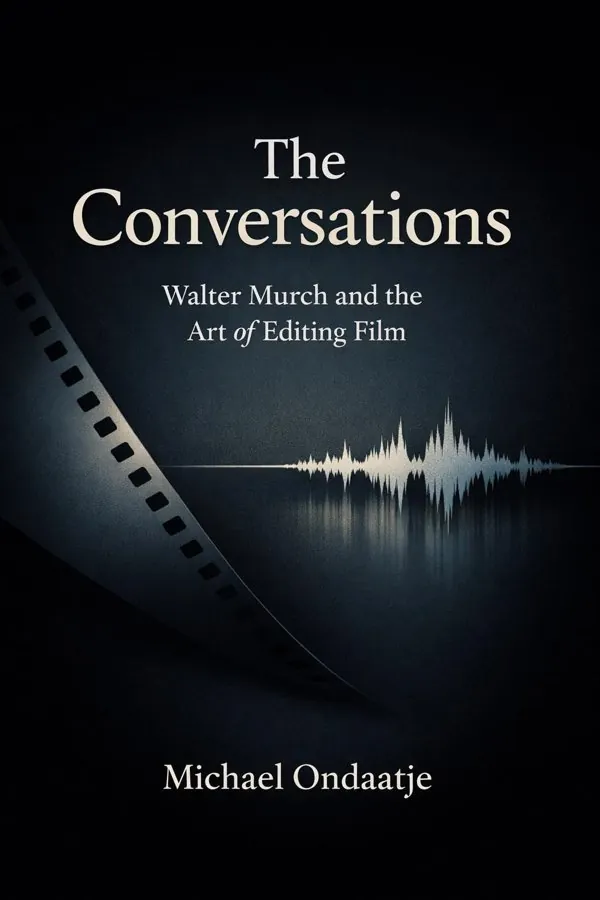
The Conversations: Walter Murch and the Art of Editing Film: Summary & Key Insights
 10 min10 chaptersAudio available
Key Takeaways from The Conversations: Walter Murch and the Art of Editing Film
Every art form changes the moment it discovers what it can leave out.
The most memorable edits are often the ones you never notice.
We often think we watch films, but Murch reminds us that we also hear them into meaning.
New tools promise speed, flexibility, and precision, but Murch insists that technology does not replace taste.
Not every great editorial choice can be explained by formula.
What Is The Conversations: Walter Murch and the Art of Editing Film About?
The Conversations: Walter Murch and the Art of Editing Film by Michael Ondaatje is a music_film book spanning 11 pages. The Conversations: Walter Murch and the Art of Editing Film is not a conventional how-to guide, nor is it a simple interview book. Instead, it is an intimate, intellectually rich exchange between novelist Michael Ondaatje and legendary film editor and sound designer Walter Murch about how films are truly made in the editing room. Across their discussions, Murch reflects on the hidden craft that shapes cinema: when to cut, how sound alters meaning, why rhythm matters more than rules, and how instinct and structure work together to create emotional truth. Drawing on landmark films such as Apocalypse Now, The Godfather, and The English Patient, the book reveals editing as both technical labor and philosophical inquiry. It matters because it makes visible one of cinema’s most invisible arts, showing how stories are discovered rather than merely assembled. Ondaatje is an ideal guide for this exploration. As the author of The English Patient and a writer deeply interested in memory, time, and artistic process, he brings both curiosity and literary sensitivity to the conversation, helping Murch translate complex ideas into insights that filmmakers, writers, and attentive viewers can all use.
This FizzRead summary covers all 10 key chapters of The Conversations: Walter Murch and the Art of Editing Film in approximately 10 minutes, distilling the most important ideas, arguments, and takeaways from Michael Ondaatje's work. Also available as an audio summary and Key Quotes Podcast.
The Conversations: Walter Murch and the Art of Editing Film
The Conversations: Walter Murch and the Art of Editing Film is not a conventional how-to guide, nor is it a simple interview book. Instead, it is an intimate, intellectually rich exchange between novelist Michael Ondaatje and legendary film editor and sound designer Walter Murch about how films are truly made in the editing room. Across their discussions, Murch reflects on the hidden craft that shapes cinema: when to cut, how sound alters meaning, why rhythm matters more than rules, and how instinct and structure work together to create emotional truth. Drawing on landmark films such as Apocalypse Now, The Godfather, and The English Patient, the book reveals editing as both technical labor and philosophical inquiry. It matters because it makes visible one of cinema’s most invisible arts, showing how stories are discovered rather than merely assembled. Ondaatje is an ideal guide for this exploration. As the author of The English Patient and a writer deeply interested in memory, time, and artistic process, he brings both curiosity and literary sensitivity to the conversation, helping Murch translate complex ideas into insights that filmmakers, writers, and attentive viewers can all use.
Who Should Read The Conversations: Walter Murch and the Art of Editing Film?
This book is perfect for anyone interested in music_film and looking to gain actionable insights in a short read. Whether you're a student, professional, or lifelong learner, the key ideas from The Conversations: Walter Murch and the Art of Editing Film by Michael Ondaatje will help you think differently.
- ✓Readers who enjoy music_film and want practical takeaways
- ✓Professionals looking to apply new ideas to their work and life
- ✓Anyone who wants the core insights of The Conversations: Walter Murch and the Art of Editing Film in just 10 minutes
Want the full summary?
Get instant access to this book summary and 100K+ more with Fizz Moment.
Get Free SummaryAvailable on App Store • Free to download
Key Chapters
Every art form changes the moment it discovers what it can leave out. Walter Murch begins by tracing editing back to cinema’s earliest days, when films were little more than unbroken views of reality: a train arriving, workers leaving a factory, a street scene unfolding. At first, the camera simply recorded. But once filmmakers realized they could join one shot to another, cinema stopped being a passive witness and became a language. Editing introduced selection, emphasis, surprise, comparison, and emotional shaping. In other words, the cut transformed moving pictures into storytelling.
Murch treats this historical shift not as a technical upgrade but as a revolution in thought. A cut allows time to compress, space to expand, and meaning to emerge between images. Two separate shots can suggest causality, irony, tenderness, or fear without a single spoken explanation. That insight is foundational: editing is not merely trimming footage after the “real” work is done. It is part of the very grammar of film.
This matters beyond cinema. Writers revise by deciding what scene to follow with another. Musicians sequence tracks to create emotional progression. Even in everyday communication, we edit experience by choosing what to highlight and what to omit. The principle is the same: arrangement creates meaning.
A practical application for creators is to stop asking only, “What did I capture?” and start asking, “What happens when these moments are placed together?” Try reviewing any piece of work by focusing on transitions rather than individual parts. The takeaway: powerful storytelling begins not with abundance, but with decisive selection.
The most memorable edits are often the ones you never notice. Murch argues that the best cut is not the most clever, smooth, or technically impressive one, but the one that feels emotionally inevitable. He famously prioritizes emotion above all else: if a cut preserves what the audience should feel in a given moment, minor issues of continuity or screen direction can be forgiven. But if the emotional pulse is broken, even a visually perfect edit will feel wrong.
This idea reframes editing as a psychological art. A cut is not simply a change of angle or a way to speed things up. It is a decision about what the viewer is allowed to feel next. That is why editors must attend to tiny shifts in expression, breath, hesitation, and tension. A fraction of a second too early can flatten a moment. A fraction too late can turn intensity into awkwardness.
Murch’s philosophy is useful for anyone who structures experience. In public speaking, the pause before a key point can matter more than the point itself. In writing, paragraph breaks create tempo and expectation. In leadership, timing difficult conversations affects how truth is received.
A practical way to apply this is to review a scene, chapter, or presentation with one question in mind: “What should the audience feel here?” Once that answer is clear, shape transitions around that feeling rather than around neatness alone. If necessary, sacrifice perfection for impact. The takeaway: technical skill matters, but emotional coherence is what makes an edit come alive.
We often think we watch films, but Murch reminds us that we also hear them into meaning. As one of cinema’s great sound designers as well as editors, he is uniquely positioned to explain how sound can deepen, redirect, or even contradict what an image seems to say. A close-up of a face accompanied by silence feels different from the same image paired with distant traffic, wind, or an off-screen cry. Sound does not simply decorate the visual track; it tells the audience how to interpret the world of the film.
Murch discusses sound as a storytelling force that can expand space, suggest memory, and create psychological continuity across cuts. A sound can begin before the image changes, preparing us emotionally for what comes next. It can also continue after a cut, stitching two separate shots into one felt experience. This is especially powerful when the visible world is fragmented but the aural world remains coherent.
The lesson extends beyond filmmaking. In podcasts, presentations, and digital media, tone, pacing, and ambient texture affect comprehension as much as content. Even in conversation, a person’s voice can alter the meaning of identical words.
To apply this insight, revisit a scene or project with the sound turned off, then with your eyes closed. Notice what each version loses or gains. Ask whether your audio elements are merely explanatory or whether they are actively shaping emotion and expectation. If you create content, think of sound early rather than adding it at the end. The takeaway: audiences do not only see story; they hear its hidden architecture.
New tools promise speed, flexibility, and precision, but Murch insists that technology does not replace taste. He has worked across major shifts in filmmaking, from physical film and analog sound to digital systems, and his reflections are balanced rather than nostalgic. Better tools can remove friction, allow more experimentation, and open new forms of control. Yet they also create new temptations: endless revision, over-complexity, and the illusion that options automatically produce better work.
For Murch, the central question is not whether a process is old or new, but whether it helps the artist make clearer decisions. Working with film imposed physical limits. You could not instantly generate infinite versions. Digital editing, by contrast, allows rapid comparison and non-destructive experimentation. That is liberating, but it can also make it harder to know when to stop. Convenience can dilute conviction.
This principle applies in almost every creative and professional field. Writers have software that tracks every draft. Designers can test countless layouts. Teams can revise presentations forever. But without criteria, productivity becomes motion without progress.
A practical application is to create decision rules before entering the abundance of tools. Define what success looks like: emotional clarity, narrative pace, simplicity, coherence. Then use technology to test possibilities against those standards rather than wandering through options for their own sake. Set constraints deliberately if the tools provide too much freedom.
The takeaway: tools expand what is possible, but only judgment determines what is necessary.
Not every great editorial choice can be explained by formula. Murch describes editing as an activity where conscious analysis and unconscious recognition constantly interact. Editors rely on craft, structure, and accumulated experience, but they also depend on memory and intuition: subtle internal signals that something is too long, too abrupt, emotionally false, or unexpectedly right. These responses often arise before language catches up.
What makes this idea powerful is that Murch does not romanticize intuition as magic. He shows that instinct is trained. The editor watches hundreds of gestures, listens to countless tonal shifts, and internalizes patterns of human behavior and cinematic rhythm. Over time, memory stores these impressions, allowing rapid judgments that seem spontaneous but are actually informed by deep exposure.
This has broad relevance. In any complex field, expertise often appears intuitive because masters have absorbed so much structure that recognition becomes immediate. A physician senses something is wrong before test results arrive. An experienced teacher detects confusion before students say a word. A manager knows a proposal lacks focus even before pinpointing the weak section.
To apply this insight, build reflective habits around your instincts. When a scene or section feels off, pause before forcing a solution. Ask what specifically triggered the discomfort. Keep notes on recurring patterns in your own work: where attention drops, where energy spikes, where confusion begins. Over time, your intuitive sense will sharpen because it is being examined, not ignored.
The takeaway: intuition is not the opposite of discipline; it is discipline that has moved beneath the surface.
Some films are assembled; others are found. In discussing Apocalypse Now, Murch reveals editing as a process of excavation under extreme conditions. The film’s production was famously chaotic, with vast amounts of footage, shifting intentions, and the challenge of shaping a coherent emotional and thematic journey out of near-overwhelming material. The editor’s task was not to execute a tidy preexisting plan but to discover what film was hidden inside the footage.
This case study illustrates the editor’s role at its most demanding. When material is abundant and uneven, editing becomes an act of diagnosis. What is the spine of the story? Which scenes belong to atmosphere and which to narrative progression? How do you maintain psychological descent without losing the audience? Murch shows that large-scale editing requires both macro and micro vision: seeing the architecture of the whole while tuning the rhythm of each cut.
Apocalypse Now also demonstrates how editing can preserve ambiguity without losing force. The film does not explain everything neatly. Instead, it uses juxtaposition, sound, duration, and fragmentation to immerse viewers in a disorienting moral landscape.
This lesson is valuable for anyone dealing with messy material, whether raw research, interview transcripts, product ideas, or a disorganized first draft. You do not always need to impose order immediately. First, identify themes, repetitions, emotional peaks, and turning points. Let the material reveal its own structure.
The takeaway: when a project feels chaotic, do not rush to simplify it prematurely; search for the hidden pattern that gives the chaos meaning.
Not all stories move in a straight line, and Murch’s work on The English Patient offers a rich example of editing as the orchestration of memory. Because the film moves between past and present, intimacy and war, desire and loss, it depends on editing to guide the viewer through emotional rather than strictly chronological logic. The challenge is not just clarity, but grace: how to let one memory open into another without making the structure feel mechanical.
Murch’s reflections show that nonlinear storytelling succeeds when transitions are motivated by feeling, association, or sensory connection. A glance, a sound, a gesture, or a phrase can bridge time periods more elegantly than an explicit explanation. In this sense, editing mirrors how the mind actually works. Memory does not proceed according to clock time. It leaps through echoes, wounds, and desires.
This approach is relevant far beyond film. Essays, memoirs, documentaries, and brand narratives often rely on weaving multiple timelines or perspectives. The temptation is to over-explain every jump. Murch suggests a subtler method: trust emotionally resonant links and let the audience participate in making connections.
A useful practice is to map your material not only by chronology but by emotional state. Group scenes, chapters, or segments according to longing, confusion, revelation, or grief. Then look for transitions that connect those inner states across time. This often produces a more human flow than strict sequence alone.
The takeaway: when telling a complex story, organize time around feeling as much as around event.
The myth of the solitary genius collapses quickly in the editing room. Murch emphasizes that editors work within a network of collaboration involving directors, cinematographers, actors, writers, sound teams, producers, and composers. Yet the editor occupies a special position inside that network: close enough to the material to understand its fine detail, but distant enough from production to see what the film is becoming. This combination makes the editor both interpreter and negotiator.
Collaboration in editing is not passive obedience. A strong editor must be able to challenge assumptions, propose alternatives, and defend choices in service of the film rather than ego. At the same time, the editor must understand the director’s intentions and the realities of production. It is a role that requires diplomacy, empathy, and rigor.
This idea transfers easily to creative and organizational life. Many important roles are “middle positions” that translate between vision and execution: product managers, managing editors, chiefs of staff, producers, and coaches. Their value lies in helping others see more clearly, not merely in processing information.
To apply this, treat collaboration as a process of joint discovery rather than approval-seeking. When reviewing work with others, ask: What is this trying to become? What is essential here? What can be removed? Invite disagreement early, while change is still possible. Make critique specific and tied to purpose rather than taste.
The takeaway: the best collaborators do not protect their own ideas; they protect the integrity of the work.
One of the quiet revelations in Murch’s thinking is that great editing begins with attention, and attention is often auditory before it is visual. He speaks about the importance of listening: to dialogue, to silence, to ambient sound, to cadence, and even to what performers are doing beneath words. Listening allows the editor to detect subtext, tension, and rhythm that the eye alone might miss.
This is especially important because film performance is rarely about the literal line reading. Meaning resides in breath, interruption, overlap, uncertainty, and emphasis. An editor who only watches action may miss the emotional center of a moment. But one who listens closely can sense where a scene truly turns.
The broader implication is that many forms of understanding require listening beyond surface content. Leaders who hear only explicit statements miss resistance and fear. Interviewers who focus only on facts overlook emotional cues. Writers who read their work silently may fail to catch awkward cadence that becomes obvious aloud.
A practical method is simple but powerful: review dialogue-heavy material without looking at the screen, or read your own writing aloud and listen for rhythm. Notice where the energy drops, where meaning becomes muddy, and where silence does more work than explanation. In meetings, summarize not just what was said, but what seemed unsaid.
The takeaway: whether in art or life, better listening sharpens judgment because rhythm, truth, and tension often arrive through the ear first.
Murch’s conversations with Ondaatje repeatedly return to a crucial insight: editing is not a secondary craft attached to storytelling, but a form of storytelling itself. In that sense, editors are writers working with images, sounds, duration, and absence instead of sentences. They shape emphasis, reveal character, create suspense, and determine what the audience knows when. The screenplay may begin the story, and production may gather the material, but the final narrative is written again in the edit.
This perspective helps explain why Ondaatje, a novelist, is such an effective interlocutor. He recognizes in editing the same core questions that animate literature: point of view, structure, timing, omission, pattern, and memory. Both novelist and editor ask what to include, where to withhold, and how to move a reader or viewer through time.
The insight has practical value for creators in any medium. Revision is not cleanup; it is composition. A rough draft, a recorded interview, a product prototype, or a strategy document rarely contains its final meaning at first pass. Meaning emerges through rearrangement, subtraction, emphasis, and re-sequencing.
To apply this, approach revision with the dignity of authorship. Do not think of editing as fixing mistakes at the end. Instead, ask what story your current material is actually telling, and whether that story matches your intention. Cut aggressively where repetition weakens impact. Reorder where momentum stalls. Let structure do part of the explaining.
The takeaway: editing is writing by other means, and mastery comes when revision is treated as creation, not correction.
All Chapters in The Conversations: Walter Murch and the Art of Editing Film
About the Author
Michael Ondaatje is a Sri Lankan-born Canadian writer celebrated for his novels, poetry, and nonfiction. He is best known for The English Patient, which won the Booker Prize and later became an acclaimed film adaptation. Across his body of work, Ondaatje is known for blending lyricism with historical depth, often exploring memory, identity, violence, and the fragmented nature of experience. His writing frequently moves across time and perspective, making him especially attuned to artistic forms that shape narrative through structure and omission. In addition to fiction and poetry, he has written about film and visual art with unusual sensitivity. That combination of literary craft and curiosity about other creative disciplines makes him an ideal conversational partner for Walter Murch in this exploration of editing, sound, and cinematic storytelling.
Get This Summary in Your Preferred Format
Read or listen to the The Conversations: Walter Murch and the Art of Editing Film summary by Michael Ondaatje anytime, anywhere. FizzRead offers multiple formats so you can learn on your terms — all free.
Available formats: App · Audio · PDF · EPUB — All included free with FizzRead
Download The Conversations: Walter Murch and the Art of Editing Film PDF and EPUB Summary
Key Quotes from The Conversations: Walter Murch and the Art of Editing Film
“Every art form changes the moment it discovers what it can leave out.”
“The most memorable edits are often the ones you never notice.”
“We often think we watch films, but Murch reminds us that we also hear them into meaning.”
“New tools promise speed, flexibility, and precision, but Murch insists that technology does not replace taste.”
“Not every great editorial choice can be explained by formula.”
Frequently Asked Questions about The Conversations: Walter Murch and the Art of Editing Film
The Conversations: Walter Murch and the Art of Editing Film by Michael Ondaatje is a music_film book that explores key ideas across 10 chapters. The Conversations: Walter Murch and the Art of Editing Film is not a conventional how-to guide, nor is it a simple interview book. Instead, it is an intimate, intellectually rich exchange between novelist Michael Ondaatje and legendary film editor and sound designer Walter Murch about how films are truly made in the editing room. Across their discussions, Murch reflects on the hidden craft that shapes cinema: when to cut, how sound alters meaning, why rhythm matters more than rules, and how instinct and structure work together to create emotional truth. Drawing on landmark films such as Apocalypse Now, The Godfather, and The English Patient, the book reveals editing as both technical labor and philosophical inquiry. It matters because it makes visible one of cinema’s most invisible arts, showing how stories are discovered rather than merely assembled. Ondaatje is an ideal guide for this exploration. As the author of The English Patient and a writer deeply interested in memory, time, and artistic process, he brings both curiosity and literary sensitivity to the conversation, helping Murch translate complex ideas into insights that filmmakers, writers, and attentive viewers can all use.
You Might Also Like
Beethoven: A Documentary Study
H. C. Robbins Landon
10 min
Cinema Speculation
Quentin Tarantino
10 min
Deep Listening: A Composer's Sound Practice
Pauline Oliveros
10 min
Dylan Goes Electric!: Newport, Seeger, Dylan, and the Night That Split the Sixties
Elijah Wald
10 min
Future Frames
Maria Walsh
10 min
Hamilton: The Revolution: Being the Complete Libretto of the Broadway Musical, with a True Account of Its Creation, and Concise Remarks on Hip-Hop, the Power of Stories, and the New America
Lin-Manuel Miranda, Jeremy McCarter
10 minBrowse by Category
Ready to read The Conversations: Walter Murch and the Art of Editing Film?
Get the full summary and 100K+ more books with Fizz Moment.