
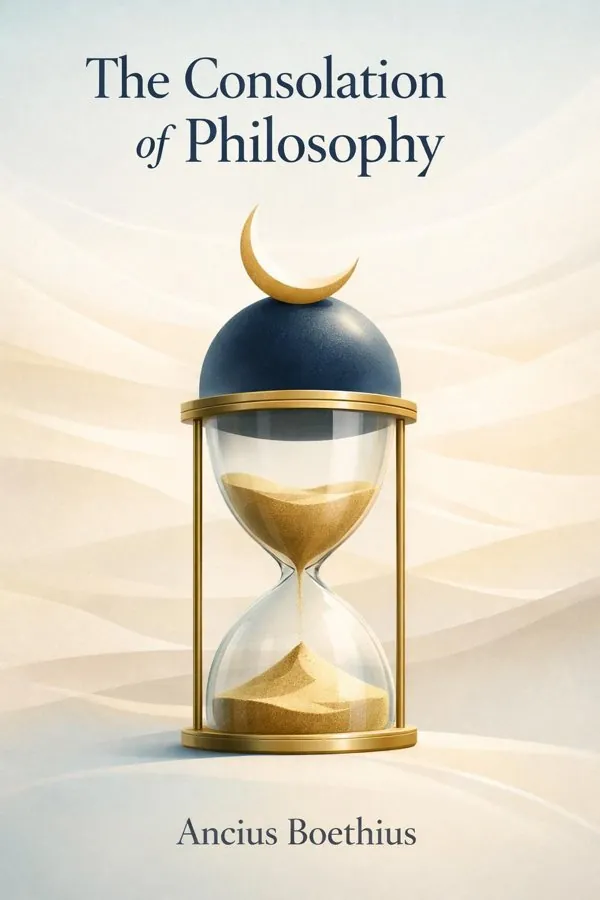
The Consolation of Philosophy: Summary & Key Insights
 10 min9 chaptersAudio available
Key Takeaways from The Consolation of Philosophy
Suffering often feels like proof that life has no order, yet Boethius begins by showing that despair can become the starting point of philosophical awakening.
What we call security is often just temporary luck wearing a respectable disguise.
People chase many things in the hope of happiness, but Boethius argues that most of what we pursue are fragments mistaken for the whole.
If human beings are dissatisfied by lesser goods, that dissatisfaction points toward something greater.
The success of the wicked is one of life’s oldest scandals, but Boethius turns the problem upside down.
What Is The Consolation of Philosophy About?
The Consolation of Philosophy by Ancius Boethius is a western_phil book spanning 5 pages. Anicius Boethius’s The Consolation of Philosophy is one of the most powerful works ever written about suffering, loss, and the search for inner freedom. Composed while Boethius awaited execution in prison, the book takes the form of a dialogue between the fallen statesman and Lady Philosophy, a majestic figure who challenges his despair and leads him back toward reason. What begins as a personal lament becomes a sweeping inquiry into some of the deepest questions in human life: Why do the wicked prosper? What is real happiness? Can fortune ever be trusted? How can divine order exist alongside human freedom? The book matters because it speaks to crises that never disappear. Careers collapse, reputations fade, injustice stings, and external success proves fragile. Boethius argues that true security cannot rest on wealth, status, pleasure, or power, but only on wisdom and alignment with the highest good. His authority comes not only from scholarship—he was one of late antiquity’s greatest translators, philosophers, and statesmen—but from experience. He wrote not in comfort, but under extreme adversity, giving the work an emotional force that has resonated for centuries.
This FizzRead summary covers all 9 key chapters of The Consolation of Philosophy in approximately 10 minutes, distilling the most important ideas, arguments, and takeaways from Ancius Boethius's work. Also available as an audio summary and Key Quotes Podcast.
The Consolation of Philosophy
Anicius Boethius’s The Consolation of Philosophy is one of the most powerful works ever written about suffering, loss, and the search for inner freedom. Composed while Boethius awaited execution in prison, the book takes the form of a dialogue between the fallen statesman and Lady Philosophy, a majestic figure who challenges his despair and leads him back toward reason. What begins as a personal lament becomes a sweeping inquiry into some of the deepest questions in human life: Why do the wicked prosper? What is real happiness? Can fortune ever be trusted? How can divine order exist alongside human freedom?
The book matters because it speaks to crises that never disappear. Careers collapse, reputations fade, injustice stings, and external success proves fragile. Boethius argues that true security cannot rest on wealth, status, pleasure, or power, but only on wisdom and alignment with the highest good. His authority comes not only from scholarship—he was one of late antiquity’s greatest translators, philosophers, and statesmen—but from experience. He wrote not in comfort, but under extreme adversity, giving the work an emotional force that has resonated for centuries.
Who Should Read The Consolation of Philosophy?
This book is perfect for anyone interested in western_phil and looking to gain actionable insights in a short read. Whether you're a student, professional, or lifelong learner, the key ideas from The Consolation of Philosophy by Ancius Boethius will help you think differently.
- ✓Readers who enjoy western_phil and want practical takeaways
- ✓Professionals looking to apply new ideas to their work and life
- ✓Anyone who wants the core insights of The Consolation of Philosophy in just 10 minutes
Want the full summary?
Get instant access to this book summary and 100K+ more with Fizz Moment.
Get Free SummaryAvailable on App Store • Free to download
Key Chapters
Suffering often feels like proof that life has no order, yet Boethius begins by showing that despair can become the starting point of philosophical awakening. At the opening of the book, he is not calm or wise. He is broken, angry, and convinced that he has been betrayed by the world. He had served the state, pursued justice, and lived with seriousness, yet now he sits in prison waiting for death. His grief has narrowed his vision so completely that he can remember his losses but not the truths he once knew.
Lady Philosophy appears at precisely this point. She does not soothe him with easy comfort. Instead, she diagnoses his condition: he has forgotten who he is. His misery is real, but his deeper sickness is confusion. He has allowed changing circumstances to define his identity. Philosophy’s first task is not to erase pain but to restore perspective.
This opening matters because it treats emotional collapse with both compassion and rigor. Boethius does not deny sorrow; he insists that sorrow becomes destructive when it convinces us that temporary misfortune reveals ultimate reality. Many modern crises work the same way. Losing a job, ending a relationship, or being publicly misunderstood can make us conclude that our whole life has failed. In those moments, we need more than distraction. We need to recover principles bigger than the event itself.
Boethius suggests a practical discipline: when shaken, ask what you have forgotten. Have you confused your role with your worth? Your comfort with your character? Your circumstances with your identity? Naming that confusion is the first movement toward freedom.
Actionable takeaway: In your next moment of discouragement, write down the loss that is hurting you, then list three truths about yourself that remain unchanged by it.
What we call security is often just temporary luck wearing a respectable disguise. One of Boethius’s most famous teachings is his account of Fortune as a spinning wheel. Wealth, rank, influence, health, and popularity rise and fall without permanence. People celebrate these things as if they possess them by right, but Fortune never promised stability. Her nature is mutability itself.
Lady Philosophy tells Boethius that he should not be shocked when Fortune takes away what she once gave. If something is external, it is also unstable. Offices can be stripped, applause can vanish, beauty can fade, and political favor can turn overnight into danger. The mistake is not merely enjoying good fortune; it is treating it as a foundation.
This is one of the book’s most enduring insights because modern life still trains people to trust Fortune. Promotions, investments, social media attention, and public approval all seem solid while they last. Yet careers can be disrupted by a market shift, a scandal, illness, or simple bad timing. A person who builds identity on external success is guaranteed anxiety, because what is unstable can never fully reassure.
Boethius does not ask us to hate good things. He asks us to see them clearly. Gifts of Fortune may be useful, pleasant, or honorable, but they are not truly ours in the deepest sense. They can accompany a good life, yet they cannot define one. The wise person receives them without dependence and loses them without total ruin.
A practical application is to separate possession from attachment. You may have money, position, or recognition, but if losing them would destroy your sense of self, you are serving Fortune rather than using her gifts wisely.
Actionable takeaway: Identify one external success you rely on emotionally, and practice imagining your worth apart from it for five minutes each day.
People chase many things in the hope of happiness, but Boethius argues that most of what we pursue are fragments mistaken for the whole. Lady Philosophy examines the common objects of ambition—wealth, status, power, fame, and pleasure—and asks a devastating question: do they actually provide what people seek? Money promises independence, yet the wealthy often fear loss. Honors promise respect, yet titles can be granted to fools. Power promises control, yet rulers are trapped by enemies and anxieties. Fame promises immortality, yet reputation is unstable and local. Pleasure promises delight, yet bodily satisfaction passes quickly and can leave emptiness behind.
The problem is not that these goods are always bad. The problem is that they are incomplete. Human beings do not merely want isolated advantages. They want self-sufficiency, dignity, security, joy, and a good that cannot be taken away. False goods attract us because they seem to contain these qualities, but none can deliver them fully.
This diagnosis is startlingly current. Many people structure their lives around salary milestones, credentials, followers, or lifestyle upgrades, then feel confused when achievement does not produce lasting peace. Boethius would say the confusion comes from expecting partial goods to do the work of the highest good.
A useful way to apply this idea is to ask not just, “Do I want this?” but, “What deeper desire do I think this will fulfill?” A person may crave a promotion not for the money itself, but for a sense of significance. They may seek fame not for visibility, but for permanence. Once the deeper desire is named, it becomes easier to judge whether the chosen path can truly satisfy it.
Actionable takeaway: Take one goal you are currently pursuing and write down the deeper need beneath it—security, love, worth, or peace—then ask whether the goal can truly provide that need permanently.
If human beings are dissatisfied by lesser goods, that dissatisfaction points toward something greater. Boethius argues that all people seek happiness, but true happiness must be perfect, complete, and lacking nothing. If a supposed good can be lost, corrupted, or outgrown, it cannot be the highest good. Lady Philosophy therefore leads Boethius toward a metaphysical conclusion: the ultimate source of happiness is the divine good itself.
In the book’s reasoning, God is not one desirable object among others. God is the fullness in which all genuine goods are united—goodness, power, justice, order, and blessedness. To seek happiness rightly is therefore to seek participation in this highest good. This makes the moral life more than rule-following. It becomes a movement toward reality itself.
Boethius’s argument is philosophical as much as spiritual. Since everyone desires happiness and happiness must be complete, the object of that desire must be something complete. Since only the divine is fully sufficient, all restless striving is ultimately a search for God, whether people realize it or not.
This idea can be applied even by readers approaching the text philosophically rather than devotionally. It challenges the tendency to scatter life across many minor aims without asking what final end unifies them. What would count as a life fully worth wanting? What kind of good would not collapse under time, loss, or death? Boethius insists that only a transcendent good can answer those questions.
Practically, this means reordering life around what is ultimate rather than urgent. A person may still work, love, build, and enjoy, but these activities are healthiest when they are not treated as final ends.
Actionable takeaway: Set aside ten minutes this week to define what “highest good” means in your own life, and compare your calendar to that definition.
The success of the wicked is one of life’s oldest scandals, but Boethius turns the problem upside down. He argues that evil people may appear powerful, yet in reality they are deeply weak because they fail to attain the very good that all rational beings seek. To do evil is not to gain strength but to lose one’s proper nature. Since human flourishing lies in goodness, injustice damages the wrongdoer even when it produces outward advantage.
Lady Philosophy goes further: the good are strong because they achieve what they are meant for, while the wicked are impotent because they chase illusions. A tyrant may command armies, terrify citizens, and accumulate riches, but if he cannot govern himself, pursue the good, or live in truth, he is not powerful in the fullest sense. His apparent success hides inner disorder.
This view offers a profound correction to envy. We are often tempted to compare ourselves to dishonest people who seem to win—corrupt executives, manipulative politicians, exploitative influencers, or simply colleagues who advance by cutting corners. Boethius insists that external gain should not blind us to moral reality. If a person secures advantage by becoming less just, less truthful, or less human, that gain is actually a form of loss.
This does not erase the social harm evil can cause. Boethius is not naive about injustice. His claim is that moral evil carries its punishment within itself. To become vicious is already to be diminished.
Applied practically, this idea can strengthen integrity under pressure. When tempted to compromise values for immediate rewards, remember that character is not a decorative extra. It is the condition of your freedom and well-being. Winning at the cost of your soul is not winning.
Actionable takeaway: When you feel envy toward someone’s questionable success, ask, “What kind of person is this path producing?” and let that answer guide your choices.
What looks like chaos from below may belong to an order we cannot fully see. Boethius distinguishes between providence and fate to explain how the world can appear unstable while still unfolding within divine intelligence. Providence is the timeless, unified plan held in the mind of God. Fate is the temporal unfolding of that plan through changing events, causes, and circumstances in the created world.
This distinction is crucial. Human beings experience life sequentially: one event after another, often with confusion and limited understanding. From that perspective, history feels tangled. Good people suffer, plans fail, and outcomes seem random. But Boethius argues that this apparent disorder does not prove the absence of order. It may simply reflect the limits of finite perspective.
An everyday analogy helps. A person standing inches from the back of a tapestry sees only knots and loose threads. The artist, or the viewer from a distance, sees the pattern. For Boethius, providence is that complete vision; fate is the threadwork as it appears in time.
This idea can be practically stabilizing without becoming passive. It does not mean every event is pleasant or easily justified. It means that not understanding a moment does not prove meaninglessness. In personal setbacks—a rejected opportunity, an unwanted delay, a painful relocation—people often assume life has gone off course. Boethius invites a humbler response: maybe the course is larger than our current sight.
At the same time, fate includes secondary causes, which means human decisions still matter within the unfolding order. We are participants, not spectators.
Actionable takeaway: In a confusing season, replace the question “Why is this happening to me?” with “What wise response is available to me within what I do not yet understand?”
One of the book’s most difficult and influential questions is this: if God knows everything in advance, are human choices really free? Boethius refuses the easy conclusion that divine foreknowledge makes freedom impossible. His solution begins by challenging the way human beings think about knowledge itself.
We know things within time. We remember the past, perceive the present, and anticipate the future. God, by contrast, does not wait for events to happen one after another. God exists in an eternal present, seeing all of time at once. From the divine standpoint, events are not “foreknown” in the same way that a human predicts tomorrow’s weather. They are immediately present to divine vision.
This means God’s knowledge does not force events to occur. Seeing is not causing. If you watch someone sit down, your observation does not compel the action. In an infinitely higher way, God’s eternal knowledge encompasses free choices without destroying their freedom. The necessity lies in God’s knowing, not in the human act being coerced.
The argument is subtle, but its practical value is significant. Many people struggle with the relationship between control and responsibility. Boethius offers a model in which human agency is real even within a universe upheld by divine order. We are neither abandoned to randomness nor reduced to puppets.
In everyday life, this supports moral seriousness. Your choices matter. You cannot excuse vice by appealing to fate, nor can you despair as though your decisions are meaningless. Ethical effort remains necessary because freedom is part of the structure of reality.
Actionable takeaway: When facing a difficult choice, act as someone whose decision genuinely matters, even if you cannot fully understand how it fits into the larger order.
Pain does not automatically teach wisdom; it can just as easily make us bitter, confused, or self-absorbed. Boethius shows that suffering becomes transformative only when it is interpreted through reason. Lady Philosophy does not remove his prison, reverse his sentence, or promise worldly rescue. What she offers is intellectual and moral healing. She helps him move from emotional chaos to spiritual clarity.
This is one of the most durable lessons of the book. External misfortune is not fully under our control, but our judgment about it can be examined, corrected, and refined. Boethius’s prison becomes the setting for an inner reordering. The real liberation in the text is not political. It is cognitive and ethical.
That makes the book especially relevant in an age rich in comfort but poor in steadiness. Modern people often seek immediate relief from discomfort through distraction, entertainment, outrage, or numbness. Boethius suggests a different path: think more deeply, not less. Ask what assumptions your suffering has exposed. Has it revealed dependence on praise? Fear of uncertainty? Confusion about what counts as success?
This does not mean suppressing emotion. Boethius begins with lament. But lament must eventually submit to examination if it is to become wisdom. Reflection, reading, conversation, prayer, and disciplined attention can all serve this healing function.
A practical example: after a personal setback, instead of endlessly replaying the injustice, set aside time to analyze what exactly has been threatened—comfort, ego, control, belonging—and which of those can truly ground a life.
Actionable takeaway: The next time you experience disappointment, spend fifteen minutes writing not only what happened, but what belief about life the event has challenged.
A life can look successful from the outside while remaining disordered at the center. Boethius insists that happiness is not a mood or a collection of favorable circumstances. It is the condition of a soul aligned with the good. This means inner order matters more than outer arrangement.
The person governed by greed, fear, vanity, or resentment is fragmented. Different desires pull in different directions, producing restlessness and instability. By contrast, the person who has oriented life toward the highest good becomes more unified. Such a person can enjoy external blessings without slavery to them and endure losses without total collapse.
This insight has obvious modern relevance. Many people optimize the visible parts of life—career, fitness, image, possessions—while neglecting the invisible architecture of character. Yet anxiety, envy, compulsive comparison, and moral compromise reveal that inner disorder cannot be solved by better branding. Boethius asks us to think of happiness less as acquisition and more as integration.
How does inner order develop? Through habits of truthfulness, self-command, contemplation, justice, and reverence for what is ultimate. These habits train desire so that we want what is genuinely good rather than merely stimulating. The result is not emotional numbness, but depth and steadiness.
A practical application is to examine recurring inner conflict. If you repeatedly choose what you later regret, that pattern may reveal a divided soul. Instead of treating each episode as isolated, ask what higher commitment could bring your desires into better order.
Actionable takeaway: Choose one daily practice—silence, journaling, prayer, or ethical reflection—that helps align your inner life before external demands begin.
All Chapters in The Consolation of Philosophy
About the Author
Anicius Manlius Severinus Boethius (c. 480–524 CE) was a Roman philosopher, theologian, translator, and statesman whose work helped preserve classical learning for the medieval world. Born into a distinguished aristocratic family, he received an exceptional education in Greek and Latin thought and devoted himself to transmitting the ideas of Plato and Aristotle to Latin readers. He later rose to high political office under the Ostrogothic king Theodoric the Great, serving as consul and advisor. After being accused of treason, Boethius was imprisoned and eventually executed. During this final period, he wrote The Consolation of Philosophy, his most famous work, a dialogue on fortune, happiness, evil, providence, and free will. His influence shaped medieval philosophy, theology, and literature for centuries.
Get This Summary in Your Preferred Format
Read or listen to the The Consolation of Philosophy summary by Ancius Boethius anytime, anywhere. FizzRead offers multiple formats so you can learn on your terms — all free.
Available formats: App · Audio · PDF · EPUB — All included free with FizzRead
Download The Consolation of Philosophy PDF and EPUB Summary
Key Quotes from The Consolation of Philosophy
“Suffering often feels like proof that life has no order, yet Boethius begins by showing that despair can become the starting point of philosophical awakening.”
“What we call security is often just temporary luck wearing a respectable disguise.”
“People chase many things in the hope of happiness, but Boethius argues that most of what we pursue are fragments mistaken for the whole.”
“If human beings are dissatisfied by lesser goods, that dissatisfaction points toward something greater.”
“The success of the wicked is one of life’s oldest scandals, but Boethius turns the problem upside down.”
Frequently Asked Questions about The Consolation of Philosophy
The Consolation of Philosophy by Ancius Boethius is a western_phil book that explores key ideas across 9 chapters. Anicius Boethius’s The Consolation of Philosophy is one of the most powerful works ever written about suffering, loss, and the search for inner freedom. Composed while Boethius awaited execution in prison, the book takes the form of a dialogue between the fallen statesman and Lady Philosophy, a majestic figure who challenges his despair and leads him back toward reason. What begins as a personal lament becomes a sweeping inquiry into some of the deepest questions in human life: Why do the wicked prosper? What is real happiness? Can fortune ever be trusted? How can divine order exist alongside human freedom? The book matters because it speaks to crises that never disappear. Careers collapse, reputations fade, injustice stings, and external success proves fragile. Boethius argues that true security cannot rest on wealth, status, pleasure, or power, but only on wisdom and alignment with the highest good. His authority comes not only from scholarship—he was one of late antiquity’s greatest translators, philosophers, and statesmen—but from experience. He wrote not in comfort, but under extreme adversity, giving the work an emotional force that has resonated for centuries.
You Might Also Like
A Little History of Philosophy
Nigel Warburton
10 min
Areopagitica
John Milton
10 min
How To Think Like A Philosopher: Essential Principles For Clear Thinking
Peter Cave
10 min
Language, Truth and Logic
A. J. Ayer
10 min
The Age of Reason
Thomas Paine
10 min
The Essays
Michel De Montaigne
10 minBrowse by Category
Ready to read The Consolation of Philosophy?
Get the full summary and 100K+ more books with Fizz Moment.