
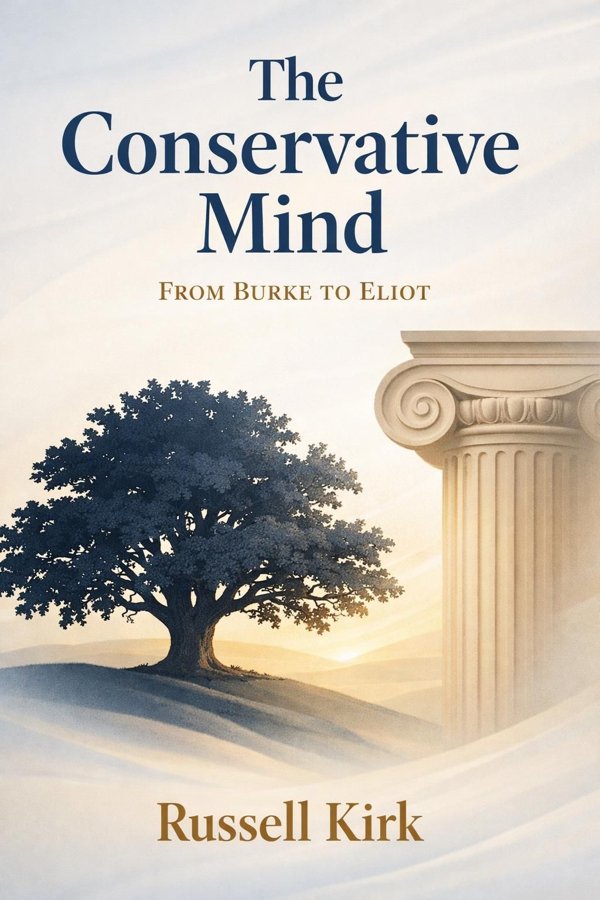
The Conservative Mind: From Burke to Eliot: Summary & Key Insights
by Russell Kirk
 10 min10 chaptersAudio available
What Is The Conservative Mind: From Burke to Eliot About?
The Conservative Mind: From Burke to Eliot by Russell Kirk is a politics book spanning 10 pages. Originally published in 1953, Russell Kirk’s *The Conservative Mind* is a foundational work in modern American conservatism. The book traces the intellectual lineage of conservative thought from Edmund Burke through figures such as John Adams, Alexis de Tocqueville, and T.S. Eliot. Kirk argues that conservatism is not a rigid ideology but a disposition rooted in respect for tradition, moral order, and the continuity of civilization.
This FizzRead summary covers all 10 key chapters of The Conservative Mind: From Burke to Eliot in approximately 10 minutes, distilling the most important ideas, arguments, and takeaways from Russell Kirk's work. Also available as an audio summary and Key Quotes Podcast.
The Conservative Mind: From Burke to Eliot
Originally published in 1953, Russell Kirk’s *The Conservative Mind* is a foundational work in modern American conservatism. The book traces the intellectual lineage of conservative thought from Edmund Burke through figures such as John Adams, Alexis de Tocqueville, and T.S. Eliot. Kirk argues that conservatism is not a rigid ideology but a disposition rooted in respect for tradition, moral order, and the continuity of civilization.
Who Should Read The Conservative Mind: From Burke to Eliot?
This book is perfect for anyone interested in politics and looking to gain actionable insights in a short read. Whether you're a student, professional, or lifelong learner, the key ideas from The Conservative Mind: From Burke to Eliot by Russell Kirk will help you think differently.
- ✓Readers who enjoy politics and want practical takeaways
- ✓Professionals looking to apply new ideas to their work and life
- ✓Anyone who wants the core insights of The Conservative Mind: From Burke to Eliot in just 10 minutes
Want the full summary?
Get instant access to this book summary and 100K+ more with Fizz Moment.
Get Free SummaryAvailable on App Store • Free to download
Key Chapters
All study of conservatism must begin with Edmund Burke, for he supplied the vocabulary, the moral underpinning, and the philosophy that shaped every later conservative thinker. When he confronted the French Revolution, Burke perceived not merely a political upheaval but an assault on the very principle of moral and social continuity. To him, the Revolution’s promise of liberty concealed a deeper tyranny: the notion that human reason, detached from tradition and prejudice, could redesign society as though it were a machine.
Burke’s defense of prescription—the idea that accumulated wisdom of generations is superior to abstract speculation—was not an argument against reform but against reckless innovation. He saw in the ‘little platoons’ of society, from the family to the church and local community, the organic bonds that make liberty possible. His reverence for prudence was rooted in the recognition that politics is the art of the possible, not of utopia.
In Burke’s eyes, civilization depended on the moral imagination—the faculty that perceives order and beauty in human obligation. Without it, man becomes a consumer of pleasures and an engineer of systems, stripped of reverence for the divine origin of order. This notion of moral imagination became the keystone of the conservative mind. It explains why conservatism is fundamentally a moral and cultural disposition, not an economic or political program. From his writings, conservatives learned that stability is not stagnation, that true progress defends the worth and dignity of the inherited moral law.
John Adams brought the Anglo-American version of Burke’s conservatism to life. While he shared with Jefferson a devotion to liberty, his temperament and philosophy were profoundly conservative. Adams revered the mixed constitution, seeing in its balance among executive, legislative, and judicial powers an embodiment of historical wisdom. He understood that liberty must be channeled through institutions that restrain both tyranny and anarchy.
Adams viewed history as a moral tutor. Human nature, to his mind, was unchanging—ambitious, passionate, and flawed. The American republic could not depend on idealism or virtue unmoored from institutional check. Hence, Adams emphasized the necessity of religious sentiment and education in sustaining republican virtue. In his belief, liberty without virtue degenerates into license.
The conservative force in America, thus born, was not reactionary but protective: protective of the spiritual and moral foundations that made self-government possible. Adams stood against the temptation to sever the new nation from its inherited civilization. He saw America’s independence not as a rejection of the British moral order but as its continuation in a freer guise. His thought anchored American conservatism in the conviction that political liberty cannot survive apart from moral discipline.
+ 8 more chapters — available in the FizzRead app
All Chapters in The Conservative Mind: From Burke to Eliot
About the Author
Russell Kirk (1918–1994) was an American political theorist, historian, and literary critic. He is best known for his role in shaping postwar American conservatism through his writings on political philosophy, culture, and moral imagination. Kirk authored numerous books and essays, including *The Roots of American Order* and *The Politics of Prudence*.
Get This Summary in Your Preferred Format
Read or listen to the The Conservative Mind: From Burke to Eliot summary by Russell Kirk anytime, anywhere. FizzRead offers multiple formats so you can learn on your terms — all free.
Available formats: App · Audio · PDF · EPUB — All included free with FizzRead
Download The Conservative Mind: From Burke to Eliot PDF and EPUB Summary
Key Quotes from The Conservative Mind: From Burke to Eliot
“All study of conservatism must begin with Edmund Burke, for he supplied the vocabulary, the moral underpinning, and the philosophy that shaped every later conservative thinker.”
“John Adams brought the Anglo-American version of Burke’s conservatism to life.”
Frequently Asked Questions about The Conservative Mind: From Burke to Eliot
The Conservative Mind: From Burke to Eliot by Russell Kirk is a politics book that explores key ideas across 10 chapters. Originally published in 1953, Russell Kirk’s *The Conservative Mind* is a foundational work in modern American conservatism. The book traces the intellectual lineage of conservative thought from Edmund Burke through figures such as John Adams, Alexis de Tocqueville, and T.S. Eliot. Kirk argues that conservatism is not a rigid ideology but a disposition rooted in respect for tradition, moral order, and the continuity of civilization.
You Might Also Like
Antifa: The Anti-Fascist Handbook
Mark Bray
10 min
Attack from Within: How Disinformation Is Sabotaging America
Barbara McQuade
10 min
Coercion, Capital, and European States, AD 990–1992
Charles Tilly
10 min
Digital Democracy: Concepts, Methodologies, Tools, and Applications
Various Authors
10 min
Fascism
Stanley G. Payne
10 min
Fire And Fury: Inside The Trump White House
Michael Wolff
10 minBrowse by Category
Ready to read The Conservative Mind: From Burke to Eliot?
Get the full summary and 100K+ more books with Fizz Moment.