
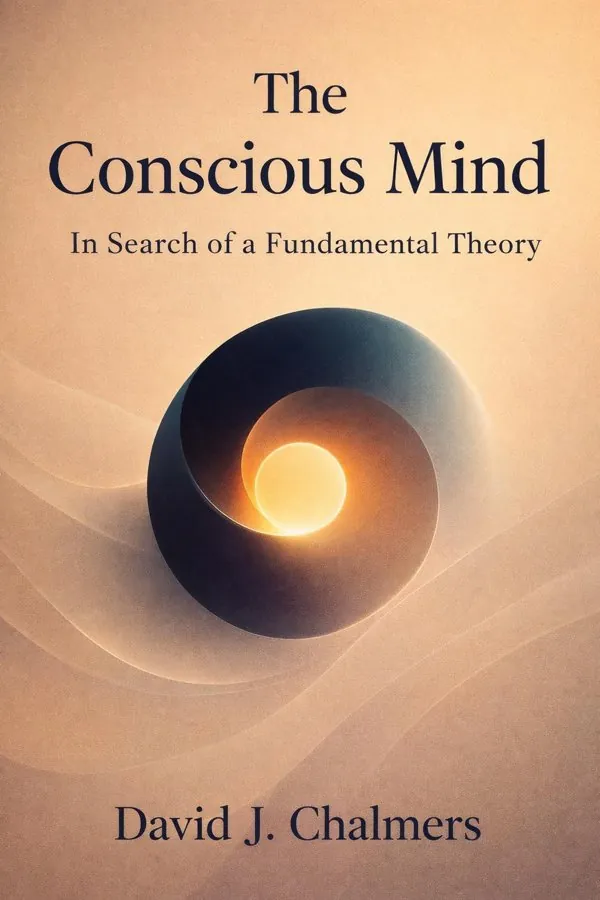
The Conscious Mind: In Search of a Fundamental Theory: Summary & Key Insights
 10 min9 chaptersAudio available
What Is The Conscious Mind: In Search of a Fundamental Theory About?
The Conscious Mind: In Search of a Fundamental Theory by David J. Chalmers is a western_phil book spanning 9 pages. In this influential work, philosopher David J. Chalmers presents a rigorous argument for the existence of consciousness as a fundamental feature of the universe. He distinguishes between the 'easy problems' of explaining cognitive functions and the 'hard problem' of explaining subjective experience. Chalmers proposes a nonreductive theory of consciousness, suggesting that conscious experience cannot be fully explained by physical processes alone and may require new fundamental laws of nature.
This FizzRead summary covers all 9 key chapters of The Conscious Mind: In Search of a Fundamental Theory in approximately 10 minutes, distilling the most important ideas, arguments, and takeaways from David J. Chalmers's work. Also available as an audio summary and Key Quotes Podcast.
The Conscious Mind: In Search of a Fundamental Theory
In this influential work, philosopher David J. Chalmers presents a rigorous argument for the existence of consciousness as a fundamental feature of the universe. He distinguishes between the 'easy problems' of explaining cognitive functions and the 'hard problem' of explaining subjective experience. Chalmers proposes a nonreductive theory of consciousness, suggesting that conscious experience cannot be fully explained by physical processes alone and may require new fundamental laws of nature.
Who Should Read The Conscious Mind: In Search of a Fundamental Theory?
This book is perfect for anyone interested in western_phil and looking to gain actionable insights in a short read. Whether you're a student, professional, or lifelong learner, the key ideas from The Conscious Mind: In Search of a Fundamental Theory by David J. Chalmers will help you think differently.
- ✓Readers who enjoy western_phil and want practical takeaways
- ✓Professionals looking to apply new ideas to their work and life
- ✓Anyone who wants the core insights of The Conscious Mind: In Search of a Fundamental Theory in just 10 minutes
Want the full summary?
Get instant access to this book summary and 100K+ more with Fizz Moment.
Get Free SummaryAvailable on App Store • Free to download
Key Chapters
To begin, I distinguish between what I call the easy and hard problems of consciousness. The easy problems are those associated with explaining cognitive functions and mechanisms—how we discriminate sensory inputs, how we attend to relevant information, how we produce verbal reports, or how we integrate information across systems. These are 'easy' not because they are trivial but because they fall within the familiar methodological reach of cognitive neuroscience and computational theory. They can, in principle, be explained in terms of processes that perform certain functions.
Consider, for example, perception. We can chart the neural pathways that transform light into retinal stimulation, then into electrochemical signals processed by visual cortex. We can model how attention enhances certain features and suppresses others, or how memory interacts with perception to create recognition. Every step here can be accounted for by mechanisms—information flows, neural computations, representational dynamics. None of this, however, tells us why it feels like something to see, why the experience of red is as it is.
Similarly, memory and rational behavior can be functionally described without reference to experience. A computer could, in theory, perform all these functions. Thus, while these problems are scientifically rich, they belong to the domain of 'easy' explanation because they involve objective functional analysis. They can be solved by understanding systems that perform causal roles. Yet solving every easy problem would still leave consciousness itself, the subjective aspect, untouched.
The hard problem emerges when we ask not how information is processed, but why any of it should be accompanied by experience. When neural systems integrate data and control behavior, why isn’t all of this 'dark inside'? Philosophers have long puzzled over the gap between physical processes and mental phenomena, but I insist that the gap here is not merely epistemic—it is ontological. There seems to be no logical entailment from physical facts to phenomenal facts.
To appreciate this, imagine a world physically identical to ours but devoid of experience. Its inhabitants—call them zombies—behave exactly like us, speak about consciousness, even claim to feel pain, yet no light of awareness burns within them. The very conceivability of such a world demonstrates that consciousness cannot logically supervene on the physical. This is the riddle that reductionist science cannot dissolve.
Every theory that represents consciousness as a pattern of function or brain activity overlooks what it is like to undergo those states. The subjective feel—the qualia—cannot be deduced from any physical description. So the hard problem forces us to consider that explanation here must take a new form, one that goes beyond physical reduction and involves new fundamental principles.
+ 7 more chapters — available in the FizzRead app
All Chapters in The Conscious Mind: In Search of a Fundamental Theory
About the Author
David John Chalmers is an Australian philosopher and cognitive scientist specializing in the philosophy of mind and language. He is best known for formulating the 'hard problem of consciousness' and for his contributions to debates on artificial intelligence and the nature of reality. Chalmers is a professor of philosophy and neural science at New York University.
Get This Summary in Your Preferred Format
Read or listen to the The Conscious Mind: In Search of a Fundamental Theory summary by David J. Chalmers anytime, anywhere. FizzRead offers multiple formats so you can learn on your terms — all free.
Available formats: App · Audio · PDF · EPUB — All included free with FizzRead
Download The Conscious Mind: In Search of a Fundamental Theory PDF and EPUB Summary
Key Quotes from The Conscious Mind: In Search of a Fundamental Theory
“To begin, I distinguish between what I call the easy and hard problems of consciousness.”
“The hard problem emerges when we ask not how information is processed, but why any of it should be accompanied by experience.”
Frequently Asked Questions about The Conscious Mind: In Search of a Fundamental Theory
The Conscious Mind: In Search of a Fundamental Theory by David J. Chalmers is a western_phil book that explores key ideas across 9 chapters. In this influential work, philosopher David J. Chalmers presents a rigorous argument for the existence of consciousness as a fundamental feature of the universe. He distinguishes between the 'easy problems' of explaining cognitive functions and the 'hard problem' of explaining subjective experience. Chalmers proposes a nonreductive theory of consciousness, suggesting that conscious experience cannot be fully explained by physical processes alone and may require new fundamental laws of nature.
You Might Also Like
A Little History of Philosophy
Nigel Warburton
10 min
Areopagitica
John Milton
10 min
How To Think Like A Philosopher: Essential Principles For Clear Thinking
Peter Cave
10 min
Language, Truth and Logic
A. J. Ayer
10 min
The Age of Reason
Thomas Paine
10 min
The Essays
Michel De Montaigne
10 minBrowse by Category
Ready to read The Conscious Mind: In Search of a Fundamental Theory?
Get the full summary and 100K+ more books with Fizz Moment.