
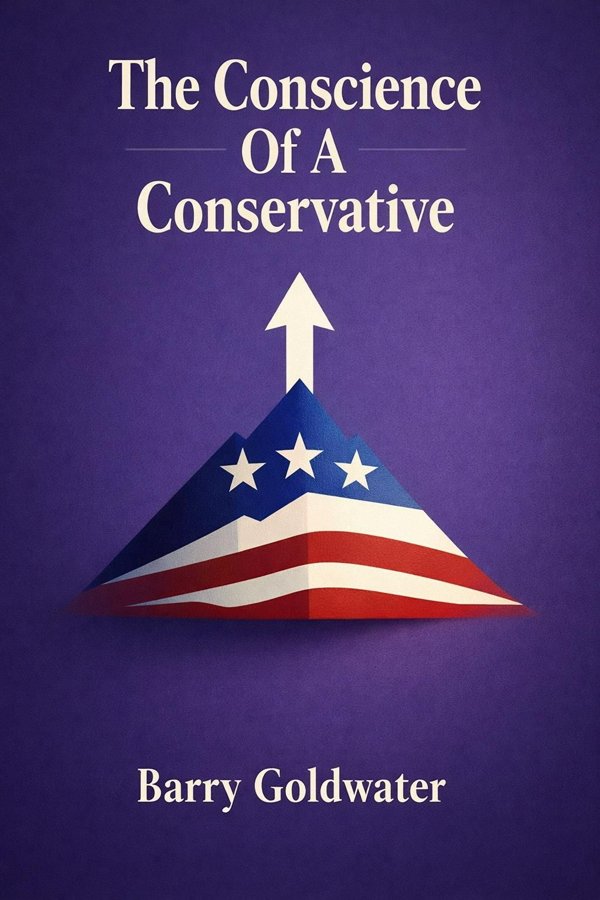
The Conscience Of A Conservative: Summary & Key Insights
 10 min10 chaptersAudio available
Key Takeaways from The Conscience Of A Conservative
A free society depends not only on good intentions but on the structure of power.
Prosperity is not created by decree, and freedom is not preserved when the state controls the means of livelihood.
Moral urgency does not erase constitutional questions.
The formation of the mind is too important to be turned into a distant administrative project.
Compassion can become corrosive when it replaces responsibility instead of supporting it.
What Is The Conscience Of A Conservative About?
The Conscience Of A Conservative by Barry Goldwater is a politics book spanning 10 pages. Originally published in 1960, The Conscience Of A Conservative is one of the defining political manifestos of modern American conservatism. In this short but forceful book, Barry Goldwater argues that freedom is best preserved when government is limited, power is decentralized, citizens are morally responsible, and national defense is taken seriously. He challenges the growing reach of the federal state and insists that prosperity, liberty, and civic virtue are inseparable. More than a campaign document or ideological tract, the book is a moral statement about what Goldwater believed the American constitutional order was designed to protect. Its importance extends far beyond its era. The book helped give intellectual shape to the postwar conservative movement and influenced generations of politicians, activists, and voters, including many who later reshaped the Republican Party. Goldwater wrote not as a detached academic but as a U.S. senator deeply engaged in the policy battles of his time. Whether one agrees with him or not, his arguments remain essential for understanding debates over federalism, free markets, civil rights, welfare, taxes, labor, education, and foreign policy. This is a compact book with outsized historical and ideological influence.
This FizzRead summary covers all 10 key chapters of The Conscience Of A Conservative in approximately 10 minutes, distilling the most important ideas, arguments, and takeaways from Barry Goldwater's work. Also available as an audio summary and Key Quotes Podcast.
The Conscience Of A Conservative
Originally published in 1960, The Conscience Of A Conservative is one of the defining political manifestos of modern American conservatism. In this short but forceful book, Barry Goldwater argues that freedom is best preserved when government is limited, power is decentralized, citizens are morally responsible, and national defense is taken seriously. He challenges the growing reach of the federal state and insists that prosperity, liberty, and civic virtue are inseparable. More than a campaign document or ideological tract, the book is a moral statement about what Goldwater believed the American constitutional order was designed to protect.
Its importance extends far beyond its era. The book helped give intellectual shape to the postwar conservative movement and influenced generations of politicians, activists, and voters, including many who later reshaped the Republican Party. Goldwater wrote not as a detached academic but as a U.S. senator deeply engaged in the policy battles of his time. Whether one agrees with him or not, his arguments remain essential for understanding debates over federalism, free markets, civil rights, welfare, taxes, labor, education, and foreign policy. This is a compact book with outsized historical and ideological influence.
Who Should Read The Conscience Of A Conservative?
This book is perfect for anyone interested in politics and looking to gain actionable insights in a short read. Whether you're a student, professional, or lifelong learner, the key ideas from The Conscience Of A Conservative by Barry Goldwater will help you think differently.
- ✓Readers who enjoy politics and want practical takeaways
- ✓Professionals looking to apply new ideas to their work and life
- ✓Anyone who wants the core insights of The Conscience Of A Conservative in just 10 minutes
Want the full summary?
Get instant access to this book summary and 100K+ more with Fizz Moment.
Get Free SummaryAvailable on App Store • Free to download
Key Chapters
A free society depends not only on good intentions but on the structure of power. Goldwater’s argument about the states begins with a constitutional insight: liberty is safer when authority is divided. The American system was designed so that the federal government would exercise limited, enumerated powers, while the states would retain broad responsibility for local matters. In his view, this was not an administrative convenience but a safeguard against political concentration.
Goldwater believed that by the mid-twentieth century, Washington had steadily expanded beyond its proper role. Programs once handled locally or regionally were increasingly directed from the national capital. He saw this shift as dangerous because centralized power tends to standardize policy, weaken community judgment, and distance decision-making from the people affected by it. When all solutions come from one place, citizens lose both control and responsibility.
A practical example is education, transportation, or local business regulation. Goldwater would argue that Arizona and New York need not solve every problem in identical ways. Different states can test different policies, and citizens can hold closer authorities more directly accountable. Federalism thus encourages experimentation and limits overreach.
His position does not deny the importance of national unity. Rather, it insists that unity and liberty coexist best when local self-government remains strong. The closer government is to the people, the easier it is to correct mistakes, preserve consent, and reflect distinct local values.
Actionable takeaway: When evaluating public policy, ask first which level of government is constitutionally and practically best suited to handle the issue. That habit sharpens political judgment and keeps freedom tied to self-government.
Prosperity is not created by decree, and freedom is not preserved when the state controls the means of livelihood. Goldwater argues that economic liberty is inseparable from political liberty because people who depend excessively on government for economic security gradually lose their independence as citizens. If government can allocate jobs, prices, credit, subsidies, and opportunity at will, it gains enormous power over everyday life.
In Goldwater’s view, the belief that government can spend its way into lasting prosperity confuses temporary stimulation with genuine wealth creation. Wealth comes from production, investment, risk-taking, savings, entrepreneurship, and voluntary exchange. The freer the market, the more room there is for innovation and individual initiative. By contrast, heavy regulation, bureaucratic planning, and large-scale spending programs distort incentives and often create new inefficiencies while claiming to solve old ones.
Consider a small business owner deciding whether to expand. Under a freer economic system, that decision depends largely on customer demand, available talent, and business judgment. Under a highly interventionist system, the owner must also navigate unpredictable taxes, subsidies, mandates, and compliance costs. Goldwater believed that as these burdens grow, economic energy contracts and dependence grows.
His point is not that all government action is illegitimate, but that government should referee the market rather than dominate it. The more people are allowed to work, save, invest, and exchange freely, the stronger both the economy and the habits of independence become.
Actionable takeaway: Whenever a policy promises economic security, also ask what it does to autonomy, incentives, and long-term productivity. A good economic policy should expand opportunity without making citizens more politically dependent.
Moral urgency does not erase constitutional questions. In one of the book’s most debated sections, Goldwater addresses civil rights by trying to reconcile two commitments: opposition to racial discrimination and fidelity to constitutional limits on federal power. He maintains that individual rights are real and essential, but he also argues that not every moral wrong may be corrected by any means whatsoever. For Goldwater, ends and methods both matter.
He distinguishes between government-enforced segregation, which he opposes, and the use of expansive federal authority to regulate private conduct in ways he believed exceeded constitutional boundaries. His concern is that if the federal government can override limits whenever the cause is morally compelling, then constitutional restraints become fragile. In his framework, preserving liberty requires refusing even well-intentioned shortcuts around constitutional design.
This argument remains controversial because critics contend that such formal limits can preserve injustice when local authorities fail to protect equal rights. Supporters respond that constitutional government cannot survive if emergency morality becomes a standing justification for federal expansion. Regardless of one’s conclusion, Goldwater’s discussion reveals a central tension in American politics: how to secure justice while preserving the limits meant to guard freedom.
A practical application is to distinguish among goals, legal authority, and policy tools. Citizens may agree that discrimination is wrong yet still debate whether courts, Congress, states, or civil society are best equipped to respond. Goldwater wanted those distinctions taken seriously rather than dissolved by passion.
Actionable takeaway: In contentious debates, discipline yourself to ask two separate questions: Is the goal morally just? And is the proposed governmental mechanism constitutionally sound? Sound statesmanship requires both answers, not just one.
The formation of the mind is too important to be turned into a distant administrative project. Goldwater argues that education works best when responsibility remains close to families, communities, and states rather than concentrated in the federal government. His concern is not merely efficiency. He believes centralized control over education risks weakening parental authority, flattening local diversity, and inviting political agendas into the classroom through bureaucracy.
In his view, education is deeply connected to character, citizenship, and community values. Those are not abstract national outputs but lived realities shaped locally. A school board in a town understands its students, culture, and needs more concretely than a federal office ever could. Goldwater therefore sees local control as both a practical and philosophical necessity.
A concrete example is curriculum and standards. Under local governance, communities can debate what students should learn, how schools should be run, and which reforms fit their conditions. Under centralized systems, policy tends to become one-size-fits-all. That may simplify administration, but it often reduces innovation and weakens accountability. When parents must navigate distant agencies instead of local institutions, their influence shrinks.
Goldwater does not reject excellence or public support for education. Rather, he insists that educational quality is strengthened when authority is proximate and plural rather than remote and uniform. The same federalist principle guiding his politics appears here: freedom and responsibility grow together.
Actionable takeaway: When thinking about school reform, prioritize policies that increase parental visibility, local accountability, and institutional variety. Better education often begins not with larger systems, but with stronger communities that can shape and evaluate their own schools.
Compassion can become corrosive when it replaces responsibility instead of supporting it. Goldwater’s critique of the welfare state rests on the belief that society should help those in genuine need, but should do so in ways that do not create dependency or transfer too much authority to the central government. He worries that a large welfare apparatus changes the citizen’s relationship to both work and government.
For Goldwater, freedom is not simply the absence of coercion; it also requires habits of self-command, initiative, and mutual aid. When government assumes primary responsibility for solving hardship, citizens may gradually surrender functions once carried by families, churches, neighborhoods, and voluntary associations. What begins as relief can evolve into a permanent system of dependence, bureaucracy, and political patronage.
Imagine two approaches to poverty. One relies almost entirely on distant, standardized benefits administered by complex agencies. The other combines temporary assistance with local institutions, work incentives, and strong expectations of personal recovery. Goldwater clearly favors the second model because it preserves dignity and social bonds while avoiding the growth of an impersonal administrative state.
His argument also has a fiscal dimension. Expanding entitlements can outpace revenue, requiring higher taxes, more borrowing, and further bureaucracy. In that sense, the welfare state affects not only recipients but the overall distribution of economic and political power.
Actionable takeaway: Support policies that relieve suffering while asking whether they restore independence or entrench dependence. Effective compassion should aim to help people stand again, not indefinitely reposition them beneath expanding administrative structures.
Good intentions in agriculture can produce bad economics and unhealthy politics. Goldwater criticizes federal farm programs for trying to manage production, prices, and subsidies from Washington. In his view, these interventions often distort market signals, reward political influence, and trap farmers in systems that reduce independence rather than protect it.
The farm problem, as Goldwater sees it, is real: agriculture is vulnerable to weather, fluctuating demand, and price instability. But he argues that federal management is not a sound cure. Once government begins guaranteeing prices or directing production, it encourages overproduction in some areas, inefficiency in others, and endless lobbying everywhere. Farmers become not just producers, but petitioners before the state.
A practical example is subsidy dependence. A farmer may begin making planting decisions based less on market demand and soil conditions than on federal formulas and payment rules. Over time, that weakens entrepreneurial judgment and ties agricultural life to political bargaining. It can also advantage large, well-connected operators over smaller independent producers.
Goldwater’s larger point is that sectors of the economy should not be treated as permanent wards of the federal government. Agriculture, like other industries, functions best when incentives reflect real costs, real demand, and personal responsibility. That does not rule out temporary emergency support, but it rejects bureaucratic micromanagement as normal policy.
Actionable takeaway: When assessing agricultural policy, look beyond promises of stability and ask whether the policy encourages independence, fair competition, and market responsiveness. Sustainable support should help people navigate volatility without permanently subordinating their decisions to political incentives.
Power can threaten liberty whether it sits in government offices or private organizations with public influence. Goldwater’s discussion of labor unions does not reject the right of workers to organize. Instead, he warns that unions, when granted excessive legal privilege or political leverage, can become coercive institutions that distort markets and undermine individual freedom.
His concern is twofold. First, labor laws may compel workers to support unions they did not freely choose or to accept representation they do not want. Second, union power can extend beyond workplace bargaining into politics, where organized blocs shape legislation in self-interested ways. Goldwater believes that when any group gains special exemption from ordinary market discipline or legal limits, liberty is endangered.
A practical example is compulsory unionism. If a worker must join or financially support an organization as a condition of employment, Goldwater sees that as a violation of freedom of association. Similarly, if union leaders can shut down essential industries or extract political favors through concentrated power, the public interest suffers.
This chapter reflects a broader pattern in the book: Goldwater is suspicious not only of state power but of any concentrated force insulated from accountability. He prefers voluntary association, competitive labor markets, and legal equality rather than systems that privilege organized power centers.
Actionable takeaway: Evaluate labor policy by asking whether it protects workers’ freedom to associate—or not associate—while maintaining fair negotiation and public accountability. A just labor system should defend workers without creating coercive monopolies of representation or political influence.
Taxation is not only a budgetary issue; it is a question of who controls the fruits of labor. Goldwater argues that high taxes and unchecked public spending do more than burden the economy. They shift decision-making power from households and businesses to government agencies, thereby shrinking the sphere in which individuals can freely choose how to live, invest, save, and give.
He rejects the idea that government spending is inherently productive simply because it is authorized by law. Public expenditures must first be taken from citizens—through current taxes, borrowing, or inflationary pressures. Excessive spending therefore imposes real costs, even when hidden. Goldwater fears that politicians often promise benefits without confronting the long-term consequences: larger bureaucracies, fiscal irresponsibility, and a citizenry increasingly accustomed to asking what government will provide next.
In practical terms, lower taxes can leave a family with more room to save for education, support a local charity, start a business, or buy a home. Goldwater sees these as morally and politically meaningful choices. They reflect dispersed decision-making in a free society. By contrast, when the state claims a larger share of income, it decides more and citizens decide less.
He does not deny that government requires revenue. His insistence is that spending should be restrained by constitutional purpose and fiscal discipline rather than by the political temptation to expand indefinitely.
Actionable takeaway: Treat every spending proposal as a transfer of both money and authority. Ask not only whether a program sounds useful, but whether it justifies the taxes, debt, and administrative power needed to sustain it over time.
A nation unwilling to defend freedom eventually invites those who wish to destroy it. Goldwater’s argument for national defense is rooted in the Cold War context, but its logic is broader: liberty at home cannot be separated from security abroad. He believed the United States faced ideological and military threats that could not be met by wishful thinking, diplomatic slogans, or strategic hesitation.
For Goldwater, peace is preserved not by weakness but by strength so visible and credible that adversaries are deterred from aggression. He is skeptical of policies that confuse restraint with passivity or negotiation with security. A free nation must maintain military preparedness, strategic clarity, and the will to confront hostile powers before threats become catastrophes.
A practical application of this principle can be seen in deterrence. If a rival power believes a nation lacks the capability or resolve to respond, the likelihood of provocation rises. Conversely, strong defense capacity can reduce conflict by making aggression unattractive. Goldwater therefore links defense spending, military readiness, and anti-communist vigilance to the preservation of freedom itself.
His emphasis on defense also has a moral dimension. He sees the protection of the nation as one of the few unquestionably legitimate functions of the federal government. In this area, unlike many domestic matters, national authority is not an intrusion but a necessity.
Actionable takeaway: In foreign policy debates, distinguish between avoiding war and ignoring danger. Serious peace requires preparedness, clear commitments, and the willingness to recognize that freedom sometimes survives because it is defended, not merely desired.
Liberty cannot survive on procedures alone; it requires citizens capable of using freedom well. Goldwater closes on a theme that gives coherence to the entire book: conservatism is not merely a preference for smaller government but a moral vision of the person and society. Free institutions depend on self-restraint, courage, duty, and a willingness to accept the burdens that accompany liberty.
He rejects the idea that government can permanently relieve individuals of moral and civic responsibility. The more citizens expect the state to provide direction, security, and meaning, the less they cultivate the character needed for self-government. Goldwater therefore treats freedom not as comfort but as discipline. It is demanding because it asks people to make choices, face consequences, and contribute to the common good without constant coercion.
This insight applies well beyond politics. In family life, professional life, and community life, freedom works only when people honor commitments and govern themselves. A society of rights without duties will eventually invite external control because disorder creates demand for management. Goldwater’s conservatism thus joins constitutional limits with personal virtue.
The chapter also explains why he writes with such urgency. He believes America’s crisis is not only institutional but spiritual: too many citizens are forgetting that the preservation of freedom requires sacrifice, vigilance, and moral confidence.
Actionable takeaway: Practice political freedom as a personal ethic. Take responsibility before demanding intervention, participate in local civic life, and cultivate the habits of self-government—integrity, discipline, and courage—that make limited government possible in the first place.
All Chapters in The Conscience Of A Conservative
About the Author
Barry Goldwater (1909–1998) was an American politician, businessman, and U.S. Senator from Arizona who became one of the central architects of modern American conservatism. Before entering national politics, he worked in his family’s department store business and served as a pilot in the military, experiences that shaped his practical and patriotic worldview. Goldwater served five terms in the Senate and was the Republican nominee for president in 1964. Though he lost that election, his campaign galvanized a new conservative movement built around limited government, anti-communism, free enterprise, and constitutional originalism. His book The Conscience Of A Conservative became a landmark statement of those beliefs. Goldwater’s influence extended far beyond his own career, helping lay the intellectual groundwork for the conservative resurgence that followed in later decades.
Get This Summary in Your Preferred Format
Read or listen to the The Conscience Of A Conservative summary by Barry Goldwater anytime, anywhere. FizzRead offers multiple formats so you can learn on your terms — all free.
Available formats: App · Audio · PDF · EPUB — All included free with FizzRead
Download The Conscience Of A Conservative PDF and EPUB Summary
Key Quotes from The Conscience Of A Conservative
“A free society depends not only on good intentions but on the structure of power.”
“Prosperity is not created by decree, and freedom is not preserved when the state controls the means of livelihood.”
“Moral urgency does not erase constitutional questions.”
“The formation of the mind is too important to be turned into a distant administrative project.”
“Compassion can become corrosive when it replaces responsibility instead of supporting it.”
Frequently Asked Questions about The Conscience Of A Conservative
The Conscience Of A Conservative by Barry Goldwater is a politics book that explores key ideas across 10 chapters. Originally published in 1960, The Conscience Of A Conservative is one of the defining political manifestos of modern American conservatism. In this short but forceful book, Barry Goldwater argues that freedom is best preserved when government is limited, power is decentralized, citizens are morally responsible, and national defense is taken seriously. He challenges the growing reach of the federal state and insists that prosperity, liberty, and civic virtue are inseparable. More than a campaign document or ideological tract, the book is a moral statement about what Goldwater believed the American constitutional order was designed to protect. Its importance extends far beyond its era. The book helped give intellectual shape to the postwar conservative movement and influenced generations of politicians, activists, and voters, including many who later reshaped the Republican Party. Goldwater wrote not as a detached academic but as a U.S. senator deeply engaged in the policy battles of his time. Whether one agrees with him or not, his arguments remain essential for understanding debates over federalism, free markets, civil rights, welfare, taxes, labor, education, and foreign policy. This is a compact book with outsized historical and ideological influence.
You Might Also Like
Antifa: The Anti-Fascist Handbook
Mark Bray
10 min
Attack from Within: How Disinformation Is Sabotaging America
Barbara McQuade
10 min
Coercion, Capital, and European States, AD 990–1992
Charles Tilly
10 min
Digital Democracy: Concepts, Methodologies, Tools, and Applications
Various Authors
10 min
Fascism
Stanley G. Payne
10 min
Fire And Fury: Inside The Trump White House
Michael Wolff
10 minBrowse by Category
Ready to read The Conscience Of A Conservative?
Get the full summary and 100K+ more books with Fizz Moment.