
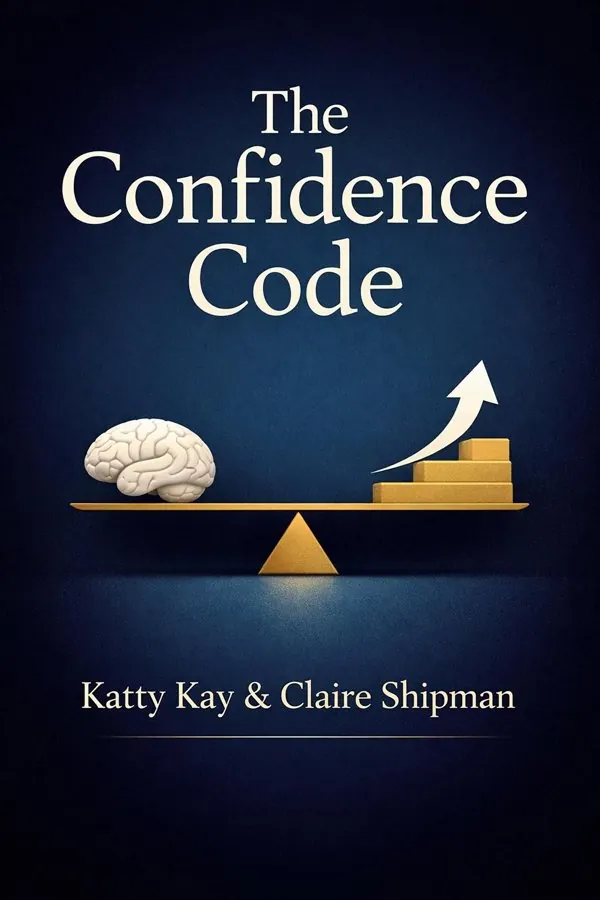
The Confidence Code: The Science and Art of Self-Assurance—What Women Should Know: Summary & Key Insights
 10 min9 chaptersAudio available
Key Takeaways from The Confidence Code: The Science and Art of Self-Assurance—What Women Should Know
A surprising truth sits at the heart of this book: confidence is not the same as competence, self-esteem, or certainty.
One of the book’s most important claims is that there is a measurable confidence gap between men and women, and it affects careers, leadership, and daily decision-making.
Confidence feels personal, but part of it is biological.
Confidence is not formed in isolation.
Many people think confidence comes from success, but the book shows that it often comes from surviving failure.
What Is The Confidence Code: The Science and Art of Self-Assurance—What Women Should Know About?
The Confidence Code: The Science and Art of Self-Assurance—What Women Should Know by Katty Kay & Claire Shipman is a positive_psych book spanning 10 pages. Why do so many capable women hesitate just when it matters most? In The Confidence Code, veteran journalists Katty Kay and Claire Shipman investigate a question that sits at the center of achievement, leadership, and personal fulfillment: why confidence often seems harder for women to claim, even when they are highly competent. Drawing on interviews with accomplished women, conversations with researchers, and findings from genetics, neuroscience, psychology, and behavioral science, they argue that confidence is not a mysterious gift reserved for a lucky few. It is a quality shaped by biology, experience, habit, and action. What makes this book especially valuable is its blend of evidence and practicality. Kay and Shipman do not simply diagnose a confidence gap; they explain how overthinking, perfectionism, fear of failure, and social conditioning can undermine self-assurance, while risk-taking, decisiveness, and repeated action can strengthen it. Their authority comes from years of reporting on powerful women in politics, business, and public life, combined with a clear-eyed willingness to examine their own struggles. The result is an insightful, energizing guide for women who want to stop waiting to feel ready and start moving forward with greater courage.
This FizzRead summary covers all 9 key chapters of The Confidence Code: The Science and Art of Self-Assurance—What Women Should Know in approximately 10 minutes, distilling the most important ideas, arguments, and takeaways from Katty Kay & Claire Shipman's work. Also available as an audio summary and Key Quotes Podcast.
The Confidence Code: The Science and Art of Self-Assurance—What Women Should Know
Why do so many capable women hesitate just when it matters most? In The Confidence Code, veteran journalists Katty Kay and Claire Shipman investigate a question that sits at the center of achievement, leadership, and personal fulfillment: why confidence often seems harder for women to claim, even when they are highly competent. Drawing on interviews with accomplished women, conversations with researchers, and findings from genetics, neuroscience, psychology, and behavioral science, they argue that confidence is not a mysterious gift reserved for a lucky few. It is a quality shaped by biology, experience, habit, and action.
What makes this book especially valuable is its blend of evidence and practicality. Kay and Shipman do not simply diagnose a confidence gap; they explain how overthinking, perfectionism, fear of failure, and social conditioning can undermine self-assurance, while risk-taking, decisiveness, and repeated action can strengthen it. Their authority comes from years of reporting on powerful women in politics, business, and public life, combined with a clear-eyed willingness to examine their own struggles. The result is an insightful, energizing guide for women who want to stop waiting to feel ready and start moving forward with greater courage.
Who Should Read The Confidence Code: The Science and Art of Self-Assurance—What Women Should Know?
This book is perfect for anyone interested in positive_psych and looking to gain actionable insights in a short read. Whether you're a student, professional, or lifelong learner, the key ideas from The Confidence Code: The Science and Art of Self-Assurance—What Women Should Know by Katty Kay & Claire Shipman will help you think differently.
- ✓Readers who enjoy positive_psych and want practical takeaways
- ✓Professionals looking to apply new ideas to their work and life
- ✓Anyone who wants the core insights of The Confidence Code: The Science and Art of Self-Assurance—What Women Should Know in just 10 minutes
Want the full summary?
Get instant access to this book summary and 100K+ more with Fizz Moment.
Get Free SummaryAvailable on App Store • Free to download
Key Chapters
A surprising truth sits at the heart of this book: confidence is not the same as competence, self-esteem, or certainty. Many people assume confidence means feeling fully secure, having no doubts, or possessing perfect knowledge before acting. Kay and Shipman challenge that idea. Confidence is better understood as the willingness to act despite uncertainty. It is behavioral before it is emotional.
This distinction matters because many talented women delay action until they feel completely prepared. They want one more qualification, one more round of revision, one more sign that they are ready. But confidence rarely arrives first. More often, it follows action. You speak up in a meeting, take on a stretch assignment, pitch an idea, or try something unfamiliar—and only afterward does your confidence begin to grow.
The authors also separate confidence from self-esteem. Self-esteem is how you feel about your worth; confidence is your belief that you can handle a challenge. You can be accomplished and still feel shaky in new situations. Likewise, you can lack total certainty and still move decisively. This reframing is liberating because it means you do not need to become fearless before you take the next step.
In practice, this could mean applying for a job before you meet every listed requirement, volunteering to lead a project even if you are learning as you go, or expressing an opinion without rehearsing it to perfection. Confidence is built in motion, not in endless preparation.
Actionable takeaway: Stop using “I’m not fully ready” as a reason to wait. Pick one meaningful situation this week where you normally hesitate, and take a concrete step before you feel completely comfortable.
One of the book’s most important claims is that there is a measurable confidence gap between men and women, and it affects careers, leadership, and daily decision-making. Study after study shows that men tend to rate their abilities more highly, apply for roles with fewer qualifications, and recover from setbacks more quickly. Women, by contrast, are more likely to underestimate their readiness, second-guess themselves, and wait for external validation.
The authors are careful not to frame this as a simple matter of individual weakness. The gap is not proof that women are less capable. In many cases, women perform as well as or better than men. The difference lies in how ability is perceived and acted upon. Men are more likely to assume they can figure things out as they go. Women are more likely to believe they need to prove themselves before stepping up.
This dynamic has visible consequences. A woman may hesitate to negotiate a raise, ask a question in public, or pursue a promotion because she interprets uncertainty as a warning. A male peer with equal or lower ability may move ahead simply because he is willing to take the risk. Over time, small differences in confidence compound into larger differences in opportunity and influence.
Recognizing the confidence gap is not about blaming men or shaming women. It is about seeing the hidden mechanism that often shapes outcomes. Once named, it becomes easier to challenge. Women can begin to question the internal standards they impose on themselves and organizations can rethink how they assess readiness and leadership potential.
Actionable takeaway: Notice one area where you hold yourself to a higher threshold than others. Replace the question “Am I fully qualified?” with “Am I capable of learning and delivering?”
Confidence feels personal, but part of it is biological. Kay and Shipman explore research suggesting that genetics, brain chemistry, and hormones may influence how people respond to stress, uncertainty, and risk. Some individuals appear naturally more inclined toward boldness, while others are more sensitive to threat or more prone to caution. This scientific angle helps explain why confidence can feel easier for some than for others.
Yet the authors are equally clear that biology is not destiny. Genes may tilt the playing field, but they do not write the final script. The brain remains adaptable. Neural pathways change through repetition, experience, and behavior. A person who tends toward anxiety can still become more confident by practicing new responses. Likewise, someone with natural boldness can lose confidence if they stop stretching themselves.
This perspective is powerful because it removes two extremes: shame and fatalism. If confidence has a biological component, struggling with it is not a moral failing. But if the brain is plastic, struggle is not permanent either. Habits of thought and action matter. Repeated exposure to challenge can reduce fear. Learning to regulate stress can improve performance. Practicing decisive behavior can strengthen self-trust.
A practical example is public speaking. Some people feel a natural jolt of fear at the thought of presenting. Understanding that this reaction may be partly hardwired can reduce self-criticism. At the same time, repeated practice, preparation, and exposure can train the brain to interpret the event as manageable rather than dangerous.
Actionable takeaway: When self-doubt appears, do not treat it as a verdict. Treat it as a tendency. Ask, “What behavior would help retrain my brain here?” and repeat that behavior consistently.
Confidence is not formed in isolation. It is shaped by families, schools, workplaces, media, and the expectations absorbed from childhood. The authors argue that many girls are subtly rewarded for being careful, polite, likable, and correct, while boys are more often encouraged to be bold, competitive, and resilient after failure. Over time, these messages can create very different relationships to risk.
Girls may learn that mistakes are embarrassing and that being wrong threatens approval. Boys may learn that mistakes are part of play, experimentation, and eventual mastery. As adults, these patterns show up in familiar ways: women overprepare, hesitate to self-promote, soften their opinions, and seek consensus before acting. Men, on average, are more likely to improvise, bluff confidence, and move ahead despite incomplete information.
This is not true of every individual, but the pattern is strong enough to matter. Social conditioning can become internalized so deeply that it feels natural. A woman may think, “I’m just cautious,” when in reality she has spent years being taught that caution is the safer, more acceptable version of herself.
The workplace often reinforces these pressures. Assertive men may be seen as decisive, while assertive women risk being judged as abrasive. That double bind can encourage women to play smaller than they need to. Understanding the cultural roots of confidence struggles helps women externalize part of the problem instead of automatically blaming themselves.
Parents, managers, and mentors can help by praising effort, resilience, and experimentation rather than only correctness. Individuals can challenge inherited scripts by practicing more direct communication, tolerating occasional disapproval, and valuing progress over perfection.
Actionable takeaway: Identify one “good girl” rule you still obey—such as never upsetting anyone or never speaking unless certain—and deliberately break it once in a low-stakes setting.
Many people think confidence comes from success, but the book shows that it often comes from surviving failure. If you never risk embarrassment, rejection, or mistakes, you may preserve comfort but you do not develop resilience. Confidence grows when you discover, through experience, that setbacks are uncomfortable but not fatal.
Women are often socialized to avoid failure more intensely than men. They may interpret mistakes as evidence that they are not good enough, rather than as normal feedback in the learning process. This can lead to playing safe: choosing only tasks they know they can do well, remaining silent until an idea is polished, or avoiding visible challenges that could expose imperfection.
The cost of safety is stagnation. Without risk, there is little expansion. By contrast, each time you attempt something uncertain and recover from the outcome, your tolerance for uncertainty increases. You build emotional evidence: I can handle this. That evidence is more durable than praise because it comes from experience.
In practical terms, this might mean proposing an idea that may be rejected, asking for a raise that may not be granted, launching a side project before it is flawless, or entering a new field where you are not yet an expert. Some attempts will fail. But failure, when viewed correctly, becomes information rather than identity.
The authors encourage women to rethink the meaning of mistakes. Failure does not disqualify you; often it initiates growth. Confidence is not built by avoiding situations where you might fail. It is built by engaging them and learning that your value survives imperfect outcomes.
Actionable takeaway: This month, choose one meaningful risk with a real chance of failure. Define success as taking the risk itself, not controlling the outcome.
One of the book’s most counterintuitive insights is that too much thinking can erode confidence. Reflection has value, but overthinking creates a loop of analysis, prediction, and self-monitoring that can paralyze action. Women, the authors note, are especially prone to rumination—replaying conversations, imagining negative scenarios, and scrutinizing their own performance.
This mental habit often disguises itself as responsibility. It feels wise to consider every angle, anticipate every objection, and refine every detail. But beyond a certain point, analysis stops being useful and starts feeding anxiety. The brain treats imagined threats as signals to delay. Soon, the challenge feels larger, the stakes feel higher, and action feels riskier than it actually is.
High performers in many fields often rely on a different pattern: preparation followed by trust. Athletes, entrepreneurs, and leaders know that once the moment arrives, execution matters more than obsessive internal commentary. Confidence improves when attention shifts from “How am I doing?” to “What needs to be done?”
A practical example is an important presentation. Overthinking leads to endless revision and anxiety about how you will be judged. A more confident approach is to prepare thoroughly, identify your core message, and then focus outward on helping the audience understand. The same principle applies to interviews, negotiations, and difficult conversations.
Reducing overthinking does not mean becoming careless. It means knowing when thought has done its job. Creating time limits for decisions, using simple criteria, and taking action before every doubt is resolved can interrupt the rumination cycle.
Actionable takeaway: The next time you are stuck in analysis, set a decision deadline. Give yourself a fixed amount of time to prepare, then act without reopening the question.
If there is one practical rule in The Confidence Code, it is this: do first, confidence follows. The authors repeatedly return to the idea that behavior changes belief more reliably than belief changes behavior. Waiting to feel brave before acting can keep you stuck for years. Acting in small, repeated ways creates the evidence that bravery is possible.
This is why confidence is best understood as a practice. Every time you take initiative, speak up, make a decision, or enter unfamiliar territory, you strengthen your sense of agency. These moments do not have to be dramatic. Confidence is often built through ordinary repetitions: sending the email you are nervous about, introducing yourself to someone senior, asking a question in a meeting, or setting a boundary without excessive apology.
The mechanism is simple but powerful. Action produces experience. Experience reduces uncertainty. Reduced uncertainty makes future action easier. Over time, what once felt intimidating becomes normal. This is especially important for women who have learned to interpret discomfort as a sign to retreat. In reality, discomfort is often just the sensation of growth.
The book encourages experimentation rather than grand transformation. You do not need to reinvent your personality overnight. You need enough courage to take the next visible step. Then another. Then another. Confidence accumulates through evidence, not intention.
This principle also applies in leadership. People often think leaders are those who naturally radiate certainty. In truth, leadership confidence often comes from repeatedly making decisions, adjusting, and learning. Motion creates authority.
Actionable takeaway: Build a daily confidence habit. Every day for two weeks, do one small thing you would normally avoid because it feels uncomfortable or exposing.
In professional life, confidence often matters almost as much as ability because it affects visibility, negotiation, and advancement. Kay and Shipman show how women’s hesitation can have major career consequences. A woman may do excellent work, yet fail to claim credit, ask for opportunities, negotiate compensation, or project readiness for leadership. Meanwhile, less qualified colleagues who appear more self-assured may move faster.
This dynamic does not mean women should simply mimic stereotypically aggressive behavior. Rather, they need to understand how confidence is read in organizational settings. Speaking clearly, making recommendations instead of only observations, stating achievements without apology, and tolerating some uncertainty are all career-relevant behaviors. They signal leadership capacity.
The book also addresses a difficult reality: women are often judged differently. The same behavior can be interpreted more harshly when performed by women, which makes confidence at work more complicated. But this complexity is not a reason to remain passive. It is a reason to become strategic. Women can combine warmth with directness, prepare strong evidence for negotiations, and build networks of sponsors who will advocate for them.
Examples include applying for promotions before meeting every criterion, volunteering for profit-and-loss roles or high-visibility assignments, and resisting the urge to downplay achievements with phrases like “I was just lucky” or “It was a team effort” when individual contribution should be recognized.
Professional confidence is not vanity. It is the ability to represent your value accurately. Organizations benefit when capable women stop hiding behind modesty norms and step more fully into influence.
Actionable takeaway: In your next professional conversation, state one accomplishment or idea directly and without minimizing language. Practice sounding factual, not apologetic.
Beyond isolated behaviors, the book points toward a broader shift in identity: confident people tell themselves a different story about challenge, ability, and setbacks. They do not assume that anxiety means incapacity. They do not treat criticism as proof of inadequacy. They interpret growth as messy, effortful, and sometimes uncomfortable. In other words, confidence is sustained by mindset.
A confidence mindset includes several beliefs. First, ability is expandable. You may not know how to do something yet, but you can learn. Second, action is more important than perfection. Third, discomfort is not danger. And fourth, other people’s judgments are data points, not final truths. These beliefs create emotional room to keep moving.
The authors show that women often carry narratives shaped by comparison and perfectionism. They may focus on where they fall short, assume others are more certain than they are, or believe that confidence must look effortless. But confidence is often built through deliberate mental reframing: replacing “I’m not ready” with “I’m in progress,” or “If I fail, it means I’m not good enough” with “If I fail, I’ll learn what to do next.”
Real-life stories in the book reinforce this lesson. Even highly accomplished women often wrestle with doubt. The difference is not the absence of insecurity; it is the decision not to let insecurity make every choice. A confidence mindset lets you hold doubt without obeying it.
Actionable takeaway: Write down one recurring self-defeating belief and create a more useful replacement statement. Repeat the new statement before situations where your old story usually takes over.
All Chapters in The Confidence Code: The Science and Art of Self-Assurance—What Women Should Know
About the Authors
Katty Kay and Claire Shipman are award-winning journalists and bestselling authors who have written extensively about women’s leadership, ambition, and self-belief. Katty Kay is a British broadcaster and longtime anchor known for her work with BBC World News America, where she covered international affairs, politics, and culture with a global perspective. Claire Shipman is an American journalist who served as a correspondent for major news organizations including ABC News, CNN, and NBC, reporting on politics, international events, and social issues. Together, they have built a reputation for translating complex research into accessible, practical insights for women navigating modern work and life. Their collaboration combines investigative rigor, sharp storytelling, and a sustained interest in the forces that shape women’s confidence and advancement.
Get This Summary in Your Preferred Format
Read or listen to the The Confidence Code: The Science and Art of Self-Assurance—What Women Should Know summary by Katty Kay & Claire Shipman anytime, anywhere. FizzRead offers multiple formats so you can learn on your terms — all free.
Available formats: App · Audio · PDF · EPUB — All included free with FizzRead
Download The Confidence Code: The Science and Art of Self-Assurance—What Women Should Know PDF and EPUB Summary
Key Quotes from The Confidence Code: The Science and Art of Self-Assurance—What Women Should Know
“A surprising truth sits at the heart of this book: confidence is not the same as competence, self-esteem, or certainty.”
“One of the book’s most important claims is that there is a measurable confidence gap between men and women, and it affects careers, leadership, and daily decision-making.”
“Confidence feels personal, but part of it is biological.”
“It is shaped by families, schools, workplaces, media, and the expectations absorbed from childhood.”
“Many people think confidence comes from success, but the book shows that it often comes from surviving failure.”
Frequently Asked Questions about The Confidence Code: The Science and Art of Self-Assurance—What Women Should Know
The Confidence Code: The Science and Art of Self-Assurance—What Women Should Know by Katty Kay & Claire Shipman is a positive_psych book that explores key ideas across 9 chapters. Why do so many capable women hesitate just when it matters most? In The Confidence Code, veteran journalists Katty Kay and Claire Shipman investigate a question that sits at the center of achievement, leadership, and personal fulfillment: why confidence often seems harder for women to claim, even when they are highly competent. Drawing on interviews with accomplished women, conversations with researchers, and findings from genetics, neuroscience, psychology, and behavioral science, they argue that confidence is not a mysterious gift reserved for a lucky few. It is a quality shaped by biology, experience, habit, and action. What makes this book especially valuable is its blend of evidence and practicality. Kay and Shipman do not simply diagnose a confidence gap; they explain how overthinking, perfectionism, fear of failure, and social conditioning can undermine self-assurance, while risk-taking, decisiveness, and repeated action can strengthen it. Their authority comes from years of reporting on powerful women in politics, business, and public life, combined with a clear-eyed willingness to examine their own struggles. The result is an insightful, energizing guide for women who want to stop waiting to feel ready and start moving forward with greater courage.
You Might Also Like

Don't Sweat the Small Stuff... and It's All Small Stuff
Richard Carlson
10 min
Option B
Sheryl Sandberg & Adam Grant
10 min
Hallelujah Anyway: Rediscovering Mercy
Anne Lamott
10 min
I Can Do It: How to Use Affirmations to Change Your Life
Louise Hay
10 min
The Coffee Bean: A Simple Lesson to Create Positive Change
Jon Gordon, Damon West
10 min
The Happiness Hypothesis: Finding Modern Truth in Ancient Wisdom
Jonathan Haidt
10 minBrowse by Category
Ready to read The Confidence Code: The Science and Art of Self-Assurance—What Women Should Know?
Get the full summary and 100K+ more books with Fizz Moment.