
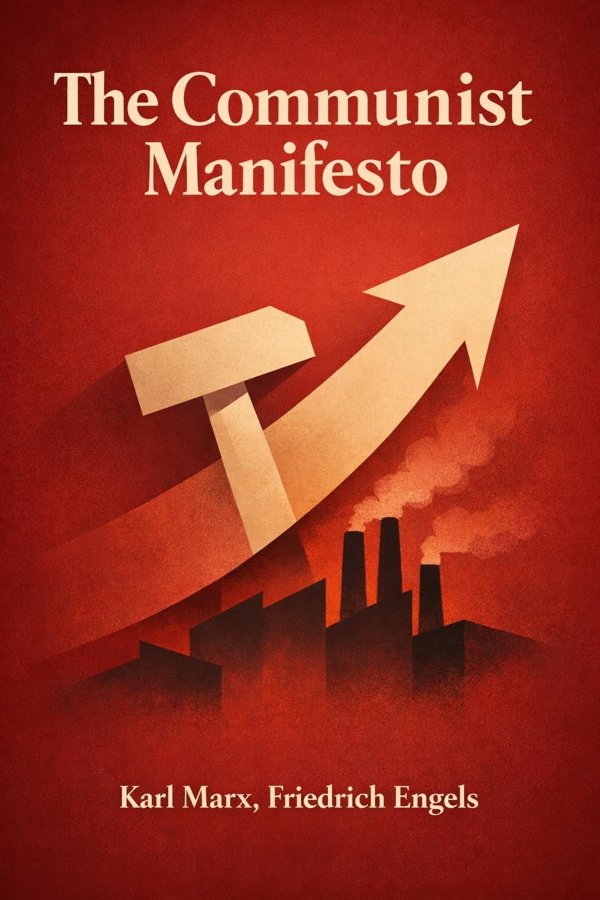
The Communist Manifesto: Summary & Key Insights
by Karl Marx, Friedrich Engels
 10 min9 chaptersAudio available
Key Takeaways from The Communist Manifesto
One of the manifesto’s most provocative claims is that the engine of history is not moral progress, national destiny, or brilliant rulers, but struggle between classes.
Few political texts are as critical of capitalism as The Communist Manifesto, yet few also describe its historical achievements with such force.
A system built to maximize production also creates the class most capable of challenging it.
The manifesto’s critique of capitalism is not simply that it is unfair; it is that it is unstable.
The proletariat does not become revolutionary simply by suffering.
What Is The Communist Manifesto About?
The Communist Manifesto by Karl Marx, Friedrich Engels is a politics book spanning 7 pages. Published in 1848 on the eve of revolutionary upheaval across Europe, The Communist Manifesto is one of the most consequential political texts ever written. In a short but explosive work, Karl Marx and Friedrich Engels argue that history is shaped not primarily by ideals or heroic leaders, but by conflicts between social classes rooted in economic life. They trace the rise of capitalism, explain how the bourgeoisie transformed the world through industry and global trade, and predict that capitalism itself will produce its own gravedigger: the proletariat, or modern working class. More than a political pamphlet, the book is a framework for understanding power, inequality, labor, and social change. Its language is urgent, its claims sweeping, and its influence immense, inspiring socialist movements, revolutions, labor struggles, and fierce criticism in equal measure. Marx, a philosopher and economist, and Engels, a social theorist and sharp observer of industrial society, wrote with unusual authority about the economic transformations of their time. Whether one agrees with its conclusions or not, The Communist Manifesto remains essential reading for anyone trying to understand modern politics and capitalism.
This FizzRead summary covers all 9 key chapters of The Communist Manifesto in approximately 10 minutes, distilling the most important ideas, arguments, and takeaways from Karl Marx, Friedrich Engels's work. Also available as an audio summary and Key Quotes Podcast.
The Communist Manifesto
Published in 1848 on the eve of revolutionary upheaval across Europe, The Communist Manifesto is one of the most consequential political texts ever written. In a short but explosive work, Karl Marx and Friedrich Engels argue that history is shaped not primarily by ideals or heroic leaders, but by conflicts between social classes rooted in economic life. They trace the rise of capitalism, explain how the bourgeoisie transformed the world through industry and global trade, and predict that capitalism itself will produce its own gravedigger: the proletariat, or modern working class. More than a political pamphlet, the book is a framework for understanding power, inequality, labor, and social change. Its language is urgent, its claims sweeping, and its influence immense, inspiring socialist movements, revolutions, labor struggles, and fierce criticism in equal measure. Marx, a philosopher and economist, and Engels, a social theorist and sharp observer of industrial society, wrote with unusual authority about the economic transformations of their time. Whether one agrees with its conclusions or not, The Communist Manifesto remains essential reading for anyone trying to understand modern politics and capitalism.
Who Should Read The Communist Manifesto?
This book is perfect for anyone interested in politics and looking to gain actionable insights in a short read. Whether you're a student, professional, or lifelong learner, the key ideas from The Communist Manifesto by Karl Marx, Friedrich Engels will help you think differently.
- ✓Readers who enjoy politics and want practical takeaways
- ✓Professionals looking to apply new ideas to their work and life
- ✓Anyone who wants the core insights of The Communist Manifesto in just 10 minutes
Want the full summary?
Get instant access to this book summary and 100K+ more with Fizz Moment.
Get Free SummaryAvailable on App Store • Free to download
Key Chapters
One of the manifesto’s most provocative claims is that the engine of history is not moral progress, national destiny, or brilliant rulers, but struggle between classes. Marx and Engels argue that every society has been organized around material production: who owns land, tools, factories, and resources, and who must labor for them. From ancient slave societies to medieval feudalism to modern capitalism, each era develops social classes with opposing interests. Those tensions shape laws, institutions, beliefs, and eventually political upheaval.
This idea is often called historical materialism. It does not mean that ideas do not matter, but that ideas are often rooted in concrete social arrangements. A society dependent on feudal agriculture tends to produce one set of values and hierarchies; a society organized around industrial factories produces another. Religion, law, and political theory can help stabilize a social order, but beneath them lie conflicts over property, labor, and power.
You can see the relevance of this idea today by examining workplace struggles, housing inequality, or debates over wages and automation. When gig workers seek legal protections, or when employees organize unions at large corporations, Marx would say these are not isolated disputes but expressions of deeper structural tension between labor and capital. The same lens can be applied to debates over healthcare, taxation, education, and ownership of technology platforms.
The practical takeaway is to look beneath political slogans and ask a sharper question: what material interests are at stake, and which social groups benefit or lose? That habit of analysis helps reveal the deeper forces shaping public life.
Few political texts are as critical of capitalism as The Communist Manifesto, yet few also describe its historical achievements with such force. Marx and Engels portray the bourgeoisie, the class that owns capital and controls production, as a revolutionary power that shattered feudal boundaries and transformed human life. Through commerce, industry, science, and competition, the bourgeoisie expanded markets, accelerated innovation, and connected distant regions of the globe. In doing so, it created the modern world.
This analysis is important because Marx and Engels do not treat capitalism as mere greed or moral failure. They see it as a dynamic system with extraordinary productive power. It uproots old customs, weakens inherited privilege, and relentlessly pushes societies toward change. Traditional local economies give way to national and global markets. Small workshops are replaced by mechanized industry. Social relations become more impersonal, contractual, and shaped by money.
Modern examples are everywhere. Global supply chains, e-commerce, artificial intelligence, international finance, and mass consumer culture all reflect the bourgeois tendency to innovate, expand, and disrupt. A smartphone sold in one city may depend on minerals from one continent, assembly in another, design in a third, and software teams spread across the world. This capacity for constant reinvention is one reason capitalism has proven so resilient.
But Marx’s point is double-edged: the same class that modernizes society also destabilizes it. Progress comes with disruption, inequality, and insecurity. The actionable lesson is to evaluate capitalism honestly in both directions: recognize its immense productive achievements while asking who controls them, who benefits most, and what social costs accompany that progress.
A system built to maximize production also creates the class most capable of challenging it. Marx and Engels argue that capitalism does not simply enrich the bourgeoisie; it also gathers workers into factories, standardizes labor, and reduces many people to selling their labor power in order to survive. This growing class, the proletariat, has no meaningful ownership of the means of production. Its members depend on wages, while the value they produce is controlled by capital owners.
Under feudalism, social relationships were personal, layered, and tied to local obligations. Capitalism strips away many of those bonds and reorganizes life around wage labor. Workers become interchangeable parts in a production process. As machines and industrial discipline expand, skill may be deskilled, labor fragmented, and individual bargaining power weakened. Yet in that very process, workers are brought together in large numbers and exposed to the common reality of exploitation.
This remains visible in contemporary life. Warehouse employees monitored by algorithms, delivery drivers paid by the task, call center workers following rigid scripts, and freelancers competing on global digital platforms all experience forms of labor shaped by systems larger than themselves. They may have different job titles, but they often face similar insecurity, surveillance, and limited control over working conditions.
Marx’s insight is that social power can emerge from shared conditions. When people recognize that their difficulties are not merely personal failures but structural features of an economic system, they may begin to organize collectively. The takeaway is practical: if you want to understand labor politics, stop viewing workers as isolated individuals and start looking at the conditions that link their experiences.
The manifesto’s critique of capitalism is not simply that it is unfair; it is that it is unstable. Marx and Engels argue that capitalism generates recurring crises because its drive for profit and expansion clashes with its social consequences. Businesses compete to increase productivity, lower labor costs, and expand output. But the same process can reduce workers’ purchasing power, intensify inequality, and produce more goods than markets can absorb. The result is periodic crisis: overproduction, unemployment, bankruptcies, and social unrest.
This is a structural critique. Capitalists are not condemned as uniquely wicked individuals; rather, they operate within a system that compels accumulation and competition. A firm that refuses to cut costs or innovate may be destroyed by rivals. That means even well-intentioned actors reproduce the pressures of the system. Marx saw this as one reason reforms alone may not fully solve the deeper instability.
Modern economic shocks make this argument easier to grasp. Financial crashes, housing bubbles, debt crises, layoffs during downturns, and the concentration of wealth in a few corporate giants all reflect tensions between social needs and profit-driven production. Even when economies grow, many people still face insecure jobs, stagnant wages, or rising living costs. Productivity can increase while the benefits are unevenly distributed.
A practical application is to analyze economic crises as more than random misfortune or poor leadership. Ask how incentives, ownership structures, and competitive pressures contribute to instability. The actionable takeaway is to develop systemic thinking: when institutions repeatedly produce similar harms, the problem may lie not only in management choices but in the rules of the system itself.
The proletariat does not become revolutionary simply by suffering. Marx and Engels emphasize that workers gain power when they organize, develop class consciousness, and move from scattered grievances to collective action. Early on, workers may compete with one another, blame immigrants, resent machinery, or protest only local abuses. Over time, however, the shared experience of exploitation can encourage solidarity across workplaces, cities, and even nations.
Class consciousness means understanding oneself not only as an individual employee, but as part of a broader class with common interests. This shift matters because isolated workers are usually weak, while organized workers can negotiate, disrupt production, and alter political institutions. Trade unions, strikes, political parties, mutual aid networks, and worker education all become tools through which labor develops agency.
Examples today include union drives in retail and logistics, teacher strikes, campaigns for gig worker protections, and transnational labor pressure within global supply chains. Even online communities where workers share salary information or expose abusive employers can help transform private frustration into collective awareness. Marx would likely view these as early forms of organization that can expand into broader political movements.
The deeper point is that social change requires more than outrage. It requires institutions, strategy, and shared identity. For readers today, the takeaway is straightforward: when confronting large systems, do not rely only on individual effort. Build alliances, share information, and participate in collective structures that can convert scattered complaints into durable power.
At the center of the manifesto lies a bold and controversial claim: communism aims not at abolishing all personal belongings, individuality, or human aspiration, but at abolishing bourgeois property relations that allow one class to dominate another. Marx and Engels argue that in capitalist society, the means of producing wealth are concentrated in private hands, while the majority must work under conditions set by owners. Communism, in their view, seeks to end this arrangement by making the major means of production collectively controlled.
The manifesto responds to common criticisms by insisting that communists do not oppose effort, creativity, or personal life. What they oppose is a social order in which wealth and power are inherited, labor is subordinated to profit, and human relationships are reduced to market transactions. Their goal is a classless society where production serves common needs rather than private accumulation.
This argument remains relevant whenever people debate public ownership, universal services, democratic workplaces, or whether essentials like housing, healthcare, and education should be treated as commodities. Even those who reject communism in full still grapple with versions of the same question: how much of social life should be governed by markets, and how much by collective responsibility?
An actionable way to engage this idea is to distinguish clearly between personal possessions and productive property that generates power over others. That distinction sharpens debates about inequality and ownership. The takeaway is to ask not merely who has wealth, but how that wealth structures dependence, hierarchy, and freedom.
One of the manifesto’s most discussed sections outlines a set of transitional measures, often summarized as ten proposals, including progressive taxation, abolition of inheritance, centralization of credit, public control of transport, expansion of public education, and extension of industrial production under collective direction. Marx and Engels present these not as a final blueprint for utopia, but as practical steps that might be taken in advanced countries moving from capitalism toward a new social order.
This distinction is crucial. The manifesto is not a detailed constitutional design for a communist society. Instead, it identifies reforms that weaken the old ruling class and expand social control over key institutions. Some measures were radical in 1848 but later became familiar features of modern states. Progressive income taxes, public schools, and state involvement in infrastructure are now common in many non-communist countries.
That does not mean Marx’s full project was realized through ordinary welfare policy. It means the manifesto recognized that major social change often occurs through transitional institutions. In contemporary terms, one might compare this to debates over stronger labor law, wealth taxes, public banking, healthcare systems, or democratic oversight of essential industries. These are disputes about how far society should socialize risk and power.
The practical takeaway is to avoid treating political transformation as all-or-nothing. Lasting change often depends on intermediate steps that alter incentives, shift power, and create new expectations. Whether or not one endorses Marx’s destination, the strategy of thinking in transitions remains highly useful for political analysis.
Marx and Engels do not present communists as a separate sect with private interests detached from everyone else. They argue that communists work within broader working-class struggles while keeping in view the long-term goal of abolishing class domination. In the manifesto’s final sections, they discuss how communists relate to various opposition parties in different countries, supporting progressive movements against reactionary forces while maintaining an international and class-based perspective.
This is a strategic insight as much as an ideological one. Political change rarely comes from purity or isolation. It comes from navigating alliances, understanding stages of struggle, and recognizing when immediate fights connect to larger structural goals. Communists may support democratic reforms, anti-feudal movements, or campaigns against aristocratic privilege, even if those struggles do not yet abolish capitalism. The key is to participate without losing sight of broader class interests.
This approach helps explain many modern political dilemmas. Activists often debate whether to join broad coalitions, support imperfect reforms, or maintain ideological independence. Labor groups may work with environmental movements, civil rights campaigns, or democratic reform efforts, even when priorities differ. Marx and Engels suggest that engagement is necessary, but strategic clarity matters.
The actionable takeaway is to think politically on two levels at once: immediate alliances and long-term goals. Effective movements need both. Support concrete improvements where possible, but continually ask whether those alliances build deeper collective power or merely manage the existing order.
The manifesto closes with one of the most famous calls in political literature: workers of the world should unite. This is not rhetorical flourish alone. Marx and Engels argue that capitalism expands beyond borders, linking markets, labor systems, and political pressures across nations. If capital is international in its reach, labor movements cannot remain purely local or national without risking division and defeat.
This insight feels strikingly modern. Today corporations operate across jurisdictions, shift production to lower-wage regions, move profits through global financial systems, and use international supply chains to reduce costs. Workers, meanwhile, are often encouraged to see one another as competitors rather than allies. Nationalism can obscure how similar many labor struggles are across countries: low wages, insecure contracts, weak bargaining power, and dependence on distant corporate decision-makers.
International solidarity does not mean ignoring national context. It means recognizing that many problems are transnational and that responses may require cross-border coordination. Examples include labor standards in supply chains, climate justice campaigns, efforts to regulate multinational firms, and global pressure against exploitative practices. Digital communication now makes such cooperation more feasible than in Marx’s time.
The practical lesson is to resist explanations that blame ordinary people in other countries for systemic problems created by global economic structures. Instead, look for shared interests across borders. The takeaway is simple but powerful: when power is organized internationally, meaningful resistance often must be international too.
All Chapters in The Communist Manifesto
About the Authors
Karl Marx (1818–1883) was a German philosopher, economist, journalist, and political theorist whose work transformed the study of capitalism, class, and history. He developed influential ideas about historical materialism, alienation, and the dynamics of economic systems, most fully explored in Capital and other writings. Friedrich Engels (1820–1895) was a German social scientist, political thinker, and close collaborator of Marx. The son of a textile manufacturer, Engels drew on firsthand observations of industrial labor to write about working-class conditions, especially in England. Together, Marx and Engels authored The Communist Manifesto in 1848, creating one of the foundational texts of socialist and communist thought. Their partnership combined philosophical depth, economic analysis, and political urgency, leaving a lasting mark on modern political movements, labor struggles, and social theory.
Get This Summary in Your Preferred Format
Read or listen to the The Communist Manifesto summary by Karl Marx, Friedrich Engels anytime, anywhere. FizzRead offers multiple formats so you can learn on your terms — all free.
Available formats: App · Audio · PDF · EPUB — All included free with FizzRead
Download The Communist Manifesto PDF and EPUB Summary
Key Quotes from The Communist Manifesto
“One of the manifesto’s most provocative claims is that the engine of history is not moral progress, national destiny, or brilliant rulers, but struggle between classes.”
“Few political texts are as critical of capitalism as The Communist Manifesto, yet few also describe its historical achievements with such force.”
“A system built to maximize production also creates the class most capable of challenging it.”
“The manifesto’s critique of capitalism is not simply that it is unfair; it is that it is unstable.”
“The proletariat does not become revolutionary simply by suffering.”
Frequently Asked Questions about The Communist Manifesto
The Communist Manifesto by Karl Marx, Friedrich Engels is a politics book that explores key ideas across 9 chapters. Published in 1848 on the eve of revolutionary upheaval across Europe, The Communist Manifesto is one of the most consequential political texts ever written. In a short but explosive work, Karl Marx and Friedrich Engels argue that history is shaped not primarily by ideals or heroic leaders, but by conflicts between social classes rooted in economic life. They trace the rise of capitalism, explain how the bourgeoisie transformed the world through industry and global trade, and predict that capitalism itself will produce its own gravedigger: the proletariat, or modern working class. More than a political pamphlet, the book is a framework for understanding power, inequality, labor, and social change. Its language is urgent, its claims sweeping, and its influence immense, inspiring socialist movements, revolutions, labor struggles, and fierce criticism in equal measure. Marx, a philosopher and economist, and Engels, a social theorist and sharp observer of industrial society, wrote with unusual authority about the economic transformations of their time. Whether one agrees with its conclusions or not, The Communist Manifesto remains essential reading for anyone trying to understand modern politics and capitalism.
You Might Also Like

Antifa: The Anti-Fascist Handbook
Mark Bray
10 min
Attack from Within: How Disinformation Is Sabotaging America
Barbara McQuade
10 min
Coercion, Capital, and European States, AD 990–1992
Charles Tilly
10 min
Digital Democracy: Concepts, Methodologies, Tools, and Applications
Various Authors
10 min
Fascism
Stanley G. Payne
10 min
Fire And Fury: Inside The Trump White House
Michael Wolff
10 minBrowse by Category
Ready to read The Communist Manifesto?
Get the full summary and 100K+ more books with Fizz Moment.